Friday of the Thirtieth Week in Ordinary Time – Lectionary: 483
When Grace Refuses to Quit
Everyone knows the quiet ache of an unfinished project, the half-painted room, the abandoned resolution, the prayer life that started strong in January and faded by Lent. The readings for October 30th, Friday of the Thirtieth Week in Ordinary Time, answer that ache with one of the most consoling promises in all of Scripture: God finishes what He starts, and His finishing work is mercy.
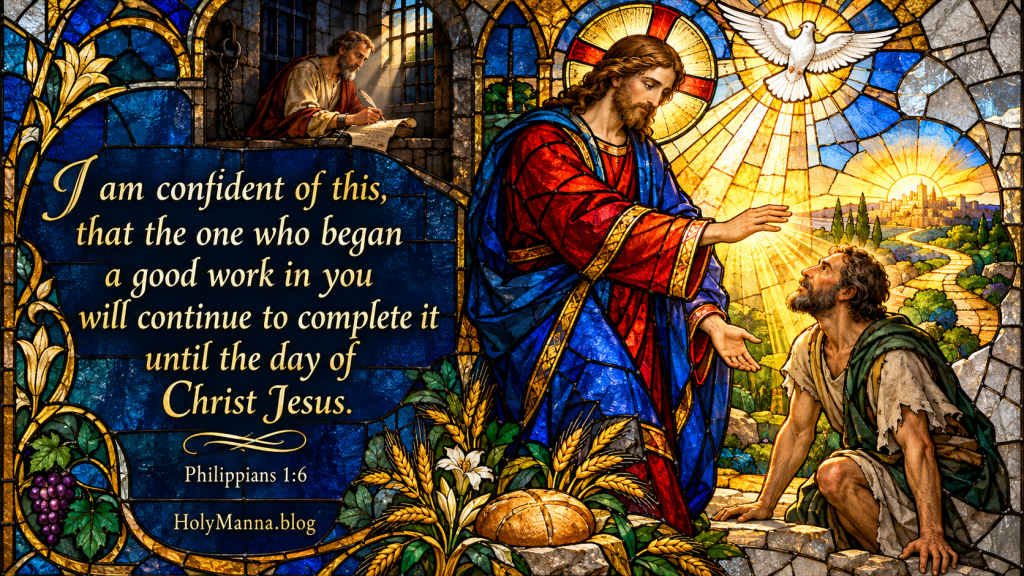
In the First Reading, Saint Paul writes from a prison cell to his beloved church in Philippi, the first Christian community on European soil, and tells them, “the one who began a good work in you will continue to complete it until the day of Christ Jesus.” The Responsorial Psalm picks up the melody, singing, “How great are the works of the Lord!” and naming the greatest of those works as grace and mercy toward His covenant people. Then the Gospel shows what that mercy looks like in real time. At a tense sabbath dinner party, surrounded by religious experts watching His every move, Jesus heals a man suffering from dropsy and asks a question nobody dares to answer.
The thread running through all three readings is the unstoppable, patient, merciful work of God. Paul calls it a good work begun. The psalmist calls it wondrous deeds remembered. Luke shows it as a healing that would not wait for a more convenient day. The Church reads these texts near the end of the liturgical year, when autumn itself preaches about endings, precisely to remind the faithful that in God’s hands nothing good is ever left unfinished.
First Reading — Philippians 1:1-11
A Love Letter From a Prison Cell
Philippi was a proud Roman colony in Macedonia, a city of veterans and merchants sitting on the great Via Egnatia trade road. Around the year 50, Saint Paul arrived there and founded the first Christian church on European soil, beginning with Lydia the cloth merchant and a jailer whose whole household was baptized in a single night, as The Acts of the Apostles recounts in chapter 16. Roughly a decade later, Paul writes back to that little community, and he writes in chains. Yet Philippians is the most joyful letter he ever composed. The opening eleven verses heard at Mass today set the tone for the whole epistle, and they anchor the day’s central theme: the God who began a good work will see it through to completion. This is also the only Pauline letter addressed explicitly to the bishops and deacons, a precious early glimpse of the ordained structure of the Church already in place within one generation of the Resurrection.
Philippians 1:1-11
Paul and Timothy, slaves of Christ Jesus,
to all the holy ones in Christ Jesus who are in Philippi,
with the bishops and deacons:
grace to you and peace from God our Father and the Lord Jesus Christ.I give thanks to my God at every remembrance of you,
praying always with joy in my every prayer for all of you,
because of your partnership for the Gospel
from the first day until now.
I am confident of this,
that the one who began a good work in you
will continue to complete it
until the day of Christ Jesus.
It is right that I should think this way about all of you,
because I hold you in my heart,
you who are all partners with me in grace,
both in my imprisonment
and in the defense and confirmation of the Gospel.
For God is my witness,
how I long for all of you with the affection of Christ Jesus.
And this is my prayer:
that your love may increase ever more and more
in knowledge and every kind of perception,
to discern what is of value,
so that you may be pure and blameless for the day of Christ,
filled with the fruit of righteousness
that comes through Jesus Christ
for the glory and praise of God.
Detailed Exegesis
Verse 1: “Paul and Timothy, slaves of Christ Jesus, to all the holy ones in Christ Jesus who are in Philippi, with the bishops and deacons:”
Paul does not open with his title as an apostle, as he does elsewhere. He calls himself a slave, in Greek doulos, someone wholly owned by his Master. He addresses ordinary believers as holy ones, because baptism truly sets a person apart for God. The mention of bishops and deacons shows that holy orders are not a later invention but part of the Church’s original architecture.
Verse 2: “grace to you and peace from God our Father and the Lord Jesus Christ.”
This greeting fuses the Greek blessing of grace with the Hebrew blessing of peace, shalom. Paul places Jesus side by side with God the Father as the single source of both gifts, a quiet but unmistakable confession of Christ’s divinity in the very first breath of the letter.
Verse 3: “I give thanks to my God at every remembrance of you,”
For Paul, memory itself becomes prayer. Every time the Philippians cross his mind, gratitude rises. That is a habit worth imitating, letting the thought of the people God has placed in one’s life turn immediately into thanksgiving.
Verse 4: “praying always with joy in my every prayer for all of you,”
Joy is the signature word of this letter, appearing again and again, and it comes from a man awaiting trial. Christian joy is clearly not the fruit of circumstances. It is the fruit of communion with Christ and with His people.
Verse 5: “because of your partnership for the Gospel from the first day until now.”
The word translated partnership is koinonia, deep communion and shared enterprise. The Philippians did not merely admire Paul’s mission; they funded it, suffered for it, and prayed it forward. The Gospel has always been a team effort.
Verse 6: “I am confident of this, that the one who began a good work in you will continue to complete it until the day of Christ Jesus.”
Here is the heart of the reading. Grace initiates, grace sustains, and grace completes. Salvation is God’s project before it is anyone’s achievement, and He does not abandon His projects. The day of Christ Jesus refers to His return in glory, the horizon toward which every baptized life is being steadily finished.
Verse 7: “It is right that I should think this way about all of you, because I hold you in my heart, you who are all partners with me in grace, both in my imprisonment and in the defense and confirmation of the Gospel.”
Paul’s confidence is not abstract theology; it is affection. Even his chains have become a shared possession with his friends, because in the Body of Christ no one suffers alone and no one perseveres alone.
Verse 8: “For God is my witness, how I long for all of you with the affection of Christ Jesus.”
Paul swears an oath that his love is real, and he names its source. The affection he feels is literally the affection of Christ working through him. Grace does not bypass human emotion; it transfigures it.
Verse 9: “And this is my prayer: that your love may increase ever more and more in knowledge and every kind of perception,”
Notice what Paul asks for. Not comfort, not success, but a love that keeps growing smarter. Love without knowledge drifts into sentimentality, while knowledge without love hardens into pride. The Christian life needs both together.
Verse 10: “to discern what is of value, so that you may be pure and blameless for the day of Christ,”
Discernment is love’s practical skill, the ability to tell the truly valuable from the merely urgent. This verse quietly prepares the ground for the Gospel, where the Pharisees fail at exactly this kind of discernment.
Verse 11: “filled with the fruit of righteousness that comes through Jesus Christ for the glory and praise of God.”
The finished work looks like fruit, a living harvest of holiness. And the harvest is not for self-congratulation. It exists for the glory and praise of God, which is where the Responsorial Psalm will pick up the song.
Teachings
Saint John Chrysostom, Doctor of the Church, preached a celebrated series of homilies on this letter, and he lingered over verse 6 with a goldsmith’s care. In his Homilies on Philippians he observes of Paul, “He did not rob them of the achievement… nor did he call their good deeds solely their own, but primarily of God.” For Chrysostom, this single verse holds together divine grace and human cooperation, the great both-and of Catholic teaching on salvation. He also marvels at the apostle’s heart, noting, “Greatly still does he show here his longing desire, in that he had them in his heart; and in the very prison, and though bound, he remembered the Philippians.”
The Catechism teaches that this kind of prayer for others belongs to the very shape of Christian life. CCC 2634 states, “Intercession is a prayer of petition which leads us to pray as Jesus did. He is the one intercessor with the Father on behalf of all men, especially sinners.” Paul’s prayer in verses 9 through 11 is also a portrait of charity itself, which CCC 1822 defines: “Charity is the theological virtue by which we love God above all things for his own sake, and our neighbor as ourselves for the love of God.”
Reflection
Think honestly about the unfinished places in your own soul, the habits you have tried to break a dozen times, the virtues that never seem to take root. Paul’s promise is for you: God started this, and God intends to finish it. One concrete step is to pray verse 6 over yourself each morning this week, slowly and by name. Another is to become Paul for someone else, choosing one person and thanking God every single time they come to mind, then telling them so. Who in your life needs to hear that you thank God at every remembrance of them? Where have you quietly concluded that God has given up on you, and what would change if you believed He has not?
Responsorial Psalm — Psalm 111:1-6
An Alphabet of Gratitude
Psalm 111 is a small masterpiece of craftsmanship. In the original Hebrew it is an acrostic, with each half-line beginning with the next letter of the alphabet, as though the poet were saying that everything from A to Z belongs in the praise of God. It opens the trio of Hallelujah psalms that close this section of the Psalter, and ancient Israel sang it in the liturgical assembly, remembering the exodus, the manna in the desert, and the gift of the promised land. Today’s response, “How great are the works of the Lord!” gathers the whole psalm into a single cry. Placed between Paul’s promise that God completes His good work and Jesus healing on the sabbath, the psalm names the day’s theme from the side of worship: when God works, the only fitting answer is wholehearted thanksgiving.
Psalm 111:1-6
R. (2) How great are the works of the Lord!
or:
R. Alleluia.
I will give thanks to the LORD with all my heart
in the company and assembly of the just.
Great are the works of the LORD,
exquisite in all their delights.
R. How great are the works of the Lord!
or:
R. Alleluia.
Majesty and glory are his work,
and his justice endures forever.
He has won renown for his wondrous deeds;
gracious and merciful is the LORD.
R. How great are the works of the Lord!
or:
R. Alleluia.
He has given food to those who fear him;
he will forever be mindful of his covenant.
He has made known to his people the power of his works,
giving them the inheritance of the nations.
R. How great are the works of the Lord!
or:
R. Alleluia.
Detailed Exegesis
Verse 1: “I will give thanks to the LORD with all my heart in the company and assembly of the just.”
The psalmist refuses a halfhearted faith. Thanksgiving is total, and it is public, offered in the assembly rather than in private sentiment alone. For Catholics this points straight to the Mass, where the word Eucharist itself means thanksgiving, and where gratitude is offered together as one Body.
Verse 2: “Great are the works of the LORD, exquisite in all their delights.”
God’s works are not merely powerful; they are delightful, meant to be pondered and savored. Creation, the covenant, and redemption reward those who study them the way a friend’s gift rewards a second look. Wonder is a spiritual discipline.
Verse 3: “Majesty and glory are his work, and his justice endures forever.”
Human achievements fade, empires crumble, and trophies tarnish, but the justice of God outlasts every age. The psalmist anchors hope not in circumstances but in the permanent character of the Lord.
Verse 4: “He has won renown for his wondrous deeds; gracious and merciful is the LORD.”
This line quotes the great self-revelation of God to Moses in The Book of Exodus, chapter 34. Israel’s creed was never an abstraction. When asked who God is, the people answered with His track record: gracious and merciful. Mercy is His reputation.
Verse 5: “He has given food to those who fear him; he will forever be mindful of his covenant.”
The first reference is to the manna in the wilderness, bread given daily to a people who had done nothing to earn it. The Church has long heard in this verse a foreshadowing of the Eucharist, the true bread from heaven, which is why this psalm appears so often in Eucharistic worship. God feeds because God remembers His covenant.
Verse 6: “He has made known to his people the power of his works, giving them the inheritance of the nations.”
God does not work anonymously. He makes His power known so that His people can trust Him with their future. The inheritance of the land prefigures the greater inheritance of heaven, the completed good work Paul wrote about in the First Reading.
Teachings
Saint Augustine, Doctor of the Church, wrote a beautiful exposition of this psalm, and he begins by untangling a word modern readers also misunderstand. In his Expositions on the Psalms he teaches, “Confession is not always confession of sins, but the praise of God is poured forth in the devotion of confession. The former mourneth, the latter rejoiceth: the former showeth the wound to the physician, the latter giveth thanks for health.” In other words, the same heart that confesses sin in the confessional is meant to confess praise in the liturgy, and both are acts of honesty before God.
The Catechism echoes verse 1 when it describes the public character of worship. CCC 2176 roots Sunday worship in the moral law itself, and the Catechism’s teaching on thanksgiving in prayer flows directly from psalms like this one. Augustine’s insight also explains the structure of the Mass, which moves from the confession of sins in the Penitential Act to the confession of praise in the Gloria, mourning the wound and then thanking the Physician, exactly as the Doctor of Grace described.
Reflection
Gratitude, like the psalmist’s alphabet, works best when it is specific. Try writing a personal acrostic this week, one work of God in your life for several letters of the alphabet, and watch how quickly the page fills. Bring that list to Mass on Sunday and offer it during the Eucharistic Prayer, joining your private thanksgiving to the great public thanksgiving of the Church. When was the last time you thanked God with all your heart rather than with leftover attention? Which wondrous deed of God in your own story have you never once mentioned out loud in the company of others?
Holy Gospel — Luke 14:1-6
The Dinner Party Where Nobody Spoke
This is the third and final sabbath healing in The Gospel of Luke, after the man with the withered hand in chapter 6 and the bent woman in chapter 13, and Luke stages it like a scene from a tense film. Jesus accepts a dinner invitation from a leading Pharisee, which already says something about Him; He never stopped going to the tables of His critics. Sabbath meals were festive occasions prepared the day before, and inviting a famous rabbi was an honor. Yet the hospitality here has an edge, because the guests are watching Jesus the way prosecutors watch a defendant. In front of Him stands a man suffering from dropsy, the ancient name for edema, a painful swelling of the body with fluid that left its victims desperately thirsty no matter how much they drank. Ancient writers used dropsy as a picture of greed, the disease of wanting more while being full, which makes the scene a quiet parable about the watching Pharisees themselves. Here the day’s theme reaches its climax: the God who completes His good work will not postpone mercy, not even for a day of rest.
Luke 14:1-6
On a sabbath Jesus went to dine
at the home of one of the leading Pharisees,
and the people there were observing him carefully.
In front of him there was a man suffering from dropsy.
Jesus spoke to the scholars of the law and Pharisees in reply, asking,
“Is it lawful to cure on the sabbath or not?”
But they kept silent; so he took the man and,
after he had healed him, dismissed him.
Then he said to them
“Who among you, if your son or ox falls into a cistern,
would not immediately pull him out on the sabbath day?”
But they were unable to answer his question.
Detailed Exegesis
Verse 1: “On a sabbath Jesus went to dine at the home of one of the leading Pharisees, and the people there were observing him carefully.”
The Greek verb for observing suggests hostile surveillance. The guests are not curious; they are gathering evidence. And still Jesus comes. He walks knowingly into rooms full of suspicion, because His mission is to seek the lost wherever they sit, including at respectable tables.
Verse 2: “In front of him there was a man suffering from dropsy.”
The sick man says nothing and asks for nothing. Saint Cyril of Alexandria suggests he was afraid to ask because of the sabbath, so he simply stood where Jesus could see him. Sometimes the most honest prayer is just placing oneself in front of the Lord.
Verse 3: “Jesus spoke to the scholars of the law and Pharisees in reply, asking, ‘Is it lawful to cure on the sabbath or not?’”
Luke says Jesus spoke in reply, though no one had spoken. He answers their thoughts. By asking the legal experts a legal question before acting, He gives them every chance to say what the Law of Moses never actually forbade, that healing is a work of God, not a violation of rest.
Verse 4: “But they kept silent; so he took the man and, after he had healed him, dismissed him.”
Their silence is the loudest sound in the room. They cannot condemn mercy, but they will not bless it. Jesus responds with touch; He took the man, a gesture of tenderness in front of an audience of critics, healed him, and sent him home free.
Verse 5: “Then he said to them, ‘Who among you, if your son or ox falls into a cistern, would not immediately pull him out on the sabbath day?’”
Jesus appeals to what their own hearts already know. Rabbinic schools debated whether an animal in a pit could be helped on the sabbath, and most allowed it. If compassion for an ox is instinctive and immediate, how much more for a human being made in God’s image. Mercy, Jesus insists, is always urgent.
Verse 6: “But they were unable to answer his question.”
The scene ends in a second silence, but a different one. The first silence was calculation; this one is defeat. The experts in the Law cannot refute the Lord of the Law, because He has exposed the gap between their rules and God’s heart.
Teachings
Saint Cyril of Alexandria, Doctor of the Church, preached through The Gospel of Luke verse by verse, and his commentary on this scene is wonderfully blunt. He writes, “Disregarding then the snares of the Jews, He cures the dropsical, who from fear of the Pharisees did not ask to be healed on account of the sabbath, but only stood up, that when Jesus beheld him, He might have compassion on him and heal him.” Then Cyril draws the lesson for every disciple: “For it becomes us, when a great good is the result, not to care if fools take offense.” Saint Ambrose, commenting on the same passage, presses the inconsistency of the watchers with a pointed question: if healing is unlawful, “why do they take care of their cattle on the sabbath?”
The Catechism gives this episode its full doctrinal weight. CCC 2173 teaches, “The Gospel reports many incidents when Jesus was accused of violating the sabbath law. But Jesus never fails to respect the holiness of this day. He gives this law its authentic and authoritative interpretation: ‘The sabbath was made for man, not man for the sabbath.’ With compassion, Christ declares the sabbath for doing good rather than harm, for saving life rather than killing. The sabbath is the day of the Lord of mercies and a day to honor God.” And CCC 2172 adds that the day of rest “is a day of protest against the servitude of work and the worship of money.” Jesus does not abolish the sabbath; He reveals it.
Reflection
It is easy to read this Gospel and cast yourself as the man who gets healed, but be brave enough to ask whether you are sometimes the silent guest, the person who knows the merciful thing and stays quiet because it is inconvenient or socially costly. One concrete practice is to make Sunday a day of active mercy as well as rest, a phone call to someone lonely, a visit, a reconciliation you have postponed. Another is to stand before the Lord in Adoration like the man with dropsy, saying nothing, simply letting Him see what is swollen and aching in you. When mercy and convenience collide in your week, which one usually wins? What good deed have you been postponing to a more comfortable day?
Let Him Finish What He Started
Set the three readings side by side and a single story emerges. A prisoner writes to his friends that God never abandons a work in progress. A poet turns the alphabet into a litany of God’s great deeds and lands on the heart of the matter: gracious and merciful is the Lord. And at a watchful dinner table, the Son of God proves them both right, completing in one afternoon a healing that religion’s gatekeepers would have postponed indefinitely. The works of the Lord are great, and the greatest of them is mercy that refuses to wait.
That promise lands close to home. Every believer carries unfinished business, a conversion half made, wounds half healed, a love that is real but not yet wise. The world says to hide the unfinished parts. Today’s readings say to stand where Jesus can see them, like the man with dropsy, and let the Master keep working. He began this good work at baptism. He feeds it at every Mass with the food given to those who fear Him. And He will complete it on the day of Christ Jesus, not because anyone earned it, but because He is forever mindful of His covenant.
So take the next small step. Pray the prayer of Paul over someone you love. Thank God out loud for one wondrous deed. Do the merciful thing today instead of the convenient thing tomorrow. The Lord of the sabbath is not watching the clock; He is watching His children, with the affection of Christ Jesus, and He does not quit. Let Him finish what He started, and join the assembly of the just in saying, how great are the works of the Lord.
Engage With Us!
Every good conversation needs more than one voice, so share your reflections in the comments below. Which reading spoke to your heart today, and what is the Lord asking of you through it? Your story might be exactly the encouragement another reader needs. Here are a few questions to pray with before you write:
- In Philippians 1:1-11, Saint Paul prays that love may increase in knowledge and perception so that his friends can discern what is of value. What is one thing in your life that feels urgent but may not actually be valuable, and what truly valuable thing deserves that time instead?
- In Psalm 111:1-6, the psalmist gives thanks with all his heart in the assembly of the just. What wondrous deed has God done in your story that you could share publicly this week, whether at Mass, with family, or right here in the comments?
- In Luke 14:1-6, the experts stay silent while Jesus heals. Where in your life are you staying safely silent when mercy is asking you to act, and what would it cost you to move?
- Taken together, the readings promise that the One who began a good work in you will complete it. What unfinished area of your soul will you hand back to God today, trusting Him to finish it in His time?
Keep walking, friend. The life of faith is not a performance for watchful eyes; it is a long partnership in grace with the God who never abandons His work. Do everything this week with the love and mercy Jesus taught us, and He will take care of the finishing.
Sacred Heart of Jesus, we trust in You!
Immaculate Heart of Mary, pray for us!
Saint Michael the Archangel, defend us in battle!
Follow us on YouTube, TikTok, Instagram and Facebook for more insights and reflections on living a faith-filled life.


Leave a Reply