A Flame That Refused to Go Out
On October 29th the Church remembers Saint Narcissus of Jerusalem, one of the most astonishing figures of the early Church. He was a bishop who took up the shepherd’s staff at an age when most men of his era had long been in the grave, a wonder worker whose prayer turned well water into lamp oil on the night of the Easter Vigil, a victim of calumny who answered slander with silence and solitude, and a shepherd who returned to his flock after years in the desert, in the words of Butler’s Lives of the Saints, “like one from the dead.” By the testimony of his own coadjutor, Saint Alexander of Jerusalem, Narcissus was still praying for his people at 116 years of age.
Nearly everything the Church knows about him comes from Eusebius of Caesarea’s Ecclesiastical History, written within about a century of his death, which makes Narcissus unusually well attested for a saint of the 2nd century. He governed the see of Jerusalem, the mother church of all Christendom, founded by the apostles themselves and first led by Saint James. The Catechism teaches that “the apostles left bishops as their successors” and gave them “their own position of teaching authority” (CCC 77), and Narcissus stands as a living link in that unbroken chain, the 30th bishop of Jerusalem in the list Eusebius preserved. His life is a long argument against despair: against the idea that it is ever too late to serve God, that slander gets the last word, or that an old flame cannot burn bright again.
A Child of the Church’s First Morning
Narcissus was born toward the close of the 1st century. A later tradition places his birth in the year 99 and gives him a Greek origin, but these details cannot be verified from the early sources, and nothing reliable is known of his parents, his family, or his formation. What can be said with confidence is staggering on its own: he was born while men and women who had seen the apostles still walked the earth. The ink was barely dry on the last books of the New Testament. The Church of his childhood was the Church of the catacombs and the house churches, worshiping under the shadow of an empire that regarded the name of Christ as a crime.
He grew up in the aftermath of catastrophe. In the year 70 the Romans had destroyed Jerusalem and its Temple, and after the second Jewish revolt was crushed in 135, the emperor Hadrian rebuilt the city as a pagan Roman colony called Aelia Capitolina and barred Jews from entering it. The Christian community that remained was small, largely Gentile, and worshiped in a city whose very name had been erased from the map. This was the flock Narcissus would one day lead. The see of Jerusalem in his lifetime was not a seat of earthly power; it was a remnant, a lampstand kept burning in a city that had been plowed under.
The sources record no dramatic conversion story, because there is none to record; Narcissus appears to have belonged to the Church from his early life and to have grown steadily in holiness through the long decades of ordinary, hidden faithfulness. Around the year 180, when he was almost 80 years old, he was chosen bishop of Jerusalem. Butler notes that he was “almost fourscore years old when he was placed at the head of the church of Jerusalem.” Let that settle for a moment. At an age when the world would have written him off entirely, the Holy Spirit was only getting started with him. His episcopate would prove that Psalm 92 speaks the truth about the just man: “They shall bear fruit even in old age.”
What he is most known for follows from that late calling: the Easter Vigil miracle of water turned to oil, his heroic endurance of a vicious slander, his years of hidden prayer in the desert, his return to his see as if risen from the dead, his role in settling the date of Easter for the universal Church, and the almost unbelievable length of his life in Christ’s service.
Water Into Oil on the Night of Nights
Narcissus did not govern like a tired old man waiting out his final years. Eusebius records that the Christians of Jerusalem still spoke of many miracles God had worked through him, handed down, as Eusebius puts it, “on the tradition of the brethren who succeeded him.” The most famous of these took place on the holiest night of the year.
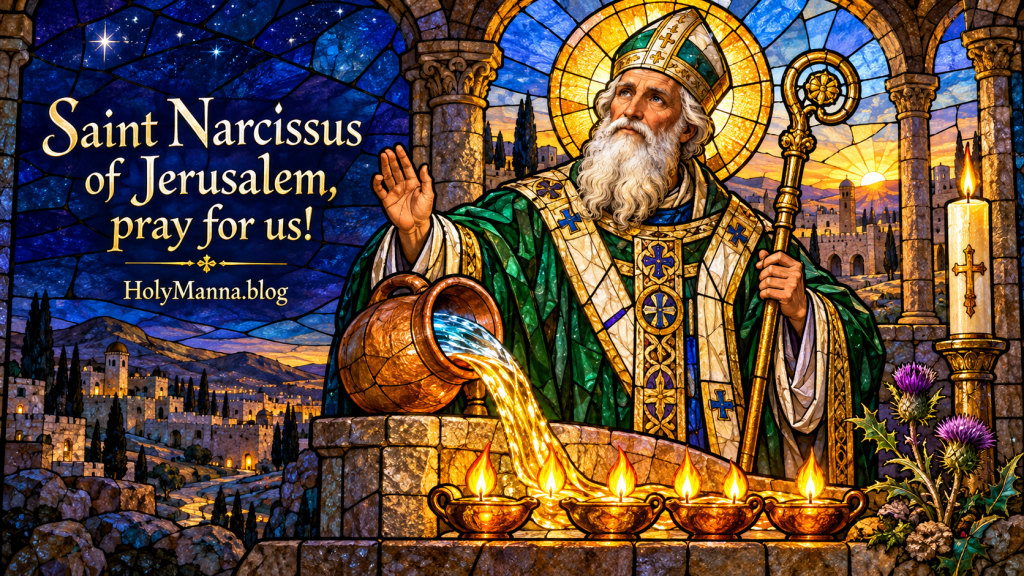
One year, on the eve of Easter, the deacons discovered to their horror that there was no oil for the lamps of the church. The great Vigil, the mother of all vigils, the night on which the Church keeps watch for the Resurrection, was about to begin in darkness. Narcissus did not panic and he did not improvise. He told the men who tended the lamps to draw water from the neighboring wells and bring it to him. He prayed over the water with earnest faith, then commanded them to pour it into the lamps, trusting in the Lord. They obeyed, and the water burned as oil. Eusebius adds a detail that gives the account its weight: a quantity of that miraculous oil was preserved in Jerusalem as a memorial, and it was still being kept there in his own day, roughly a century later. This is not a tale that grew in the telling centuries after the fact; it is a report from a historian who says the physical evidence was still on hand.
The miracle is rich with meaning. The Catechism teaches that the signs worked by Christ, and by His saints in His name, “attest that the Father has sent him” and invite belief in Him (CCC 548); miracles are never magic tricks, they are sermons in action. On the night the Church celebrates the Light that darkness could not overcome, God refused to let the lamps of Jerusalem go dark. The Lord who turned water into wine at Cana to reveal His glory turned water into oil in Jerusalem to honor His Resurrection. There is also an echo of the wise virgins of Matthew 25, who “took flasks of oil with their lamps” and were ready when the Bridegroom came. Narcissus was the wise virgin of his city, a man whose lamp was trimmed and whose reserves of faith ran deep enough to light a church when every human supply had failed. The Catechism reminds the faithful that Easter is “not simply one feast among others” but the “Feast of feasts” (CCC 1169), and it was precisely on that feast that God chose to glorify His elderly servant.
Nor was his service confined to wonders. Around the year 195, during the great Paschal controversy under Pope Saint Victor I, when the churches of Asia Minor kept Easter on the day of the Jewish Passover regardless of the day of the week, Narcissus and Theophilus, bishop of Caesarea, presided together over a council of the bishops of Palestine held at Caesarea. That council decreed that Easter must always be celebrated on a Sunday, the day of the Resurrection, in union with the practice of Rome and the greater Church. Eusebius preserves the memory of this synod in Book V of his Ecclesiastical History. It is a quiet but enormous legacy: every Christian who has ever celebrated Easter on a Sunday morning stands downstream of decisions in which this ancient bishop of Jerusalem took a leading part. Here was a man who understood that unity with the universal Church is not optional, a truth The Catechism affirms when it teaches that the bishops are “the visible source and foundation of unity in their particular Churches” (CCC 886).
Why should anyone remember and emulate Narcissus today? Because he demonstrates what sanctity looks like when it has no spotlight. He wrote no books that survive, built no basilicas, and left no famous sayings of his own. He simply prayed, governed, disciplined, forgave, and endured, decade after decade, and God did the rest. In an age obsessed with platforms and personal brands, Narcissus is the model of the opposite path: a hidden faithfulness so deep that heaven itself kept interrupting it with miracles.
The Long Silence of the Desert
Holiness attracts admiration, and it also attracts hatred. Narcissus was, by every account, firm in enforcing the discipline of the Church, and his firmness made enemies among those who had no intention of reforming their lives. Eusebius relates that three such men, dreading the bishop’s severity against their sins, conspired to destroy his reputation. They accused him publicly of a grave crime, so shameful that Eusebius refuses even to name it. Knowing that no one would believe them on their word alone, they sealed their lie with terrible self cursing oaths. The first swore that he might perish by fire if the accusation were false. The second swore that his body might be consumed by a wasting disease, which Butler renders as leprosy. The third swore that he might lose his eyes.
The faithful of Jerusalem did not believe a word of it. Eusebius says plainly that the virtue and continence of Narcissus were too well known for the slander to take hold. And yet the blow landed on the old bishop’s heart all the same. Anyone who has ever been lied about knows this wound: even when nobody believes the lie, something in the soul staggers under it. Narcissus did not lash out, did not sue for his honor, did not mount a public defense. Scripture says of Christ in 1 Peter 2:23, “when he was insulted, he returned no insult,” and Narcissus followed his Master’s pattern exactly. He quietly left Jerusalem and disappeared into the desert, embracing the life of solitude and prayer that he had long desired, and for years no one knew whether he was alive or dead.
The Catechism names the sin committed against him with precision. A person is guilty of calumny “who, by remarks contrary to the truth, harms the reputation of others” (CCC 2477), and calumny offends against both truth and justice because it destroys the honor and reputation to which every person has a right (CCC 2479). The eighth commandment is not a minor regulation; it guards something sacred. The story of Narcissus shows what the Church has always believed: lies about a person are a form of violence, and God takes them personally.
God’s answer came in time, and Eusebius records it without flinching. The first slanderer died when a small spark set his house ablaze in the night, and he perished in the flames with his whole family. The second was struck from head to foot with the very disease he had invoked. The third, watching the fate of his companions, was seized with terror and repentance. He confessed the conspiracy publicly, and he wept over his sin so continually and so bitterly that he lost his sight, dying blind but reconciled. The Church does not delight in these punishments, and neither should the reader; the third man’s tears are the real point of the story. Divine justice is real, but its purpose is always to drive the sinner back into the arms of divine mercy. Narcissus himself, as far as the record shows, never sought revenge and never spoke against his accusers. He simply trusted the promise of Psalm 37, that the Lord would “make your righteousness shine like the dawn.”
Meanwhile Jerusalem could not remain without a shepherd. The bishops of the surrounding region, assuming Narcissus was gone for good, appointed Dius to the see, then Germanio, then Gordius. And then, while Gordius was still governing the church, the impossible happened: the old man walked back into Jerusalem. Butler writes that he appeared “like one from the dead.” The whole community erupted with joy and begged him to take up his office again, for his innocence was now vindicated before all, and his years of hidden prayer had only increased their veneration for him. He consented, and so this one man held the see of Jerusalem twice.
Narcissus was not a martyr. He died in peace, a confessor rather than a victim of the persecutor’s sword, yet his hardships were a slow martyrdom of their own: the exhaustion of governing a church in a hostile empire, the wound of betrayal by his own people, the stripping away of reputation, comfort, and company in the desert, and the sheer weight of extreme old age borne in unbroken service. The Catechism defines fortitude as “the moral virtue that ensures firmness in difficulties and constancy in the pursuit of the good” (CCC 1808), and few lives in the history of the Church display that virtue over a longer stretch of years.
In his final chapter, God sent him help in a way no one could have scripted. A bishop from Cappadocia named Alexander came to Jerusalem on pilgrimage in fulfillment of a vow, to pray at the holy places. Eusebius and Saint Jerome both record that it was revealed in a night vision to Narcissus and to others that a bishop would enter the city who was destined to share his throne. Alexander arrived, the prophecy was recognized, and the bishops of Palestine, with Narcissus himself urging it, kept the pilgrim in Jerusalem as coadjutor around the year 212. It was an extraordinary arrangement for the time, a bishop transferred from one see to another and two bishops serving one city, and the early Church accepted it as the manifest will of God. Even then Narcissus did not retire into idleness. Saint Alexander, writing to the church of the Antinoites in Egypt, closed his letter with the one verified contemporary quotation about the saint that survives: “Narcissus salutes you, who held the episcopate here before me, and is now associated with me in prayers, being one hundred and sixteen years of age; and he exhorts you, as I do, to be of one mind.” No words from Narcissus’s own mouth have come down to the Church, but this single sentence is portrait enough: at 116, his two occupations were prayer and the pleading for unity.
He died around the year 215, though the sources do not agree on the exact year, with dates ranging from about 212 to 222. A tradition holds that death found him on his knees, still at prayer. That detail cannot be verified.
A Memory the Church Refused to Lose
Honesty requires saying it plainly: no catalogue of posthumous miracles, healings at a tomb, or translations of relics survives for Saint Narcissus. His grave in Jerusalem was lost to the upheavals of the centuries, and no shrine or pilgrimage dedicated to him endures today. What did survive, however, is in some ways more remarkable than relics: his memory itself, preserved with care by the generation that followed him and fixed in writing by Eusebius while the memorial oil of his Easter miracle was reportedly still kept in Jerusalem. For a Christian of the 2nd century, that is an extraordinary inheritance.
The Church never let go of him. The traditional Roman Martyrology commemorates him each year on October 29th with these words: “At Jerusalem, the birthday of blessed Narcissus, a bishop distinguished for holiness, patience and faith, who went to the kingdom of God at the age of one hundred and sixteen years.” The Martyrology calls the day of a saint’s death his birthday, because it is the day he was born into eternal life. The 2004 Martyrologium Romanum retains his commemoration on the same date, and the Eastern churches honor him on August 7th, so that East and West together have venerated this bishop continuously for some 18 centuries. By inscribing him among the saints, the Church “recognizes the power of the Spirit of holiness within her” and sustains the hope of the faithful through his example and intercession (CCC 828).
His influence also flowed through the man he raised up. Saint Alexander, the coadjutor given to him by revelation, went on to govern Jerusalem for decades, founded a famous theological library there, befriended the great scholar Origen, and finally died a martyr in the persecution of Decius. The library that nourished generations of Christian scholarship, including Eusebius himself, exists downstream of an old man’s night vision and his humility in sharing his throne. And every believer who has ever marked Easter on a Sunday participates, knowingly or not, in the liturgical unity Narcissus labored to secure.
In sacred art he is depicted as an aged bishop, sometimes shown holding a thistle in blossom, an image of life flowering out of a dry and prickly old stalk, and sometimes with a pitcher of water and burning lamps recalling the miracle of the Vigil. He should not be confused with Saint Narcissus of Athens, one of the 70 disciples commemorated in the East on October 31st, nor with the Narcissus whose household Saint Paul greets in Romans 16:11; the bishop of Jerusalem is his own man, and his story needs no borrowing. The Catechism teaches that the saints in heaven “do not cease to intercede with the Father for us” (CCC 956), which means the bishop who prayed for his people at 116 has not stopped. He has simply moved closer to the Throne.
Lessons from a Shepherd Who Would Not Quit
Saint Narcissus has a particular word for anyone who has ever felt that the decisive years are behind them, and an equally sharp word for anyone in their 20s, 30s, or 40s who feels burned out already. He was nearly 80 when God handed him his life’s great work. The world’s math says a life peaks early and declines; God’s math raised up the bishop of Jerusalem from the ranks of the elderly and kept him fruitful past his 116th year. Is there a dream of serving God that you have quietly filed away as too late? What would change if you believed that God’s timeline for your life is longer and stranger than your own?
His response to slander is the hardest and most needed lesson. When the three liars attacked him, Narcissus did not fight for his reputation; he entrusted it to God and withdrew to pray. Modern life runs on the opposite instinct. A critical comment, a rumor at work, a subtweet, an unjust review, and the heart demands immediate, public, total vindication. The saint’s path is harder: answer calumny with integrity, silence, and prayer, and let God be the defender. This does not mean truth is unimportant; The Catechism devotes an entire section of its treatment of the eighth commandment to the gravity of calumny and detraction (CCC 2477 and CCC 2479) precisely because reputations matter. It means the follower of Christ refuses to become what the liars are. Our Lord promised, “Blessed are you when they insult you and persecute you” and speak “every kind of evil against you falsely” on His account (Matthew 5:11). When someone speaks falsely about you, is your first move toward your own defense, or toward prayer? Is there anyone whose reputation you have wounded with careless or malicious words, and what would repairing that look like this week?
Then there is the fate of the third slanderer, the one who repented, confessed publicly, and wept himself blind. His story proves that no conspiracy against God’s servants is beyond mercy, but only through honest confession. The Catechism teaches that the Lord’s petition for forgiveness “will not be heard” unless the demanding requirement of forgiving others has first been met (CCC 2838), and the whole drama of the three oaths is a dark mirror held up to the confessional: what the slanderers invoked on themselves in lies, the penitent dissolved in tears. For the Catholic reader, the application is concrete. Sins of the tongue, gossip, detraction, and calumny belong in the Sacrament of Reconciliation, spoken aloud, not managed privately.
Finally, there is the lamp oil. Narcissus could work the Vigil miracle because his own interior reserves were full; a lifetime of prayer stood behind that single blessing over the water. Practical imitation of this saint looks unglamorous: a daily holy hour, or even a daily holy 10 minutes, kept with the stubbornness of an old man; fidelity to Sunday Mass as the weekly Easter, since the Eucharist is “the source and summit of the Christian life” (CCC 1324); fasting from the comment section when provoked; praying by name for the person who has spoken worst about you; and refusing to retire from discipleship at any age. If your soul were a lamp tonight, how much oil is actually in it, and what one daily practice would begin to fill it?
Engage With Us!
The story of Saint Narcissus of Jerusalem stretches across more than a century of faithfulness, and it raises questions worth sitting with. Readers are warmly invited to share their thoughts, experiences, and reflections in the comments below; someone else may need exactly the testimony another reader carries. To help the conversation begin, here are a few questions for prayer and discussion.
- Narcissus received his life’s mission at nearly 80 years old. Where in your own life have you decided it is “too late,” and what might God think of that verdict?
- When the three slanderers attacked him, Narcissus chose silence, prayer, and withdrawal rather than public self-defense. How do you typically respond when you are criticized or lied about, and what would his response look like in your situation?
- The third accuser found mercy through public confession and tears. Is there a sin of the tongue, gossip, detraction, or calumny, that you need to bring to the Sacrament of Reconciliation?
- On the Easter Vigil, God turned water into oil so the lamps would not go out. What daily practices keep the lamp of your faith filled, and which one needs attention this week?
- At 116, the saint’s entire ministry had become prayer and the plea “to be of one mind.” Who in your family, parish, or friend group needs you to become an agent of unity rather than division?
Saint Narcissus waited out slander, outlasted empires, and out-prayed his own obituary, because he knew that the Lord who raised Jesus from the dead could certainly keep one old bishop’s lamp burning. The same God is at work in the reader’s life right now, at every age and in every trial. So go live this day with courage: guard your tongue, fill your lamp, forgive quickly, and do everything with the love and mercy that Jesus taught us.
Saint Narcissus of Jerusalem, pray for us.
Follow us on YouTube, TikTok, Instagram and Facebook for more insights and reflections on living a faith-filled life.


Leave a Reply