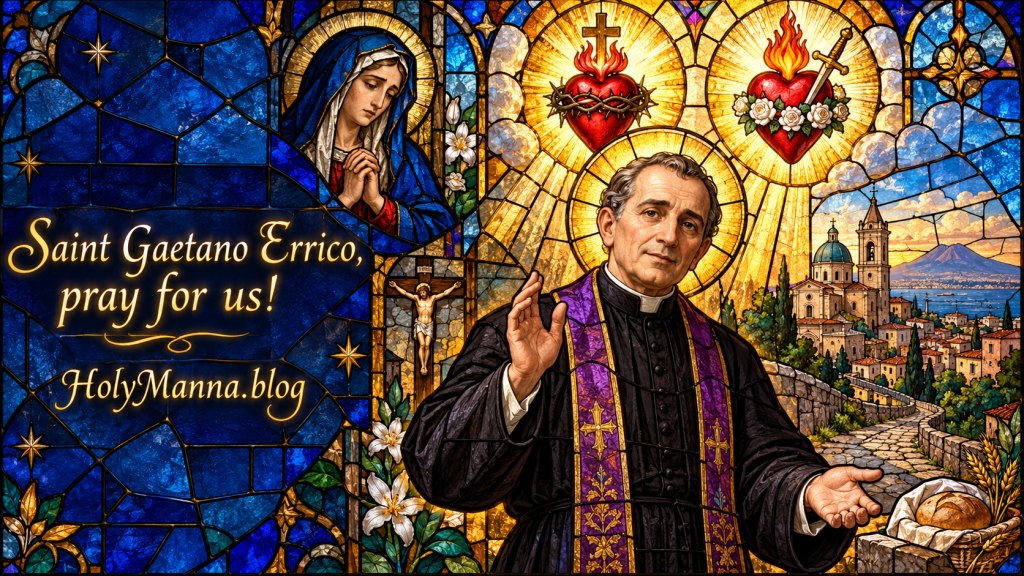
The Science of Forgiveness
Some saints arrive in history like lightning. Saint Gaetano Errico arrived like a long, patient rain. He was a pasta maker’s son from a poor village on the edge of Naples, rejected by two religious orders before he turned 16, and he went on to build a church, carve out a religious congregation from nothing, and spend so many hours in the confessional that a pope would one day call him an expert in the science of forgiveness. When Pope Benedict XVI canonized him on October 12th, 2008, he held him up to the whole Church as a model of God’s mercy poured out through the Sacrament of Reconciliation. The Holy Father preached that Saint Gaetano taught his missionaries this rule of the confessional: “God, who does not desire the sinner’s death, is always more merciful than his ministers; thus may you be as merciful as you can be, so that you will receive mercy from God.”
That one sentence is the whole man. The Church celebrates his feast on October 29th, the day he went home to God in 1860, and his story matters now more than ever, because he is proof that holiness is not reserved for the brilliant, the wealthy, or the well connected. The Catechism teaches that “by canonizing some of the faithful, i.e., by solemnly proclaiming that they practiced heroic virtue and lived in fidelity to God’s grace, the Church recognizes the power of the Spirit of holiness within her and sustains the hope of believers by proposing the saints to them as models and intercessors” (CCC 828). Saint Gaetano Errico is exactly that kind of model, a man whose entire résumé was perseverance, prayer, and mercy.
The Pasta Maker’s Son
Gaetano Errico was born on October 19th, 1791, in Secondigliano, at that time a small village on the northern boundary of the city of Naples in southern Italy. His father, Pasquale Errico, managed a small pasta factory, and his mother, Maria Marseglia, worked at the loom weaving plush fabric. They were devout and hardworking people of modest means. The Vatican’s English biography describes Gaetano as the second of 9 children, while the Vatican’s Italian and Spanish materials describe him as the third of 10; the sources conflict on this detail, and honesty requires saying so rather than pretending certainty. What every source agrees on is the home itself, a household of faith where work and prayer lived side by side. According to the Vatican canonization booklet, he was baptized with the names Gaetano, Cosmas, and Damian, a quiet foreshadowing, since the parish church of Saints Cosmas and Damian would one day be the place of his priestly service.
A story is told that his mother brought the infant Gaetano to a Redemptorist priest to be blessed, and that the priest looked at the child and told her, “This child will be a priest, a great preacher, he will be a saint and he will do good work in Secondigliano.” It is a beautiful account, and it is cherished in the devotional tradition surrounding the saint, but it cannot be verified.
What is documented is less picturesque and more instructive. Gaetano grew up helping his father in the pasta factory, and his father, under the strain of financial pressure, would sometimes lose his temper and strike the boy whether or not Gaetano had done anything wrong. Gaetano bore it with patience and kept working beside him. That hidden endurance, long before any vision or vocation, was already a school of the Cross.
By age 14, Gaetano felt called to the priesthood and religious life. He applied first to the Capuchins and then to the Redemptorists, and both rejected him because of his age. Imagine being a teenager, certain that God is calling you, and hearing no twice from the very communities you admire most. He did not sulk and he did not quit. At 16 he applied to the Archdiocesan Seminary of Naples and was accepted, receiving the habit in January 1808. His family’s meager income could not cover room and board, so he enrolled as a day student, which meant walking roughly 8 kilometers to the seminary and 8 kilometers back, every single day, for years. He excelled in his studies, never missed daily Mass and Holy Communion, helped his parents at home, visited the sick on Thursdays, and on Sundays walked through the town encouraging children to attend their catechism classes. On September 23rd, 1815, in the Chapel of Saint Restituta within the Cathedral of Naples, Gaetano Errico was ordained a priest by Cardinal Ruffo Scilla. The boy nobody wanted had become a priest of Jesus Christ.
Twenty Years a Teacher, a Lifetime a Confessor
Immediately after ordination, Don Gaetano was appointed a teacher, and for the next 20 years he poured himself into his students, giving them both a solid education and real spiritual formation in Christian doctrine and moral life. At the same time he served with loving commitment at the parish church of Saints Cosmas and Damian. The Vatican biography identifies 4 principal concerns that defined his ministry: proclamation of the Word, the ministry of reconciliation, material and spiritual assistance to the sick, and selfless charity. Each one, for Gaetano, was a way of announcing a single message, that in God every man and woman has a Father who loves them.
Then came the moment that changed everything. Every year Don Gaetano traveled to Pagani, near Salerno, to make his annual retreat at the house of the Redemptorists, the order founded by Saint Alphonsus Liguori. In 1818, while he was praying on retreat, the Vatican biography records that Saint Alphonsus Liguori appeared to him in a vision and told him that God wanted him to found a new religious congregation. As a sign of this divine desire, he was to build a church in Secondigliano in honor of Our Lady of Sorrows, and a vision of Our Lady assured him that he would succeed. Stop and sit with the poetry of that for a moment. The Redemptorists had rejected Gaetano as a boy, and now their own founder, from heaven, was personally commissioning him to become a founder himself. God wastes nothing, not even rejection.
The people of Secondigliano mostly welcomed the news that God wanted a church in honor of the Sorrowful Mother in their little village, but some opposed the project, and though their numbers were few, their jealousy and distrust made the work harder. Gaetano never lost sight of the goal, and against the odds the church rose. The church of Our Lady of Sorrows was blessed on December 9th, 1830, 12 years after the vision. Let that number land. He carried a private promise from heaven for 12 years of fundraising, opposition, and manual labor before the first external sign of it was complete. Perseverance of that kind is precisely what The Catechism describes when it teaches that “the way of perfection passes by way of the Cross. There is no holiness without renunciation and spiritual battle” (CCC 2015).
While the church was being finished, he built a small house beside it to serve as the first home of the future congregation, and he lived there with a lay brother who maintained the church. He then commissioned Francesco Verzella, a famous Neapolitan sculptor, to create an image of Our Lady of Sorrows. The Vatican biography relays the tradition that the sculptor had to redo the statue several times, because the sorrowful face Don Gaetano had seen in his vision was vivid in his mind, until at last the sculptor captured it and Gaetano exclaimed, “It is so!” The detail of the repeated attempts is told as a received account and cannot be verified. What is certain is that the statue arrived in Secondigliano in May 1835 and from that day drew an unending stream of pilgrims, which it still does nearly 2 centuries later.
In 1836, again on retreat at Pagani, God revealed to him that the new congregation must be founded in honor of the Sacred Hearts of Jesus and Mary. Gaetano already carried a burning devotion to the Sacred Hearts, and now that love became the engine of everything. The Church teaches that the Sacred Heart of Jesus, “pierced by our sins and for our salvation,” is rightly considered the chief sign and symbol of the love with which the Redeemer loves the Father and every human being (CCC 478). Gaetano’s whole apostolate became an extension of that pierced Heart. He received diocesan approval for the congregation and its statutes on March 14th, 1836, and opened a novitiate that October with 8 novices. Royal approval followed on May 13th, 1840, and after years of further petitions in Rome, Blessed Pius IX issued the Apostolic Brief of Approbation on August 7th, 1846. The Missionaries of the Sacred Hearts of Jesus and Mary were now fully established, and Gaetano was unanimously elected Superior General, which is why generations in Secondigliano simply called him “O Superiore,” The Superior.
It is worth being honest about something here, because honesty is itself a form of reverence. The official Vatican biography records no wonder-working miracles performed by Gaetano during his lifetime, no multiplied bread, no instant healings at his hands. His miracles during life were of another kind, and arguably a harder kind. Benedict XVI described them in his canonization homily when he preached, “How many wounded souls did he heal by this sacrament! How many people did he bring to reconcile themselves with God through the Sacrament of forgiveness!” The street and the confessional, the Pope said, were the privileged places of his pastoral action. He sought out sinners, the sick, the abandoned, the shunned, and the spiritually bereft, and brought them back to the Father. This is exactly the ministry The Catechism describes: “When he celebrates the sacrament of Penance, the priest is fulfilling the ministry of the Good Shepherd who seeks the lost sheep, of the Good Samaritan who binds up wounds, of the Father who awaits the prodigal son and welcomes him on his return” (CCC 1465). The Lord Himself declared through the prophet, “As I live, says the Lord GOD, I have no pleasure in the death of the wicked, but that the wicked turn from his way and live” (Ezekiel 33:11), and Gaetano built his entire priesthood on that verse. The townspeople understood what they were seeing. The Vatican canonization booklet records that when he passed by, people would exclaim, “Here comes Saint Gaetano!” They canonized him in their hearts long before Rome did.
Rejection, Jealousy, and the Long Yes of Rome
Saint Gaetano Errico was not a martyr, but his life was a slow martyrdom of perseverance, and it deserves to be told in full. The hardships began early. He was rejected twice as a teenager by religious orders he loved. He spent his seminary years walking 16 kilometers a day because his family could not afford his lodging. As a child he absorbed his father’s temper without bitterness. When the vision of 1818 set him on his mission, he faced the jealousy and distrust of some of his own neighbors, who opposed the church he was commanded by heaven to build. When he began gathering companions for the future congregation, some of the first priests who joined him grew impatient with the slow, humble beginnings and left him to manage on his own. Founding a religious community sounds romantic until it is one man, a lay brother, and an unfinished dream in a poor village.
Then there was the sheer length of the road. From the vision in 1818 to the blessing of the church in 1830 was 12 years. From the church to diocesan approval in 1836 was 6 more. From diocesan approval to the papal brief of 1846 was another decade of petitions, travel to Rome, and waiting on the machinery of both Church and crown. Gaetano answered all of it with prayer and penance. The first secret of his holiness, the Vatican biography says plainly, was prayer. He was so constantly on his knees that his small room in Secondigliano bears the indentations in the floor where he knelt, and those marks can still be seen. He fasted continuously, often taking only bread and water so that his share of food could go to the poor, and he practiced severe bodily penances, including self-flagellation, offered humbly for the sins that wounded the Heart of Jesus. Such austerities belonged to the ascetical culture of his age and were always understood by the Church as expressions of interior conversion, for The Catechism teaches that “the interior penance of the Christian can be expressed in many and various ways. Scripture and the Fathers insist above all on three forms, fasting, prayer, and almsgiving, which express conversion in relation to oneself, to God, and to others” (CCC 1434). Notice that Gaetano practiced all 3 at once, since his fasting was itself almsgiving, bread denied to himself and handed to the poor.
Through every decade of labor he never stopped the ordinary work of a priest. He was never too tired to travel on, preaching parish missions, hearing confessions for hours on end, and urging the faithful toward the Holy Eucharist, which the Church calls “the source and summit of the Christian life” (CCC 1324). On October 29th, 1860, at 10:00 in the morning, at the age of 69, Don Gaetano Errico died in Secondigliano of natural causes, surrounded by the congregation he had carved out of 4 decades of obedience. His last testament to his missionaries was short enough to memorize and deep enough to spend a lifetime on: “Love one another and be very observant of our Rules.” It is impossible to miss the echo of the Lord’s own farewell, “A new commandment I give to you, that you love one another; even as I have loved you, that you also love one another” (The Gospel of John 13:34). When the news of his death spread, the townspeople of Secondigliano said it out loud: “A saint is dead.”
The Shrine That Never Emptied
Death did not end Gaetano Errico’s ministry; it enlarged it. The Catechism teaches of the saints in glory that “they do not cease to intercede with the Father for us” (CCC 956), and the story of his cause is a case study in that doctrine. His body rests in the Sanctuary of the Addolorata in Secondigliano, the very church he built at heaven’s command, near the statue of Our Lady of Sorrows that he commissioned. The sanctuary, affectionately called “la Cappella” by the people of Secondigliano, remains a living shrine within the motherhouse complex of his congregation, with an adjoining museum, and pilgrims still come to pray at his tomb and before the Addolorata, just as they have since 1835. His congregation, the Missionaries of the Sacred Hearts of Jesus and Mary, which had already spread through southern Italy in his lifetime, continues his work today in Italy and abroad, including in the United States, and the faithful around the world still write to the motherhouse requesting his relics for veneration.
His path to the altars was as unhurried as his life. The Vatican’s English biography contains a line stating that Pope Leo XIII declared him Venerable in December 1876, but that date is internally impossible, since Leo XIII’s pontificate did not begin until 1878, and other reference sources place the formal introduction of his cause under Leo XIII in 1884. What is certain from the Vatican’s own record is that Pope Paul VI declared the heroism of his virtues on October 4th, 1974, giving him the title Venerable. The conflicting earlier date is noted here honestly rather than smoothed over.
The miracle that opened the door to beatification is documented in moving detail. On January 9th, 1952, in Naples, a man named Salvatore Caccioppoli lay gravely ill. His wife, Gaetana, had been named after Venerable Gaetano Errico, had grown up praying at the church of Our Lady of Sorrows, and had a lifelong devotion to the Superior. Around 4:00 in the afternoon, she remembered that she possessed a relic of Gaetano Errico, and she gave it to her dying husband to kiss. Salvatore recovered, and his healing was judged medically inexplicable. The theologians and physicians of the Archdiocesan Tribunal of Naples studied the case and approved it on October 20th, 1999, the Congregation for the Causes of Saints unanimously approved it on January 9th, 2001, and Pope John Paul II signed the decree on April 24th, 2001. On April 14th, 2002, John Paul II beatified Gaetano Errico in Saint Peter’s Square, and 50 years after that afternoon in Naples, the Caccioppoli family, including grandchildren living in the United States, traveled to Rome to witness it.
A second miracle attributed to his intercession was then examined, and on July 6th, 2007, Pope Benedict XVI signed the decree approving it. The specific details of this second healing are not described in the accessible official sources, and so they are not invented here. At the Consistory of March 1st, 2008, the Pope decreed the date, and on October 12th, 2008, in Saint Peter’s Square, Benedict XVI canonized Saint Gaetano Errico alongside Saint Maria Bernarda Bütler, Saint Alphonsa of the Immaculate Conception, the first canonized female saint of India, and Saint Narcisa de Jesús Martillo Morán of Ecuador. The rejected teenager from Secondigliano was now inscribed in the catalogue of saints of the universal Church, and in Secondigliano itself, where his name is still a point of reference and his shrine a point of refuge, the canonization simply confirmed what his neighbors had said on the day he died.
What the Kneeling Marks in the Floor Are Trying to Tell You
The floor of Saint Gaetano’s little room is worn where his knees pressed into it for decades. That is not a metaphor. It is wood and stone shaped by one man’s persistence in prayer, and it asks you a quiet question. What is your life slowly wearing a mark into, and is it anything that will matter in eternity?
Saint Gaetano’s story offers 3 lessons that fit a modern life with startling precision. The first is perseverance under rejection. He was turned away by the Capuchins and the Redemptorists, and instead of concluding that God had no plan for him, he took the long road, 8 kilometers at a time, and let God redefine the dream. Rejection was not the end of his vocation; it was the raw material of it. Where in your own life have you treated a closed door as proof that God has forgotten you, rather than as a redirection toward something He has prepared?
The second is mercy as a daily practice. Gaetano’s greatness was not built on spectacle but on the confessional, on the patient, hidden work of reconciling one soul at a time to the Father. The Catechism reminds every baptized person that “Christ’s call to conversion continues to resound in the lives of Christians” (CCC 1428), and the most practical way to answer it is the one Saint Gaetano spent his life offering: regular confession. If it has been months, or years, his feast day is a providential nudge. Go back. The Lord Himself promised that “there will be more joy in heaven over one sinner who repents than over ninety-nine righteous persons who need no repentance” (The Gospel of Luke 15:7). And mercy runs in both directions. His counsel to his priests, to be as merciful as they could possibly be, applies to everyone who has a coworker who wronged them, a family member who tests them, or a grudge that has quietly calcified. Who in your life is waiting, whether they know it or not, for you to be more merciful than they deserve?
The third is hidden, concrete charity. Gaetano fasted on bread and water so the poor could eat his portion, visited the sick on his one free day as a seminarian, and sought out the abandoned and the shunned. None of that requires a vision of Saint Alphonsus. It requires a calendar and a decision. Skipping one meal a week and giving its cost away, visiting one sick or lonely person a month, and praying one daily act of consecration to the Sacred Hearts of Jesus and Mary would be a thoroughly Errico-shaped rule of life. Which of those 3 could you begin this week, before his feast day passes?
Engage With Us!
Saint Gaetano Errico spent his whole life proving that God’s mercy is bigger than rejection, bigger than small beginnings, and bigger than every sin brought into the confessional. Now the conversation turns to you. Share your thoughts and reflections in the comments below; your story of perseverance or of a powerful experience of the Sacrament of Reconciliation might be exactly what another reader needs today. Here are some questions to pray with and respond to:
- Saint Gaetano was rejected by two religious orders before finding his true calling. When has a rejection in your life turned out to be God’s redirection?
- He walked 8 kilometers each way to seminary for years. What daily sacrifice is God asking of you right now in pursuit of your vocation?
- Benedict XVI called him an expert in the science of forgiveness. How long has it been since your last confession, and what is holding you back from returning?
- Gaetano waited 28 years between his vision in 1818 and the papal approval of his congregation in 1846. How do you handle seasons when God’s promises seem painfully slow?
- His last words were a command to love one another. What is one concrete act of love or mercy you can offer someone in your life before October 29th?
Saint Gaetano Errico shows that a quiet life of prayer, penance, and mercy can echo for centuries. Live this week with his courage. Kneel often, forgive quickly, give generously, and bring every wound to the Sacred Hearts of Jesus and Mary, doing everything with the love and mercy that Jesus taught us.
Saint Gaetano Errico, pray for us!
Follow us on YouTube, TikTok, Instagram and Facebook for more insights and reflections on living a faith-filled life.


Leave a Reply