Thursday of the Thirtieth Week in Ordinary Time – Lectionary: 482
When the Battle Is Real and the Refuge Is Sure
Somewhere in Rome around the year 62, a prisoner sat chained to a soldier and wrote a letter about armor. That image alone is worth sitting with for a moment. Paul could see the breastplate, the shield, and the sword every single day, yet he insisted that the real war was happening somewhere else entirely, in a realm no legion could reach.
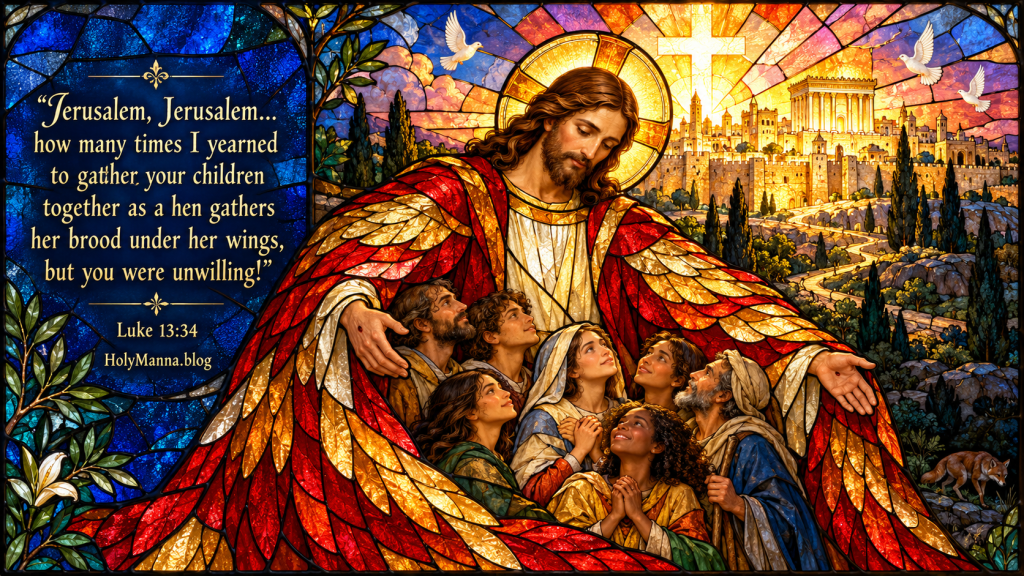
The readings for Thursday of the Thirtieth Week in Ordinary Time, October 29th, gather around one central theme: the Christian life is a real battle against a real enemy, but the strength, the armor, and the shelter all belong to God. In Ephesians 6:10-20, Paul tells believers to “put on the armor of God,” because the struggle is “not with flesh and blood” but with spiritual powers. In Psalm 144, David, the shepherd who became a warrior king, blesses the Lord as his rock, his fortress, and the one “who trains my hands for battle.” Then in Luke 13:31-35, Jesus receives a death threat from Herod Antipas, calls the tetrarch “that fox,” and keeps walking toward Jerusalem. In the very same breath, the fearless prophet reveals the heart of a mother hen longing to gather her chicks under her wings.
As the liturgical year moves toward its final weeks, the Church turns the attention of the faithful toward vigilance, perseverance, and the last things. These readings fit that season perfectly. They insist that courage and tenderness are not opposites in Christ. The same Lord who hands out armor also opens his wings. The battle is real, but so is the refuge, and both are found in him.
First Reading — Ephesians 6:10-20
A Prisoner in Chains Hands Out the Armor of God
Paul wrote these words around the year 62 while under Roman custody, likely chained day and night to a member of the imperial guard. The irony is beautiful. The man in chains is the one distributing armor. Ephesus itself was famous for magic, occult practices, and the great temple of Artemis, so Paul’s readers did not need convincing that spiritual powers were real. What they needed was to know who wins. This passage is the grand finale of the entire letter, and nearly every piece of the armor comes straight out of Isaiah, where it is God himself who wears it. That is the whole point of the day’s theme. The armor is not human equipment. It is God’s own strength, handed to his children.
Ephesians 6:10-20
Brothers and sisters:
Draw your strength from the Lord and from his mighty power.
Put on the armor of God so that you may be able to stand firm
against the tactics of the Devil.
For our struggle is not with flesh and blood
but with the principalities, with the powers,
with the world rulers of this present darkness,
with the evil spirits in the heavens.
Therefore, put on the armor of God,
that you may be able to resist on the evil day
and, having done everything, to hold your ground.
So stand fast with your loins girded in truth,
clothed with righteousness as a breastplate,
and your feet shod in readiness for the Gospel of peace.
In all circumstances, hold faith as a shield,
to quench all the flaming arrows of the Evil One.
And take the helmet of salvation and the sword of the Spirit,
which is the word of God.With all prayer and supplication,
pray at every opportunity in the Spirit.
To that end, be watchful with all perseverance and supplication
for all the holy ones and also for me,
that speech may be given me to open my mouth,
to make known with boldness the mystery of the Gospel
for which I am an ambassador in chains,
so that I may have the courage to speak as I must.
Detailed Exegesis
Verse 10
“Draw your strength from the Lord and from his mighty power.”
The battle begins with a surrender. Paul does not say to generate strength but to draw it from the Lord, the way a branch draws life from the vine. Self-reliance is the first casualty of real spiritual combat, and grace is the first provision.
Verse 11
“Put on the armor of God so that you may be able to stand firm against the tactics of the Devil.”
The Greek word here is panoplia, the full armor of a heavily equipped soldier. Nothing is optional. The Devil is presented as a real, personal enemy with tactics, schemes, and strategy, not a vague symbol of bad luck. Yet the command is modest and achievable: stand firm.
Verse 12
“For our struggle is not with flesh and blood but with the principalities, with the powers, with the world rulers of this present darkness, with the evil spirits in the heavens.”
This verse reorders every human conflict. The difficult coworker, the hostile critic, and the broken family member are not the true enemy. Behind the visible struggle stands an invisible one against fallen angelic powers. Saint John Chrysostom preached that this is a harder warfare and a fiercer conflict than any battle of the senses.
Verse 13
“Therefore, put on the armor of God, that you may be able to resist on the evil day and, having done everything, to hold your ground.”
The evil day is any day when temptation, persecution, or despair concentrates its fire. Paul assumes such days will come. The goal is not conquest by human effort but perseverance, because Christ has already won the decisive victory on the Cross.
Verse 14
“So stand fast with your loins girded in truth, clothed with righteousness as a breastplate,”
The belt held a soldier’s gear together and freed him to move, and Isaiah 11:5 gives this belt to the Messiah. The breastplate of righteousness, drawn from Isaiah 59:17, guards the heart. A life of integrity leaves the enemy nothing to grab.
Verse 15
“and your feet shod in readiness for the Gospel of peace.”
Soldiers wore studded boots for sure footing, and Isaiah 52:7 praises the beautiful feet of the one announcing peace. Chrysostom resolved the paradox of a war fought for peace in a single line: “if we are at war with the devil, we are at peace with God” (Homilies on Ephesians, Homily 24).
Verse 16
“In all circumstances, hold faith as a shield, to quench all the flaming arrows of the Evil One.”
The Roman scutum was a large shield that could be soaked in water to extinguish flaming arrows. Faith works the same way against the enemy’s incendiary lies, accusations, and discouragements. They strike, hiss, and die.
Verse 17
“And take the helmet of salvation and the sword of the Spirit, which is the word of God.”
The helmet guards the mind with the assurance of salvation. The sword is the only offensive weapon in the list, and it is Scripture. Jesus himself wielded it in the desert, answering every temptation with the written word of God.
Verse 18
“With all prayer and supplication, pray at every opportunity in the Spirit. To that end, be watchful with all perseverance and supplication for all the holy ones”
The armor is put on kneeling. Prayer is not one more weapon on the list but the atmosphere in which every weapon works, and it is intercessory, offered for all the holy ones, because no soldier fights alone.
Verse 19
“and also for me, that speech may be given me to open my mouth, to make known with boldness the mystery of the Gospel”
The great Apostle humbly begs for prayers. He does not ask for release from prison but for boldness in preaching. The measure of his heart is what he wants most, and what he wants most is to proclaim Christ.
Verse 20
“for which I am an ambassador in chains, so that I may have the courage to speak as I must.”
Ambassadors normally enjoyed diplomatic immunity, yet this ambassador of heaven writes from custody. The chains do not contradict the mission. They authenticate it, because the Gospel advances through weakness clothed in the power of God.
Teachings
The Catechism takes Paul’s battlefield seriously and applies it to every human life. In CCC 409, quoting Gaudium et Spes 37, the Church teaches: “The whole of man’s history has been the story of dour combat with the powers of evil, stretching, so our Lord tells us, from the very dawn of history until the last day. Finding himself in the midst of the battlefield man has to struggle to do what is right, and it is at great cost to himself, and aided by God’s grace, that he succeeds in achieving his own inner integrity.” Pope Francis renewed this teaching in Gaudete et Exsultate 158: “The Christian life is a constant battle. We need strength and courage to withstand the temptations of the devil and to proclaim the Gospel. This battle is sweet, for it allows us to rejoice each time the Lord triumphs in our lives.” Saint John Chrysostom, preaching on this very passage in the fourth century, added a word of steady hope: “So long then as faith be right and the life be right, the armor remains uninjured” (Homilies on Ephesians, Homily 24).
Reflection
The armor still fits, and putting it on is wonderfully practical. Start tomorrow with five minutes of prayer before touching a phone, because that is how a soldier reports for duty. Keep the sword sharp by reading the day’s Gospel, even a few verses. Go to Confession regularly, since the breastplate of righteousness is restored there. When conflict flares with another person, pause and remember that the real enemy is not flesh and blood, then respond with charity instead of fire. Which piece of the armor has been left sitting in the closet lately? When the evil day comes, what is the first thing you reach for, and is it God?
Responsorial Psalm — Psalm 144:1-2, 9-10
The Warrior King Who Gives God All the Credit
Psalm 144 is a royal psalm attributed to David, and it reads like a soldier’s prayer journal. Much of its language echoes Psalm 18, David’s great song of thanksgiving after the Lord delivered him from Saul and from all his enemies. Here is a man who fought lions, bears, giants, and kings, yet every verse the Church sings today points away from his own skill and toward God. The refrain the congregation repeats at Mass, “Blessed be the Lord, my Rock!”, sets the tone for the whole liturgy of the day. Placed between Paul’s armor and Jesus’ fearless march to Jerusalem, this psalm teaches the faithful how a warrior actually talks. He blesses God first, fights second, and sings afterward. The Tradition has long read David as a figure of Christ, the true Son of David, and has read these battles as the soul’s spiritual combat.
Psalm 144:1-2, 9-10
R. (1b) Blessed be the Lord, my Rock!
Blessed be the LORD, my rock,
who trains my hands for battle, my fingers for war.
R. Blessed be the Lord, my Rock!
My mercy and my fortress,
my stronghold, my deliverer,
My shield, in whom I trust,
who subdues my people under me.
R. Blessed be the Lord, my Rock!
O God, I will sing a new song to you;
with a ten-stringed lyre I will chant your praise,
You who give victory to kings,
and deliver David, your servant from the evil sword.
R. Blessed be the Lord, my Rock!
Detailed Exegesis
Verse 1
“Blessed be the LORD, my rock, who trains my hands for battle, my fingers for war.”
The psalm opens with blessing, not with strategy. A rock in the ancient world meant high ground, shelter, and a fortress that could not be moved, and David had literally hidden among the rocks of the Judean wilderness. The striking claim is that God trains his servant. Grace does not replace effort. It forms it, the way a master trains an apprentice, which is exactly how the saints describe growth in virtue and in prayer.
Verse 2
“My mercy and my fortress, my stronghold, my deliverer, My shield, in whom I trust, who subdues my people under me.”
The titles pour out in a cascade, and the first one is the most surprising. Before fortress or shield, God is called “my mercy,” translating the great Hebrew word hesed, the steadfast covenant love of God. Strength without mercy becomes tyranny, so David anchors his power in love. The shield here answers the shield of faith in Ephesians 6:16, and the ordered kingdom at the end of the verse is presented as God’s gift rather than David’s achievement.
Verse 9
“O God, I will sing a new song to you; with a ten-stringed lyre I will chant your praise,”
In the psalms, a new song always answers a new act of salvation. Old mercies get remembered, but fresh deliverance demands fresh music. The ten-stringed lyre signals full, festive, public worship, nothing halfhearted. The Book of Revelation picks up this very image, where the redeemed sing a new song before the throne of the Lamb, which means every Mass is a rehearsal.
Verse 10
“You who give victory to kings, and deliver David, your servant from the evil sword.”
The psalm closes the circle. Kings do not win victories; God gives them. David calls himself not a king here but a servant, which is his truest title and the one the Messiah would make his own. The “evil sword” David escaped points forward to the greater deliverance of the Resurrection, when the Father delivered the Son of David from death itself.
Teachings
The Church hears in this psalm her own teaching on prayer as combat. The Catechism devotes an entire article to the subject and opens it in CCC 2725 with these words: “Prayer is both a gift of grace and a determined response on our part. It always presupposes effort. The great figures of prayer of the Old Covenant before Christ, as well as the Mother of God, the saints, and he himself, all teach us this: prayer is a battle. Against whom? Against ourselves and against the wiles of the tempter who does all he can to turn man away from prayer, away from union with God. We pray as we live, because we live as we pray.” David’s trained hands and his new song belong together, because the discipline of the fight and the joy of praise are two movements of the same grace.
Reflection
Try praying this psalm the way David wrote it, as a soldier’s morning report. Before the day’s battles begin, bless God out loud for one specific way he has been your rock. Let him train your hands through small, repeated acts: a daily Rosary decade, a kept promise, a held tongue. Then end the day with a new song, naming one victory that was clearly his and thanking him for it. What battle are you still trying to win with untrained hands? When was the last time a victory in your life produced actual praise?
Holy Gospel — Luke 13:31-35
The Fox, the Hen, and the Road That Only Goes One Way
This scene unfolds on the great journey that begins at Luke 9:51, where Jesus “set his face to go to Jerusalem.” The Herod in question is Herod Antipas, tetrarch of Galilee and Perea, the man who had already beheaded John the Baptist. A death threat from him was no empty rumor. The Pharisees who deliver the warning may have mixed motives, and Saint Cyril of Alexandria suspected their pretended concern was really an attempt to scare Jesus out of the territory. Either way, Jesus is unmoved. In five short verses, the reader meets the most fearless man who ever lived, and then watches that same man speak with the tenderness of a mother. This is the day’s theme in miniature. The battle is real, Jerusalem will be deadly, and still the Lord opens his wings.
Luke 13:31-35
Some Pharisees came to Jesus and said,
“Go away, leave this area because Herod wants to kill you.”
He replied, “Go and tell that fox,
‘Behold, I cast out demons and I perform healings today and tomorrow,
and on the third day I accomplish my purpose.
Yet I must continue on my way today, tomorrow, and the following day,
for it is impossible that a prophet should die
outside of Jerusalem.’“Jerusalem, Jerusalem,
you who kill the prophets and stone those sent to you,
how many times I yearned to gather your children together
as a hen gathers her brood under her wings,
but you were unwilling!
Behold, your house will be abandoned.
But I tell you, you will not see me until the time comes when you say,
Blessed is he who comes in the name of the Lord.”
Detailed Exegesis
Verse 31
“Some Pharisees came to Jesus and said, ‘Go away, leave this area because Herod wants to kill you.’”
Whether the warning was sincere or staged, it carried a real temptation: abandon the mission, choose safety, let fear set the route. Every disciple eventually hears some version of this voice. Jesus models the response, which is neither panic nor bravado, but total clarity about the Father’s plan.
Verse 32
“He replied, ‘Go and tell that fox, “Behold, I cast out demons and I perform healings today and tomorrow, and on the third day I accomplish my purpose.”‘”
Calling Herod “that fox” named him cunning, destructive, and ultimately small. Tyrants do not set the Messiah’s schedule. The phrase “on the third day I accomplish my purpose” reaches far beyond the week at hand, for Luke’s readers already know what the third day means. The casting out of demons and the healings are the daily skirmishes of a war that will be won in the Paschal Mystery.
Verse 33
“Yet I must continue on my way today, tomorrow, and the following day, for it is impossible that a prophet should die outside of Jerusalem.”
The little word “must” carries the weight of divine necessity, which Luke uses again and again for God’s saving plan. The Catechism comments directly on this verse in CCC 557: “By this decision he indicated that he was going up to Jerusalem prepared to die there. Three times he had announced his Passion and Resurrection; now, heading toward Jerusalem, Jesus says: ‘It cannot be that a prophet should perish away from Jerusalem.’” Jesus is not a victim of circumstances. He is a willing offering walking toward the altar.
Verse 34
“Jerusalem, Jerusalem, you who kill the prophets and stone those sent to you, how many times I yearned to gather your children together as a hen gathers her brood under her wings, but you were unwilling!”
The doubled name is a cry of grief, not condemnation for its own sake. The city that should have welcomed God’s messengers had buried them, yet Jesus still longs for her. The hen is one of the most maternal images Jesus ever used for himself, a creature with no weapon at all except her own body placed between danger and her young. The tragedy sits in four words: “but you were unwilling!” Grace can be refused, and heaven grieves when it is.
Verse 35
“Behold, your house will be abandoned. But I tell you, you will not see me until the time comes when you say, Blessed is he who comes in the name of the Lord.”
The abandoned house points to the Temple, which would fall to Rome in the year 70, within a generation. Yet the verse ends in hope, quoting Psalm 118:26. The crowds will sing exactly these words on Palm Sunday, and the Church has never stopped singing them. The lament ends not with a door slammed shut but with a promised reunion for all who will finally welcome him.
Teachings
The Catechism continues its meditation on this lament in CCC 558: “Jesus recalls the martyrdom of the prophets who had been put to death in Jerusalem. Nevertheless he persists in calling Jerusalem to gather around him: ‘How often would I have gathered your children together as a hen gathers her brood under her wings, and you would not!’ When Jerusalem comes into view he weeps over her and expresses once again his heart’s desire: ‘Would that even today you knew the things that make for peace! But now they are hid from your eyes.’” Saint Cyril of Alexandria, in his Commentary on Luke, explained the image of the wings this way: “He would have had them under his wings, that is, under the protection of his power, but they lost the valuable blessings by being disposed to evil, ungrateful and scornful.” The Catechism also notes in CCC 559 that the acclamation “Blessed be he who comes in the name of the Lord” is “taken up by the Church in the ‘Sanctus’ of the Eucharistic liturgy that introduces the memorial of the Lord’s Passover.” Every Mass, then, answers this Gospel. What Jerusalem refused, the faithful at the altar say yes to, week after week.
Reflection
Two invitations rise out of this passage. The first is courage. Somewhere in your life a fox is suggesting a safer route around your calling, whether that means staying quiet about the faith, postponing a hard conversation, or avoiding a sacrifice God is clearly asking for. Keep walking the road anyway, today, tomorrow, and the following day. The second is surrender. The hen’s wings are still open, especially in the sacraments, and the only thing that has ever kept anyone out from under them is unwillingness. Go to Mass this week and mean the words when the congregation sings that he who comes in the name of the Lord is blessed. Where has fear of a fox been quietly rerouting your discipleship? What would it look like, concretely, to stop being unwilling?
Stand Firm, Sing On, Stay Under His Wings
Look at the three figures this liturgy places side by side. A prisoner in chains hands out armor he cannot wear in his cell, because the armor was never his to begin with. A warrior king puts down his sword long enough to pick up a ten-stringed lyre, because the victories were never his either. And the Messiah himself, with a fox on his trail and a cross on his horizon, describes his own heart as a hen spreading her wings over her brood. Taken together, they tell one story. The Christian life is a battle, the strength for it comes entirely from God, and the safest place on the battlefield is under his wings.
That is wonderfully freeing news for anyone who feels outmatched by the week ahead. Nobody is asked to manufacture courage or to win the war single-handedly. The invitation is simpler and far more hopeful: draw strength from the Lord, put on what he provides, bless the Rock before the fighting starts, and refuse to let any fox reroute the road God has marked out. Then, at the end of the day, sing the new song, because the Lord will have triumphed somewhere, and he loves to be thanked.
The hen’s wings are still open. They stretch widest at the altar, where the Church sings that he who comes in the name of the Lord is blessed, and where the Lord who once yearned over Jerusalem now gathers his children in the Eucharist. Come to him this week armored, grateful, and willing. The battle is real, but so is the refuge, and the refuge always wins.
Engage With Us!
These readings have a way of finding the exact battle each person is fighting this week, so share your reflections in the comments below. Your story of standing firm, or of finally stepping under the Lord’s wings, might be precisely the encouragement another reader needs today. Here are a few questions to pray with before you write:
- In Ephesians 6:10-20, Paul says the struggle is not with flesh and blood. Which piece of the armor of God do you most need to put back on right now, and what is one concrete way you will do it this week?
- In Psalm 144:1-2, 9-10, David blesses the Lord as his rock and credits every victory to God. What recent victory in your life deserves a new song of thanksgiving, and how will you offer it?
- In Luke 13:31-35, Jesus refuses to let Herod’s threat change his course and longs to gather his children like a hen gathering her brood. Where is fear rerouting your path, and what is keeping you from resting under his wings?
- Taking all the readings together, where is God inviting you to trade self-reliance for his strength, his armor, and his shelter in the battle you are facing today?
Living a life of faith does not mean the battles disappear. It means never fighting them alone, and never fighting them without hope. So stand firm, pray without ceasing, and stay close to the sacraments where the Lord’s strength is poured out. Above all, do everything, even the fighting, with the love and mercy Jesus taught us, because that love is the one weapon no fox and no darkness can ever overcome.
Sacred Heart of Jesus, we trust in You!
Immaculate Heart of Mary, pray for us!
Saint Michael the Archangel, defend us in battle!
Follow us on YouTube, TikTok, Instagram and Facebook for more insights and reflections on living a faith-filled life.


Leave a Reply