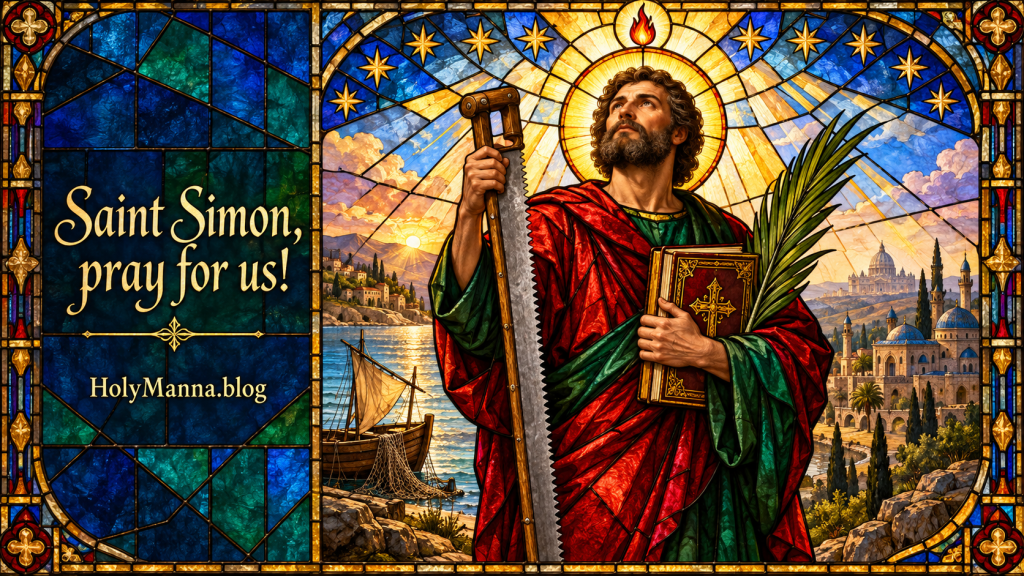
The Zealot Who Let God Rewrite His Fire
On October 28th, the Church celebrates the Feast of Saints Simon and Jude, Apostles, and today the spotlight falls on the quieter of the two, Saint Simon the Apostle. He is one of the 12 men Jesus Christ personally chose, prayed over, and sent into the world, and yet he is also one of the most hidden figures in the entire New Testament. His name appears in every list of the Apostles, in The Gospel of Matthew, The Gospel of Mark, The Gospel of Luke, and The Acts of the Apostles, but Scripture does not record a single word he ever spoke. Not one sermon, not one question, not one line. That silence is not an accident to be apologized for; it is the heart of his witness. Simon reminds every believer that a person does not need a famous voice to be a pillar of the Church. He needs only to stay close to Jesus and to go where Jesus sends him.
The Catechism teaches that the Church is apostolic because she is founded on the Apostles, remains built on that foundation, and continues to be taught, sanctified, and guided by the Apostles through their successors (CCC 857). Simon is part of that foundation. Every time a Catholic professes faith in the “one, holy, catholic, and apostolic Church,” Simon is quietly included in that word “apostolic.” He is also named at the altar itself; Eucharistic Prayer I, the ancient Roman Canon, lists Simon and Jude among the Apostles in whose communion the Church celebrates every Mass. The Church honors Saint Simon as the patron of tanners, curriers, and sawyers, trades long associated with the instrument of his traditional martyrdom.
From the Fire of Zeal to the Call of Christ
Scripture tells almost nothing about Simon’s origins, and honesty demands saying so plainly. His birthplace, his family, and his trade are not recorded. What the Gospels do give is his surname, and that surname is a window into his soul. The Gospel of Matthew and The Gospel of Mark call him the Cananaean, while The Gospel of Luke calls him “Simon who was called the Zealot” (Lk 6:15). These are not two different descriptions. Both come from the Hebrew root qana, which means zealous or ardent. The Catholic Encyclopedia notes that the name does not prove Simon belonged to the armed revolutionary party later known as the Zealots, but that he was a man of burning zeal for the Law of God even before his call. It also corrects an old assumption; Saint Jerome and others thought the name Cananaean meant Simon came from Cana in Galilee, but the Greek form of the word points to zeal, not to a hometown.
Pope Benedict XVI, in his General Audience of October 11th, 2006, devoted an entire catechesis to Simon and Jude. He explained that the Hebrew verb behind Simon’s name describes both God’s own jealous love for His people and the ardor of men like Elijah who burned to serve Him without reserve. Benedict concluded that even if Simon was not formally a member of the nationalist Zealot movement, he was almost certainly a man passionately attached to his Jewish identity, to God, to his people, and to the divine Law. In other words, Simon did not come to Jesus lukewarm. He came to Jesus already on fire, and Jesus did not extinguish that fire. He redirected it.
Here is where Simon’s story becomes a story about every disciple. Benedict XVI pointed out that Simon stood at the opposite end of the religious and social spectrum from Matthew, the tax collector who had worked for the occupying power that zealous Jews despised. Jesus called them both, seated them at the same table, and formed them into one apostolic band. As Benedict put it, “It was people who interested him, not social classes or labels!” The Holy Father drew the lesson out further; what bound the Twelve together, despite every difference that should have torn them apart, was Jesus himself, in whom they found themselves united with one another, and the Twelve in this way prefigure the Church, where there must be room for every people, every temperament, and every charism, all finding unity in communion with Christ.
The moment of Simon’s call is preserved in The Gospel of Luke, which recounts that before choosing the Twelve, Jesus spent the entire night on the mountain in prayer to God, and when day came He called His disciples and chose 12 of them, whom He named Apostles (Lk 6:12 to 13). Simon was an answer to the prayer of Christ. The Catechism teaches that Jesus chose the Twelve “to be with him, and to be sent out to preach” (CCC 858, quoting Mk 3:14), and that in the Twelve the Lord gave His community a permanent structure, with the Apostles as the foundation stones of the new Jerusalem (CCC 765). Whatever Simon had been zealous for before, from the night of that mountain prayer onward his zeal had a new name, and the name was Jesus.
Zeal Transfigured
What is Simon most known for? Paradoxically, for his hiddenness and for his fire. For 3 years he walked with Jesus through Galilee and Judea. He heard the Sermon on the Mount with his own ears. He watched the Lord touch lepers, forgive sinners, and raise the dead. He was there for the multiplication of the loaves and for the storm on the sea. Scripture never singles him out in these scenes, but it never excludes him either; he is one of the Twelve who “left everything and followed him” (Lk 5:11 describes this response of the first disciples, and the apostolic lists confirm Simon’s place among them). When Jesus sent the Twelve out 2 by 2, He gave them authority over unclean spirits, and they went out, preached repentance, cast out many demons, and anointed and healed the sick (Mk 6:7 to 13). Simon shared fully in that mission and in those works of power. These healings and exorcisms, worked through the Twelve by the authority of Christ, are the miracles of Simon’s public life that Scripture itself attests, even though it attributes none to him by name.
Simon’s fidelity is also written into the most important 10 days in the Church’s infancy. After the Ascension, The Acts of the Apostles places him by name in the upper room, where the Apostles “with one accord devoted themselves to prayer” together with Mary the Mother of Jesus (Acts 1:13 to 14). The former Zealot, who might once have dreamed of driving out the Romans by the sword, now waited in prayer beside the Mother of God for the promise of the Holy Spirit. On Pentecost that Spirit descended on him in tongues of fire, and the fire he had carried his whole life was finally, fully transfigured.
A beloved Eastern tradition adds a tender detail to his story. The Greek, Coptic, and Ethiopian churches have long identified Simon with Nathanael of Cana, and Greek tradition goes further, holding that Simon was the bridegroom at the wedding feast of Cana, where Jesus changed water into wine as His first sign (John 2:1 to 11). In this telling, the young husband who watched Christ transform the water left the feast transformed himself, and followed. It is a beautiful story, and it preaches well, but it must be told as what it is. This tradition cannot be verified, and the oldest Latin sources do not support it.
Why should the reader remember and emulate Simon? Because Simon shows what grace does with a strong personality. The Church has never taught that holiness means becoming bland. The Catechism teaches that Christ, the Son of God made man, is the Father’s one, perfect, and unsurpassable Word, and that the Apostles were sent to proclaim Him to the ends of the earth (CCC 65, CCC 858 to 860). God did not need Simon to stop being intense. God needed Simon’s intensity aimed at the right target. Zeal for a political cause became zeal for the Kingdom; readiness to fight became readiness to suffer; passion for the Law became passion for the Lawgiver who had pitched His tent among men.
The Saw and the Crown
After Pentecost, Simon disappears from the pages of Scripture, and the historical record grows thin. The Catholic Encyclopedia states frankly that where Simon actually preached is uncertain, and that nearly every land of the ancient world, even Britain in some accounts, has been claimed for him. The Church’s own received summary is found in the traditional Roman Martyrology for October 28th, which records that Simon preached the Gospel in Egypt and Jude in Mesopotamia, that the 2 Apostles afterwards entered Persia together, that there they “converted to Christ a numberless multitude of the inhabitants,” and that they then underwent martyrdom. Butler’s Lives of the Saints adds that some traditions extend Simon’s African mission through Cyrene and Mauritania before his journey east.
The most widespread Western tradition of his death is vivid and terrible. According to the ancient Latin passion account of Simon and Jude, the 2 Apostles confronted the pagan magicians Zaroes and Arfaxat in Persia, won enormous numbers of converts, and were finally seized when they refused to offer sacrifice to the sun. In this account Simon was martyred at a city called Suanir, and the manner of death most often attached to his name is that he was sawn in two, which is why Christian art for centuries has placed a saw in his hands, and why sawyers, tanners, and curriers took him as their patron. Saint Fortunatus of Poitiers, a sixth century bishop and hymn writer, states that Simon and Jude were buried at Suanir in Persia, where they suffered martyrdom. This passion account comes from apocryphal sources, and it cannot be verified.
Honesty also requires laying out the conflicting claims, because the sources genuinely disagree. Butler’s Lives of the Saints reports that “those who mention the manner of his death say he was crucified,” a tradition echoed in the East, where Simon is said to have been crucified after preaching as far as the Black Sea. A tradition associated with Saint Basil the Great has Simon dying peacefully in upper Mesopotamia. The Armenian historian Moses of Chorene places his death at Weriosphora in Caucasian Iberia. An Ethiopian tradition has him crucified in Jerusalem as that city’s bishop, though this depends on identifying him with Simeon of Jerusalem, a separate figure whom the Western calendar commemorates on his own day. Even the date of his death is unknown; proposals range from around the year 65 to the early second century. None of these accounts can be verified, and the differences are flagged here rather than smoothed over. What the Church holds with confidence is what her liturgy proclaims; Simon is honored as an Apostle and a martyr, a man who carried the Gospel far from home and sealed his preaching with his blood.
That witness is what matters most. The Catechism teaches that “martyrdom is the supreme witness given to the truth of the faith” (CCC 2473), the testimony of a disciple who endures death united to Christ. Jesus had told the Twelve, “You did not choose me, but I chose you” (John 15:16), and He had promised that the servant is not greater than the master. Simon the Zealot, who once would have died for the honor of the Law, died instead for the honor of the One who fulfilled it. The fire Christ had redirected on the mountain in Galilee burned all the way to Persia, and it did not go out even under the saw.
Resting Beside the Hopeless Causes
Scripture and the early sources record no specific miracles attributed to Simon’s individual intercession after death, and in keeping with honesty nothing will be invented here. His legacy after death runs instead through the extraordinary history of his relics and his feast, and through the quiet weight of his place in the Church’s prayer.
The relics of Saints Simon and Jude were brought to Rome, and since October 27th, 1605 they have been venerated together at the central altar of the left transept of Saint Peter’s Basilica. That altar was long known as the Tribune of Saints Simon and Jude, and in 1963 it was dedicated to Saint Joseph, Patron of the Universal Church, so that today the 2 Apostles rest beneath the altar of Saint Joseph. Anyone who has visited Saint Peter’s has likely seen pilgrims gathered there, because that altar is one of the most visited devotional sites in the basilica; countless faithful come to pray to Saint Jude, patron of hopeless causes, and every one of them is also standing at the tomb of Simon. There is something fitting, and honestly a little funny in the way God’s providence often is, about the hidden Apostle spending the centuries beside the most invoked Apostle, sharing in every candle and every whispered petition without ever drawing the crowd himself. The Basilica of Saint-Sernin in Toulouse also claims a major portion of the relics of the 2 Apostles, and Reims is named among relic claimants as well; these competing claims are a well known feature of medieval relic history, and the conflict is noted here plainly rather than resolved.
The joint feast itself is part of Simon’s legacy. The West celebrates Simon and Jude together on October 28th precisely because their relics were venerated together in Rome, while the Byzantine churches honor Simon separately on May 10th and the Coptic and Ethiopian churches keep their own dates. Their names stand side by side in the Roman Canon, so that at every Mass celebrated with Eucharistic Prayer I the Church on earth audibly joins herself to Simon’s communion. The Catechism teaches that the veneration of relics and pilgrimages to the tombs of the saints belong to the forms of piety that surround and extend the sacramental life of the Church (CCC 1674), and that the witness of the saints continually renews the Church’s holiness (CCC 828). Churches, parishes, and schools across the world bear the names of Simon and Jude together, from Rome to England to the Americas, a quiet testimony that the Church has never forgotten her hidden pillar.
One more thing should be said, because it protects the truth. Quotations attributed to Saint Simon circulate online, usually lifted from the apocryphal passion accounts. No verified sayings of Saint Simon exist anywhere; Scripture preserves none of his words, and no reliable ancient source does either. Rather than diminishing him, that silence crowns the whole story. The man whose name means zeal said everything with his life.
What Simon’s Silence Teaches a Noisy World
Simon’s life lands differently for people between 20 and 45 than almost any other saint’s, because this is the generation formed by platforms that measure a person’s worth in followers, impressions, and reach. Simon had none of that, and he is a pillar of the Church. He belonged to the inner circle of the most important movement in human history, and history did not keep a single quote of his. If visibility were the measure of a life, Simon’s life would be a failure. The Gospel measures differently. Jesus did not ask Simon to be famous; He asked Simon “to be with him, and to be sent out to preach” (CCC 858, quoting Mk 3:14), and Simon did both unto death.
His story asks hard, freeing questions. Where does your zeal actually go each day, and would it survive being hidden? So much modern passion is performed for an audience; Simon’s was spent in Persia, far from anyone who could applaud. Is there a cause, a politics, or a grievance that holds the place in your heart that only Christ should hold? Simon knew that temptation from the inside, and the answer was not to care less but to let Jesus re-aim the caring. Who is the Matthew in your life, the person whose background, politics, or past makes them feel like the natural enemy, and can you kneel at the same altar with them? Benedict XVI’s teaching cuts deep here; the unity of the Twelve was not agreement, it was Jesus.
Practically, Simon’s path can be walked this very week. A believer can bring one hidden act of service to God daily and tell no one, letting the secrecy itself become a prayer. A Catholic can attend one weekday Mass and listen for Simon’s name in the Roman Canon, consciously uniting with the Apostles in the Eucharist. Anyone carrying resentment toward a “Matthew” can pray for that person by name for 7 days straight, because zeal that cannot bless an enemy has not yet been converted. And when life demands endurance without recognition, in parenting, in caregiving, in honest work nobody notices, the reader can remember that the Church still stands on 12 stones, and one of them never said a word.
Engage With Us!
The conversation does not end here, and every reader is warmly invited to share thoughts, struggles, and reflections on Saint Simon in the comments below. His hidden zeal has something to say to every season of life, and hearing how it speaks to others builds up the whole community.
- What is one passion in your life that God might be asking not to extinguish, but to redirect toward Him?
- When was the last time you served God in complete hiddenness, with no one watching and no credit given, and what did it do to your heart?
- Who is the “Matthew” to your “Simon,” the person you struggle to stand beside, and what one concrete step could you take toward unity in Christ this week?
- If your words were never remembered and only your faithfulness remained, what would your life say?
- How can you bring greater zeal, the ardent and peaceful kind Simon learned from Jesus, into your work, your family, and your parish this month?
Saint Simon gave everything, his fire, his future, and finally his body, to the Lord who chose him on a mountain at dawn. The same Lord chooses every baptized soul today, not for fame but for faithfulness. Go into this feast with courage; love the people in front of you, serve without needing to be seen, endure without needing to be praised, and do everything with the love and mercy that Jesus taught us.
Saint Simon the Apostle, zealous and hidden pillar of the Church, pray for us!
Follow us on YouTube, TikTok, Instagram and Facebook for more insights and reflections on living a faith-filled life.


Leave a Reply