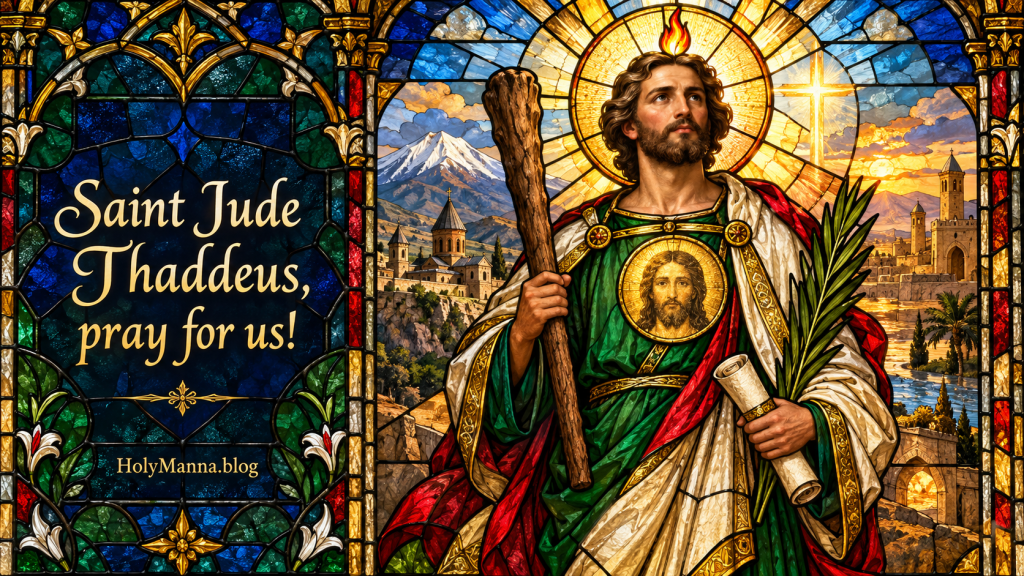
The Forgotten Apostle
There is a beautiful irony at the heart of Saint Jude Thaddeus. For centuries he was the apostle almost nobody prayed to, passed over because his name sounded too much like the name of the betrayer. Today he is one of the most invoked saints on the face of the earth, the one people turn to when the diagnosis is terminal, when the marriage is collapsing, when the addiction will not let go, when every other door has slammed shut. The Church honors him as the patron of hopeless, desperate, and impossible causes, often simply as the patron of hope, and as a patron of Armenia, the first nation to embrace Christianity. His feast is celebrated on October 28th alongside his companion in mission and martyrdom, Saint Simon the Zealot.
Jude was one of the Twelve, a kinsman of Jesus Himself, the author of one of the shortest and fiercest books in the New Testament, and, by tradition, a martyr who gave his life for the Gospel in distant Persia. The Catechism teaches that “the Church is apostolic because she is founded on the apostles” (CCC 857), and that through the apostles and their successors Christ remains present to His Church until the end of the age (CCC 858 to 860). Every Catholic who has ever lit a candle before his image, slipped a Saint Jude medal around a sick child’s neck, or whispered a novena at 2 in the morning stands in a direct line back to this quiet Galilean who once sat at the Last Supper and asked Jesus a single, searching question.
His story is a story about being overlooked, and about what God does with the overlooked. It is worth telling slowly.
A Carpenter’s Cousin from the Hills of Galilee
Saint Jude was a Jew of Galilee, raised in the same world of village synagogues, olive groves, and hard manual labor that formed Our Lord Himself. The Gospels give him several names. Saint Luke calls him “Judas the son of James” (Luke 6:16; Acts 1:13). Saint Matthew and Saint Mark list him as “Thaddaeus” (Matthew 10:3; Mark 3:18), a name drawn from an Aramaic root usually rendered “great-hearted” or “courageous,” and often translated in Catholic sources as “generous and kind.” Saint John, writing with evident care, distinguishes him forever from the traitor by calling him “Judas, not the Iscariot” (John 14:22). The early translators of Scripture rendered his name “Jude” in English for the same reason, so that no one would ever confuse the faithful apostle with the man who sold his Master.
Catholic tradition, following the Church Fathers and the Roman liturgy, identifies this apostle with the “Judas” named among the kinsmen of Jesus in Nazareth. When the Lord returned to His hometown, the astonished crowd asked, “Is he not the carpenter’s son? Is not his mother named Mary and his brothers James, Joseph, Simon, and Judas?” (Matthew 13:55). The Catechism explains that these “brothers” of the Lord are not children of the Blessed Virgin, whose perpetual virginity the Church has always confessed, but close relatives of Jesus according to a common Old Testament manner of speaking (CCC 500). Tradition holds that Jude’s father was Clopas and his mother was Mary of Clopas, the woman Saint John places at the foot of the Cross beside Our Lady (John 19:25). Fragments preserved from Papias of Hierapolis, a writer of the early second century, support this family picture. If the tradition is correct, Jude grew up as a cousin of Jesus, part of the wider household of Nazareth, formed within arm’s reach of the Holy Family.
Scripture records nothing of his call, and tradition adds only that he worked the land before following Christ. Yet one remarkable early account does survive about his family. The historian Hegesippus, preserved by Eusebius in Ecclesiastical History III.19 to 20, records that near the end of the first century the Emperor Domitian, fearing any surviving descendants of King David, had the grandsons of Jude arrested and brought before him. They turned out to be poor farmers. They showed the emperor their calloused, work-hardened hands, told him plainly that the kingdom of Christ was not an earthly kingdom but a heavenly one that would come at the end of the world, and were dismissed as harmless. Domitian, the account says, then called off his persecution. It is a scene straight out of the Magnificat; the mighty emperor of Rome stood face to face with the humble household of Jude and found nothing to fear and everything to misunderstand.
Jude’s one moment of recorded speech in the Gospels came at the Last Supper, and it tells much about his heart. As Jesus spoke of revealing Himself to His own, Jude asked, “Master, what happened that you will reveal yourself to us and not to the world?” (John 14:22). It is the question of a man who wants everyone to see what he has seen. And Jesus answered him with one of the most consoling promises in all of Scripture: “Whoever loves me will keep my word, and my Father will love him, and we will come to him and make our dwelling with him” (John 14:23). God does not reveal Himself through spectacle imposed on the world, but through love, obedience, and the quiet indwelling of the Trinity in the soul. Jude asked the question; the whole Church received the answer.
Contending for the Faith from Jerusalem to the East
After Pentecost, Jude went out with the rest of the Twelve to make disciples of all nations. The historical record of his journeys is thin, and the Church is honest about that, but the traditions are ancient and consistent in their general shape. He is said to have preached first in Judea, Samaria, and Idumaea, then pressed eastward through Syria and Mesopotamia and into Persia. Saint Paulinus, writing centuries later, adds that Jude planted the faith as far away as Libya. The Armenian Church venerates him, together with Saint Bartholomew, as the apostle who first brought the Gospel to Armenia, and when Armenia became the first nation on earth to adopt Christianity in the year 301, it was on the foundation that tradition says Thaddeus laid. He remains a patron of the Armenian people to this day.
The most famous story attached to his missionary life is the healing of King Abgar of Edessa, and it deserves to be told carefully, as a tradition. According to the account recorded by Eusebius in Ecclesiastical History I.13, Abgar V, the ruler of the small kingdom of Edessa, was afflicted with an incurable and painful disease, often described as leprosy. Having heard of the wonders Jesus was working in Judea, he wrote the Lord a letter begging Him to come and heal him, and even offered Him refuge from His enemies. Jesus replied, the account says, that He must fulfill His mission in Jerusalem, but promised that after His Ascension He would send one of His disciples to heal the king. After the Ascension, a disciple named Thaddeus was sent to Edessa, laid his hands on Abgar, and the king was instantly healed, and he and his city believed. Later tradition adds a further marvel, that a miraculous image of the Holy Face of Jesus, imprinted on a cloth and known as the Image of Edessa or the Mandylion, was carried to the king, which is why Saint Jude is almost always depicted holding or wearing an image of Christ near his heart. It must be said plainly that Eusebius attributes this mission to a Thaddeus “of the Seventy” rather than explicitly to the apostle, that the image belongs to a later layer of the tradition, and that the story as attached to Saint Jude cannot be verified. Yet the Church has never been embarrassed by it, because it preaches something true: that the healing of an incurable king was, humanly speaking, an impossible case, and that through Christ’s apostle the impossible was done. The devotion to Jude as the saint of the impossible grows straight out of this soil.
What can be verified, word for word, is his epistle. The Epistle of Jude is only 25 verses long, tucked just before The Book of Revelation, and it burns. Writing as “Jude, a slave of Jesus Christ and brother of James” (Jude 1:1), he confronts false teachers who had crept into the community, twisting the grace of God into a license for immorality. His charge to the faithful has echoed for two thousand years: “contend for the faith that was once for all handed down to the holy ones” (Jude 1:3). He is blunt about sin and judgment, yet tender toward the struggling: “On those who waver, have mercy” (Jude 1:22). And his positive program for the Christian life could be printed on a card and carried in every wallet: “But you, beloved, build yourselves up in your most holy faith; pray in the holy Spirit. Keep yourselves in the love of God and wait for the mercy of our Lord Jesus Christ that leads to eternal life” (Jude 1:20 to 21). Here is the apostle in his own voice, courageous and great-hearted exactly as his name promised, a man who loved the truth too much to water it down and loved sinners too much to abandon them.
Why should anyone remember and emulate him? Because Jude shows what fidelity looks like without fame. He worked no recorded wonders in the Gospels, delivered no sermons that survive, held no primacy like Peter and wrote no towering theology like Paul. He simply stayed. He believed, he followed, he asked his one honest question, he went where he was sent, and he contended for the faith until it cost him everything. Most Christian lives look far more like Jude’s than like Paul’s, and that is precisely his gift.
The Club and the Crown in Distant Persia
Tradition holds that in Persia, Jude’s road joined that of Saint Simon the Zealot, the former revolutionary whom Jesus had transformed into an apostle of peace. Together, the old accounts say, the two kinsmen of the Lord preached throughout the Persian lands, converting great numbers, by some tellings many thousands in Babylonia and the surrounding cities, and confounding the pagan priests whose idols stood silent before the name of Jesus. Their success earned them the hatred of those whose power rested on the old gods.
The Western tradition, reflected in the ancient Roman Breviary and in the writings of Saint Venantius Fortunatus, relates that the two apostles were seized at a place called Suanir and put to death for refusing to honor the idols, around the year 65. Jude, the tradition says, was beaten to death with a club, with some accounts adding that his body was then beheaded with an axe, while Simon was sawn in half. This is why sacred art almost always places a club in Jude’s hand, the instrument of his death carried like a trophy, and why a small flame often burns above his head, the sign of the Holy Spirit who descended upon him at Pentecost and never left him. Honesty requires noting that the traditions do not fully agree. Armenian tradition places his martyrdom in Armenia around the year 65; one Eastern account says he died around the year 80 near Mount Ararat; another strand of tradition points to Beirut. The precise place and date cannot be established, and the Church does not pretend otherwise. What every tradition holds in common is the essential fact the Church has always celebrated on October 28th: Jude died a martyr, faithful to the end, sealing with his blood the faith he had commanded others to contend for.
There is a quiet fittingness in how he died. No cross like Peter’s, no sword like Paul’s, no dramatic trial before emperors. A club is a crude, ordinary instrument, the weapon of a mob rather than a state. The forgotten apostle received a forgettable death, and heaven received another crown. The Catechism teaches that martyrdom is “the supreme witness given to the truth of the faith” (CCC 2473), and by that measure the obscure Jude stands shoulder to shoulder with the greatest names of the apostolic age.
From a Roman Crypt to Every Corner of the Earth
According to tradition, the relics of Saint Jude were eventually brought from the East to Rome. Today his remains rest with those of Saint Simon beneath the altar of Saint Joseph in the left transept of St. Peter’s Basilica, where pilgrims from every nation can kneel a few steps from the tomb of Peter and pray beside the apostle of the impossible. A major relic of his arm, kept for centuries in Dominican custody in Rome, was carried across the United States on an extraordinary tour beginning in September 2023, visiting well over 100 parishes and drawing enormous crowds, many of whom waited hours in line simply to touch the reliquary of a man who touched Jesus.
An old story relates that after his martyrdom, pilgrims began visiting his grave and experiencing his powerful intercession, so that he came to be called the saint of the hopeless and the despairing. Tradition further relates that Saint Bridget of Sweden and Saint Bernard of Clairvaux each received visions directing the faithful to invoke Saint Jude as the patron of the impossible, with Our Lord telling Saint Bridget to turn to him with great confidence. These stories cannot be verified.
What can be verified is the strange history of his devotion, and it may be the most moving chapter of his whole story. For long centuries, Jude was the forgotten apostle. The faithful, flinching at the sound of the name Judas, simply did not pray to him. Devotional writers came to say that this very neglect made him all the more eager to help those who finally called on him, especially those whose causes everyone else had given up. Documented devotion to Saint Jude as patron of desperate cases appears in France and Germany in the late 1700s. It spread through Mexico in the 19th century, where San Judas Tadeo became one of the most beloved saints of the poor; to this day the church of San Hipólito in Mexico City overflows with enormous crowds of his devotees on the 28th of each month, a river of green and white images and candles filling the streets.
Then came Chicago. In 1929, Father James Tort, a Claretian missionary serving a parish of Mexican immigrant steelworkers at Our Lady of Guadalupe Church in South Chicago, founded the National Shrine of St. Jude, holding the first solemn novena on February 17th, 1929, just months before the stock market crash. As the Great Depression crushed the country, thousands upon thousands streamed to the shrine to beg the saint of the impossible for work, for food, for sick children, for hope itself, and the devotion exploded across America. From the 1930s came the humble custom, still seen today, of placing small thank-you notices to Saint Jude in newspapers for favors received. The Chicago Police Department developed a lasting devotional bond with him through the Claretians. And in the 1940s a struggling young entertainer named Danny Thomas, the son of Lebanese immigrants, knelt before Saint Jude and vowed that if the saint would show him his way in life, he would build him a shrine. Thomas became a star, and he kept his vow; in 1962 he founded St. Jude Children’s Research Hospital in Memphis, Tennessee, which has transformed the survival rates of childhood cancer worldwide and made the name of the forgotten apostle one of the most recognized names on earth.
The old world honors him too. In the mountains of northwestern Iran stands the Monastery of St. Thaddeus, known as Qara Kelisa, which Armenian tradition holds to mark the place of his tomb. The monastery dates to the 7th century, was inscribed on the UNESCO World Heritage List in 2008, and every July thousands of Armenian pilgrims camp in tents around its black and white stone towers for a three-day pilgrimage that UNESCO added to its list of Intangible Cultural Heritage in 2020. Countless cures, conversions, rescued marriages, and impossible turnarounds have been attributed to Saint Jude’s intercession by the faithful across these centuries; by their nature such favors are personal and cannot be individually verified, yet the sheer persistence of the devotion, from a Persian roadside to a Memphis hospital ward, is its own kind of testimony. The Catechism teaches of the saints in glory that “they do not cease to intercede with the Father for us” (CCC 956), and that “their intercession is their most exalted service to God’s plan. We can and should ask them to intercede for us and for the whole world” (CCC 2683). The Church does not merely permit devotion to Saint Jude; she commends it.
When Every Door Seems Closed
Saint Jude’s life speaks with surprising directness to anyone between a dead-end job and a 2 a.m. anxiety spiral. He was overlooked, and he was faithful anyway. He shared a name with the worst traitor in history, and he let God redeem it. He asked his one question at the Last Supper, and the answer he received is the answer every restless heart still needs: the God of the universe makes His dwelling not in spectacle but in the soul that loves and obeys. The Catechism defines hope as “the theological virtue by which we desire the kingdom of heaven and eternal life as our happiness, placing our trust in Christ’s promises and relying not on our own strength, but on the help of the grace of the Holy Spirit” (CCC 1817). That is the virtue Jude has spent two thousand years teaching from heaven. Hope is not optimism, and it is not denial. It is trust in a Person who has already conquered death.
There are practical ways to let his lessons take root. When a situation feels impossible, name it honestly before God instead of numbing it, and then hand it over, perhaps through the traditional novena to Saint Jude, 9 days of persistent, humble asking. Imitate his epistle: contend for the faith in daily life, which rarely means arguing online and usually means refusing to water down the truth at work, in friendships, and in parenting, while showing mercy “on those who waver” (Jude 1:22). Build an interior life the way he commanded, through prayer in the Holy Spirit, the sacraments, and Scripture, so that faith has deep roots before the storm arrives. And learn from his centuries of obscurity: do the faithful thing even when nobody notices, because God notices, and God is the only audience that matters.
What is the one situation in life right now that feels genuinely impossible, and has it truly been handed over to God in prayer? Is there a place where faith is being quietly watered down to avoid discomfort, a place that calls for contending? Who in the circle of family and friends is wavering in faith and needs mercy rather than judgment? Saint Jude asked Jesus why He would not show Himself to the whole world. The answer, then and now, is that He shows Himself through those who love Him. That includes every reader of these words.
Engage With Us!
Saint Jude waited centuries for the Church to rediscover him, so there is no reason to wait to share a reflection; the comments below are open, and every story of hope helps someone else hold on. Whether Saint Jude has been a lifelong companion or is a brand-new friend as of today, consider these questions and share what stirs the heart:
- When has God answered a prayer in a situation that seemed completely hopeless, and how did that answer change the way faith is lived today?
- Saint Jude was overlooked for centuries because of his name. Where does it feel like life or faithfulness is going unnoticed, and what would it mean to trust that God sees it?
- The Epistle of Jude commands believers to contend for the faith. What is one concrete way to stand firm for the truth this week while still showing mercy to those who waver?
- Jesus promised that He and the Father would make their dwelling in the one who loves Him and keeps His word. What daily habit could make the soul a more welcoming home for God?
- Danny Thomas turned one answered prayer into a hospital that has saved countless children. What small, concrete act of gratitude could flow from a favor God has already granted?
Take heart from the forgotten apostle who became the patron of hope. No cause is truly lost while Christ is risen, no person is beyond the reach of grace, and no quiet act of fidelity is wasted in the economy of God. Light the candle, pray the novena, contend for the faith, and keep going. Live this day, and every day, with the love and mercy that Jesus taught us, and Saint Jude Thaddeus, apostle and martyr, will be a friend for the journey.
Saint Jude Thaddeus, the patron of hope, pray for us!


Leave a Reply