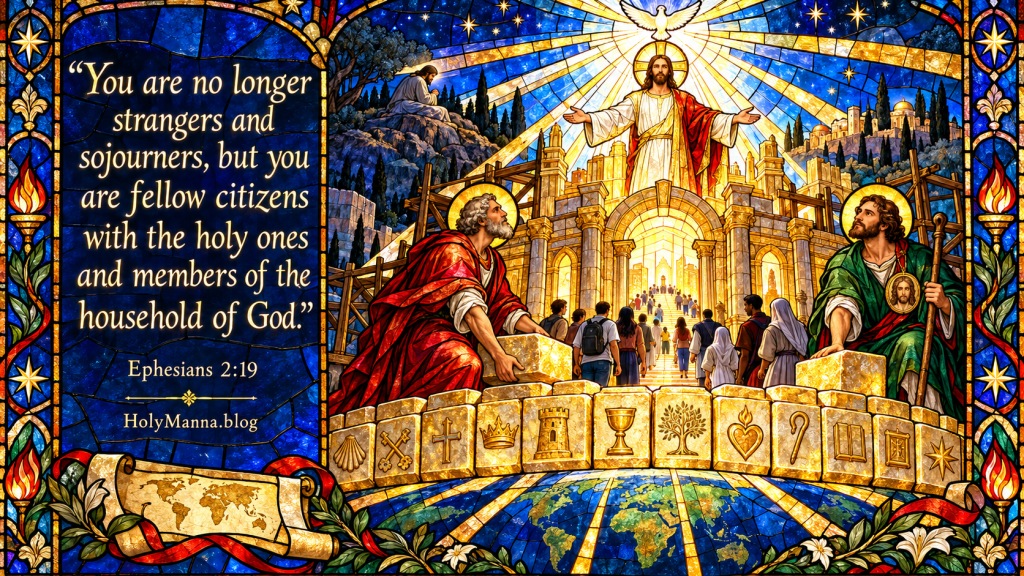
Feast of Saints Simon and Jude, Apostles – Lectionary: 666
A Church Built in the Dark of Night
Every great building has a story hidden in its foundation, and the Church is no exception. On October 28th, the Church celebrates the Feast of Saints Simon and Jude, two Apostles so hidden that Scripture records almost nothing about them beyond their names. Simon carries the title Zealot, a man once burning with passion for Israel. Jude, called Thaddaeus, is remembered for a single question at the Last Supper and a short letter near the end of the New Testament. They are celebrated together because ancient tradition holds that they preached the Gospel side by side and were martyred together in Persia, and because their relics have long been venerated together in Rome, where they rest today beneath the altar of Saint Joseph in Saint Peter’s Basilica.
The readings for this feast form one magnificent picture. Saint Paul tells the Ephesians that they are no longer strangers but members of the household of God, built upon the foundation of the Apostles and prophets with Christ as the capstone. Psalm 19 sings of a message that resounds through all the earth, words the Church has always applied to the preaching of the Apostles. Then The Gospel of Luke pulls back the curtain on the night it all began, when Jesus prayed until dawn and then chose twelve ordinary men.
The central theme uniting these readings is this: the Church is not a human project but God’s own building, founded in prayer, raised on the Apostles, held together by Christ, and still growing until its message reaches the ends of the world. Simon and Jude prove that God loves to build with stones the world overlooks.
First Reading — Ephesians 2:19-22
From Outsiders to Family: God’s Blueprint for His Church
Saint Paul wrote to the Church at Ephesus, a wealthy port city in Asia Minor famous for the Temple of Artemis, one of the seven wonders of the ancient world. The Christians there were mostly Gentile converts, people who had grown up outside the covenant of Israel. In the Jerusalem Temple, a literal stone barrier separated the Court of the Gentiles from the inner courts, and crossing it meant death. Earlier in this same chapter, Paul announces that Christ broke down the dividing wall of enmity between Jew and Gentile through His Cross (Ephesians 2:14). The verses proclaimed on this feast are the glorious conclusion of that argument. Paul takes the two greatest images of belonging in the ancient world, citizenship and family, then adds a third, the temple, and declares that in Christ the Gentiles now possess all three. On the Feast of Saints Simon and Jude, the Church proclaims this passage because it names the Apostles as the very foundation stones of this new temple, which is the heart of the day’s central theme.
Ephesians 2:19-22
Brothers and sisters:
You are no longer strangers and sojourners,
but you are fellow citizens with the holy ones
and members of the household of God,
built upon the foundation of the Apostles and prophets,
with Christ Jesus himself as the capstone.
Through him the whole structure is held together
and grows into a temple sacred in the Lord;
in him you also are being built together
into a dwelling place of God in the Spirit.
Detailed Exegesis
Verse 19: “You are no longer strangers and sojourners, but you are fellow citizens with the holy ones and members of the household of God.”
In the Roman world, a stranger had no rights and a sojourner was a resident alien, tolerated but never belonging. Paul declares that status abolished. Through Baptism, the Gentile believer becomes a full citizen of God’s people and, even more intimately, a member of God’s own household. The phrase the holy ones reaches beyond the local congregation to the whole communion of saints, meaning every baptized believer now shares a home with patriarchs, prophets, Apostles, and martyrs. Belonging to the Church is not a membership card; it is adoption into a family.
Verse 20: “Built upon the foundation of the Apostles and prophets, with Christ Jesus himself as the capstone.”
Here the imagery shifts from household to construction site. The Apostles and prophets form the foundation because they are the authorized witnesses of God’s revelation, the prophets preparing for Christ and the Apostles testifying to Him. The word rendered capstone, often translated cornerstone, points to the one stone that determines the alignment of the entire structure. Christ is the measure against which every stone is set. This verse is why the Creed calls the Church apostolic, and it echoes Revelation 21:14, where the heavenly city’s wall rests on twelve courses of stones bearing the twelve names of the twelve apostles of the Lamb. Simon and Jude, hidden as they seem, are load-bearing stones.
Verse 21: “Through him the whole structure is held together and grows into a temple sacred in the Lord.”
Paul says something no architect could say about an ordinary building: this one grows. The Church is a living temple, expanding across centuries and continents, yet it holds together only through him. Remove Christ and the structure collapses into rubble, a lesson every age of Church history has confirmed. The unity of the Church is not organizational efficiency; it is a Person.
Verse 22: “In him you also are being built together into a dwelling place of God in the Spirit.”
The passage ends with astonishing intimacy. The purpose of the whole construction is that God Himself would dwell within His people. What the Jerusalem Temple foreshadowed, the Church fulfills, and each believer is being built in, present tense, stone by stone. Notice also the Trinitarian shape of the verse: in Christ, as God’s dwelling, through the Spirit.
Teachings
The Catechism of the Catholic Church gathers this temple imagery into its teaching on the Church. In CCC 756, drawing on the Second Vatican Council, the Church teaches: “On this foundation the Church is built by the apostles and from it the Church receives solidity and unity. This edifice has many names to describe it: the house of God in which his family dwells; the household of God in the Spirit; the dwelling-place of God among men; and, especially, the holy temple.” The same paragraph adds: “As living stones we here on earth are built into it.” In CCC 857, the Catechism explains that the Church is apostolic because “she was and remains built on ‘the foundation of the Apostles’” and because “with the help of the Spirit dwelling in her, the Church keeps and hands on the teaching, the ‘good deposit’, the salutary words she has heard from the Apostles.”
Saint John Chrysostom, Doctor of the Church, preached on this very passage in his Homily 6 on Ephesians. Marveling that Gentile converts received instantly what Israel awaited for centuries, he told his congregation: “The very thing which they at the first had, by means of so many toils and troubles, has been for you accomplished by the grace of God.” On the purpose of the temple, he added simply: “It is that God may dwell in this temple.” Centuries later, Pope Francis, teaching on this same passage in his General Audience of October 16th, 2013, concluded: “The Church is apostolic because she is sent to bring the Gospel to all the world.” Simon and Jude lived that sentence to the point of shedding their blood.
Reflection
Many people today feel like strangers and sojourners, scrolling through life without a place that truly claims them. This reading insists that in the Church you are not a guest; you are family, and the house was built to hold you. Living this out can be wonderfully concrete. Register at a parish instead of drifting between them, because citizens have an address. Learn the faith handed down from the Apostles by reading the Catechism a few paragraphs at a time, because a stone needs to know its foundation. Let yourself be built together with others by joining a small group, a ministry, or simply by staying ten minutes after Mass to meet the people who share your pew.
Where in your life do you still act like a stranger in God’s house rather than a son or daughter? Is your faith resting on the foundation of the Apostles, or on opinions gathered along the way? What is one way this week that you could help another person feel less like a sojourner and more like family?
Responsorial Psalm — Psalm 19:2-5
A Sermon Without Words That Reaches Every Shore
Psalm 19 is attributed to David and opens with one of the most beloved images in all of Scripture: creation itself as a preacher. In the ancient Near East, Israel’s neighbors worshiped the sun, the moon, and the stars as gods. David turns that entire worldview on its head. The heavens are not gods; they are heralds, and their silent testimony proclaims the glory of the one God who made them. The Church places this psalm on the feasts of Apostles for a profound reason. In Romans 10:18, Saint Paul quotes this very psalm to describe the preaching of the Gospel: “But I ask, did they not hear? Certainly they did; for ‘Their voice has gone forth to all the earth, and their words to the ends of the world.’” Under the inspiration of the Holy Spirit, Paul reads the psalm as a prophecy of the apostolic mission. What the stars do by their beauty, the Apostles do by their preaching. The response sung at Mass, their message goes out through all the earth, becomes on this feast a description of Simon and Jude themselves, which ties the psalm directly to the day’s central theme of a Church whose message is still spreading.
Psalm 19:2-5
R. (5a) Their message goes out through all the earth.
The heavens declare the glory of God,
and the firmament proclaims his handiwork.
Day pours out the word to day,
and night to night imparts knowledge.
R. Their message goes out through all the earth.
Not a word nor a discourse
whose voice is not heard;
Through all the earth their voice resounds,
and to the ends of the world, their message.
R. Their message goes out through all the earth.
Detailed Exegesis
Verse 2: “The heavens declare the glory of God, and the firmament proclaims his handiwork.”
The verbs are present tense and continuous. The heavens are declaring right now, in an unbroken liturgy that began at creation. The firmament, the vast dome of sky above, functions like a cathedral ceiling painted by God Himself. No one needs a degree to read this sermon; a sunset over the Gulf or a clear night far from city lights preaches it to every human heart. This natural knowledge of God is real, yet it points beyond itself, preparing the soul for the fuller word that comes through revelation.
Verse 3: “Day pours out the word to day, and night to night imparts knowledge.”
The image is a relay. Each day hands the message to the next day, each night to the next night, so that the proclamation never pauses. There is something deeply apostolic in that picture. The faith is not reinvented by each generation; it is handed on, day to day, century to century, from the Apostles to their successors down to the present hour. Tradition, in the Catholic sense, is exactly this unbroken handing over of the word.
Verse 4: “Not a word nor a discourse whose voice is not heard.”
Here is the beautiful paradox of the psalm. The heavens have no vocal cords, no language, no audible speech, and yet their voice is heard everywhere. Their eloquence is their existence. The verse quietly rebukes the excuse that God has left anyone without a witness, a point Paul makes forcefully in Romans 1:20. It also consoles anyone who feels unqualified to evangelize. A faithful life, like the silent heavens, can preach without saying a word.
Verse 5: “Through all the earth their voice resounds, and to the ends of the world, their message.”
This is the verse Paul seizes in Romans 10:18 and applies to the Apostles. The message knows no border, no language barrier, no boundary of culture or class. For Simon and Jude, this verse reads almost like a biography. Tradition holds that their preaching carried them far beyond Israel, through Egypt and Mesopotamia and into Persia, quite literally toward the ends of the world as they knew it. The psalm that began with stars ends as a map of the missions.
Teachings
Saint Augustine, Doctor of the Church, read this psalm as a portrait of the Church’s first preachers. In his Exposition on Psalm 19, he wrote: “The righteous Evangelists, in whom, as in the heavens, God dwells, set forth the glory of our Lord Jesus Christ, or the glory wherewith the Son glorified the Father upon earth.” For Augustine, the heavens of the psalm are the holy messengers of the Gospel. God dwells in them as He dwells in the skies, and through them His glory becomes visible to the world below. That interpretation transforms the psalm from a poem about nature into a prophecy about people, and on this feast, about two people in particular. Simon and Jude left no books of their own apart from the short letter attributed to Jude, no famous sermons, no dramatic conversion stories recorded in Scripture. Yet their voice resounds through all the earth, because the Churches they planted, the believers they baptized, and the blood they shed became part of the living structure Paul described in the First Reading. The Church still sings their message at every Mass offered from Houston to Hong Kong, which is a louder echo than any of history’s forgotten emperors can claim.
Reflection
This psalm invites a double examination. First, look up. When was the last time the night sky actually stopped you? Modern life buries the oldest sermon in the world under screens and schedules. A simple practice, stepping outside for five minutes each evening to look at the sky and thank God for one specific thing, retrains the soul to hear creation’s voice. Second, look outward. The message that went out through all the earth now travels through ordinary believers, through a text to a struggling friend, a word of faith at the office, grace said openly in a restaurant. The relay of day to day continues through you or it pauses with you.
What is one place in creation where you most easily sense the glory of God, and when will you return to it this week? If your life were the only sermon someone ever heard, what would it declare? Who is one person at the ends of your own world, distant, difficult, or forgotten, whom God may be asking you to reach?
Holy Gospel — Luke 6:12-16
A Night of Prayer and Twelve Unlikely Names
Saint Luke places this scene at a turning point. In the verses just before, the scribes and Pharisees, enraged by a Sabbath healing, began discussing what they might do to Jesus (Luke 6:11). Opposition is rising, and the shadow of the Cross has appeared on the horizon. What does Jesus do? He climbs a mountain and prays through the night. In Scripture, the mountain is where God meets His people, from Sinai to Zion, so Luke is signaling that something covenantal is about to happen. At dawn, Jesus chooses twelve men, a number no Jewish listener could miss. Israel was founded on twelve tribes; the new Israel, the Church, will be founded on twelve Apostles. Among those names stand Simon the Zealot and Judas the son of James, the Jude Thaddaeus honored on this feast. This Gospel is the day’s central theme caught in the act: the foundation stones of the temple from the First Reading are being selected, and the messengers of Psalm 19 are receiving their call.
Luke 6:12-16
Jesus went up to the mountain to pray,
and he spent the night in prayer to God.
When day came, he called his disciples to himself,
and from them he chose Twelve, whom he also named Apostles:
Simon, whom he named Peter, and his brother Andrew,
James, John, Philip, Bartholomew, Matthew,
Thomas, James the son of Alphaeus,
Simon who was called a Zealot,
and Judas the son of James,
and Judas Iscariot, who became a traitor.
Detailed Exegesis
Verse 12: “Jesus went up to the mountain to pray, and he spent the night in prayer to God.”
Luke, more than any other evangelist, shows Jesus praying before every decisive moment, and nowhere is the detail more striking than here. The eternal Son, who knows the Father perfectly, still spends an entire night in prayer before choosing the Twelve. The lesson lands hard in an age of instant decisions. The most important choices of the Church’s history were not made by committee or by algorithm but on a mountainside in the dark, in communion with the Father.
Verse 13: “When day came, he called his disciples to himself, and from them he chose Twelve, whom he also named Apostles.”
Three movements hide in one verse. Jesus calls, Jesus chooses, Jesus names. A disciple is a learner; an apostle, from the Greek apostolos, is one who is sent with the full authority of the sender, like an ambassador. The initiative belongs entirely to Christ. None of the Twelve applied for the position, which remains true of every authentic vocation. The naming matters too, because in Scripture the one who names holds authority and confers mission, as when God renamed Abram and Jacob.
Verse 14: “Simon, whom he named Peter, and his brother Andrew, James, John, Philip, Bartholomew.”
Peter stands first in every biblical list of the Apostles, a quiet testimony to the primacy Christ gave him. The list then unfolds in pairs and brothers, fishermen and friends, a reminder that Jesus builds His Church out of existing human bonds rather than erasing them.
Verse 15: “Matthew, Thomas, James the son of Alphaeus, Simon who was called a Zealot.”
Here the list becomes almost scandalous. Matthew had collected taxes for Rome, the occupying power. Simon bears the title Zealot, marking him as a man of burning, even revolutionary, devotion to Jewish identity and the Law. In any other setting, these two men would have been enemies. At the same table of Jesus, they became brothers, and both died as His witnesses. The Church has never been a gathering of the like-minded; it is a communion of the differently wounded, healed by the same Lord.
Verse 16: “And Judas the son of James, and Judas Iscariot, who became a traitor.”
Two men named Judas close the list, and their destinies could not stand further apart. Judas the son of James, Jude Thaddaeus, remained faithful to the end and is now invoked by millions. Judas Iscariot became a traitor, and Luke’s word choice is merciful and terrifying at once. He was not created a traitor; he became one, by degrees, through freedom misused. Because the faithful Jude shared a name with the betrayer, Christians long hesitated to invoke him, and a tradition grew of turning to him only when every other hope had failed. From that history comes his beloved patronage as the saint of hopeless causes.
Teachings
The Catechism of the Catholic Church points directly to this scene when it teaches on the prayer of Jesus. In CCC 2600, the Church teaches: “He also prays before the decisive moments involving the mission of his apostles: at his election and call of the Twelve, before Peter’s confession of him as ‘the Christ of God,’ and again that the faith of the chief of the Apostles may not fail when tempted.” The same paragraph concludes: “Jesus’ prayer before the events of salvation that the Father has asked him to fulfill is a humble and trusting commitment of his human will to the loving will of the Father.”
Pope Benedict XVI devoted his General Audience of October 11th, 2006 to Simon and Jude, and drew out the meaning of their presence in this list. Reflecting on how the Zealot and the tax collector could share one calling, he said: “It was people who interested him, not social classes or labels!” He continued that despite their differences the Twelve lived side by side, because “what bound them together was Jesus himself, in whom they all found themselves united with one another.” Then he added: “the group of the Twelve is the prefiguration of the Church, where there must be room for all charisms, peoples and races, all human qualities that find their composition and unity in communion with Jesus.” Pope Francis, teaching on this same passage in his General Audience of June 2nd, 2021, pressed the point home personally: “We must be aware of this: Jesus prays for me.”
As for what became of these two Apostles, Scripture falls silent, and tradition takes up the story. The Church’s ancient tradition, echoed in the Roman Martyrology, holds that Simon preached the Gospel in Egypt and Jude in Mesopotamia, and that the two then entered Persia together, converted a great multitude, and were martyred there. Later tradition depicts Jude killed with a club and Simon with a saw, which is why sacred art gives them those emblems. Their relics were brought to Rome and rest together beneath the altar of Saint Joseph in Saint Peter’s Basilica, two hidden Apostles honored at the heart of the Church they helped to found.
Reflection
This Gospel offers a simple rule of life: big decisions deserve real prayer. Before the job change, the relationship decision, the major purchase, give God the first word, not the last-minute sign-off. Try a concrete version of the mountain this week by taking one unhurried hour, phone silenced, before the Blessed Sacrament or in a quiet room, and laying one pending decision before the Father. This Gospel also asks for honesty about the Matthews and Simons in your own life, the people whose politics, personality, or past put them on the other side of your invisible wall. Jesus put such men in one apostolic band and bound them together in Himself.
What decision are you currently making faster than you are praying about it? Who is the Zealot or the tax collector in your life, and what would it cost you to share a table with them? Jude remained faithful while another Judas fell; what small daily choices are forming the person you are becoming?
The House Is Still Rising
Step back and look at what this feast has built. It began on a dark mountainside, where Jesus spent the whole night in prayer before calling twelve ordinary men by name. It continued in Saint Paul’s soaring vision of a temple founded on those same Apostles, held together by Christ the capstone, growing stone by living stone into a dwelling place of God. And over it all, Psalm 19 kept singing that the message has gone out through all the earth, a line that reads like the travel log of Simon and Jude, who carried the Gospel, according to ancient tradition, all the way to Persia and sealed it with their blood.
Here is the wonder of October 28th: almost nothing is known about these two men, and yet the Church stands on them. Heaven, it turns out, keeps better records than history does. The same Lord who prayed all night before choosing them still chooses, still calls people by name, still sets unlikely stones side by side and binds them together in Himself. The house He began on that mountain is still rising, and there is room in its walls for every seeker, every skeptic, every weary soul who feels like a stranger.
So take the lesson of the hidden Apostles into the week ahead. Pray before deciding. Hand the faith on, day to day, like the heavens in the psalm. Love the person on the other side of the wall. And when a cause looks hopeless, remember the man whose name was almost forgotten, Saint Jude, and ask for his prayers. In the words of Pope Benedict XVI, “may both Simon the Cananaean and Jude Thaddeus help us to rediscover the beauty of the Christian faith ever anew and to live it without tiring, knowing how to bear a strong and at the same time peaceful witness to it.”
Engage With Us!
The conversation does not end here, and honestly, the best part of this little corner of the internet is hearing how God is working in your life. Share your reflections in the comments below. Which reading spoke to you most on this Feast of Saints Simon and Jude? Here are a few questions to pray with and respond to:
- In Ephesians 2:19-22, Saint Paul says believers are no longer strangers and sojourners but members of the household of God. Where do you still feel like a stranger in the Church, and what is one step you could take this week toward belonging more fully?
- In Psalm 19:2-5, creation preaches without a single word and its message reaches the ends of the world. What does your life, apart from anything you say, currently declare about God?
- In Luke 6:12-16, Jesus prays through the night and then chooses twelve very different men, including Simon the Zealot and Jude. What major decision in your life needs a night on the mountain, and who is the unlikely person Jesus may be asking you to welcome?
- Taking all the readings together, God builds His Church on hidden, ordinary people whose message still resounds across the earth. If God wants to build something through your hidden, ordinary faithfulness, what might it be?
Drop a comment, even a short one, because your witness might be exactly what another reader needs today. Keep showing up, keep praying before the big decisions, and keep handing on the faith one day at a time. Live this week with the love and mercy Jesus taught, and like Saints Simon and Jude, let your quiet faithfulness carry His message farther than you will ever see. God bless you, and see you tomorrow!
Sacred Heart of Jesus, we trust in You!
Immaculate Heart of Mary, pray for us!
Saint Michael the Archangel, defend us in battle!
Follow us on YouTube, TikTok, Instagram and Facebook for more insights and reflections on living a faith-filled life.


Leave a Reply