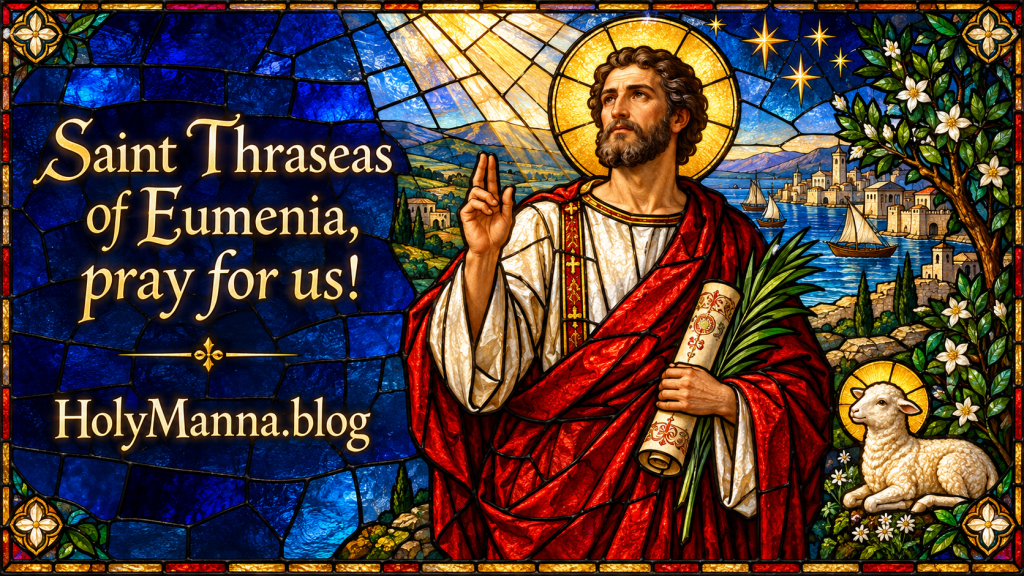
The Bishop History Almost Forgot
Some saints fill entire libraries. Saint Thraseas of Eumenia fills a few precious sentences, and those sentences have carried his name across more than eighteen centuries. He was a bishop in Roman Phrygia during the second century, one of the earliest generations of successors to the Apostles, and he died a martyr at Smyrna, the same city where his older contemporary Saint Polycarp had been burned for the faith. The Church has never stopped commemorating him. The current Roman Martyrology remembers him on October 27th with a single, dense line: “At Smyrna in Asia, Saint Thraseas, bishop of Eumenia in Phrygia and martyr.”
What makes Thraseas remarkable is who remembered him and why. Around the year 190, Polycrates, the bishop of Ephesus, wrote a letter to Pope Victor I in Rome defending the ancient Paschal custom of the churches of Asia. To prove that this custom came from the Apostles themselves, Polycrates named the holiest men Asia had ever produced, the ones whose witness no one could question. He named Philip, one of the Twelve. He named John, the Beloved Disciple who reclined on the breast of the Lord. He named Polycarp, bishop and martyr of Smyrna. And in that same breath, in that same company, he named Thraseas. Eusebius of Caesarea preserved the letter in his Ecclesiastical History, and so a country bishop from a Phrygian valley stands forever listed among the Apostles and the greatest martyrs of the early Church.
Thraseas holds no documented patronage, no shrine, and no surviving relics. What he holds instead is something the modern world desperately needs to see again: proof that a life of quiet, stubborn fidelity, lived far from the centers of power, can echo through eternity. The Catechism teaches that “martyrdom is the supreme witness given to the truth of the faith: it means bearing witness even unto death” (CCC 2473). Thraseas gave that witness, and the Church still speaks his name.
Roots in a Phrygian Valley
Nothing is documented about Thraseas’s birth, his family, or the path that led him to Christ and to the episcopate. The honest historian must say so plainly, and HolyManna will not invent what God has chosen to keep hidden. What can be known with confidence is the world he shepherded. Eumenia was a real and prosperous city, founded in the second century before Christ by King Attalus II Philadelphus of Pergamum, who named it after his brother Eumenes. It sat in the region of Phrygia, in the heart of western Asia Minor, near the sources of the river Cludrus in what is today the countryside of Turkey. The Catholic Encyclopedia notes that numerous inscriptions and coins survive from Eumenia, showing a thriving city under Roman rule, and that by the third century its population was in great part Christian.
That last detail deserves a pause. Phrygia was not evangelized by accident. Within a few generations of the Resurrection, the Gospel had taken such deep root in this inland region that whole towns leaned Christian, and Eumenia became famous for it. Bishops do not inherit flourishing churches; they build them, defend them, and water them with their sweat and often their blood. Thraseas governed the church of Eumenia in the generation when that transformation was underway, during the reigns of Antoninus Pius and Marcus Aurelius, when confessing Christ could cost a man everything. The faith of third-century Eumenia was the harvest of second-century shepherds like him.
His formation, whatever its details, placed him squarely within the living apostolic tradition of Asia. The churches of that province traced their customs directly to Saint John and Saint Philip, who had both ministered and died in Asia Minor. Thraseas was formed by men who had been formed by men who had seen the Lord. This is exactly the pattern the Catechism describes: “In order that the full and living Gospel might always be preserved in the Church the apostles left bishops as their successors. They gave them their own position of teaching authority” (CCC 77). Thraseas was not a religious entrepreneur with a personal brand. He was a link in a chain, and he knew it.
Guarding What Was Handed Down
Why should anyone remember a bishop about whom so little survives? Because the little that survives reveals a man defined entirely by faithfulness, and faithfulness is the whole job description of a Christian. Two episodes from the historical record show what kind of shepherd Thraseas was.
The first concerns the date of Easter. The churches of Asia, following what they had received from Saint John, celebrated the Pascha of the Lord on the fourteenth day of the month of Nisan, the day of the Jewish Passover, whatever day of the week it fell on. Rome and most of the rest of the world kept the feast on the following Sunday. The question of which custom should prevail grew into one of the first great disputes of the universal Church, and it was in defending Asia’s practice that Polycrates wrote to Pope Victor. His words still burn with conviction: “We observe the exact day; neither adding, nor taking away. For in Asia also great lights have fallen asleep, which shall rise again on the day of the Lord’s coming, when he shall come with glory from heaven, and shall seek out all the saints” (Eusebius, Ecclesiastical History, Book V, Chapter 24). Among those great lights, after Polycarp, he named this saint directly: “and Thraseas, bishop and martyr from Eumenia, who fell asleep in Smyrna.”
Catholics today should read this carefully. The Church, through the See of Peter, ultimately settled the question in favor of the Sunday celebration, and every Catholic now rightly keeps Easter on Sunday. Thraseas is not honored because his liturgical calendar won; it did not. He is honored because his instinct was right: hold fast to what the Apostles handed down, and never treat sacred tradition as negotiable or disposable. Saint Paul commanded exactly this: “So then, brethren, stand firm and hold to the traditions which you were taught by us, either by word of mouth or by letter” (2 Thessalonians 2:15). The Catechism echoes him, teaching that the apostolic preaching “was to be preserved by a continuous line of succession until the end of time” (CCC 77). Thraseas lived and died inside that conviction.
The second episode concerns heresy. In Thraseas’s own Phrygia, a man named Montanus began claiming that the Holy Spirit was speaking new revelations through him and through two prophetesses, Priscilla and Maximilla. The movement, which the early writers called the Phrygian heresy, was emotional, impressive, and spreading fast. The bishops of Asia examined it, judged it a false prophecy, and cut it off from the communion of the Church. The Catholic writer Apollonius of Ephesus, composing his refutation of the Montanists around the year 197, pointed to the true martyrs of the previous generation as the standard against which the sect’s counterfeit claims collapsed, and Eusebius records that in doing so Apollonius “mentions also a certain Thraseas among the martyrs of that time” (Ecclesiastical History, Book V, Chapter 18). In the memory of the early Church, Thraseas stood on the side of sober, apostolic truth against spiritual novelty and manipulation. Scripture had already given the charge he fulfilled: “contend for the faith which was once for all delivered to the saints” (Jude 1:3).
No miracles worked by Thraseas during his lifetime are recorded anywhere, and none will be invented here. His documented wonder was of another kind: he kept the faith whole in an age of persecution and confusion, which may be the most underrated miracle there is.
Faithful unto Death at Smyrna
Thraseas shepherded his flock in one of the most dangerous eras the early Church ever faced. Under Marcus Aurelius, persecution flared viciously across the empire; this is the same period that produced the martyrs of Lyons and the aged Polycarp’s death in the stadium of Smyrna. A Christian bishop in Asia Minor lived with the constant knowledge that a mob’s anger or a governor’s decree could end his life. Thraseas did not flee, did not soften his preaching, and did not disappear into safety. He kept serving.
The sources agree on where his road ended. Though his see was Eumenia, Thraseas was arrested and martyred at Smyrna, the great port city on the Aegean coast, the same church to which the Lord Himself had spoken in the Apocalypse of Saint John: “Do not fear what you are about to suffer… Be faithful unto death, and I will give you the crown of life” (Revelation 2:10). It is hard to imagine a more fitting place for a bishop of Asia to die. The older Roman Martyrology summarized his end in words the Church repeated for centuries on October 5th: “blessed Thraseas, bishop of Eumenia, who ended his career by martyrdom at Smyrna.”
The exact year is uncertain, and honesty requires saying so. Polycrates lists Thraseas between Polycarp, who died around 155, and Sagaris of Laodicea, who died around 166 to 167, which has led some scholars to place his martyrdom near the year 160. Other Catholic sources and the annotations of the traditional Martyrology place his death around 170 or 171, under Marcus Aurelius. The manner of his death is likewise not recorded; no authentic acts of his martyrdom survive. What is certain, because the whole early Church testified to it, is the fact itself: Thraseas confessed Christ before his persecutors and paid for that confession with his life. Polycrates’s phrase for his death is itself a small catechism: he “fell asleep in Smyrna.” For the Christian, even a violent death is a falling asleep in Christ, awaiting the Resurrection. The Catechism teaches that the martyr “bears witness to Christ who died and rose, to whom he is united by charity” and “endures death through an act of fortitude” (CCC 2473).
A Myrtle Tree Over a Martyr’s Grave
After his martyrdom, the Christians of Smyrna buried Thraseas among their own. An ancient text known as The Life of Polycarp, written in Smyrna in the third or early fourth century, preserves the memory of his resting place. It recounts that Boukolos, the bishop of Smyrna who preceded Polycarp, lay buried in the Christian cemetery before the Ephesian Royal gate, and that Thraseas the martyr was later buried near that same spot. The text then adds a tender detail: after the burial of the body of Thraseas, a myrtle tree sprang up at the site. The early Christians seem to have seen in that tree a quiet sign of grace, as if creation itself marked the ground where a martyr slept, green and living above a body awaiting resurrection. This story comes from a hagiographical tradition written generations after the events it describes, and it cannot be verified.
Beyond that single tradition, no miracles, healings, or interventions attributed to Saint Thraseas after death are recorded. No relics are known to survive, and no shrine or pilgrimage dedicated to him exists today. His cemetery lay in ancient Smyrna, which is the modern Turkish city of İzmir, where the visible traces of the early Christian burial grounds have long since vanished beneath centuries of history.
And yet his veneration never died, which is its own kind of marvel. The Latin Church carried his name in the Roman Martyrology for century after century, and when the Martyrology was revised after the Second Vatican Council, his commemoration was retained and now stands on October 27th. The Eastern Orthodox Church venerates him as well. A man with no shrine, no relics, and no surviving writings is still prayed with and honored by the universal Church more than eighteen hundred years after his death. The Catechism explains why the Church refuses to let her martyrs fade: “It is not merely by the title of example that we cherish the memory of those in heaven; we seek, rather, that by this devotion to the exercise of fraternal charity the union of the whole Church in the Spirit may be strengthened” (CCC 957). The communion of saints does not depend on marble and gold. It depends on the Body of Christ, which forgets no one.
What a Nearly Forgotten Bishop Still Teaches
Saint Thraseas is a saint for everyone who will never be famous, which is to say, a saint for almost everyone. His life answers a question that haunts many believers between the ages of 20 and 45: does faithfulness matter if nobody sees it? Thraseas pastored a provincial town, defended an inherited tradition, resisted a fashionable spiritual movement, and died far from home. By the world’s metrics, his life left almost no data. By heaven’s metrics, he is a great light. Whose approval are you actually living for, and would your faith survive if no one ever noticed it?
His witness also speaks directly to a generation drowning in spiritual novelty. Montanism promised fresh revelations, intense experiences, and prophets with charisma. Thraseas held instead to what was handed down from the Apostles, and the Church vindicated him. Today the marketplace of ideas offers endless customized spiritualities, and the temptation to curate a personal faith is enormous. The Catechism teaches that “the Church, in her doctrine, life and worship, perpetuates and transmits to every generation all that she herself is, all that she believes” (CCC 78). Receiving the faith whole, rather than editing it, is not closed-mindedness; it is humility before a gift. Where in your own life have you been editing the faith to fit your preferences instead of letting the faith edit you?
Practically, Thraseas offers a rule of life that fits in one sentence: stay at your post. He invites the reader to keep the commitments that nobody applauds, the daily prayer, the Sunday Mass, the marriage vow, the honest work, the unglamorous service to a parish or a family. He invites the reader to learn the faith deeply enough to recognize counterfeits, perhaps by reading a section of the Catechism each week or praying slowly with The Book of Revelation, chapters 2 to 3, where the Lord addresses the churches of Thraseas’s own Asia. And he invites the reader to make friends with the martyrs, asking their intercession by name, trusting that the Church is one family across death. When the annual cycle brings his day around, the Church “proclaims the Paschal mystery” in her saints, as the Catechism says of the memorials of the martyrs (CCC 1173). If your entire legacy were reduced to a single sentence, as his was, what would you want that sentence to say?
Engage With Us!
The story of Saint Thraseas of Eumenia proves that heaven keeps perfect records even when history keeps poor ones, and HolyManna would love to hear how his quiet, unbreakable fidelity speaks to you. Share your thoughts and reflections in the comments below, and consider these questions as you pray with his memory this week.
- Saint Thraseas was remembered by others for his faithfulness rather than by any words or works of his own. Who in your life models that kind of hidden holiness, and have you ever told them?
- Thraseas held fast to the tradition he received from the Apostles even when it was contested. What part of the Church’s teaching do you find hardest to receive, and what would it look like to approach it with his humility?
- He stood firm against a movement that promised exciting new revelations. How do you test the spiritual voices, influencers, and trends competing for your attention against the teaching of the Church?
- The Lord told the church of Smyrna to be faithful unto death. What is one small, concrete act of fidelity you can commit to this week, even if no one ever sees it?
- Thraseas has no shrine and no relics, yet the Church still prays with him. How does the communion of saints change the way you think about your own mortality and legacy?
May the witness of Saint Thraseas strengthen every reader to stay at their post, to guard the faith once delivered to the saints, and to trust that God forgets nothing done for love of Him. Live this week with the courage of the martyrs and the tenderness of the Good Shepherd, and do everything, seen and unseen, with the love and mercy that Jesus taught us.
Saint Thraseas of Eumenia, pray for us!
Follow us on YouTube, TikTok, Instagram and Facebook for more insights and reflections on living a faith-filled life.


Leave a Reply