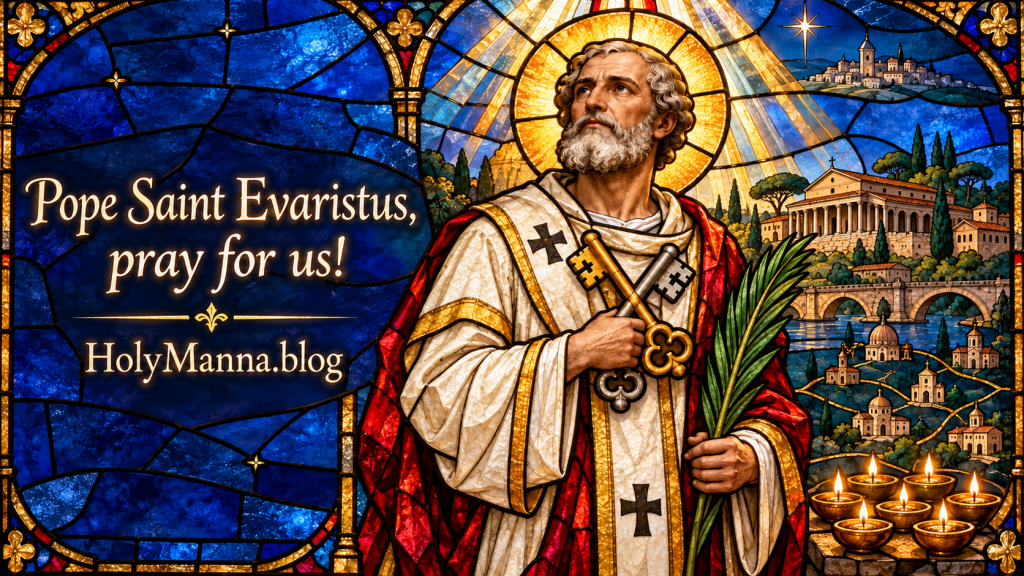
A Light Kindled at the Edge of the Apostolic Age
When Catholics today walk into a parish church, light a candle, and greet their pastor by name, they are living inside a structure so old that its first outlines reach back to a man almost no one remembers. Pope Saint Evaristus was the 5th Bishop of Rome, the 4th successor of Saint Peter, and he governed the universal Church at the turn of the 2nd century, roughly from 97 to 107 AD, in the dangerous years of the Emperor Trajan. The current Roman Martyrology commemorates him on October 27th, the traditional date of his burial near the tomb of Saint Peter, though older editions of the Martyrology and the preconciliar calendar kept his feast on October 26th, a difference worth noting honestly.
Evaristus is venerated as a martyr by a tradition stretching back to the 6th century, and he is honored as a saint not only in the Catholic Church but also among the Eastern Orthodox and Oriental Orthodox. Yet what makes him remarkable is not a dramatic biography, because history preserved almost none of his story. What makes him remarkable is his place in the unbroken chain. Saint Irenaeus of Lyons, writing within living memory of that era in Against Heresies, Book 3, Chapter 3, listed the bishops of Rome from Peter onward and recorded plainly, “To this Clement there succeeded Evaristus.” The Catechism teaches that this chain is no accident of history but the design of Christ Himself: “In order that the mission entrusted to them might be continued after their death, [the apostles] consigned, by will and testament, as it were, to their immediate collaborators the duty of completing and consolidating the work they had begun” (CCC 861). Evaristus is one of the first links in that testament, a shepherd who held the keys when holding them could cost a man his life.
A Son of Bethlehem’s Soil, A Father of Rome’s Church
Nothing certain is known about the birth or early life of Evaristus. His date of birth is unknown, and the earliest historical sources, including Eusebius of Caesarea in his Ecclesiastical History, say only that he succeeded Clement in the episcopate of the Church of Rome. Everything more personal comes from the Liber Pontificalis, the ancient book of the popes compiled in the 6th century, several hundred years after Evaristus lived. That source must therefore be received as venerable tradition rather than documented history, and this post will treat it as such throughout.
According to that tradition, Evaristus was Greek by nationality, and one version of the text adds that he was from Antioch. His father is named as a Jew called Judah, from the city of Bethlehem. If the tradition is accurate, the detail is breathtaking. The man who would one day sit in the Chair of Peter traced his blood to the little town where Christ was born, and his very household joined Jew and Greek in one family, a living image of Saint Paul’s teaching in The Letter to the Ephesians that Christ “is our peace, he who made both one and broke down the dividing wall of enmity” (Eph 2:14). The Catechism teaches that the Church herself was prepared for in the people of Israel and inaugurated by Christ for all nations (CCC 759 to 762), and the traditional family story of Evaristus reads like that doctrine written into one man’s genealogy. This account of his origins cannot be verified.
His name, Evaristus, comes from the Greek for well-pleasing, and in the 4th-century Liberian Catalogue he appears under the shortened form Aristus. The dates of his reign are reported differently across the ancient lists, and honesty requires saying so. The 2nd-century catalogues used by Saint Irenaeus and Hippolytus allow him about 8 years, from roughly 98 or 99 to about 106 or 107. Eusebius gives 8 years in one work and 9 in another. The Liberian Catalogue stretches his episcopate from 96 to 108, and the Liber Pontificalis counts 9 years, 10 months, and 2 days. The sources agree on the window; they disagree on the exact length. What no source disputes is the succession itself. Evaristus followed Clement, and Alexander followed Evaristus, exactly as Irenaeus recorded.
One more probable fact deserves wonder. Saint John the Apostle, the beloved disciple, is traditionally held to have died around the year 100 at Ephesus. If the common chronology is right, Evaristus was the Bishop of Rome when the last living Apostle went home to God. The apostolic age closed on his watch. The Church did not falter, did not scatter, and did not reinvent herself, because Christ had already provided for that moment. As the Catechism teaches, “the apostles left bishops as their successors” and “gave them their own position of teaching authority” (CCC 77). Evaristus stood in that position at the precise hour when the world could no longer run to an Apostle.
Ordering the Household of God
What is Pope Saint Evaristus most known for? Tradition answers with something quiet and enduring: he organized the Church of Rome. The Liber Pontificalis attributes to him the allotment of definite churches, called tituli, to the priests of Rome, and the division of the city into 7 regions served by deacons. A titulus was a fixed community gathered around a particular place of worship with a particular priest responsible for it. In other words, tradition credits Evaristus with the seed of what Catholics now call the parish. Butler’s Lives of the Saints goes further and notes that some have ascribed to him the remote origins of the cardinal priests of Rome, precisely because he first divided the city into titles and assigned a priest to each.
A note of scholarly honesty belongs here. The Catholic Encyclopedia observes that the Liber Pontificalis likely retrojects into the time of Evaristus an institution that developed somewhat later in the Roman Church. The attribution is ancient and venerable, but it cannot be confirmed, and it may compress a longer development into one pontificate. Even so, the tradition points to something true about this era: the generation after the Apostles had to give the Church durable, local, visible structure, and Rome remembered Evaristus as the pope who did it. The Catechism describes the fruit of that work in words every Catholic recognizes: “A parish is a definite community of the Christian faithful established on a stable basis within a particular church” entrusted to a pastor under the authority of the bishop, and it is there that the faithful “can be gathered together for the Sunday celebration of the Eucharist” (CCC 2179). Every neighborhood church with a name, a pastor, and an altar stands downstream of the instinct tradition assigns to Evaristus.
Tradition also says he appointed 7 deacons to attend the bishop, and the old accounts preserved by the Vatican’s own saint-of-the-day commemoration add a fascinating purpose: the deacons were to watch over the bishop’s preaching and the sacred liturgy, guarding the orthodoxy of what was proclaimed in an age when liturgical formulas were not yet fixed. The number 7 deliberately echoes The Acts of the Apostles, where the Apostles chose 7 men of good repute for service, and the Catechism teaches that “the diaconate is intended to help and serve” the bishops and priests, with deacons ordained “not unto the priesthood, but unto a ministry of service” (CCC 1569 to 1570). The ancient sources also report that Evaristus held 3 ordinations, though they disagree on the numbers. One line of tradition counts 17 priests, 2 deacons, and 15 bishops; another counts 15 bishops, 7 priests, and 2 deacons; Butler adds that he conferred holy orders 3 times in the month of December, in seasons set apart for fasting and prayer. The discrepancies are flagged here rather than smoothed over, because the exact figures cannot be established.
One further tradition attaches to his name. It is said that Evaristus decreed that, in accordance with apostolic tradition, marriage should be celebrated publicly and with the blessing of a priest. The claim comes from decretal letters attributed to him centuries later, and those decretals are known forgeries from the Pseudo-Isidorian collection, so the decree cannot be verified as his. Yet the content of the tradition is itself sound Catholic teaching, for the Catechism explains that “the public character of the consent protects the ‘I do’ once given and helps the spouses remain faithful to it”, which is among the reasons “the Church normally requires that the faithful contract marriage according to the ecclesiastical form” (CCC 1631). Whoever first wrote those words under his name, Rome found it fitting to remember Evaristus as a pope who wanted love sanctified in the open, before God and His Church.
Were any miracles worked through Evaristus during his lifetime? The sources record none. Not one healing, not one wonder, not one sign is attributed to him in any Catholic account. That silence is itself instructive, and it should not be filled with invention. The Catechism teaches that the Church is apostolic because she is built on a lasting foundation and “continues to be taught, sanctified, and guided by the apostles until Christ’s return, through their successors in pastoral office” (CCC 857). The miracle of Evaristus, so to speak, is the ordinary, unglamorous, world-sustaining miracle of succession and order, the Bread kept on the altar and the flock kept together while the empire sharpened its swords.
Keeping the Faith Under Trajan’s Sword
To govern the Church of Rome around the year 100 was to live under a suspended sentence. Christianity was not a legal religion. The Emperor Trajan, who reigned from 98 to 117, presided over the empire during the whole of Evaristus’s pontificate, and under Trajan the profession of the Name alone could bring a Christian to execution. It was in roughly the year 107, near the traditional end of Evaristus’s reign, that the great bishop Saint Ignatius of Antioch was taken in chains to Rome and thrown to the beasts in the arena. If the tradition of Evaristus’s Antiochene origin holds any truth, then the pope watched a bishop of his own ancestral city die for Christ in his own episcopal city. Every liturgy Evaristus celebrated, every priest he assigned to a titulus, every ordination he performed was an act carried out in the shadow of that danger.
The predecessor of Evaristus, Pope Saint Clement, is traditionally held to have died in exile, and his successor is counted among the saints as well. The early Roman Church remembered this whole line of shepherds as men who paid for the keys with their blood. So what of Evaristus himself? The tradition is ancient and firm. The Liber Pontificalis states of him, “He was crowned with martyrdom.” The old Roman Martyrology honored him as pope and martyr, and long custom has given him the martyr’s title ever since. Yet the historical record must be stated plainly: the Catholic Encyclopedia concludes that the martyrdom of Evaristus, though traditional, is not historically proven, and no account of a trial, a sentence, or a manner of death survives from antiquity. Some modern references even note that the current Martyrologium Romanum lists him without the martyr title, while other Catholic liturgical resources continue to style him pope and martyr on October 27th. The conflict is real, and it is reported here rather than hidden. The story of his martyrdom cannot be verified.
What can be said with confidence is this. Whether Evaristus died under the executioner or died worn out by a decade of shepherding a hunted flock, he lived the substance of what the Church calls martyrdom, the readiness to prefer Christ to life itself. The Catechism defines it in words that fit him either way: “Martyrdom is the supreme witness given to the truth of the faith: it means bearing witness even unto death” (CCC 2473). Every pope of that era accepted the office knowing where the road usually ended. Evaristus took the Chair of Peter not as a throne but as a post of danger, and he held it to the end. No miraculous escapes or displays of divine protection are recorded for him, and none will be invented here. His endurance was the hidden kind, the kind measured in years of fidelity rather than in a single blazing hour.
Resting Beside the Fisherman
After his death around the year 107, tradition says the Christians of Rome carried Evaristus to the Vatican Hill and buried him close to the body of Saint Peter. The Liber Pontificalis records, “He was buried close to the blessed Peter’s body on the Vatican on the 6th day before the Kalends of November,” which is October 27th, the very date on which the current Roman Martyrology now commemorates him. The Catholic Encyclopedia judges this burial notice to be among the more trustworthy statements that source makes about him. There is a quiet poetry in it. The successor was laid down beside the first of the line, the Greek son of a Bethlehem father resting near the Galilean fisherman, both waiting together for the resurrection beneath the soil where Saint Peter’s Basilica would one day rise.
Are there miracles attributed to Pope Saint Evaristus after his death? Here again honesty must govern the telling. The Catholic sources record no posthumous miracles, no healings at his tomb, no translations of relics accompanied by wonders, and no shrine tradition of cures attached to his name. Nothing of the kind can be verified, and so nothing of the kind will be claimed. His veneration took a different shape. The Roman Church inscribed his name in her lists of sainted popes, the East received him into its calendars as well, and for nearly 2,000 years the Church has counted him among the holy bishops of Rome whose fidelity carried the faith across its most fragile century.
His impact, though quiet, is enormous. Anyone who has ever prayed in Saint Peter’s Basilica has stood above the ground that tradition names as his resting place, in the greatest pilgrimage church of Christendom, built over the necropolis where Peter and his earliest successors were laid. Anyone who belongs to a parish inherits the pattern of stable local communities with their own priests that Roman tradition traces to his hands. Anyone who professes in the Creed that the Church is apostolic leans on the succession he helped carry forward, for the Catechism teaches that the pope, “Peter’s successor,” is “the perpetual and visible source and foundation of the unity both of the bishops and of the whole company of the faithful” (CCC 882). Evaristus was that foundation for his generation, and the generations never stopped building on it.
The Holiness of Being Forgotten
Pope Saint Evaristus poses a question that cuts straight at the modern heart. He held one of the most consequential offices on earth at one of its most dangerous hours, and history forgot almost everything about him. No sermons survive. No verified sayings survive. No miracle stories survive. He is a name in a list, a tradition of structure and service, and a grave beside Saint Peter. In an age that measures a life by its visibility, by followers and reach and the fear of being overlooked, Evaristus stands as proof that God measures differently. The Lord Himself promised it in The Gospel of Matthew: “Your Father who sees in secret will repay you” (Mt 6:4). How much of your faithfulness would survive if no one ever saw it or remembered it?
His life, so far as tradition preserves it, was a life of ordering, assigning, ordaining, and holding steady. There is a word for that kind of sanctity: stewardship. He did not found the Church; he received her, cared for her, structured her for the long haul, and handed her on intact. Every Catholic is called to some version of that same work. Parents hand on the faith to children. Catechists hand it on to students. Friends hand it on to friends over coffee and hard questions. The Catechism teaches that the whole Church is apostolic in this sense, that all her members “share in this mission, though in various ways” (CCC 863). What has been entrusted to you, in your family, your parish, or your friendships, that God is asking you to hand on whole?
There is also a lesson in his probable moment. If Evaristus led the Church when Saint John died, he led her through the anxiety of a closing era, the moment when no living eyewitness of the risen Lord remained on earth. The Church of 2026 knows a cousin of that anxiety, the sense of living after something, of institutions straining and certainties thinning. Evaristus answers it not with panic but with parishes, not with novelty but with fidelity to what was received. Practical imitation of him might look like this: commit deeply to one parish instead of drifting; show up for the unglamorous jobs nobody posts about; pray for priests and bishops by name, since Evaristus spent his life providing them; and celebrate the sacraments publicly and proudly, as the tradition in his name urged for marriage. Where in your own life is God calling you to choose quiet structure and steady presence over visibility and applause?
Engage With Us!
HolyManna would love to hear from you. Share your thoughts and reflections on Pope Saint Evaristus in the comments below, especially what strikes you about a saint whose greatness was almost entirely hidden. To help the conversation begin, here are a few questions to pray with this week.
- Pope Saint Evaristus is remembered for structure and succession rather than spectacular deeds. What ordinary, repeated act of faithfulness could become your own quiet legacy?
- Tradition says he gave Rome its first parishes. How could you invest more deeply in your own parish this month, with your time, your presence, or your service?
- He likely shepherded the Church as the apostolic age ended. When you feel like you are living through the end of something, where do you look for stability in your faith?
- His martyrdom is honored by tradition even though history kept no record of it. Are you willing to be faithful to Christ even if no one ever tells your story?
- The tradition under his name called for marriage to be celebrated publicly with the Church’s blessing. What would it look like for you to live your commitments more openly before God and others?
May the witness of Pope Saint Evaristus steady every heart that feels unseen. God does not need the world to remember His servants, because He forgets none of them, and the shepherd buried quietly beside Saint Peter now shares the glory of the Master he served. Go into this week resolved to be faithful in secret, generous in service, and rooted in the Church that Christ built on the Apostles. Do everything, the seen and the unseen alike, with the love and mercy that Jesus taught us.
Pope Saint Evaristus, pray for us!
Follow us on YouTube, TikTok, Instagram and Facebook for more insights and reflections on living a faith-filled life.


Leave a Reply