Tuesday of the Thirtieth Week in Ordinary Time – Lectionary: 480
The Smallest Things God Ever Planted
Some of the most important things God has ever done began so small that almost nobody noticed. A seed pressed into garden soil. A pinch of yeast folded into flour. A promise spoken between a bride and a groom. The readings for Tuesday of the Thirtieth Week in Ordinary Time, October 27th, 2026, circle around one astonishing truth: the Kingdom of God does not arrive with trumpets and headlines. It grows quietly, hidden inside ordinary life, until it transforms everything it touches.
In the First Reading from The Letter to the Ephesians, Saint Paul, writing from Roman custody around the year 60, takes the most ordinary institution of the ancient world, the household, and reveals it as a living icon of Christ’s love for His Church. In a culture where Roman law handed the father of the family nearly absolute power, Paul does something revolutionary by commanding husbands to lay down their lives. Psalm 128, one of the Songs of Ascents that pilgrims sang while climbing the road to Jerusalem, paints the fruit of that kind of love: a table ringed with children, a home where blessing takes root. And in The Gospel of Luke, Jesus answers the question every discouraged believer eventually asks, whether something so small can really be the Kingdom of God, with two tiny images, a mustard seed and a measure of leaven.
Taken together, these readings deliver one message. God’s favorite building site is the hidden place: the garden, the kitchen, the marriage, the home. Whatever begins small in His hands does not stay small.
First Reading — Ephesians 5:21-33
A Love That Looks Like the Cross
Around the year 60, Saint Paul sat in Roman custody and wrote to the church in Ephesus, a wealthy port city saturated with pagan ideas about power and honor. Greco-Roman culture had a standard literary form called the household code, which simply told wives, children, and slaves to obey the man of the house, a man who held nearly unlimited legal authority under his own roof. Paul takes that familiar form and transforms it from the inside. He begins with mutual subordination, addresses wives directly as free moral agents, and then gives husbands a command no pagan moralist ever imagined: love like a crucified God. In doing so, he reveals that marriage was never merely a social arrangement; it is a living sign of Christ and His Church, the hidden soil where the Kingdom begins to grow.
Ephesians 5:21-33
Brothers and sisters:
Be subordinate to one another out of reverence for Christ.
Wives should be subordinate to their husbands as to the Lord.
For the husband is head of his wife
just as Christ is head of the Church,
he himself the savior of the Body.
As the Church is subordinate to Christ,
so wives should be subordinate to their husbands in everything.
Husbands, love your wives,
even as Christ loved the Church
and handed himself over for her to sanctify her,
cleansing her by the bath of water with the word,
that he might present to himself the Church in splendor,
without spot or wrinkle or any such thing,
that she might be holy and without blemish.
So also husbands should love their wives as their own bodies.
He who loves his wife loves himself.
For no one hates his own flesh
but rather nourishes and cherishes it,
even as Christ does the Church,
because we are members of his Body.For this reason a man shall leave his father and his mother
and be joined to his wife,
and the two shall become one flesh.This is a great mystery,
but I speak in reference to Christ and the Church.
In any case, each one of you should love his wife as himself,
and the wife should respect her husband.
Detailed Exegesis
Verse 21: “Be subordinate to one another out of reverence for Christ.”
This single verse governs everything that follows. In the Greek text, the next verse borrows its verb from this one, so the whole passage flows out of mutual self-gift, offered out of reverence for Christ, who is present in the other person.
Verse 22: “Wives should be subordinate to their husbands as to the Lord.”
The phrase as to the Lord changes the meaning entirely. This is not servility before a superior; it is the free, trusting response of a believer to Christ, now mirrored within marriage. Paul also addresses wives directly as persons capable of moral decision, a dignity the surrounding culture rarely offered women.
Verse 23: “For the husband is head of his wife just as Christ is head of the Church, he himself the savior of the Body.”
Headship here is defined by the Head it imitates. Christ’s headship looked like washing feet, wearing thorns, and dying so that His Bride could live, and the verse immediately names Him the savior of the Body. A husband’s authority belongs to the first to serve and the first to sacrifice, never to a tyrant.
Verse 24: “As the Church is subordinate to Christ, so wives should be subordinate to their husbands in everything.”
The Church gives herself to Christ because He has already proven His love on Calvary. The phrase in everything lives inside that same logic, presuming a husband whose model is Christ and who commands nothing contrary to God. Saint Paul never imagines obedience to sin.
Verses 25-27: “Husbands, love your wives, even as Christ loved the Church and handed himself over for her to sanctify her, cleansing her by the bath of water with the word, that he might present to himself the Church in splendor, without spot or wrinkle or any such thing, that she might be holy and without blemish.”
Here stands the sentence that shattered the ancient world. No pagan household code ever commanded a husband to love his wife, let alone to die for her. The verb is a form of agape, the total, self-emptying love of the Cross. The bath of water with the word recalls the bridal bath of ancient weddings and points to Baptism itself. A husband’s mission statement is written right here: his wife’s holiness, her splendor, and her arrival in heaven.
Verse 28: “So also husbands should love their wives as their own bodies. He who loves his wife loves himself.”
The logic of one flesh means her good and his good are no longer separable; a man who serves his wife is tending the deepest part of his own life.
Verses 29-30: “For no one hates his own flesh but rather nourishes and cherishes it, even as Christ does the Church, because we are members of his Body.”
The words nourishes and cherishes carry tender, almost parental warmth. Christ nourishes His Church above all in the Eucharist, and spouses who are members of that Body draw their love from the same altar.
Verse 31: “For this reason a man shall leave his father and his mother and be joined to his wife, and the two shall become one flesh.”
Paul reaches back to Genesis 2:24, words spoken over Adam and Eve before sin ever entered the world. Marriage was built into creation itself, quietly pointing toward something greater from the very beginning.
Verse 32: “This is a great mystery, but I speak in reference to Christ and the Church.”
The Greek word is mysterion, which the Latin Vulgate renders as sacramentum magnum, a great sacrament. Every faithful marriage since Eden has been whispering about Christ and His Church, and the Church’s teaching on marriage as a true sacrament grows from this very verse.
Verse 33: “In any case, each one of you should love his wife as himself, and the wife should respect her husband.”
Paul closes with the two daily currencies of married life, love and respect, bringing grand theology home to the kitchen table.
Teachings
The Church reads this passage as the charter of the sacrament of Matrimony. CCC 1617 teaches, “The entire Christian life bears the mark of the spousal love of Christ and the Church. Already Baptism, the entry into the People of God, is a nuptial mystery; it is so to speak the nuptial bath which precedes the wedding feast, the Eucharist. Christian marriage in its turn becomes an efficacious sign, the sacrament of the covenant of Christ and the Church. Since it signifies and communicates grace, marriage between baptized persons is a true sacrament of the New Covenant.”
Saint John Chrysostom, Doctor of the Church, captured the passage’s balance in his Homily 20 on Ephesians: “You have seen the measure of obedience, hear also the measure of love. Would you have your wife obedient unto you, as the Church is to Christ? Take then yourself the same provident care for her, as Christ takes for the Church.” He adds that a wife, “the partner of one’s life, the mother of one’s children, the foundation of one’s every joy,” must never be ruled through fear but cherished through love.
Pope Saint John Paul II, in Mulieris Dignitatem 24, called this teaching an innovation of the Gospel: “Whereas in the relationship between Christ and the Church the subjection is only on the part of the Church, in the relationship between husband and wife the ‘subjection’ is not one-sided but mutual.”
Reflection
This reading is not only for the married, because every baptized person belongs to the Bride whom Christ loved unto death. For spouses, the application is concrete: perform one hidden act of service today without being asked, speak the affirming word before the correcting one, and be the first to apologize after a quarrel. For those who are single, discerning, or widowed, the same cruciform love can be practiced in friendships, families, and parishes, where it remains the seed of the Kingdom.
Who in your life is hardest to serve right now, and what would it look like to hand yourself over for that person this week? If your marriage, family, or closest friendship were an icon of Christ and His Church, what would an outsider learn about God by watching it?
Responsorial Psalm — Psalm 128:1-5
The Blessing That Begins at the Table
Psalm 128 belongs to the Songs of Ascents, the collection of Psalms 120 through 134 that Jewish pilgrims sang as they climbed the long road up to Jerusalem for the great feasts. Picture whole families on that dusty ascent, children on shoulders, grandparents leaning on staffs, all singing about what a blessed life actually looks like. It is a wisdom psalm, and its answer is striking in its simplicity. Blessedness is not found in wealth, fame, or power, but in reverence for God lived out in honest work, a faithful marriage, and a crowded family table. Jewish tradition carried this psalm into wedding celebrations, and the Church continues to offer it as a responsorial psalm in the Nuptial Mass. Placed beside Ephesians 5 in today’s liturgy, it becomes a portrait of the home that Christ-like love builds, the very soil in which the Gospel’s mustard seed is planted.
Psalm 128:1-5
R. (1a) Blessed are those who fear the Lord.
Blessed are you who fear the LORD,
who walk in his ways!
For you shall eat the fruit of your handiwork;
blessed shall you be, and favored.
R. Blessed are those who fear the Lord.
Your wife shall be like a fruitful vine
in the recesses of your home;
Your children like olive plants
around your table.
R. Blessed are those who fear the Lord.
Behold, thus is the man blessed
who fears the LORD.
The LORD bless you from Zion:
may you see the prosperity of Jerusalem
all the days of your life.
R. Blessed are those who fear the Lord.
Detailed Exegesis
Verse 1: “Blessed are you who fear the LORD, who walk in his ways!”
Fear of the LORD is not terror before a cruel master; it is the awe-filled reverence of a creature before infinite goodness, which Proverbs 9:10 calls the beginning of wisdom and which the Church numbers among the seven gifts of the Holy Spirit. The psalmist pairs that reverence with walking, a daily, step-by-step practice rather than a single dramatic moment. Blessing begins in the ordinary rhythm of a life pointed toward God.
Verse 2: “For you shall eat the fruit of your handiwork; blessed shall you be, and favored.”
Scripture dignifies ordinary labor here. The spreadsheet, the job site, the laundry pile, and the night shift all fall within God’s blessing when they are offered to Him. Work done in reverence becomes fruitful, and the worker tastes the goodness of what his own hands have done.
Verse 3: “Your wife shall be like a fruitful vine in the recesses of your home; Your children like olive plants around your table.”
The vine and the olive are not random images; they are the classic covenant symbols of Israel herself throughout the Old Testament. By hanging them over an ordinary doorway, the psalmist declares that every faithful household is the covenant in miniature. The olive adds a lesson in patience, since an olive shoot takes years of tending before it bears fruit, exactly like the slow, hidden work of raising children in the faith.
Verse 4: “Behold, thus is the man blessed who fears the LORD.”
The psalm pauses to underline its point. This, not conquest or luxury, is what blessing looks like. The world rarely photographs such a life, yet heaven calls it favored.
Verse 5: “The LORD bless you from Zion: may you see the prosperity of Jerusalem all the days of your life.”
The blessing now widens like ripples on water, flowing from the individual to the home and outward to Zion and all Jerusalem. The health of the family and the health of the people of God are bound together. Holy homes build a holy Church, and a holy Church sends blessing back into every home.
Teachings
The Church gives this household vision a beautiful name. CCC 1656 teaches, “In our own time, in a world often alien and even hostile to faith, believing families are of primary importance as centers of living, radiant faith. For this reason the Second Vatican Council, using an ancient expression, calls the family the Ecclesia domestica.” The family is a domestic church, a small outpost of the Kingdom. CCC 1657 goes further: “It is here that the father of the family, the mother, children, and all members of the family exercise the priesthood of the baptized in a privileged way ‘by the reception of the sacraments, prayer and thanksgiving, the witness of a holy life, and self-denial and active charity.’ Thus the home is the first school of Christian life and ‘a school for human enrichment.’” The table ringed with olive plants in Psalm 128 is, in the Church’s eyes, a sanctuary where the faith is first taught, first prayed, and first lived.
Reflection
The psalm invites a loving audit of the home. Does the table gather people, or do screens scatter them? Is God’s name spoken there in prayer, or only in frustration? Concrete steps make the difference: bless the food aloud at every meal, even in a restaurant; place a crucifix or an icon where the family actually lives, not where guests will admire it; pray one decade of the Rosary together each week; and offer the day’s work to God each morning so that labor itself becomes prayer. For those living alone, the same psalm applies, because a single person’s apartment can be a domestic church too, a place of order, hospitality, and prayer.
What is one habit that could make your home feel more like a little sanctuary this week? Where has God already planted quiet blessing around your table that has gone unnoticed or unthanked?
Holy Gospel — Luke 13:18-21
The Kingdom That Grows While No One Watches
Saint Luke places these two little parables on the road to Jerusalem, in the long journey that begins at Luke 9:51 and ends at the Cross. Jesus has just healed a woman crippled for eighteen years, right in the synagogue, on the Sabbath, and the synagogue leader responded with indignation while the crowd rejoiced (Luke 13:10-17). Hanging in the air is the question nobody dares to ask aloud: if the Kingdom of God has truly arrived, why does it look so small? One wandering rabbi, a handful of fishermen, one healed woman against the might of Rome and the resistance of the religious establishment hardly resembles a kingdom. Jesus answers with a seed and a lump of dough. The Kingdom does not come the way empires come. It comes the way gardens and bread come, slowly, hidden, and unstoppable, which is precisely how grace works in a marriage, a home, and a single human heart.
Luke 13:18-21
Jesus said, “What is the Kingdom of God like?
To what can I compare it?
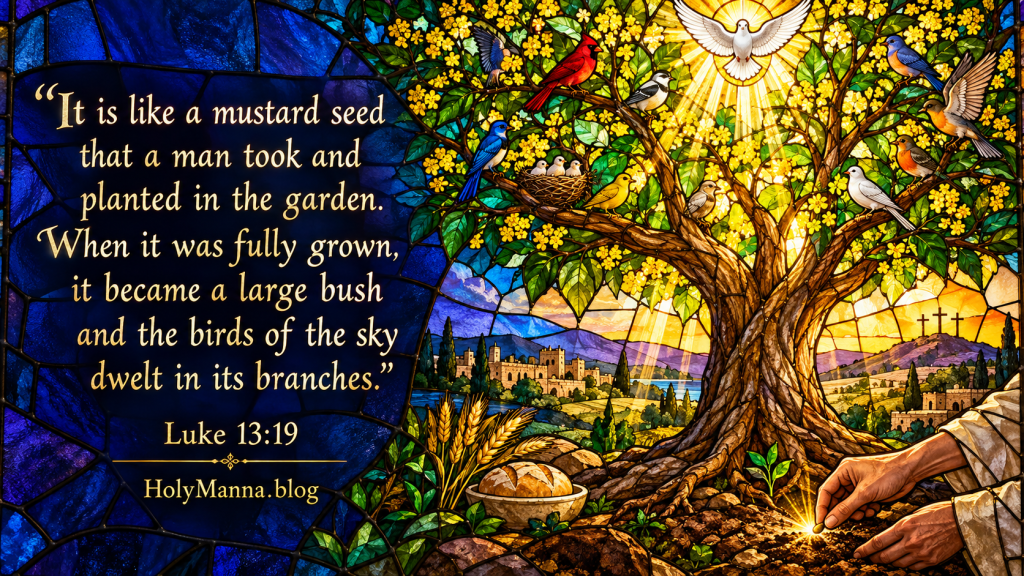
It is like a mustard seed that a man took and planted in the garden.
When it was fully grown, it became a large bush
and the birds of the sky dwelt in its branches.”Again he said, “To what shall I compare the Kingdom of God?
It is like yeast that a woman took
and mixed in with three measures of wheat flour
until the whole batch of dough was leavened.”
Detailed Exegesis
Verse 18: “Jesus said, ‘What is the Kingdom of God like? To what can I compare it?’”
Jesus opens with a doubled question, a classic rabbinic teaching device that draws listeners in and makes them lean forward. He is not thinking out loud; He is inviting the crowd, and every reader since, to wonder alongside Him. The Kingdom of God stands at the very center of His preaching in The Gospel of Luke, and here He chooses to reveal its nature not with definitions but with pictures from daily life.
Verse 19: “It is like a mustard seed that a man took and planted in the garden. When it was fully grown, it became a large bush and the birds of the sky dwelt in its branches.”
The mustard seed was proverbial in Israel as the smallest of seeds, barely a millimeter across, yet the black mustard plant of the region can tower eight to ten feet high in a single season. The man deliberately took and planted it, a quiet image of God’s intentional action in history. The birds nesting in the branches echo Ezekiel 17:23 and Daniel 4, where a great tree sheltering the birds of the air symbolizes a kingdom gathering the nations. Jesus is promising that His tiny movement will one day shelter every people on earth, a promise the worldwide Church has been fulfilling for two thousand years.
Verse 20: “Again he said, ‘To what shall I compare the Kingdom of God?’”
The repetition signals importance, and the second image forms a deliberate pair with the first. After a man in a garden comes a woman in a kitchen. Jesus consistently teaches in such pairs in The Gospel of Luke, dignifying the daily work of both men and women as windows into the mystery of God.
Verse 21: “It is like yeast that a woman took and mixed in with three measures of wheat flour until the whole batch of dough was leavened.”
The Greek verb behind mixed in literally means hid. The woman hides the yeast, and the Kingdom works the same way, invisibly transforming from within. The quantity is the real shock: three measures of flour is roughly fifty pounds, enough bread to feed well over a hundred people, and the same amount Sarah prepared when the Lord visited Abraham at Mamre in Genesis 18:6. From a pinch of leaven comes a feast for a multitude, and nothing in the batch is left untouched, for the whole of it is leavened. Grace intends to transform everything.
Teachings
The Catechism gathers these parables into its teaching on the Kingdom. CCC 543 declares, “Everyone is called to enter the kingdom. First announced to the children of Israel, this messianic kingdom is intended to accept men of all nations. To enter it, one must first accept Jesus’ word.” The birds of every sky are welcome in the branches. And CCC 2832 applies the second parable to the mission of every believer: “As leaven in the dough, the newness of the kingdom should make the earth ‘rise’ by the Spirit of Christ.”
Saint Ambrose, the great Doctor of the Church who baptized Saint Augustine, saw the deepest meaning of the seed in his Exposition of the Gospel of Luke: “The Lord Himself also is a grain of mustard seed; He wished to be bruised that we might see that we are a sweet savor of Christ.” Ambrose noticed that Christ, like the seed, was planted in a garden tomb and rose as a tree of life sheltering the world. He also tied the parable to faith itself: “If the kingdom of heaven is as a grain of mustard seed, and faith is as a grain of mustard seed, surely faith is the kingdom of heaven and the kingdom of heaven is faith. One who has faith has the kingdom.”
Reflection
Discouragement is the enemy these parables were built to defeat. Faith can feel like the smallest thing in the room, one believer in a skeptical office, one praying parent in a distracted household, one quiet rosary against a loud culture. Jesus asks for trust in the seed rather than anxiety about the harvest. Practical steps follow naturally: commit to one small, daily act of faith, such as three minutes of Scripture each morning; be leaven at work by refusing gossip and choosing visible kindness; and plant one seed of faith in conversation this week, perhaps simply telling someone about going to Mass. Then leave the growing to God, who has never once failed a seed entrusted to Him.
What small seed of faith planted in your past, perhaps by a grandmother, a teacher, or a stranger, has grown into something you now treasure? Where is God asking you to be hidden leaven right now, content to transform things quietly from within?
Where Great Things Begin
The readings for October 27th tell a single story from three angles. Saint Paul lifts the veil on marriage and shows Christ loving His Bride unto death. The psalmist stands in an ordinary doorway and sees vines, olive shoots, and the blessing of God filling a home. And Jesus, walking the road to Jerusalem, points at a seed and a lump of dough and says that this, of all things, is what the Kingdom of God is like.
The thread running through it all is that God loves to begin small. He planted His own Kingdom in a garden tomb, as Saint Ambrose so beautifully saw, and it rose as a tree sheltering the nations. He hides His grace like leaven in the ordinary flour of daily life: a faithful marriage, a blessed meal, a prayer whispered over sleeping children. The world measures greatness in noise and numbers, while heaven measures it in hidden faithfulness.
So the invitation today is simple: plant something small. Speak the gentle word at home instead of the sharp one. Serve a spouse, a parent, or a friend without waiting to be thanked. Bless the table even when the day was long. Such acts look as unimpressive as a mustard seed resting in the palm of a hand, yet Christ Himself promises what they become: a tree where others find shelter, a batch wholly leavened, a home where blessing takes root and spreads all the way to Zion. The Kingdom of God is not waiting somewhere far away. It is waiting to be planted at the nearest kitchen table, today.
Engage With Us!
The HolyManna community grows the same way the Kingdom does, one small seed at a time, and every comment planted below helps it flourish. Share a reflection, a question, or a story about how today’s readings touched your heart.
- In Ephesians, chapter 5, verses 21 to 33, Saint Paul calls spouses to mutual subordination out of reverence for Christ. Where in your closest relationships is God inviting you to serve first, love first, or forgive first?
- In Psalm 128, verses 1 to 5, blessing flows from the fear of the LORD into the home and outward to Zion. What is one concrete habit that could make your home more of a domestic church this week?
- In Luke, chapter 13, verses 18 to 21, Jesus compares the Kingdom to a mustard seed and hidden leaven. Where have you seen something small, a prayer, a kindness, or a conversation, grow into something far greater than anyone expected?
- Taking all of today’s readings together, what is one small, hidden act of love you can plant today and then trust God to grow?
Faith rarely feels dramatic in the moment. It looks like showing up, loving the people God has placed nearest, and trusting Him with the growth. Keep planting those seeds, keep kneading that leaven into daily life, and do everything with the love and mercy Jesus taught us. He delights in taking the smallest offerings and building His Kingdom out of them.
Sacred Heart of Jesus, we trust in You!
Immaculate Heart of Mary, pray for us!
Saint Michael the Archangel, defend us in battle!
Follow us on YouTube, TikTok, Instagram and Facebook for more insights and reflections on living a faith-filled life.


Leave a Reply