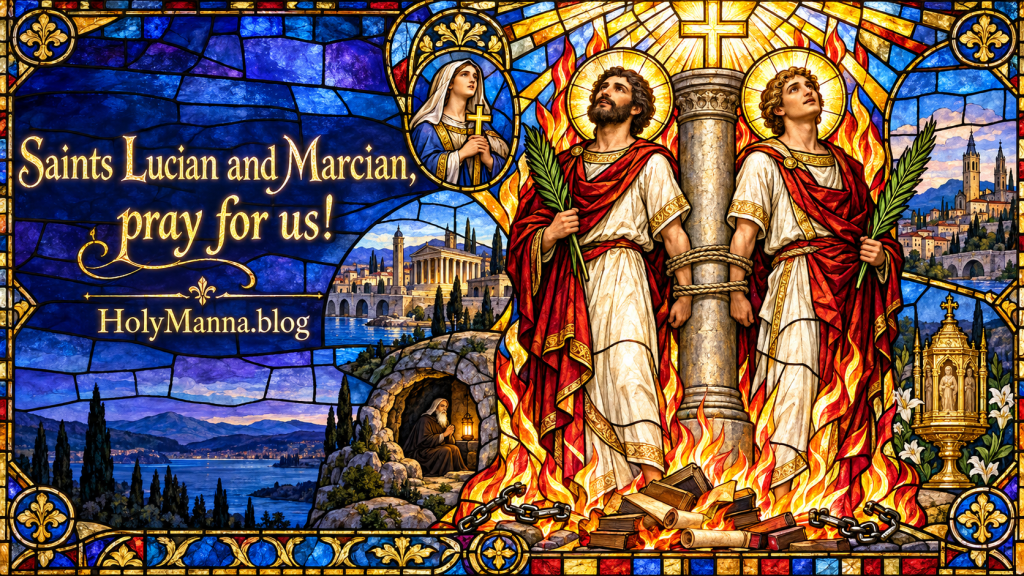
From Sorcery to Sanctity
Every generation convinces itself that it discovered the occult. Tarot decks sit next to the candy at the checkout line, astrology apps send push notifications, and “manifesting” has become a verb that millions of people use without a second thought. Yet the Church has seen all of this before, and on October 26th she holds up two men who knew the occult from the inside, mastered it, profited from it, and then threw it all into a bonfire in the middle of a public square. Saints Lucian and Marcian were professional sorcerers in the third century who became Christians, penitents, preachers, and finally martyrs, burned alive at Nicomedia rather than deny the God who had set them free. The traditional Roman Martyrology commemorates them on October 26th among the martyrs of Nicomedia who suffered in the persecution of the emperor Decius.
Their witness matters precisely because of where they started. The Catechism teaches with total clarity that “all practices of magic or sorcery, by which one attempts to tame occult powers, so as to place them at one’s service and have a supernatural power over others, even if this were for the sake of restoring their health, are gravely contrary to the virtue of religion” (CCC 2117). Lucian and Marcian lived that gravity, repented of it, and were transformed by grace into witnesses so credible that the pagans could only silence them with fire. They are venerated as the patron saints of the city of Vic in Catalonia, Spain, where their relics have been honored for centuries and where devotional songs have long hailed them as sons and patrons of the city. Their story is a standing answer to anyone who believes their past disqualifies them from holiness.
Two Magicians Meet a Power Greater Than Magic
The historical core of these saints is ancient and secure: from the early centuries, the Church’s martyrologies have commemorated martyrs named Lucian and Marcian who died for Christ at Nicomedia, the great city of Bithynia in Asia Minor, in what is today northwestern Turkey. The detailed narrative of their lives comes from their traditional acts, the account handed down and retold through sources such as The Golden Legend of Blessed Jacobus de Voragine and Butler’s Lives of the Saints. Scholars regard those acts as a later, embellished telling attached to real martyrs, so what follows should be received as the Church’s cherished tradition about them rather than as courtroom-grade documentation. The tradition itself, however, is vivid, coherent, and spiritually profound.
According to that tradition, Lucian and Marcian were pagans of Nicomedia who gave themselves to the study of the dark arts. Butler describes them as “living in the darkness of idolatry” and applying themselves to “the vain study of the black art.” They were not dabblers. They were practitioners, men who had invested their learning, their reputation, and their livelihood in the attempt to command hidden powers. The Catechism diagnoses exactly what such men were reaching for when it condemns the desire for “a supernatural power over others” (CCC 2117). Sorcery, at its root, is the hunger for control without surrender, power without worship, and results without a relationship with the living God.
The turning point of their lives, as the tradition tells it, came through a woman whose name history did not preserve. Lucian and Marcian directed their enchantments against a Christian virgin, intending to bend her will by diabolical means. Their charms failed completely. The acts say the evil spirits were defeated by the sign of the cross, the simple gesture of a baptized woman who belonged to Christ. Two professionals of the occult, confronted with a power their arts could not touch, drew the only honest conclusion available: the God of the Christians was real, and He was stronger. The tradition holds that they converted to the faith on the strength of that defeat. This episode cannot be independently verified and rests on the traditional acts alone, but the Church has never been embarrassed by it, because it preaches a truth she knows from experience. As Scripture says of Christ’s victory, He “disarmed the principalities and powers and made a public example of them, triumphing over them in him” (Colossians 2:15).
What the two men did next is the detail that has echoed for seventeen centuries. They did not quietly retire from the magic business. Butler records that “they burned their magical books in the middle of the city of Nicomedia.” It was a public renunciation, a bonfire of their own expertise in front of the neighbors and clients who knew exactly who they were. The scene deliberately mirrors the conversion of the magicians of Ephesus in The Acts of the Apostles, where “many of them who had followed curious arts, brought together their books, and burnt them before all” (Acts 19:19). Grace does not negotiate a partial surrender with the occult; it demands, and empowers, a clean and public break. Then they were baptized, and the Catechism explains what that moment accomplished in them: “By Baptism all sins are forgiven, original sin and all personal sins, as well as all punishment for sin” (CCC 1263). The sorcerers of Nicomedia stepped out of the font as new men, for “if then any be in Christ a new creature, the old things are passed away, behold all things are made new” (2 Corinthians 5:17).
The Hidden Years
What Lucian and Marcian did after baptism reveals a spiritual maturity that modern converts would do well to study. They did not immediately launch a public ministry on the strength of their dramatic testimony. According to Butler, they first “distributed their possessions among the poor, and retired together into a close solitude.” Their wealth, much of it presumably earned through sorcery, was given away. Then came years of hiddenness, silence, mortification, and prayer. Butler explains the logic of it beautifully: they withdrew so that the grace they had received might be strengthened and “fenced by rooted habits of all virtues.”
This is the ancient wisdom of the Church in miniature. The Catechism teaches that “the interior penance of the Christian can be expressed in many and various ways. Scripture and the Fathers insist above all on three forms, fasting, prayer, and almsgiving” (CCC 1434). Lucian and Marcian practiced all three before they ever preached a word. They understood that conversion is not a single lightning strike but a lifelong turning, for “Christ’s call to conversion continues to resound in the lives of Christians” and “this second conversion is an uninterrupted task for the whole Church” (CCC 1428). Two men who had spent years training their minds in darkness now spent years retraining their souls in the light.
Only after this long formation did they emerge. The tradition says they made frequent journeys out of their solitude to preach Christ to the pagans and win souls for His kingdom. Here is why these saints matter and why they deserve to be remembered and imitated. They embody the full arc of the Christian life: sin honestly faced, conversion wholeheartedly embraced, penance patiently endured, and mission courageously undertaken. The Catechism insists that this witness is not optional for any believer, because “the witness of a Christian life and good works done in a supernatural spirit have great power to draw men to the faith and to God” (CCC 2044). Their former clients and colleagues could not dismiss them. Everyone in Nicomedia knew what these two men had been, which made what they had become impossible to ignore.
Regarding miracles during their lifetime, honesty requires a plain statement. The only wonder the tradition attaches to their lives is the defeat of their own sorcery by the sign of the cross, and that episode belongs to the traditional acts and cannot be verified. No other miracles worked by them during life are recorded in the sources. Their great sign was not a healing or a prodigy; it was the public transformation of two notorious sinners into men of visible holiness, which is itself the work of God, for the Church “recognizes the power of the Spirit of holiness within her” whenever heroic virtue appears among her children (CCC 828).
The Trial and the Fire
The peace did not last, because peace rarely lasted for third-century Christians. In the year 250, the emperor Decius issued his infamous edicts requiring all inhabitants of the empire to sacrifice to the pagan gods, and the persecution reached the province of Bithynia. Lucian and Marcian, now well known as Christian preachers, were arrested and brought before the proconsul Sabinus. A note of scholarly honesty belongs here: while the Latin tradition and Butler date their martyrdom to the Decian persecution in 250, the Syriac hagiographical tradition places their deaths later, in the time of Diocletian, around the turn of the fourth century. The sources conflict, and the exact date cannot be fixed with certainty. What no source disputes is that they died at Nicomedia, by fire, for refusing to renounce Jesus Christ.
The traditional acts preserve their trial, and the dialogue deserves to be quoted in full because it contains the only sayings reliably attributed to these saints. Sabinus demanded to know by what authority Lucian presumed to preach Jesus Christ. Lucian answered, “Every man does well to endeavor to draw his brother out of a dangerous error.” It is a lawyer’s answer and a lover’s answer at once. He claimed no office and no credentials, only the duty of charity that binds every human being who has found the truth. Marcian likewise extolled the power of Christ before the court. The proconsul responded the way power usually responds to truth it cannot refute: he ordered them hung on the rack and cruelly tortured.
Even under torture, the two former sorcerers kept their wits and their irony. The acts record that they reproached the judge with a devastating observation: when they had worshipped idols and openly practiced magic, committing real crimes, Rome had never punished them; now that they had become Christians and good citizens, they were being barbarously tormented. The complaint exposes the moral absurdity of the persecution. Rome could tolerate sorcerers; it could not tolerate saints.
Sabinus threatened heavier torments, and Marcian gave the answer that became their epitaph: “We are ready to suffer, but we will never renounce the true God, lest we be cast into a fire which will never be quenched.” He was quoting his Lord’s own warning about “unquenchable fire” (Mark 9:43), and weighing one fire against another with perfect clarity. The proconsul could light a fire that burns for an hour; only God holds eternity. The Lord had prepared His martyrs for exactly this arithmetic: “And fear ye not them that kill the body, and are not able to kill the soul: but rather fear him that can destroy both soul and body in hell” (Matthew 10:28). At Marcian’s words, Sabinus condemned them both to be burned alive.
The acts close the story with a scene of staggering joy. The two men went to the place of execution not dragging their feet but rejoicing, and they died “singing hymns of praise and thanksgiving to God” amidst the flames. The men who had once tried to command spirits now surrendered their spirits to the Father, and the fire that was meant to erase them became their pulpit. The Catechism gives the Church’s definitive word on what happened that day: “Martyrdom is the supreme witness given to the truth of the faith: it means bearing witness even unto death” (CCC 2473). The martyr, the Catechism adds, “bears witness to Christ who died and rose, to whom he is united by charity” (CCC 2473). Lucian and Marcian, who had begun their adult lives seeking power over others, ended them in the most powerful act available to a human being, the free gift of everything for love of God.
From Nicomedia to Catalonia
The veneration of Lucian and Marcian did not end at the stake. Their names entered the ancient martyrologies, and the traditional Roman Martyrology has commemorated them at Nicomedia on October 26th for centuries. Regarding miracles after their death, the sources are again honest rather than abundant: no specific, documented accounts of post-mortem healings or apparitions attributed to them survive. What survives instead is something arguably more remarkable, an unbroken river of devotion that carried two Bithynian martyrs across the Mediterranean and made them the beloved patrons of a city on the other side of the known world.
That city is Vic, in the heart of Catalonia in Spain. By the Middle Ages, relics venerated as those of Saints Lucian and Marcian were enshrined there, and in the 14th century their cult received a considerable boost. A magnificent Gothic stone urn was carved in the last quarter of the 14th century to contain their relics, which were venerated in the old chapel of Sant Sadurní, later absorbed into the church of La Pietat, which still stands beside the cathedral quarter of Vic. The front of the urn, preserved today in the Museu d’Art Medieval de Vic, depicts three episodes from their story as told in The Golden Legend: the two sorcerers vainly tempting the chaste maiden by diabolical arts, their interrogation and condemnation before Sabinus, and their martyrdom, tied to a column and surrounded by flames. That final image became the standard iconography of the saints, and later artists such as Josep Bernat Flaugier painted their martyrdom around 1789.
Around these relics a local tradition grew that is worth telling, with the appropriate caution. The people of the Osona countryside long recounted that Lucian and Marcian were not foreigners at all but sons of Vic itself, sorcerers in league with the devil who, after their conversion, withdrew for years of penance to a cave on the mountain of Santa Llúcia near Sant Hipòlit de Voltregà. The cave is still pointed out today and is called the “cova dels sants màrtirs,” the cave of the holy martyrs, and a small oratory with a painted image of the saints in the flames marks the spot. The tradition continues that when they returned to Vic, the people came asking them to work witchcraft again; they refused, and for that refusal they were burned in the main square of the city. This moving local tradition conflicts with the Nicomedia account, and Catalan scholarship notes that relic bodies brought from abroad were sometimes adopted so thoroughly by a region that they came to be considered native sons. This story cannot be verified.
Verified or not as history, the devotion it expresses is entirely real and formally documented. Historic Catalan devotional songs, the goigs sung on their feast, hail Lucian and Marcian as sons and patrons of the city of Vic, and the city has kept their feast on October 26th, with an older observance also once held on April 1st. Their cultural reach extends into the first rank of Catalan literature: in 1865 the great priest-poet Jacint Verdaguer, then a young seminarian at Vic, published Dos màrtirs de ma pàtria, o sia Llucià i Marcià, an epic poem on the two martyrs of his homeland, one of his earliest major works. Relics attributed to the saints are venerated beyond Spain as well; the reliquary chapel of the Basilica of the Sacred Heart at the University of Notre Dame in the United States holds relics under their names, though it is honestly acknowledged there that their authenticity as relics of the Nicomedia martyrs is uncertain. Through martyrologies, urns, caves, songs, and poems, the Church has done for Lucian and Marcian exactly what the Catechism describes: “We venerate the memory of those in heaven” not only for their example, but so that the union of the whole Church in the Spirit may be strengthened (CCC 957), confident that “they do not cease to intercede with the Father for us” (CCC 956).
What Two Converted Sorcerers Say to a Distracted Generation
It would be easy to file Lucian and Marcian away as exotic figures from a credulous age, but their story lands uncomfortably close to home. The occult never went away; it rebranded. Horoscopes, tarot, witchcraft aesthetics, manifestation culture, and the quiet daily superstitions that promise control over an uncontrollable life are all reaching for the same thing the two magicians of Nicomedia were reaching for, power without surrender. The Catechism names the temptation without flinching and applies it to everyone, noting that such practices “contradict the honor, respect, and loving fear that we owe to God alone” (CCC 2116). What corner of your life are you still trying to control by your own hidden arts instead of entrusting it to God?
The saints’ answer was not a vague resolution but a bonfire. They identified the thing that bound them, and they destroyed it publicly, where retreat would be embarrassing and relapse would be obvious. There is deep practical wisdom in that. A modern bonfire might mean deleting the app, unfollowing the accounts, throwing out the cards, ending the side income that corrodes the conscience, or finally naming a hidden sin aloud in the confessional, where Christ Himself waits to forgive it. What would your bonfire in the middle of the city look like, and what has kept you from lighting it?
Notice, too, the patience of their path. Between conversion and mission came years of almsgiving, silence, and prayer, because grace needs roots before it bears public fruit. A generation trained to post every spiritual milestone within the hour can learn from two men who let God work on them in hiding first. Daily prayer, regular fasting, generosity that actually costs something; these are not advanced techniques for mystics but the ordinary school in which God, as the Catechism says, gives the converted heart its strength, for “the human heart is heavy and hardened. God must give man a new heart” (CCC 1432). Where in your week is the hidden solitude in which God could root His grace more deeply in you?
And when the trial came, they did not calculate; they sang. Most believers will never face a proconsul, but everyone faces smaller tribunals, the dinner table where faith is mocked, the workplace where silence is safer, the group chat where going along is easier. Lucian’s principle covers them all, that a man does well to draw his brother out of a dangerous error, with charity and without shame. When the cost of naming Christ arrives in your ordinary life, will you be ready to pay it with joy?
Engage With Us!
Saints Lucian and Marcian walked from the darkest of trades into the brightest of crowns, and their fire still gives light seventeen centuries later. Share your thoughts and reflections in the comments below; this community grows stronger every time someone tells the truth about their own road to conversion.
- Lucian and Marcian abandoned sorcery only after seeing a power greater than their own. What encounter with God’s power first convinced you, or is still convincing you, that He is real?
- Their conversion began with a public burning of the tools of their old life. What is one concrete thing you need to remove from your life this week to break with a sin or superstition?
- They spent years in hidden penance and prayer before preaching publicly. How could you build more hiddenness, silence, and fasting into your own spiritual routine?
- Marcian feared the unquenchable fire more than the proconsul’s flames. How would your daily decisions change if you kept eternity in view the way he did?
- The people of Vic have honored these martyrs with songs, poems, and pilgrimages for centuries. Which saint has carried your own faith forward, and how do you keep their memory alive?
The story of Lucian and Marcian proves that no past is too dark for the mercy of God and no beginning disqualifies a soul from sainthood. Whatever chapter you are living today, let their courage push you to live a life of bold, generous faith, and to do everything, in word and in deed, with the love and mercy that Jesus taught us.
Saints Lucian and Marcian, pray for us!
Follow us on YouTube, TikTok, Instagram and Facebook for more insights and reflections on living a faith-filled life.


Leave a Reply