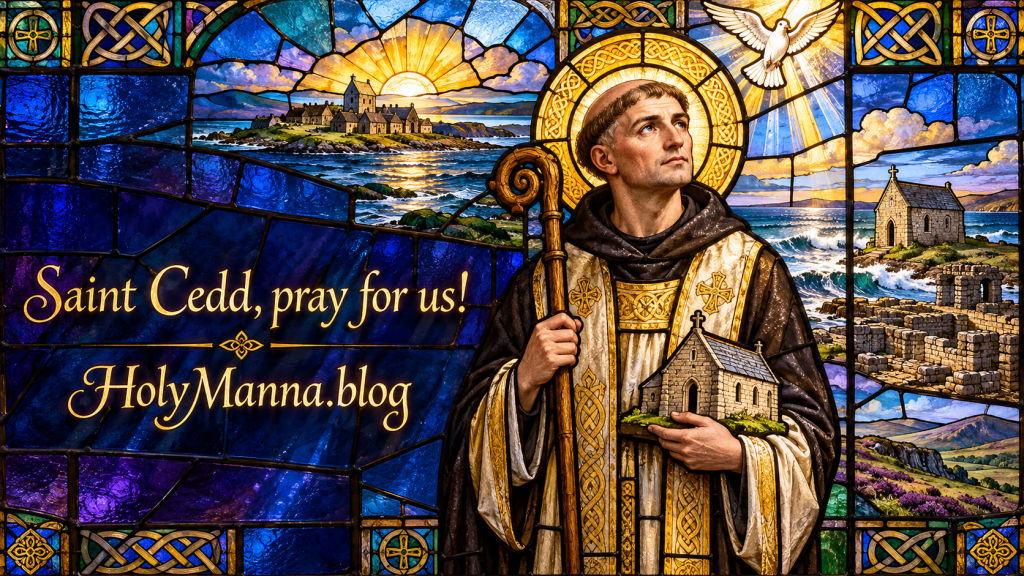
When the Light Returned to Essex
Every October 26th, the Church remembers a saint most Catholics have never heard of, and that is precisely the tragedy. Saint Cedd (c. 620 to 664) was a Northumbrian monk, a missionary bishop, and a founder of churches and monasteries who carried the Gospel back into a corner of England that had already heard it once and thrown it away. Formed on the holy island of Lindisfarne under Saint Aidan, he became the apostle of the East Saxons, the people of modern Essex, rekindling a faith that had been extinguished for nearly forty years. He built one of the oldest churches still standing in England, confronted a king to his face, interpreted for two quarreling halves of the Church at the Synod of Whitby, and died serving the plague-stricken community he had founded.
Nearly everything known about him comes from Saint Bede the Venerable, a Doctor of the Church, who recorded his life in The Ecclesiastical History of the English People within living memory of the events. That proximity makes Cedd rare among early medieval saints; his story rests not on late embellishment but on the testimony of a careful historian with close ties to the very monastery Cedd founded.
Long-standing Catholic tradition honors Saint Cedd as a patron of Essex, of Lastingham, and of interpreters, this last a nod to his bridge-building role at Whitby. These patronages are devotional attributions handed down through the centuries rather than modern formal decrees, but they capture the man exactly. The Catechism of the Catholic Church teaches that the Church proposes the saints to the faithful as models and intercessors, recognizing in them the power of the Spirit of holiness (CCC 828). Saint Cedd is a model for anyone called to rebuild what others have abandoned.
Four Brothers at One Altar
Cedd was born in the Anglo-Saxon kingdom of Northumbria, in the north of England, probably in the early 620s. The date is an inference rather than a record; Bede first mentions him as a priest in the year 653, which places his birth roughly two decades earlier. Nothing certain is known of his parents, though the family was evidently of some standing, because kings later trusted the brothers with royal business. What is known, and what Bede found remarkable, is the family itself. Cedd was the eldest of four brothers, Cedd, Cynibil, Caelin, and Chad, and every one of them became a priest. Two of them, Cedd and Chad, became bishops, and Chad is himself venerated today as Saint Chad of Mercia. Bede calls four celebrated priests of the Lord arising from a single household “a rare thing to be met with.” Curiously, all four brothers bore names of British Celtic origin rather than Anglo-Saxon ones, a small mystery that scholars still ponder.
Cedd’s conversion was not a dramatic adult turnaround but a slow forging. He was raised and formed at Lindisfarne, the tidal island monastery off the Northumbrian coast, under Saint Aidan, the gentle Irish missionary whom King Oswald had summoned to evangelize his people. Bede stresses several times that Cedd and Chad absorbed Aidan’s example and traditions: poverty freely embraced, constant prayer and immersion in Scripture, and journeys made on foot so that the missionary could stop and speak with anyone he met, rich or poor. The Catechism teaches that the duty of taking part in the life of the Church impels Christians to act as witnesses of the Gospel (CCC 2472), and Lindisfarne was a school of exactly that witness.
The forging was tested in 653. Peada, prince of the Middle Angles, came north to marry King Oswiu’s daughter and accepted Baptism from Bishop Finan, Aidan’s successor at Lindisfarne. He returned home with four priests to evangelize his people, and Cedd was one of them. The mission made only modest headway; Bede credits Cedd’s brother Chad with the effective evangelization of that region more than a decade later. It revealed Cedd, however, as a man who could be sent. Within about a year, King Oswiu recalled him for a far harder assignment: the East Saxons, a kingdom that had received the faith from Saint Mellitus around 604 and then violently rejected it, driving out its bishop and sliding back into paganism for nearly forty years.
A Shepherd on the Saxon Shore
The East Saxon mission began with a king’s change of heart. King Sigeberht, called the Good, was a friend of Oswiu of Northumbria, and Bede records the patient, brotherly way Oswiu reasoned with him on his visits north: idols fashioned by human hands could not be gods, for the true God is “of incomprehensible majesty and invisible to human eyes, almighty, eternal, the Creator of heaven and earth” (The Ecclesiastical History of the English People, Book III). Sigeberht believed, was baptized by Bishop Finan, and begged for teachers for his people. Oswiu sent Cedd with a single companion.
The two priests traveled the whole country preaching, and a church began to gather. When Cedd returned to Lindisfarne to report, Finan saw what God was doing and consecrated him bishop of the East Saxons, calling in two other bishops to assist at the rite, around the year 654. Cedd went back with greater authority and set about the patient work of building: he raised churches in many places and ordained priests and deacons to help him in the work of faith and the ministry of Baptism. The Catechism teaches that bishops, as successors of the apostles, receive the office of sanctifying, teaching, and ruling the People of God (CCC 1558), and Cedd exercised that office on foot, along the marshes and river mouths of Essex.
Two foundations anchored the mission. At Ithancester, today Bradwell-on-Sea, Cedd built a church and community on the ruins of the abandoned Roman fort of Othona, literally raising the Gospel out of the rubble of a dead empire. That chapel, St Peter-on-the-Wall, built around the year 654, still stands today and is counted among the oldest largely intact churches in all of England. The second house rose at Tilbury on the Thames, where Bede says Cedd gathered a flock of the servants of Christ and taught them the discipline of regular monastic life.
Cedd was no court chaplain content to bless whatever the powerful did. When one of the king’s nobles contracted an unlawful marriage, Cedd excommunicated him and forbade anyone to enter his house or eat his food. King Sigeberht ignored the ban and accepted the man’s dinner invitation. Leaving the house, the king met the bishop on the road. Bede paints the scene vividly: the king dismounted and fell trembling at Cedd’s feet, begging pardon, and the bishop, touching the prostrate king with the staff in his hand, spoke with pontifical authority: “I say to you, forasmuch as you would not refrain from the house of that wicked and condemned person, you shall die in that very house.” The prophecy was fulfilled around the year 660, when Sigeberht was murdered by his own kinsmen. Asked why they had done it, the murderers could only answer that they hated the king “because he was too apt to spare his enemies, and easily to forgive the wrongs they had done him.” He died, in other words, for acting like Christ, and Bede concludes that such a death not only blotted out the king’s offense but added to his merit. Admonishing the sinner is a spiritual work of mercy (CCC 2447), and Cedd practiced it upon a king.
Honesty requires saying plainly what the sources do and do not record. Bede, who delighted in miracle stories and told them freely of Aidan, Oswald, and Cuthbert, attributes no catalogue of healings or wonders to Cedd during his lifetime. The one supernatural sign he records is this prophecy over Sigeberht, delivered and fulfilled to the letter. Cedd’s great wonder was the conversion itself: a kingdom that had expelled its bishop and let its faith burn out was, within a few years, Christian again, with clergy, churches, and monasteries, and Bede presents Cedd’s work as decisive in that conversion. The bishop also baptized Sigeberht’s successor, King Swithhelm, at Rendlesham in East Anglia, with the East Anglian king standing as his godfather, a detail that shows how far Cedd’s ministry and diplomacy reached beyond his own borders.
Plague, Politics, and the Peace of Whitby
Cedd was never martyred, but his life was a catalogue of hardships willingly embraced. The mission field itself was hostile ground. Essex was not virgin territory but scorched earth, a kingdom that had already tried Christianity and discarded it, where the expulsion of Bishop Mellitus in 616 was part of the national memory. Rebuilding faith among people proud of having rejected it demands a different courage than first proclamation. After King Sigeberht’s murder, Cedd’s own position grew precarious; he had excommunicated and prophesied against men close to the throne, and his royal protector was dead. He stayed at his post anyway.
His daily life was itself a penance. Trained in Aidan’s school, he traveled constantly, shuttling hundreds of miles between Essex and his native Northumbria, where he often returned to preach. Around 658, King Æthelwald of Deira, who kept Cedd’s brother Caelin as his own priest, begged the bishop to accept land for a monastery where the king could come to pray and one day be buried. Cedd chose the bleakest site imaginable, among craggy and remote hills that Bede says looked more like lurking places for robbers and retreats for wild beasts than habitations for men, so that the prophecy of Isaiah 35:7 might be fulfilled there, that “in the habitations where before dragons dwelt, might be grass with reeds and rushes.”
Before he would lay a single foundation at Lastingham, Cedd insisted on cleansing the place by prayer and fasting through the whole of the approaching Lent. Every day except Sunday he ate nothing until evening, and then took only a little bread, one hen’s egg, and a little milk mixed with water. He explained that this was the custom of those from whom he had learned the rule of regular discipline: “first, to consecrate to our Lord, by prayer and fasting, the places which they had newly received for building a monastery or a church.” When royal business pulled him away with ten days of the fast remaining, his brother Cynibil completed it for him, a quiet image of the communion of saints at work within a single family. The Catechism teaches that fasting, prayer, and almsgiving express conversion in relation to oneself, to God, and to others (CCC 1434); Cedd fasted not only for his own conversion but for the very ground the Gospel would stand upon.
His last great trial was the Synod of Whitby in 664, when the Church in England gathered to resolve the painful division between the Celtic practices in which Cedd had been raised and the practice of the universal Church, above all the dating of Easter. Cedd arrived as a son of Lindisfarne, ordained by the Irish, his heart formed by their saints. Yet Bede records that in that council “he was a most careful interpreter for both parties.” Fluent in the tongues of both camps, he spent the synod not scoring points but making sure each side truly heard the other. When King Oswiu ruled for the Roman observance, invoking Our Lord’s promise of the keys to Peter, Cedd submitted completely; Bede writes simply that Cedd, forsaking the practices of the Scots, returned to his bishopric, having submitted to the Catholic observance of Easter. He gave up the beloved customs of his fathers for the unity of the Church, a unity The Catechism teaches is secured by visible bonds of communion, among them the profession of one faith and ecclesiastical governance in communion with the successors of the apostles (CCC 815).
That same year he traveled north to visit Lastingham, and there the great plague then ravaging Britain found him. He fell ill among his monks and died on October 26th, 664, having first entrusted the monastery’s care to his youngest brother, Chad. He did not die a martyr’s death, but he died as he had lived: in the middle of his work, far from comfort, and surrounded by the family of monks he had made.
The Thirty Who Followed Him into Eternity
What happened next is one of the most haunting scenes in all of Bede. Cedd was first buried in the open air at Lastingham. When the monks of his monastery in Essex heard that their bishop had died in Northumbria, about thirty of them set out on the long journey north, Bede writes, “being desirous either to live near the body of their father, if it should please God, or to die there and be buried.” They knew the plague was raging at Lastingham. They went anyway, choosing nearness to their spiritual father over safety. They were lovingly received by their brethren and fellow soldiers in Christ, and then, one by one, the pestilence took them all, “except one little boy, who was delivered from death by his father’s prayers.”
That boy is Saint Cedd’s great posthumous miracle, recorded by Bede himself. The child lived on at Lastingham for many years and devoted himself to the study of Scripture, and then he discovered something astonishing: he had never been baptized. He was promptly washed in the laver of salvation, was later ordained a priest, and, Bede says, proved very useful to many in the Church. Bede draws the conclusion without hesitation, declaring that he does not doubt the boy was delivered at the point of death by the intercession of his father Cedd, precisely so that he might escape eternal death through Baptism and then extend the ministry of life and salvation to others. The story is a stunning early testimony to two truths the Church still teaches: that the saints in glory intercede for those on earth (CCC 956), and that Baptism is necessary for salvation for those to whom the Gospel has been proclaimed, even as God himself “is not bound by his sacraments” (CCC 1257). Cedd’s prayers did not bypass Baptism; they bought the time for it.
In the course of time a stone church was built at Lastingham in honor of the Mother of God, and Cedd’s body was translated into it and laid at the right side of the altar. His relics made Lastingham a place of veneration for centuries, and such veneration of the saints’ relics belongs to the Church’s life of popular piety (CCC 1674). The crypt of the present St Mary’s Church at Lastingham, built in 1078 by monks refounding the monastery, is traditionally held to stand directly over his original resting place, and pilgrims still descend its steps to pray in one of the most atmospheric Norman crypts in England. A later tradition holds that in subsequent translations some of Cedd’s relics became intermingled with those of his more famous brother, Saint Chad; this story cannot be verified.
His other great monument needs no tradition to defend it, because anyone can walk up and touch it. The chapel of St Peter-on-the-Wall still stands alone against the sea at Bradwell-on-Sea, a plain rectangle of Roman brick and stone rising from the very spot where Cedd landed and built around 654. It remains a place of worship to this day, and every July an ecumenical Bradwell Pilgrimage walks out to it across the Essex flats, a pilgrimage in which the Catholic Diocese of Brentwood takes part alongside other Christians, a fitting tribute to the interpreter of Whitby. Stones from Iona, Lindisfarne, and Lastingham, the landmarks of Cedd’s own journey, have been set within the chapel, and the long-distance pilgrim path called St Peter’s Way ends at its door. Even the region’s Anglican cathedral bears his memory, for Chelmsford Cathedral is dedicated to St Mary the Virgin, St Peter, and St Cedd, and Essex has never stopped regarding him as its apostle. For a man whose name draws blank stares today, his fingerprints are pressed remarkably deep into the English landscape.
Lessons from a Saint Who Built on Ruins
Saint Cedd’s life speaks with surprising directness to anyone living the faith in the modern West. He was not sent to people who had never heard of Christ; he was sent to people who had heard, believed, and walked away. That is the mission field most Catholics inhabit today, among family members who left the Church, friends inoculated by a shallow religious upbringing, and a culture that considers Christianity tried and failed. Cedd’s answer was not argument first but presence: he walked the territory, built communities, raised up local clergy, and let holiness do its slow work, in keeping with the missionary mandate the Church receives from her Lord (CCC 849 to 850). Who in your life has heard the Gospel once and discarded it, and what would patient, unanxious presence look like with them?
Cedd also shows what loving confrontation costs. He excommunicated a powerful man and rebuked a king he genuinely served, because mercy without truth is abandonment. The Catechism numbers admonishing sinners among the spiritual works of mercy (CCC 2447), and it is perhaps the least practiced of them. Is there a hard truth you have been withholding from someone you love, not out of prudence but out of fear?
Then there is Whitby. Cedd loved the traditions in which he was raised, and when the Church decided against them, he let them go for the sake of unity, and he spent the synod itself helping both sides understand each other. In an age of Catholic infighting, of camps and labels and online contempt, his example cuts deep. When a legitimate decision of the Church goes against your preferences, do you submit with peace, or do you nurse the grievance? Where could you be an interpreter instead of a combatant?
Practical ways to weave his lessons into daily life are close at hand. Consider fasting before beginning something important, as Cedd fasted over the ground of Lastingham, offering a day of small sacrifices before a new job, a difficult conversation, or a family decision. Pray by name for the people who handed the faith on to you, as the thirty monks honored their father, and pray just as deliberately for those who have left it. Make a point this week of being a bridge in one conflict, at work, in the parish, or in the family group chat, restating the other side fairly before answering it. And remember the unbaptized boy: if there is a child in your orbit whose Baptism has been delayed or forgotten, Saint Cedd would tell you that nothing is more urgent, for the Church has always understood Baptism as God’s gift not to be deferred (CCC 1250).
Engage With Us!
The HolyManna community would love to hear from you. Share your thoughts and reflections on Saint Cedd in the comments below; your experience of rebuilding faith, keeping peace, or standing firm may be exactly what another reader needs today. Here are some questions to spark the conversation.
- Saint Cedd evangelized a people who had already rejected the faith once. Who in your life seems finished with Christianity, and how might you reach them with presence rather than pressure?
- Cedd consecrated the ground of Lastingham with forty days of prayer and fasting before building anything. What new beginning in your life deserves to be consecrated to God before you start it?
- At Whitby, Cedd served as a careful interpreter for both parties. Where in your family, parish, or workplace could you help two sides truly hear each other this week?
- The thirty monks of Essex walked into a plague zone to be near their spiritual father. Who handed the faith on to you, and how will you honor them?
- Cedd accepted the Church’s decision at Whitby even though it overturned his own cherished customs. What is one preference God may be asking you to surrender for the sake of unity?
Saint Cedd spent his life carrying light back into places where it had gone out, and he did it one church, one fast, and one hard conversation at a time. Go and do likewise. Live your faith boldly this week, and do everything with the love and mercy that Jesus taught us.
Saint Cedd, pray for us!
Follow us on YouTube, TikTok, Instagram and Facebook for more insights and reflections on living a faith-filled life.


Leave a Reply