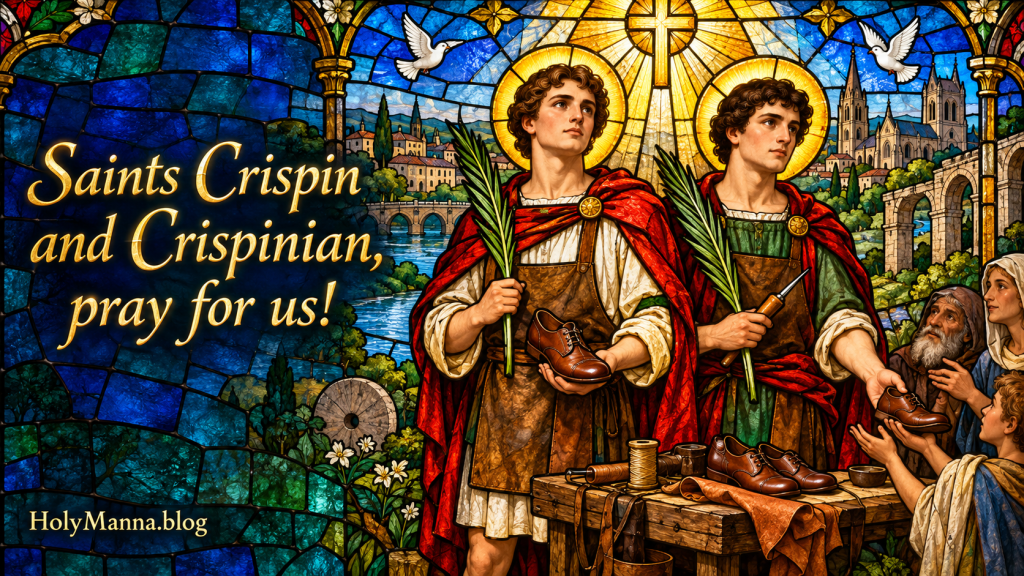
Martyrs at the Workbench
Every October 25th, the Church remembers two brothers who prove that holiness does not require a pulpit, a monastery, or a dramatic stage. It can be worked out at a wooden bench, with leather in one hand and an awl in the other. Saints Crispin and Crispinian were, according to tradition, Roman nobles who left everything behind to bring the Gospel to Gaul in the 3rd century. By day they preached Jesus Christ openly in the streets of Soissons. By night they made shoes, supporting themselves with their own hands and giving freely to the poor. When the persecution of Diocletian swept through the empire, they sealed their preaching with their blood, beheaded for refusing to deny the Lord they had spent their lives proclaiming.
The Roman Martyrology still honors them on October 25th, recording their witness with the solemn brevity the Church reserves for her martyrs: “At Soissons, in France, in the persecution of Diocletian, the holy martyrs Crispin and Crispinian, noble Romans. Under the governor Rictiovarus, after horrible torments, they were put to the sword, and thus obtained the crown of martyrdom.”
These two saints hold a remarkable collection of patronages, all tied to the trade they sanctified. They are the patron saints of shoemakers, cobblers, saddlers, tanners, curriers, and leather workers. For centuries, shoemaking itself was called “the gentle craft” in their honor, and guilds of cobblers across Europe held processions and feasts on their day. Their feast even marched into world history and literature, because the Battle of Agincourt was fought on October 25th, 1415, and Shakespeare placed his most famous battle speech on the lips of King Henry V in their name.
The Catechism teaches that “it is not merely by the title of example that we cherish the memory of those in heaven; we seek, rather, that by this devotion to the exercise of fraternal charity the union of the whole Church in the Spirit may be strengthened” (CCC 957). Crispin and Crispinian are not museum pieces from a distant century. They are living intercessors, and their story speaks with surprising force to anyone who has ever wondered whether an ordinary job can matter to God.
Noble Blood, Calloused Hands
The traditional account of their origins, preserved in the ancient Acts gathered by the Bollandists and summarized in the Catholic Encyclopedia, presents Crispin and Crispinian as Romans of distinguished descent, members of a noble family in the capital of the empire during the middle of the 3rd century. Tradition holds that they were brothers, and the Church has always venerated them together as such, though the Catholic Encyclopedia notes honestly that this detail has never been positively proved. The two names are so closely paired, both drawn from the same Latin root, that Christian memory has never separated them. Where one is named, the other follows.
What is clear in every Catholic source is the direction their lives took. At a time when bearing the name of Christ in the Roman Empire could cost a person his property, his status, and his life, these two men of privilege chose Christ anyway. They did not merely practice the faith quietly behind closed doors. They left Rome as missionaries, traveling north into Gaul, the territory of modern France, to preach the Gospel to the Gauls. Some Catholic accounts associate them with the band of Roman missionaries that included Saint Quentin, who evangelized the same region in the same generation and was martyred in the same persecution; the Roman Martyrology commemorates Quentin just six days later, on October 31st. Whether they traveled together or simply labored in the same vineyard, these men formed part of a wave of apostolic courage that planted the Church in northern Gaul.
The brothers settled in Soissons, a Roman town northeast of Paris, and made it their field of labor. Here the tradition offers one of its most beautiful details. Rather than living off the generosity of others or the wealth of their family, Crispin and Crispinian took up a trade. They became shoemakers. The Catholic Encyclopedia states that they did this deliberately, “in imitation of St. Paul,” who worked with his hands as a tentmaker so that the Gospel would cost his hearers nothing (Acts 18:3). St. Paul himself described this way of life to the Thessalonians: “Working night and day in order not to burden any of you, we proclaimed to you the gospel of God” (1 Thessalonians 2:9). The two Roman nobles took that apostolic pattern and made it their own, trading senatorial comfort for calloused hands and the smell of leather.
There was also, according to the medieval account of their lives, a practical reason. The authorities of the region had forbidden residents to give food or shelter to Christians. The brothers could expect no hospitality, so they earned their bread themselves. What persecution intended as a hardship, grace turned into a mission strategy. The shoemaker’s shop became a doorway into the lives of ordinary Gauls, and the Gospel walked in through it.
Preaching by Day, Stitching by Night
The picture the Catholic sources paint of their years in Soissons is simple and powerful. By day, Crispin and Crispinian preached Christ publicly, instructing anyone who would listen in the faith. By night, they bent over their workbench, cutting, stitching, and finishing shoes. Their trade earned enough to support them and, as the Catholic Encyclopedia records, enough “to aid the poor” as well. Tradition adds that they made and repaired shoes free of charge for those who could not pay, so that the poorest people of Soissons walked in shoes made by the hands of saints. That detail comes from the later account of their lives and cannot be verified as historical fact, but it has been cherished in Catholic memory for over a thousand years because it fits everything else the Church knows about them.
Butler, in his Lives of the Saints, describes the effect their life had on their pagan neighbors. The people listened to their instructions and were astonished at the example they saw, especially, in Butler’s words, “their charity, disinterestedness, heavenly piety, and contempt of glory and all earthly things.” The result was the conversion of many to the Christian faith. People came for shoes and stayed for conversation, and the conversation led them to Christ.
It is worth pausing on something the honest reader will notice. The Catholic sources record no spectacular wonders worked by Crispin and Crispinian during their ministry. There are no accounts of the blind seeing or the dead rising at their word during those years in Soissons. Their great work during life was quieter and, in its own way, just as supernatural: the conversion of hardened pagan hearts through preaching, charity, and the sheer credibility of two men who lived what they proclaimed. This is exactly the dynamic The Catechism describes when it teaches that “the witness of a Christian life and good works done in a supernatural spirit have great power to draw men to the faith and to God” (CCC 2044). Grace was doing the converting; the brothers were simply making themselves available, one customer and one conversation at a time.
This is why they matter, and why the reader should remember and emulate them. Most Christians will never stand in a pulpit, and most will never be asked to die for the faith in a single dramatic moment. Nearly all Christians, however, will spend decades at some version of a workbench, a desk, a job site, or a kitchen counter. Crispin and Crispinian show that this is not wasted territory. The Catechism teaches that “human work proceeds directly from persons created in the image of God and called to prolong the work of creation by subduing the earth, both with and for one another” and that “work honors the Creator’s gifts and the talents received from him” (CCC 2427). The brothers of Soissons took that truth and lived it to its limit. They turned a trade into an apostolate, and an apostolate into a crown.
Awls, Millstones, and a Winter River
The brothers had carried on their double life of preaching and shoemaking for several years when the storm finally broke. The great persecution associated with the emperor Diocletian reached Gaul, and with it came Maximian Herculius, the brutal soldier whom Diocletian had raised to the rank of co-emperor and who governed the western half of the empire. A complaint was lodged against the two Christian shoemakers of Soissons, and they were brought before Maximian himself.
According to their Acts, the co-emperor first tried the usual imperial playbook, alternating promises of favor with threats of torment, hoping to pry them away from Christ. Their answer, as preserved in the Catholic Encyclopedia, has come down through the centuries as the one great quotation attached to their names: “Thy threats do not terrify us, for Christ is our life, and death is our gain. Thy rank and possessions are nought to us, for we have long before this sacrificed the like for the sake of Christ and rejoice in what we have done. If thou shouldst acknowledge and love Christ thou wouldst give not only all the treasures of this life, but even the glory of thy crown itself in order through the exercise of compassion to win eternal life.”
Anyone who knows Scripture will hear the heartbeat of St. Paul inside that answer, for the Apostle wrote to the Philippians, “For to me life is Christ, and death is gain” (Philippians 1:21). These were not men improvising courage in a crisis. They were men who had soaked so long in the Word of God that, under pressure, the Word is what came out. The reader should note that this reply comes from the traditional Acts of their martyrdom rather than from a court transcript, so it is the voice of early Christian memory honoring them; still, it is the earliest and most authoritative record the Church possesses of their confession.
The Acts then describe what followed. Enraged that neither bribes nor threats could move them, Maximian handed the brothers over to Rictiovarus, remembered in the Roman Martyrology as the governor who tormented so many martyrs of Gaul, and described by the Catholic Encyclopedia as “a most cruel persecutor of the Christians.” Under his orders, the brothers were stretched on the rack. Thongs were cut from their living flesh. Awls, the sharp tools of their own trade, were driven under their fingernails, a detail so striking that the awl became their emblem in Christian art ever afterward. A millstone was then fastened around the neck of each man, and they were thrown into the river Aisne in the cold of late October. The account says they did not drown; they swam, millstones and all, to the opposite bank. Rictiovarus then tried fire, and the flames would not touch them. The account ends with the persecutor so consumed by rage and despair that he threw himself into the fire he had prepared for them. Finally, at the command of Maximian, the two brothers were beheaded.
Honesty requires a clear word here, and the Church’s own scholars have always provided it. The core fact of their martyrdom at Soissons is historically solid; their veneration is ancient, they appear in the Martyrologium Hieronymianum compiled in the 5th century, and a basilica stood over their graves by the 6th century, which is why Butler judged their martyrdom genuinely historical. The dramatic sequence of tortures, however, comes from a passion account written long after the events, and the Catholic Encyclopedia states plainly that it contains “many details that have little probability or historical worth.” Even the figure of Rictiovarus, who appears in many Gallic martyrdom accounts, is not attested in the surviving historical record outside those accounts, so his historicity is uncertain. The sources also differ on the year of their death; the Catholic Encyclopedia gives October 25th of 285 or 286, while Butler places it around 287. None of this should trouble the Catholic reader. The Church distinguishes between the fact of a martyrdom, which she affirms, and the embroidery of later storytelling, which she receives as tradition. The torture narrative is told here as the Church received it, as tradition, and it cannot be verified as historical fact.
What can be affirmed without hesitation is what the tortures, verified or not, were written to express: these two men valued Christ above their lives. The Catechism teaches that “martyrdom is the supreme witness given to the truth of the faith: it means bearing witness even unto death” (CCC 2473), and it adds that the Church has gathered the records of her martyrs with the greatest care, for “these are the acts of the Martyrs. They form the archives of truth written in letters of blood” (CCC 2474). On October 25th, around the year 286, Crispin and Crispinian entered those archives.
From Soissons to Agincourt
The death of the two shoemakers was not the end of their story. It was the beginning of a devotion that spread across Europe and endured for more than seventeen centuries.
The faithful of Soissons buried the brothers and never forgot where they lay. In the 6th century, a stately basilica was raised over their graves, and around that shrine grew the great abbey of Saint-Crépin-le-Grand, which carried their name through the Middle Ages. In the 7th century, St. Eligius, the master goldsmith who became bishop of Noyon and remains one of the most beloved saints of France, fashioned a costly shrine to hold the head of St. Crispinian, one holy craftsman honoring two others. Their relics then began to travel, as the relics of great martyrs do. Some were carried to Rome and enshrined in the church of San Lorenzo in Panisperna, a translation that the Roman Martyrology itself records, noting that their bodies were “entombed with due honors in the Church of St. Lawrence, in Panisperna.” Other relics were given by the emperor Charlemagne to the cathedral he founded at Osnabrück in Germany, a cathedral dedicated to Crispin and Crispinian, and to this day the two brothers are venerated as patrons of the Diocese of Osnabrück. It is a remarkable arc: two humble shoemakers of Soissons honored by the greatest Christian ruler of the early Middle Ages.
The major Catholic sources do not preserve individually named miracles of healing worked at their tombs, and nothing of the sort will be invented here. Their documented afterlife is of a different kind, the steady, centuries-long pull of their intercession on ordinary working people. Shoemakers, cobblers, tanners, and saddlers across Europe organized their guilds under the brothers’ patronage, held Masses and processions on October 25th, and proudly called their trade “the gentle craft” because saints had practiced it. In parts of Britain, festive processions crowned a “King Crispin” on the feast, and the day was kept as the cobblers’ own holiday. The Catechism explains why the faithful have always sought the saints this way, teaching that those who dwell in heaven “do not cease to intercede with the Father for us” (CCC 956).
England developed its own tradition about the brothers. According to this account, Crispin and Crispinian fled persecution not to Soissons but to Faversham in Kent, where they worked as shoemakers at a site that later became the Swan Inn; the spot drew pilgrims into the 17th century, a well there was called St. Crispin’s Well, and an altar in their honor stood in the Faversham parish church. It is a charming tradition, and it testifies to how deeply the English people loved these saints, but it conflicts with the ancient record placing them at Soissons, and it cannot be verified.
Then came the strangest chapter of their legacy. On October 25th, 1415, the feast of Crispin and Crispinian, King Henry V of England and his exhausted army won a staggering victory over the French at Agincourt. Nearly two centuries later, Shakespeare immortalized the coincidence in Henry V, where the king rallies his men by the saints’ feast with the words “we few, we happy few, we band of brothers.” Thanks to that speech, “Saint Crispin’s Day” is quoted in classrooms, films, and locker rooms by millions who have no idea that behind the phrase stand two Roman brothers who died for Jesus Christ. There is a quiet providence in that; even secular culture cannot stop pronouncing their names.
One final note shows how the Church herself has kept their day fruitful. On October 25th, 1970, St. Paul VI canonized the Forty Martyrs of England and Wales, raising to the altars on the shoemakers’ feast a company of men and women who, like Crispin and Crispinian, chose death over denial of Christ. The brothers no longer appear on the General Roman Calendar, but the Roman Martyrology continues to commemorate them every October 25th, and the Church continues to hold them out to the faithful as models and intercessors.
Sanctifying the Ordinary
What do two 3rd-century shoemakers have to say to a software developer, a nurse, a teacher, a warehouse worker, or a stay-at-home parent in the 21st century? Almost everything, because their path to holiness ran straight through the most ordinary thing in human life: work.
Crispin and Crispinian never treated their trade as an interruption of their mission. The workbench was the mission. The Catechism teaches that for the lay faithful, “all their works, prayers, and apostolic endeavors, their ordinary married and family life, their daily labor, their mental and physical relaxation, if carried out in the Spirit” become “spiritual sacrifices acceptable to God through Jesus Christ” (CCC 901). That means the spreadsheet, the shift, the commute, and the pile of laundry can all be offered on the same altar where the brothers offered their leather and thread. St. Paul gave the standard: “Whatever you do, do from the heart, as for the Lord and not for others” (Colossians 3:23). Does the work of an ordinary Tuesday get offered to God, or does it stay walled off from the life of faith?
The brothers also evangelized the way most people today can actually evangelize, through credibility and conversation. Their neighbors were won over first by what they saw, the charity, the honesty, the generosity to the poor, and only then by what they heard. Jesus Himself commanded this strategy: “your light must shine before others, that they may see your good deeds and glorify your heavenly Father” (Matthew 5:16). A practical way to imitate them is to pick one concrete act of generosity each week that costs something real, done quietly, the way they slipped shoes onto the feet of the poor. Another is to stop hiding the faith at work; not preaching at anyone, simply refusing to edit Christ out of ordinary conversation, letting people come for the shoes and stay for the conversation. If coworkers and neighbors watched closely for a month, would anything about this life point them toward Christ?
Finally, the brothers teach where courage comes from. Their answer to Maximian was Scripture under pressure, Philippians rising to their lips in the moment of trial, because the Word had been planted there long before the trial came. The fortitude The Catechism describes, the virtue that “strengthens the resolve to resist temptations and to overcome obstacles in the moral life” (CCC 1808), is built in small daily choices long before it is tested in large ones. Few readers will face an emperor. Every reader will face moments when faithfulness is inconvenient, embarrassing, or costly. When that moment comes, what has already been stored in the heart to meet it?
Engage With Us!
The story of Saints Crispin and Crispinian belongs to everyone who has ever tried to follow Christ while holding down a job, and every reader is warmly invited to share thoughts, reflections, and experiences in the comments below. Here are some questions to spark that conversation:
- What is one concrete way to turn daily work into an offering to God this week, following the example of the holy shoemakers of Soissons?
- The brothers gave shoes to the poor at their own expense. What hidden act of generosity is God inviting right now, and what is holding it back?
- Crispin and Crispinian answered the emperor with Scripture because it already lived in their hearts. Which verse would be worth memorizing this month so that it is ready when trial comes?
- Their neighbors came for shoes and stayed for conversation. Who in daily life might God be reaching through simple honesty, good work, and friendship?
- The world remembers their feast because of a battle and a play. How can Catholics reclaim October 25th as a day of witness to the two brothers behind the famous speech?
May the witness of Saints Crispin and Crispinian stir up courage for the ordinary battles of faith, the kind fought at workbenches and kitchen tables rather than on famous fields. Take up the day’s work as they did, with skill, with generosity, and with Christ on the lips and in the heart. Do everything, from the smallest stitch to the greatest sacrifice, with the love and mercy that Jesus taught us, and trust that the Lord who crowned two shoemakers in glory sees, treasures, and will reward every hidden act of faithfulness.
Saints Crispin and Crispinian, pray for us!
Follow us on YouTube, TikTok, Instagram and Facebook for more insights and reflections on living a faith-filled life.


Leave a Reply