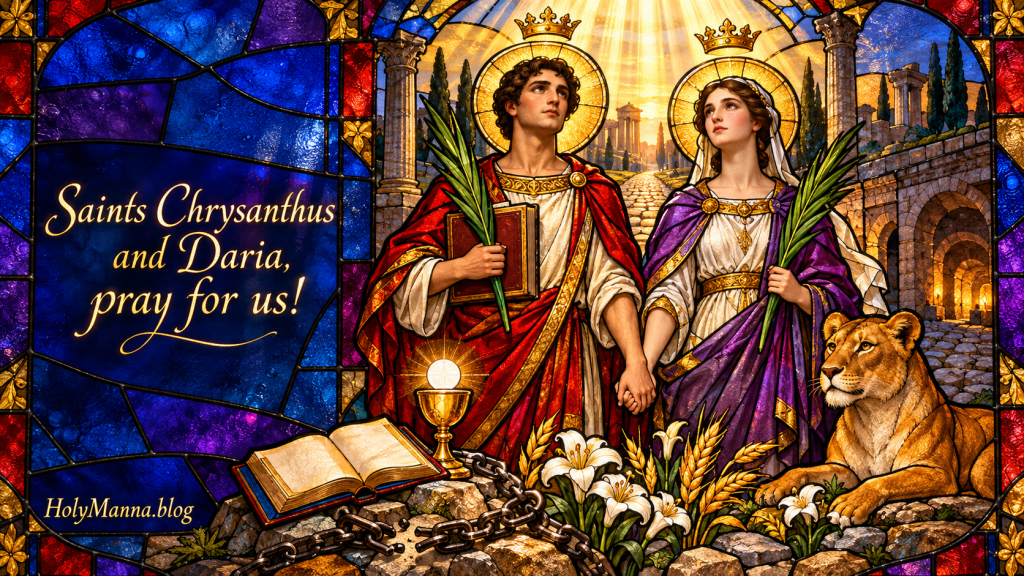
Love Strong as Death
Most love stories end at the altar. The story of Saints Chrysanthus and Daria begins there, and it does not end even in the grave. This young husband and wife of 3rd century Rome were buried alive together in a sandpit along the Salarian Way because they would not stop telling people about Jesus Christ, and the Church has never forgotten them. Their tomb was already a place of public veneration by the 4th century, Pope Saint Damasus I honored them with verses carved in marble, and the Roman Martyrology commemorates them to this day on October 25th. The Scriptures sing, “Many waters cannot quench love, neither can floods drown it” (Song of Songs 8:7), and these two martyrs prove that not even a flood of earth and stones can smother a love that has been given entirely to God.
Chrysanthus and Daria matter because they show that marriage itself can be a road to heroic holiness, and that the witness of an ordinary household can shake an empire. The Catechism teaches, “Martyrdom is the supreme witness given to the truth of the faith: it means bearing witness even unto death” (CCC 2473). This couple gave that supreme witness side by side, hand in hand, as spouses. They are venerated as the patron saints of the city of Reggio Emilia in Italy, where their relics rest beneath the cathedral altar and where, remarkably, modern science has had something to say about their story.
From Alexandria to the Eternal City
The historical core of their story is solid. Chrysanthus and Daria were real martyrs of Rome, buried in a disused sandpit beside the catacomb of Thraso on the Via Salaria Nova. The ancient pilgrim itineraries to the tombs of the Roman martyrs record their resting place, a church rose over it near the tomb of Saint Saturninus, and their names appear in the Martyrologium Hieronymianum, one of the oldest martyr lists of the Western Church. The details of their lives, however, come to us from written Acts composed in the 5th century, surviving in a longer Greek version and a shorter Latin one. The Catholic Encyclopedia, with scholarly honesty, judges those Acts to be “without historical value” as strict history. What follows, then, is the story as the Church has lovingly handed it down, told as tradition rather than as verified fact, which is exactly how the Church herself presents it.
According to that tradition, Chrysanthus was the only son of Polemius, a noble pagan of Alexandria in Egypt, who relocated his family to Rome. Polemius spared no expense on his son’s formation, and the young man received the finest education the empire could offer. It was precisely that education that undid his father’s plans. In the course of his studies Chrysanthus encountered the Gospels and the Acts of the Apostles, and the words of Scripture unsettled every pagan certainty he had been raised on. He sought out someone who could explain what he was reading and found a hidden Christian priest named Carpophorus, who instructed him in the faith and baptized him. The convert did not keep his treasure to himself; tradition says he began to proclaim Christ openly in the city.
Polemius was horrified. The story recounts that he first confined his son, then surrounded him with luxury and with women hired to seduce him, confident that pleasure would accomplish what argument could not. When Chrysanthus remained unmoved, his father reached for a final weapon, and it is here that Daria enters the story. She was a beautiful and brilliantly intelligent young pagan, described in the Latin accounts as a Vestal Virgin and in other accounts as a priestess of Minerva, whom the Greek texts call Athena. The sources genuinely conflict on this point, and honesty requires saying so. Polemius arranged the marriage believing that such a devoted servant of the Roman gods would surely win his son back to paganism.
The plan collapsed in the most beautiful way possible. Instead of Daria converting Chrysanthus to the idols, Chrysanthus converted Daria to Christ. Their conversations about the gods of Rome and the one true God ended with Daria asking for baptism. The two then entered a virginal marriage, living as husband and wife while consecrating their chastity entirely to God. The Church sees no contradiction in this, for as the Catechism teaches, “Both the sacrament of Matrimony and virginity for the Kingdom of God come from the Lord himself” (CCC 1620). This entire account of their early life comes from the later Acts and cannot be verified.
A Marriage on Mission
Tradition continues that after the death of Polemius, the home of Chrysanthus and Daria became something Rome had no category for: a married household that functioned as a mission station. Chrysanthus gathered and catechized the men of the city, Daria gathered the women, and the accounts say that great numbers of Romans, including many noble ladies, embraced Christianity through them. Their marriage was not a private arrangement turned inward on itself; it was a lamp set on a stand. This is why the Church holds them up for imitation. The Catechism insists, “The disciple of Christ must not only keep the faith and live on it, but also profess it, confidently bear witness to it, and spread it” (CCC 1816), and it teaches that lay people fulfill their prophetic mission by evangelization, proclaiming Christ by word and by the testimony of their lives (CCC 905). Chrysanthus and Daria did precisely that, centuries before anyone coined the phrase “lay apostolate.”
So many conversions could not stay hidden. The couple was denounced to a tribune named Claudius, and Chrysanthus was arrested. The tradition recounts a cascade of wonders during his imprisonment and torture. His captors bound him in strips of raw ox hide and left him in the sun, yet he was unharmed. They loaded him with chains, and the chains fell away. They tied him with ropes, and the ropes dissolved as though they were ash. Every instrument of cruelty failed, and the failure preached louder than any sermon. Claudius, the hardened Roman officer sent to break him, was broken instead. The story says that Claudius came to believe in Christ together with his wife Hilaria, his sons Maurus and Jason, and about 70 of his soldiers, all of whom were baptized. These wonders come from the 5th century Acts and cannot be verified, yet they express a truth the Church knows well: God’s power is made perfect in weakness, and the courage of one faithful witness can convert the very people sent to silence him.
Why should anyone remember this couple 17 centuries later? Because they demonstrate that holiness is not reserved for monasteries and pulpits. A young professional couple in the biggest city of their world, navigating family pressure, career expectations, and a hostile culture, became saints precisely through their marriage and not in spite of it. They are proof that the vocation of marriage, lived with total generosity, is a path to the heights.
The Sandpit on the Salarian Way
The conversions bought by their witness came at a terrible price, and the martyrs paid it first in the people they loved. Tradition holds that the emperor, enraged at the defection of an entire military household, ordered the new converts executed: Claudius was drowned with a stone tied to him, and his sons Maurus and Jason were beheaded. The traditions conflict about Hilaria; the Catholic Encyclopedia records that she alone escaped martyrdom, while Eastern accounts say she was seized while praying at the grave of her sons and died on the way to her trial. The conflict is noted here rather than smoothed over.
Then came the couple’s own hour. The story says Chrysanthus was thrown into a foul prison, where darkness turned to light around him and stench gave way to fragrance. Daria was condemned to a fate designed to destroy her consecrated purity: she was sent to a brothel. There, tradition recounts one of the most striking images in all the martyr stories, for a lioness escaped from the amphitheater took up guard at her side, and no man who approached could lay a hand on her. Daria remained untouched, and the accounts even say she commanded the beast to harm no one. This story of the lioness cannot be verified.
When neither torture nor humiliation produced the desired apostasy, the sentence of death came down. The ancient entry of the Roman Martyrology for October 25th preserves the Church’s memory of that final scene: “At Rome, the holy martyrs Chrysanthus, and his wife Daria. After many sufferings endured for Christ, under the prefect Celerinus, they were ordered by the emperor Numerian to be thrown into a sandpit on the Salarian road, where, being overwhelmed with earth and stones, they were buried alive.” One strand of the Acts describes them as stoned in the pit; either way, husband and wife went down into the earth together, praying, and the sand of the Via Salaria closed over them.
A word of honesty about the date is owed to the reader. The traditional accounts place the martyrdom around the year 283 under the emperor Numerian, and the older Martyrology names him. Historians have long pointed out a problem: Numerian never resided in Rome. The scholar Paul Allard and others therefore proposed that the persecutor was actually the emperor Valerian, and the current 2004 Martyrologium Romanum dates their martyrdom to around the year 253. Both datings circulate in Catholic sources, and the Church has flagged the question rather than hidden it. What no serious source disputes is the essential fact: a husband and wife died together in that sandpit for the name of Jesus Christ.
There is a dreadful poetry in the manner of their death that the Church has always noticed. Rome thought it was disposing of two troublemakers in a hole of sand. Heaven saw a planting. Our Lord Himself said, “Unless a grain of wheat falls into the earth and dies, it remains alone; but if it dies, it bears much fruit” (The Gospel of John 12:24). Chrysanthus and Daria were sown into the earth of the Via Salaria, and the harvest has not stopped coming in. They died as they had lived, unafraid, remembering the Lord’s command, “Do not fear those who kill the body but cannot kill the soul” (The Gospel of Matthew 10:28).
Sealed Crypts and Silver Chalices
The martyrdom of Chrysanthus and Daria has an epilogue that is itself one of the most haunting episodes of the early Church. Appended to their Acts, and described in the 6th century by Saint Gregory of Tours in De Gloria Martyrum, is the account of the Martyrs of the Crypt. On an anniversary of the couple’s death, a congregation of Roman Christians gathered in the underground chamber at their tomb to celebrate the Eucharist in their honor. Among them were a priest named Diodorus and a deacon named Marianus. The persecutors discovered the assembly and, rather than bother with arrests, simply sealed the entrance with stones and earth, burying the entire worshipping community alive at the tomb of the two saints. Generations later, when the tomb of Chrysanthus and Daria was sought out and found, searchers discovered the bones of that congregation lying where they had fallen, together with the silver liturgical vessels they had used for the celebration of the Eucharist. This account cannot be fully verified, though Gregory of Tours attests to the sanctuary itself.
What is documented is how the Church treated the site. Pope Saint Damasus I, the great 4th century champion of the Roman martyrs, adorned the tomb and had poems in praise of Chrysanthus and Daria engraved on marble. Out of reverence, everything in the crypt of the buried congregation was left exactly as it was found, and a wall was raised so that no one could enter and disturb the dead. Gregory of Tours relates that pilgrims of his day could look through a window into the sealed chamber and see the scene within, bodies and sacred vessels resting together in silence, a frozen Mass awaiting the resurrection. The old Martyrology commemorated these companion martyrs on December 1st.
The later journey of the relics reads like a map of medieval Europe, and at least three places have claimed them. When the Roman catacombs were abandoned in the 9th century, relics of the couple were said to be translated into the city, and the Basilica of the Twelve Holy Apostles in Rome preserves an altar naming Chrysanthus and Daria together with Diodorus and Marianus. In the 9th century, commonly dated to the year 844, reputed relics were carried north to the great abbey of Prüm in Germany and from there to Münstereifel, today Bad Münstereifel, where the collegiate church of Saints Chrysanthus and Daria venerates them to this day. A separate tradition holds that in 1011 Pope Sergius IV gave relics of the pair to Count Fulk III of Anjou returning from pilgrimage. And in Italy, records trace relics moved repeatedly between 757 and 914, conceded by Pope John X to King Berengario, and finally given in 946 to the Diocese of Reggio Emilia, where they were enshrined beneath the cathedral’s high altar and last recorded as opened in 1651. The Church has never pretended these claims are easily reconciled, and this post does not pretend so either.
Then came one of the most extraordinary chapters in the modern study of relics. In 2008, renovation work in the cathedral of Reggio Emilia uncovered the sealed crypt beneath the altar. Inside lay more than 300 bones forming two nearly complete skeletons, with the skulls preserved in busts of silver and gold. A scientific team led by Ezio Fulcheri of the University of Genoa, with funding from the National Geographic Society, examined the remains. The findings were stunning. The bones belonged to a young man and a young woman. Both had been healthy, and both showed the signs of upper-class life, consistent with a senator’s son and a temple priestess rather than with laborers. Radiocarbon dating placed their deaths between the years 80 and 340, squarely bracketing the 3rd century. Pollen analysis showed that the bones had not originated in the Reggio Emilia region at all, which ruled out a local forgery and matched the tradition of a translation from Rome. Fulcheri concluded that all the evidence his team gathered pointed toward the relics belonging to Chrysanthus and Daria. The relics were placed in a new reliquary and returned beneath the altar, and National Geographic aired a documentary on the investigation in April of 2011. Science cannot canonize anyone, but in this case it tipped its hat to the tradition.
None of this veneration is superstition. The Catechism teaches that the religious sense of the Christian people has always found expression in forms of piety such as “the veneration of relics, visits to sanctuaries, pilgrimages” and processions (CCC 1674). The bones of the martyrs are seeds, and the Church has always known it; Tertullian wrote in his Apologeticus that “the blood of Christians is seed.” The cultural harvest of these two seeds alone is remarkable. The Anglo-Saxon abbot Ælfric of Eynsham retold their story in Old English in his Lives of Saints in the 10th century, and the Spanish Golden Age playwright Pedro Calderón de la Barca built a drama around them, translated into English as The Two Lovers of Heaven: Chrysanthus and Daria. Western Catholics keep their memory on October 25th, Eastern Christians on March 19th, and the Church’s old collect for their feast begged, “May the prayer of Thy blessed Martyrs Chrysanthus and Daria be our stay.”
What a Buried Love Still Teaches
It would be easy to file Chrysanthus and Daria away as a beautiful antique, but their story lands squarely on modern life. Consider what actually happened: a well-educated young man from a wealthy immigrant family read the Scriptures and let them change everything. A successful, intelligent woman at the peak of pagan religious prestige listened honestly to an argument for Christ and followed the truth where it led. A couple whose marriage was arranged for worldly reasons turned it into an engine of grace. None of that requires the 3rd century. All of it is available today.
Their marriage preaches first. In a culture that treats romance as the finish line, Chrysanthus and Daria treated their relationship as a launching pad for mission, and they remind every couple that the real question is not only whether two people are good for each other but whether they are good for each other’s salvation. Their chastity preaches as well, startling as it is, because it declares that the body belongs to God and that love is proven by sacrifice, not by appetite. The Catechism is direct: “All the baptized are called to chastity” (CCC 2348), each according to his or her state of life. Their boldness preaches loudest of all. They evangelized from their living room, with their own networks, at the cost of their comfort and finally their lives. Who in your life first explained the faith to you the way Carpophorus explained it to Chrysanthus, and who might be waiting for you to do the same for them? If following Christ began to cost you socially or professionally, would your faith hold, and what are you doing now to make sure it would?
Practically, their lessons can be woven into any week. A couple can pray together daily, even briefly, and ask whether their relationship is leading both souls toward God. A single person can imitate Daria’s intellectual honesty by actually reading the Gospels and the Acts of the Apostles, the very books that converted Chrysanthus. Anyone can practice small, visible fidelity at work or school, since quiet consistency is what made Rome notice this couple in the first place. And everyone can ask their intercession with confidence, for the Catechism assures the faithful that the saints in heaven “do not cease to intercede with the Father for us” (CCC 956). What one concrete act of witness, visible to someone else, could be made this week in their honor?
Engage With Us!
The conversation does not end here, and every reader is warmly invited to share thoughts, reflections, and personal experiences in the comments below. The story of Saints Chrysanthus and Daria raises questions worth sitting with, and hearing how other readers answer them is part of the joy of this community. Here are some questions to spark reflection and discussion:
- Chrysanthus was converted by reading Scripture with an open heart. When was the last time the Bible was allowed to genuinely challenge a settled opinion in your life?
- Daria followed the truth even though it cost her status, security, and eventually her life. What is the truth costing you right now, and is there a truth you have been avoiding because of its price?
- Chrysanthus and Daria made their marriage a mission. Whether married or single, how could your closest relationships become places where faith is strengthened rather than softened?
- The Martyrs of the Crypt died celebrating the Eucharist at the tomb of the saints. What would change in your life if you treated every Mass as something worth dying for?
- Modern science examined the bones of these martyrs and found a story consistent with the tradition. How do faith and reason work together, rather than against each other, in your own journey?
Saints Chrysanthus and Daria gave everything, together, and gained everything, together. Their witness calls each reader to live a life of real, costly, joyful faith; to love the people God has given without reserve; and to do everything, at home, at work, and in the hidden places of the heart, with the love and mercy that Jesus taught us.
Saints Chrysanthus and Daria, pray for us!
Follow us on YouTube, TikTok, Instagram and Facebook for more insights and reflections on living a faith-filled life.


Leave a Reply