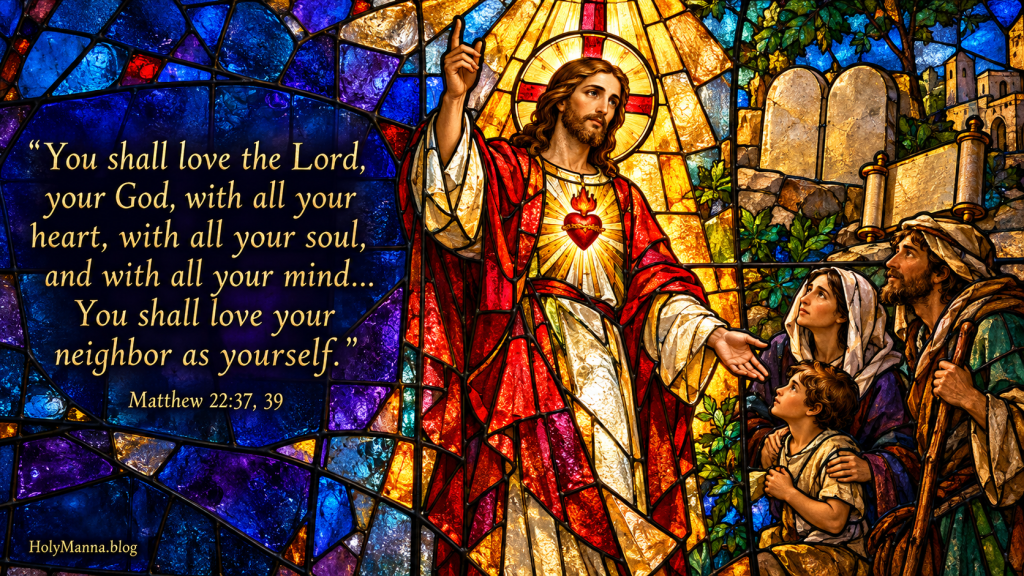
Thirtieth Sunday in Ordinary Time – Lectionary: 148
One Commandment With Two Faces
Everybody wants to know what matters most. Strip away the noise, the obligations, the endless lists, and what is the one thing God actually asks? On this Thirtieth Sunday in Ordinary Time, October 25th, the Church places that exact question on the lips of a scholar of the law, and Jesus answers it with breathtaking clarity. Love God with everything. Love your neighbor as yourself. The whole law and the prophets hang on these two commandments, and the readings for this Sunday show that they have always been one love with two faces.
The First Reading from The Book of Exodus takes the Church back to Mount Sinai, where the covenant law God gave Israel immediately turned toward the most vulnerable people in ancient society: the alien, the widow, the orphan, and the poor borrower. In that world, these were the people with no legal protector, no land, and no safety net. God Himself steps in as their defender and ends the passage with a stunning self-revelation: “for I am compassionate” (Exodus 22:26). Psalm 18 responds with the love song of a rescued king, David pouring out his heart to the God who proved to be his rock and deliverer. The Second Reading from The First Letter to the Thessalonians, likely the earliest written document of the New Testament, shows what happens when a community actually lives this love: their faith echoes across entire regions without a single advertisement. Then the Gospel of Matthew binds it all together. Loving God and loving neighbor were never rivals. They were always the same fire, burning in two directions at once.
First Reading — Exodus 22:20-26
The God Who Hears What the World Ignores
This passage comes from the Covenant Code, the body of law found in Exodus 20:22-23:33 that God gave Israel at Mount Sinai immediately after the Ten Commandments. Here is what makes it remarkable. In the ancient Near East, law codes existed to protect kings, property, and the powerful. Israel’s law turns in the opposite direction. Almost as soon as the covenant is sealed, God defends the three most defenseless groups in ancient society: the resident alien, the widow, and the orphan. These were people with no tribe to avenge them, no husband or father to provide for them, and no land to sustain them. God appoints Himself their guardian, and He grounds the command in Israel’s own story. They know what it feels like to be strangers, because Egypt taught them. The reading fits the day’s central theme perfectly, because it shows what love of neighbor looked like in God’s law centuries before Jesus named it the second greatest commandment.
Exodus 22:20-26
Thus says the LORD:
“You shall not molest or oppress an alien,
for you were once aliens yourselves in the land of Egypt.
You shall not wrong any widow or orphan.
If ever you wrong them and they cry out to me,
I will surely hear their cry.
My wrath will flare up, and I will kill you with the sword;
then your own wives will be widows, and your children orphans.“If you lend money to one of your poor neighbors among my people,
you shall not act like an extortioner toward him
by demanding interest from him.
If you take your neighbor’s cloak as a pledge,
you shall return it to him before sunset;
for this cloak of his is the only covering he has for his body.
What else has he to sleep in?
If he cries out to me, I will hear him; for I am compassionate.”
Detailed Exegesis
Verse 20: “You shall not molest or oppress an alien, for you were once aliens yourselves in the land of Egypt.”
The Hebrew word for alien, ger, refers to the resident foreigner living among Israel without the protections of citizenship or clan. God does not merely forbid cruelty toward such a person; He ties the command to memory. Israel’s entire identity is built on having been rescued from oppression, so oppressing others would be a betrayal of their own salvation story. Gratitude for mercy received must become mercy extended.
Verse 21: “You shall not wrong any widow or orphan.”
In a patriarchal agrarian society, a woman without a husband and a child without a father had no income, no inheritance rights, and no advocate in the courts. The command is stated absolutely, with no exceptions and no loopholes. Throughout Scripture, God repeatedly identifies Himself as the defender of precisely these people, as in Psalm 68:6, which calls Him the father of orphans and the defender of widows.
Verse 22: “If ever you wrong them and they cry out to me, I will surely hear their cry.”
The Hebrew verb for crying out, tsa’aq, is the same verb used in Exodus 3:7 when God tells Moses that He has heard the cry of His people in Egypt. The echo is deliberate and devastating. If Israel oppresses the weak, Israel becomes Egypt, and God will respond to the cry of the oppressed exactly as He responded at the burning bush. The poor may have no lawyer, but they have direct access to the throne of God.
Verse 23: “My wrath will flare up, and I will kill you with the sword; then your own wives will be widows, and your children orphans.”
This is one of the most severe warnings in the entire Torah, and its logic is exact. Those who manufacture widows and orphans through their injustice will see the same sorrow visit their own homes. Divine wrath in Scripture is not a loss of temper; it is the fierce protectiveness of a Father whose children are being crushed. The intensity of the threat reveals the intensity of the love behind it.
Verse 24: “If you lend money to one of your poor neighbors among my people, you shall not act like an extortioner toward him by demanding interest from him.”
Loans in ancient Israel were not business ventures; they were lifelines for a neighbor facing starvation after a failed harvest. Charging interest meant profiting from a brother’s desperation, which is why the law forbids it here and again in Leviticus 25:35-37 and Deuteronomy 23:20. The Hebrew word for interest, neshek, comes from a root meaning to bite, picturing a loan that slowly devours the borrower like a serpent’s venom.
Verses 25-26: “If you take your neighbor’s cloak as a pledge, you shall return it to him before sunset; for this cloak of his is the only covering he has for his body. What else has he to sleep in? If he cries out to me, I will hear him; for I am compassionate.”
A poor man’s cloak was his coat by day and his blanket by night, often the only thing of value he owned. God permits taking it as collateral but commands its return every evening, which effectively empties the pledge of any coercive power. Then comes the astonishing conclusion. God explains the entire law with a revelation of His own heart: “for I am compassionate.” The Hebrew word, ḥannun, meaning gracious, reappears in Exodus 34:6 when God proclaims His own name to Moses. Social justice in Israel was never mere policy. It was imitation of God.
Teachings
The Catechism of the Catholic Church treats this passage as foundational for the Church’s teaching on love for the poor. CCC 2449 states: “Beginning with the Old Testament, all kinds of juridical measures (the jubilee year of forgiveness of debts, prohibition of loans at interest and the keeping of collateral, the obligation to tithe, the daily payment of the day-laborer, the right to glean vines and fields) answer the exhortation of Deuteronomy: ‘For the poor will never cease out of the land; therefore I command you, “You shall open wide your hand to your brother, to the needy and to the poor in the land.”‘” The same paragraph preserves the words of Saint Rose of Lima, who told her mother: “When we serve the poor and the sick, we serve Jesus. We must not fail to help our neighbors, because in them we serve Jesus.”
The Church has never softened this teaching. CCC 2443 teaches that God blesses those who come to the aid of the poor and rebukes those who turn away from them, and CCC 2447 names the works of mercy, both spiritual and corporal, as the charitable actions by which the faithful come to the aid of their neighbor. Saint John Chrysostom, Doctor of the Church, puts it with his trademark fire, as quoted in CCC 2446: “Not to enable the poor to share in our goods is to steal from them and deprive them of life. The goods we possess are not ours, but theirs.”
Reflection
This reading refuses to stay safely in the past. Every age has its aliens, widows, and orphans: the immigrant coworker eating lunch alone, the recently widowed neighbor whose phone stopped ringing after the funeral, the single mother stretching a paycheck, the friend drowning in debt. God’s question is not whether you notice injustice in the abstract, but whether you hear the cry of the actual person within reach.
Consider a few concrete steps this week. Return something before sunset, so to speak, by settling a debt, an apology, or an obligation you have delayed. Give to a trusted ministry that serves refugees or struggling families, or volunteer with your parish’s Society of Saint Vincent de Paul. Check on one person who has lost a spouse or lives far from family.
Who is the vulnerable person God has placed within your reach right now? When you lend, give, or help, do you do it with the compassion of God, or with the calculation of an extortioner? What would change in your week if you truly believed that God hears every cry of the poor, including the ones you cause and the ones you could answer?
Responsorial Psalm — Psalm 18:2-4, 47, 51
The Love Song of a Rescued King
Psalm 18 is one of the longest psalms in the Psalter, and it appears almost word for word a second time in 2 Samuel 22, where it is presented as David’s song after God delivered him from all his enemies and from the hand of Saul. That double placement tells the reader how much ancient Israel treasured it. This is not a theology lecture about God; it is the raw gratitude of a man who was hunted through the wilderness, hid in caves, and lived to sing about the God who pulled him out. The liturgy places it after Exodus 22 with great care. The God who promises to hear the cry of the widow and the alien is the same God David discovered when he himself was the one crying out. The psalm answers the First Reading with lived experience: God keeps His word, and the proper response is love.
Psalm 18:2-4, 47, 51
R. (2) I love you, Lord, my strength.
I love you, O LORD, my strength,
O LORD, my rock, my fortress, my deliverer.
R. I love you, Lord, my strength.
My God, my rock of refuge,
my shield, the horn of my salvation, my stronghold!
Praised be the LORD, I exclaim,
and I am safe from my enemies.
R. I love you, Lord, my strength.
The LORD lives and blessed be my rock!
Extolled be God my savior.
You who gave great victories to your king
and showed kindness to your anointed.
R. I love you, Lord, my strength.
Detailed Exegesis
Verses 2-3: “I love you, O LORD, my strength, O LORD, my rock, my fortress, my deliverer. My God, my rock of refuge, my shield, the horn of my salvation, my stronghold!”
The opening line is startling in the Hebrew. The verb David uses for love, racham, is tender and visceral, related to the word for a mother’s womb, and it is almost never used for a human being’s love toward God. David then pours out a cascade of titles drawn from his years as a fugitive: rock, fortress, deliverer, refuge, shield, horn of salvation, stronghold. Each one is a memory with a location attached. The crags and strongholds of the Judean wilderness that once hid him from Saul became, in his prayer, images of the God who was the real hiding place all along. The horn evokes the strength of a charging animal, a symbol of saving power.
Verse 4: “Praised be the LORD, I exclaim, and I am safe from my enemies.”
Praise is not an optional decoration on David’s faith; it is the instinctive overflow of rescue. Notice the order of the logic. David does not say that he was saved and then decided to praise. Calling on the praiseworthy God and being safe belong to a single movement of trust, because the one who praises has already placed himself inside the fortress.
Verse 47: “The LORD lives and blessed be my rock! Extolled be God my savior.”
The cry that the LORD lives is a quiet polemic against every dead idol of the ancient world, and it anticipates the Thessalonians in the Second Reading turning from idols to serve the living and true God. Gods of stone cannot hear a cry. The living God does, and David has the scars and the crown to prove it.
Verse 51: “You who gave great victories to your king and showed kindness to your anointed.”
The word translated anointed is the Hebrew mashiach, the root of the word Messiah. The psalm’s final verse looks beyond David to the covenant promise of 2 Samuel 7, in which God pledges steadfast love to David’s line forever. The Church has always read this verse as reaching its fulfillment in Jesus Christ, the Son of David and the Anointed One, whose greatest victory came through the Cross and Resurrection.
Teachings
The psalm models the prayer the Catechism calls the foundation of all others. CCC 2628 teaches: “Adoration is the first attitude of man acknowledging that he is a creature before his Creator. It exalts the greatness of the Lord who made us and the almighty power of the Savior who sets us free from evil. Adoration is homage of the spirit to the ‘King of Glory,’ respectful silence in the presence of the ‘ever greater’ God.” David’s string of titles is adoration in action, each name exalting the Lord who set him free from evil.
Saint Augustine, in his Expositions on the Psalms, taught the Church to hear the voice of Christ and His Body praying in the psalms, so that when the faithful pray the words of David, they pray in union with the Son of David. Praying this psalm at Mass is therefore not borrowing someone else’s old song. It is joining the prayer of Christ Himself, who loved the Father with all His heart, soul, and strength.
Reflection
David named God from his memories. He looked back at the caves, the escapes, and the battles, and he gave God a title for each one. That is a practice worth imitating. Take ten minutes this week and write your own list of titles: the God who got you through the diagnosis, the layoff, the breakup, the year you barely prayed. Gratitude with specifics turns into love with roots.
Can you honestly say the words “I love you, Lord” and mean them, or has your faith become more routine than relationship? What are the rocks and fortresses of your own story, the moments when God proved to be your strength? When rescue comes, do you praise the Lord out loud, or quietly take the credit yourself?
Second Reading — 1 Thessalonians 1:5-10
The Little Church That Became a Megaphone
Most scholars hold that The First Letter to the Thessalonians, written around the year 50 or 51, is the earliest surviving document of the New Testament, older than any of the four Gospels in written form. That means these verses are a snapshot of Christianity in its very first generation. Thessalonica was the capital of the Roman province of Macedonia, a busy port city sitting on the Via Egnatia, the great highway linking Rome to the East. The Acts of the Apostles records in chapter 17 that Paul founded the church there amid riots and persecution, and he was forced to leave after only a short stay. He wrote this letter from Corinth after Timothy returned with news that, against all odds, the little community had not collapsed. It had caught fire. This reading fits the day’s theme because it shows the two great commandments working in real time: a community that loved God enough to abandon its idols, and loved its neighbors enough that its faith echoed across two Roman provinces.
1 Thessalonians 1:5-10
Brothers and sisters:
You know what sort of people we were among you for your sake.
And you became imitators of us and of the Lord,
receiving the word in great affliction, with joy from the Holy Spirit,
so that you became a model for all the believers
in Macedonia and in Achaia.
For from you the word of the Lord has sounded forth
not only in Macedonia and in Achaia,
but in every place your faith in God has gone forth,
so that we have no need to say anything.
For they themselves openly declare about us
what sort of reception we had among you,
and how you turned to God from idols
to serve the living and true God
and to await his Son from heaven,
whom he raised from the dead,
Jesus, who delivers us from the coming wrath.
Detailed Exegesis
Verse 5: “Brothers and sisters: You know what sort of people we were among you for your sake.”
Paul appeals not to his arguments but to his life. The Thessalonians watched how he worked, how he treated people, and how he suffered, and that witness carried the Gospel as much as his preaching did. Evangelization has always traveled on credibility.
Verse 6: “And you became imitators of us and of the Lord, receiving the word in great affliction, with joy from the Holy Spirit.”
Imitation is Paul’s method of discipleship. New believers learned the faith by watching mature believers, who were themselves imitating Christ. Notice also the paradox that defined this community from birth: great affliction held together with joy from the Holy Spirit. Persecution and joy coexisted because their joy came from God rather than from circumstances.
Verse 7: “so that you became a model for all the believers in Macedonia and in Achaia.”
The Greek word for model, typos, describes the stamp or mold from which copies are made. A church only months old, bruised by persecution, had already become the pattern other churches studied. Maturity in the faith is measured by fidelity and love rather than by years.
Verse 8: “For from you the word of the Lord has sounded forth not only in Macedonia and in Achaia, but in every place your faith in God has gone forth, so that we have no need to say anything.”
The verb translated sounded forth, execheo, suggests a trumpet blast or a rolling echo. Positioned on the empire’s great highway, Thessalonian merchants, travelers, and ordinary believers carried the news of this transformed community everywhere they went. Their lives did the preaching before any missionary arrived.
Verses 9-10: “For they themselves openly declare about us what sort of reception we had among you, and how you turned to God from idols to serve the living and true God and to await his Son from heaven, whom he raised from the dead, Jesus, who delivers us from the coming wrath.”
Here Paul compresses the entire Christian life into three movements that the Church still teaches today: conversion, service, and hope. The Thessalonians turned from idols, a costly break in a pagan city where idolatry saturated commerce, family, and civic life. They now serve the living and true God, the same living God David extolled in Psalm 18. And they wait for Jesus, risen from the dead, who delivers His people from the coming judgment. Faith, for the first Christians, was a complete reorientation of life around a Person.
Teachings
The Catechism makes the Thessalonian pattern a standing rule for the whole Church. CCC 2044 teaches: “The fidelity of the baptized is a primordial condition for the proclamation of the Gospel and for the Church’s mission in the world. In order that the message of salvation can show the power of its truth and radiance before men, it must be authenticated by the witness of the life of Christians.” The Thessalonians evangelized two provinces without programs or publicity, simply by being unmistakably changed.
The early Church Father Tertullian, writing around the year 197 in his Apology, reported that the pagans of his day said of the Christians: “See how they love one another.” Their love was the argument. Pope Benedict XVI opened his first encyclical, Deus Caritas Est, with words that could have been written about Thessalonica: “Being Christian is not the result of an ethical choice or a lofty idea, but the encounter with an event, a person, which gives life a new horizon and a decisive direction.” The Thessalonians did not adopt a philosophy. They met the living God, and everyone around them could tell.
Reflection
Every believer has idols to turn from, even if they no longer sit on shelves. Career status, comfort, scrolling, approval, and money all quietly demand the worship that belongs to the living God. The Thessalonians show that conversion is not subtraction alone; they turned from idols in order to serve and to wait in hope.
This week, name one idol honestly before God in prayer, and replace its time with service: a meal for a struggling family, an hour at the parish food pantry, a patient conversation with someone difficult. Let your life sound forth before your words do.
If your faith could be known only by watching your daily life, what would your coworkers and neighbors conclude? What idol still competes with the living and true God for your heart, your schedule, or your bank account? Who first modeled the faith for you, and who might be quietly imitating you right now?
Holy Gospel — Matthew 22:34-40
A Trap Question Becomes the Greatest Answer
This scene unfolds in Jerusalem during the final week of Jesus’ earthly life, in a rapid series of public challenges recorded in Matthew 22. The Pharisees have just tried to trap Him with the question about paying taxes to Caesar, and the Sadducees have just failed with their riddle about marriage and the resurrection. Now the Pharisees regroup and send a specialist. The question he asks was a live debate in the rabbinic schools of the day. Jewish tradition counted 613 commandments in the Law, and teachers argued over which were weighty and which were light, and whether the whole Law could be summarized at all. Any answer Jesus gave risked accusations of dismissing the rest of God’s commands. Instead of dodging, Jesus reaches into the heart of Israel’s Scriptures and joins two texts that His hearers prayed and knew, revealing that the entire moral universe hangs on love. This is the summit toward which the whole day’s liturgy has been climbing.
Matthew 22:34-40
When the Pharisees heard that Jesus had silenced the Sadducees,
they gathered together, and one of them,
a scholar of the law tested him by asking,
“Teacher, which commandment in the law is the greatest?”
He said to him,
“You shall love the Lord, your God,
with all your heart,
with all your soul,
and with all your mind.
This is the greatest and the first commandment.
The second is like it:
You shall love your neighbor as yourself.
The whole law and the prophets depend on these two commandments.”
Detailed Exegesis
Verses 34-35: “When the Pharisees heard that Jesus had silenced the Sadducees, they gathered together, and one of them, a scholar of the law tested him by asking,”
Matthew notes that Jesus silenced the Sadducees, yet the Pharisees press on, not to learn but to test. The Greek word for scholar of the law, nomikos, describes a professional expert in the Torah. The irony is thick: the expert in the Law is about to be taught the Law’s own heart by its divine Author.
Verse 36: “Teacher, which commandment in the law is the greatest?”
The question sounds academic, but it is a snare. Elevate one commandment, and Jesus could be accused of belittling the others. Refuse to answer, and He looks evasive before the crowds. Yet beneath the trap lies the most important question any human being can ask: what does God actually want from me above everything else?
Verses 37-38: “He said to him, ‘You shall love the Lord, your God, with all your heart, with all your soul, and with all your mind. This is the greatest and the first commandment.’”
Jesus answers with Deuteronomy 6:5, the heart of the Shema, the prayer every devout Jew recited morning and evening. His audience would have known it instantly. The threefold formula of heart, soul, and mind is not a psychology lesson dividing the person into parts; it is Hebrew intensity, meaning the whole self without remainder. God does not ask for a portion of life, a Sunday hour, or leftover attention. He asks for everything, because He is God and because He gave everything first.
Verse 39: “The second is like it: You shall love your neighbor as yourself.”
Here is the stroke of genius no one saw coming. Jesus quotes Leviticus 19:18 and declares it like the first, equal in kind though second in order. The choice of source matters enormously for this Sunday. Leviticus 19 is the very chapter that commands Israel to leave gleanings for the poor, pay workers promptly, and love the alien, echoing the exact concerns of Exodus 22 in the First Reading. Jesus did not invent love of neighbor; He revealed that it was always inseparable from love of God. The phrase as yourself assumes a rightly ordered self-regard and makes it the measuring stick for how fiercely the neighbor must be loved.
Verse 40: “The whole law and the prophets depend on these two commandments.”
The Greek verb pictures the entire Law and prophets hanging from these two commandments the way a door hangs on its hinges. Remove love, and all 613 commandments collapse into a dead legal system. Keep love, and every commandment finds its purpose, because each one is simply love of God or love of neighbor spelled out in detail. Jesus does not abolish the Law; He exposes its beating heart.
Teachings
The Catechism places this Gospel at the center of all Christian morality. CCC 2055 teaches: “When someone asks him, ‘Which commandment in the Law is the greatest?’ Jesus replies: ‘You shall love the Lord your God with all your heart, and with all your soul, and with all your mind. This is the greatest and first commandment. And a second is like it: You shall love your neighbor as yourself. On these two commandments hang all the Law and the prophets.’ The Decalogue must be interpreted in light of this twofold yet single commandment of love, the fullness of the Law.” Likewise, CCC 1822 defines the virtue that fulfills it: “Charity is the theological virtue by which we love God above all things for his own sake, and our neighbor as ourselves for the love of God.”
Saint John Chrysostom, preaching on this passage in his Homily 71 on Matthew, explained why the second commandment is like the first, teaching that to love God is to love one’s neighbor, and that love of neighbor works a keeping of the commandments, which is why all the law and the prophets hang on these two. Saint Augustine distilled the same truth in his Homily 7 on the First Epistle of John: “Love, and do what you will: whether you hold your peace, through love hold your peace; whether you cry out, through love cry out; whether you correct, through love correct; whether you spare, through love do you spare: let the root of love be within, of this root can nothing spring but what is good.” And Saint John of the Cross, Doctor of the Church, gave the Church the sentence quoted in CCC 1022 on the particular judgment: “At the evening of life, we shall be judged on our love.”
Reflection
It is tempting to treat these two commandments as a beautiful abstraction, but Jesus gave them as a daily examination of conscience. Loving God with all your heart, soul, and mind might look like this: ten minutes of real prayer before the phone comes out in the morning, Mass attended with attention rather than obligation, and an honest Confession this month. Loving your neighbor as yourself might look like forgiving the family member you have written off, tipping and speaking generously, and treating the irritating coworker the way you wish someone would treat you on your worst day.
The two loves feed each other. Prayer without charity goes cold, and service without prayer burns out. The saints held both, which is why the world could not ignore them.
Which half of the great commandment do you find harder, loving God with your whole self or loving the neighbor right in front of you? If you were judged on love this evening, what would today’s evidence show? What is one concrete act of love you have been postponing that you could complete before next Sunday?
Love Is the Whole Story
Step back and look at the arc of this Sunday’s readings, and a single story emerges. At Sinai, God wrote His compassion into law, binding Israel to protect the alien, the widow, the orphan, and the poor, and sealing it with a revelation of His own heart: “for I am compassionate” (Exodus 22:26). David, rescued again and again, answered that compassion the only way a rescued man can, with love: “I love you, O LORD, my strength” (Psalm 18:2). Centuries later, a tiny church in Thessalonica turned from idols to the living God, and their love rang out like a trumpet across the Roman world. Then Jesus, days before proving His own words on the Cross, gathered it all into one answer. Love God with everything. Love your neighbor as yourself. Everything else hangs on these.
The secret of this Sunday is that the commandment carries a promise inside it. The God who commands love is the God who loved first, who heard the cry of slaves in Egypt, who sheltered David in the wilderness, and who raised Jesus from the dead to deliver His people. No one is asked to manufacture this love alone. Grace supplies what the commandment demands.
So the invitation this week is simple and enormous. Pray like David, with specifics and gratitude. Turn from one idol like the Thessalonians. Return the cloak before sunset by paying the debt of kindness owed to someone nearby. The scholar asked which commandment is greatest. Jesus answered with a way of life, and He is still waiting to live it with anyone willing to begin today.
Engage With Us!
These readings have a way of finding the exact spot where love has grown thin. Share your reflections in the comments below, whether it is a story, a struggle, or a resolution for the week ahead.
- In Exodus 22:20-26, God defends the alien, the widow, the orphan, and the poor borrower, and declares, “I am compassionate.” Who is the vulnerable person within your reach this week, and what would returning their cloak before sunset look like in your life?
- In Psalm 18:2-4, 47, 51, David calls God his rock, fortress, and deliverer. Looking back on your own story, what titles would you give God for the moments He carried you, and have you ever thanked Him for them out loud?
- In 1 Thessalonians 1:5-10, a persecuted young church turned from idols and its faith sounded forth across entire regions. What modern idol is God inviting you to turn from, and who might come to know Him simply by watching how you live?
- In Matthew 22:34-40, Jesus teaches that the whole law and the prophets depend on loving God completely and loving your neighbor as yourself. Which of the two commandments challenges you more right now, and why?
- Taken together, these readings reveal that love of God and love of neighbor are one commandment with two faces. If you were judged on love at the evening of this very day, what would you want the evidence to show, and what is one step you can take before next Sunday?
Faith grows when it is lived and shared. Go into this week determined to love God with everything you have and to love the people He places in your path, doing everything with the love and mercy Jesus taught us.
Sacred Heart of Jesus, we trust in You!
Immaculate Heart of Mary, pray for us!
Saint Michael the Archangel, defend us in battle!
Follow us on YouTube, TikTok, Instagram and Facebook for more insights and reflections on living a faith-filled life.


Leave a Reply