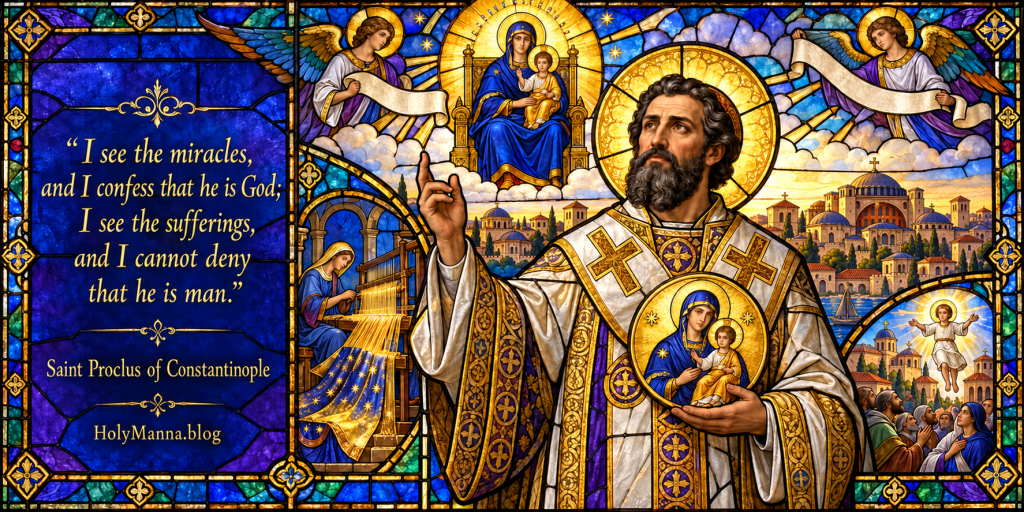
A Voice for the Theotokos
Some saints change the world with armies of converts, with hospitals and schools, with dramatic martyrdoms that echo through the centuries. Saint Proclus of Constantinople changed the world with a homily. On a feast of the Virgin Mary in the imperial capital, sometime between the years 428 and 430, a quiet bishop without a diocese stood up in the great cathedral of Constantinople and preached the most famous sermon on the Mother of God in all of ancient Christian literature. Sitting in the audience, on his own episcopal throne, was the man that sermon was aimed at: Nestorius, the Archbishop of Constantinople, who had begun telling the faithful that Mary should not be called the Theotokos, the Mother of God. Proclus looked at his own archbishop and preached the truth anyway.
That moment helped spark one of the great doctrinal battles of Church history, a battle the Church won at the Council of Ephesus in 431, when the Fathers solemnly confessed what Proclus had preached. The Catechism teaches the fruit of that victory to this day: “Called in the Gospels ‘the mother of Jesus,’ Mary is acclaimed by Elizabeth, at the prompting of the Spirit and even before the birth of her son, as ‘the mother of my Lord.’ In fact, the One whom she conceived as man by the Holy Spirit, who truly became her Son according to the flesh, was none other than the Father’s eternal Son, the second person of the Holy Trinity. Hence the Church confesses that Mary is truly ‘Mother of God’ (Theotokos)” (CCC 495).
Proclus would go on to become Archbishop of Constantinople himself, from 434 until his death in 446 or 447, and he would spend those years not settling scores but healing wounds. He brought home the relics of Saint John Chrysostom, reconciled a divided city, and answered distant churches with patience and precision. His feast is kept in the Roman Martyrology on October 24th, while the Eastern Churches honor him on November 20th. He is a saint for anyone who has ever been passed over, overlooked, or told to wait; and he is a saint for anyone who loves the Blessed Virgin Mary, because few men in history have loved her more eloquently.
A Boy Reader in the Imperial City
Proclus was born around the year 390, and the tradition recorded in Butler’s Lives of the Saints holds that he was a native of Constantinople itself, the glittering new capital that Constantine had raised on the Bosphorus only a few generations earlier. Nothing certain is recorded about his family, which is itself a kind of lesson; God often builds his greatest servants from households history never bothered to write down.
What the sources do tell us is that Proclus entered the service of the Church very young. The contemporary Church historian Socrates, quoted in The Catholic Encyclopedia, records that Proclus was a lector at a very early age and that, assiduously frequenting the schools, he devoted himself to the study of rhetoric. A lector, then as now, was entrusted with proclaiming the Word of God in the liturgical assembly, and the Church has always understood that office as a genuine participation in her mission. The Catechism teaches that “the whole community of believers is, as such, priestly. The faithful exercise their baptismal priesthood through their participation, each according to his own vocation, in Christ’s mission as priest, prophet, and king” (CCC 1546). Proclus took that seriously. The boy who read the Scriptures aloud became a man soaked in them.
A beloved tradition in both East and West remembers Proclus as a disciple of Saint John Chrysostom, the golden-mouthed preacher who governed Constantinople until his unjust deposition in 404. What is securely documented is slightly different but no less beautiful: Proclus served as secretary to Archbishop Atticus of Constantinople, who ordained him deacon and then priest, and Proclus carried a deep and lifelong devotion to Chrysostom’s memory, a devotion he would one day express in the most dramatic way imaginable. Whether or not he ever sat at Chrysostom’s feet as a student, he was unmistakably Chrysostom’s heir in the pulpit. The discipleship itself, cherished as it is, cannot be verified from the earliest records.
His gifts did not go unnoticed. When Archbishop Atticus died in 425, a strong party in the capital wanted Proclus to succeed him, but another man, Sisinnius, was chosen instead. Sisinnius clearly thought highly of the young priest, because in 426 he consecrated Proclus Archbishop of Cyzicus, an important see across the Sea of Marmara. And here Proclus received one of the strangest humiliations in the lives of the saints: the people of Cyzicus simply refused to receive him. They elected a bishop of their own, against the canons, and no one forced the issue. Proclus was left a bishop without a flock, a shepherd with no sheep, living on in Constantinople with a title and nothing else. When Sisinnius died at the end of 427, Proclus was again the obvious choice for the patriarchate, and again he was passed over; the Emperor Theodosius II brought in an outsider, a famous preacher from Antioch named Nestorius. Heaven, it turned out, had a reason for every delay.
A Hymn from the Angels
Nestorius had been archbishop less than a year when he and his circle began attacking the title that Christians in Constantinople loved to give the Virgin Mary: Theotokos, the God-bearer, the Mother of God. To Nestorius, the title seemed dangerous, as though it made a creature the origin of divinity. In reality, the title protects something far more important: the truth that the child Mary bore is one divine Person, the eternal Son of God, truly made man. Deny the Theotokos and you quietly split Christ in two. The Catechism explains what was at stake: “The Nestorian heresy regarded Christ as a human person joined to the divine person of God’s Son”, and against it the Council of Ephesus “confessed ‘that the Word, uniting to himself in his person the flesh animated by a rational soul, became man’” (CCC 466).
Into that storm stepped Proclus, the bishop without a diocese. Invited to preach on a feast of the Virgin in the great church, with Nestorius seated before him, Proclus delivered what scholars still regard as the most celebrated Marian sermon of Christian antiquity, Homily 1 on the Theotokos. The sources differ on the exact date; the New Catholic Encyclopedia places it in the Christmas season of 428, and some scholars date it as precisely as December 24, 428, while others assign it to a newly instituted feast of the Virgin in 430. What no one disputes is what he said. He opened with a cascade of praise that still takes the breath away: “She who called us here today is the Holy Mary; the untarnished vessel of virginity; the spiritual paradise of the second Adam”. And then he reached for an image only a poet could find, calling the Virgin “the awesome loom of God’s divine plan upon which the robe of union was woven in an inexpressible way”, adding that “the Holy Spirit operated the loom”. In Mary’s womb, he was saying, God wove himself a garment of our humanity, so that divinity and humanity would be united forever in the one Person of Christ, just as The Gospel of John proclaims: “And the Word became flesh and dwelt among us” (Jn 1:14).
Nestorius preached a rebuttal within days, and the controversy spun outward until it engulfed the whole Church. Proclus did not attend the Council of Ephesus in 431, but his homily did; it was placed at the very head of the Greek acts of the Council, a silent witness that the faith of Ephesus was simply the faith of the Church. Nestorius was deposed, Mary’s title was vindicated, and a priest named Maximian was made archbishop in his place. When Maximian died on April 12, 434, the long wait finally ended. Socrates records, as quoted in The Catholic Encyclopedia, that “the Emperor Theodosius wishing to prevent the disturbances which usually attend the election of a bishop, directed the bishops who were then in the city to place Proclus in the episcopal chair before the body of Maximian was interred, for he had received letters from Celestine, Bishop of Rome, approving of this election”. Catholic readers should savor that detail. The man who had been rejected twice was finally enthroned with the explicit approval of the Pope, Saint Celestine I, a quiet early witness to the communion between Constantinople and the See of Peter.
As archbishop, Proclus kept preaching; roughly 35 of his homilies on the feasts of Christ, the Virgin, and the saints survive to this day. In a sermon on the Annunciation he distilled the whole mystery of the Incarnation into two unforgettable lines. First the doctrine: “We do not say a man became God, but rather we confess that God was incarnate and became man”. Then the wonder of faith contemplating Christ: “I see the miracles, and I confess that he is God; I see the sufferings, and I cannot deny that he is man”. Sixteen centuries later, a Catholic could hand those sentences to a confused friend and have nothing to add.
The most famous miraculous story attached to Proclus belongs to his years as archbishop, and it is told as a tradition handed down by Greek historians such as Theophanes and recounted by Butler. During the reign of Theodosius II, the tradition says, Constantinople was shaken by violent earthquakes that went on for months. The emperor, the archbishop, and the whole terrified population went out into the open fields in procession, praying for deliverance. As they prayed, a young boy was suddenly lifted into the air before the eyes of the crowd, who cried out with one voice, Kyrie eleison, Lord, have mercy. When the child was returned to the earth, he reported that he had heard the choirs of angels singing a hymn: “Holy God, Holy Mighty, Holy Immortal, have mercy on us”. Proclus instructed the people to sing what the angels sang, and when they did, the tremors ceased. This hymn is the Trisagion, the thrice-holy, and the story of its heavenly origin spread so widely that Pope Felix III referred to it in a letter later in the fifth century. The story itself cannot be verified; some scholars note that no independent record of an earthquake survives from the years of Proclus’s patriarchate, and the earliest accounts come generations after his death. What can be verified is remarkable enough: the Trisagion entered the Liturgy of Constantinople in exactly these decades, between about 430 and 450, and the Fathers of the Council of Chalcedon sang it in 451, within a few years of Proclus’s death. Whatever happened in that field, the Church has never stopped singing.
Passed Over, Rejected, and Still at Peace
Proclus was not a martyr. His hardships were of the slower, quieter kind, the kind most people today will actually recognize from their own lives. He was publicly rejected by the people of Cyzicus, who would rather break canon law than accept him as their bishop. He was passed over for the patriarchate of Constantinople not once but twice, in 425 and again in 427, the second time in favor of the very man who would become the most notorious heretic of the age. He spent years as a bishop in name only, watching lesser men receive what everyone agreed he deserved. Scripture could have been written about his situation: “Wait for the Lord; be strong, and let your heart take courage; wait for the Lord!” (Ps 27:14).
And when the crisis came, he suffered the particular agony of a man who sees error being preached from the highest pulpit in the land. Proclus did not respond with rage or ambition. He preached the truth plainly, in Nestorius’s presence, and when a formal accusation of heresy was lodged against the archbishop, Proclus withdrew from communion with him rather than pretend nothing was wrong. There is real suffering in that kind of fidelity; it costs friendships, security, and reputation, and it offers no guarantee of vindication within one’s lifetime.
Even his years on the throne were not easy. Around 435, the bishops of Armenia wrote to him in distress about teachings circulating in their churches drawn from the writings of Theodore of Mopsuestia, teachings that tended in the same direction as the errors of Nestorius. Proclus answered with a letter so substantial that history calls it the Tome of Saint Proclus to the Armenians. In it he required the dangerous propositions to be condemned, laying out the Church’s faith in the Incarnation with balance and care. But when agitators tried to turn his letter into a posthumous condemnation of Theodore by name, a move that would have set the East ablaze all over again, Proclus refused; he disclaimed any intention of attributing the propositions to Theodore personally, condemning the error while declining to inflame a war over a dead man’s reputation. The contemporary historian Socrates praised precisely this quality in him, recording that Proclus governed with gentleness and prudence and won over even those who had been opposed to him. It takes one kind of courage to denounce heresy; it takes another, rarer kind to denounce heresy without destroying the peace of the Church. Proclus had both, and The Catechism names the source of that rare combination when it lists among the fruits of the Holy Spirit “charity, joy, peace, patience, kindness, goodness, generosity, gentleness, faithfulness, modesty, self-control, chastity” (CCC 1832).
His greatest act of healing came in 438. The wound left by the unjust deposition and exile of Saint John Chrysostom had never closed; more than three decades later, a faction known as the Johnites still refused communion with the archbishops of Constantinople out of loyalty to their wronged shepherd, who had died on the road in 407. Proclus had already restored Chrysostom’s name to the Church’s public prayers. Now he persuaded the emperor to bring the saint home. Chrysostom’s relics were carried in triumph to Constantinople and enshrined in the Church of the Holy Apostles, and Butler records the tradition that the young emperor Theodosius II publicly begged the dead saint’s forgiveness for the sins his parents had committed against him. The schism dissolved. The man who may never have been Chrysostom’s student in life became the guardian of his honor in death, and a city that had been divided for a generation knelt together again. Proclus died not long afterward, in 446 or 447; the sources conflict on the exact date, with some modern scholars giving July 24, 446, and the older Western tradition giving October 24, 447. He had governed for roughly 12 years and left the Church at peace.
A Legacy Sung Every Good Friday
Honesty matters when talking about the saints, so it should be said plainly: the historical sources do not preserve a catalog of healings or dramatic miracles worked at the tomb of Saint Proclus, and no major pilgrimage shrine dedicated to him survives today. His relics shared the fate of so much of Christian Constantinople across the centuries of conquest and loss. If a reader is looking for the miraculous in his afterlife, it will not be found in a reliquary. It will be found in a hymn.
Because the astonishing truth is this: the prayer that tradition associates with Saint Proclus is still on the lips of the whole Church. The Trisagion never stopped. The Fathers of Chalcedon sang it in 451. The Eastern Churches, Catholic and Orthodox alike, sing it at every Divine Liturgy to this day. And every year on Good Friday, in the Roman Rite itself, during the Adoration of the Holy Cross, the choir sings the Reproaches, and there it is, chanted in both Greek and Latin side by side: Hagios o Theos, Sanctus Deus; Holy God, Holy Mighty One, Holy Immortal One, have mercy on us. A Catholic kneeling before the Cross this coming Good Friday will pray words that tradition says the angels taught a frightened city while Proclus led its prayers. Few saints have a memorial like that. The Catechism teaches that in the earthly liturgy “we sing a hymn to the Lord’s glory with all the warriors of the heavenly army” (CCC 1090), and the Trisagion is that teaching set to music.
His influence on doctrine proved just as durable. His Tome to the Armenians was quoted and treasured for centuries in the Christological debates that followed. His Marian preaching helped fix forever the Church’s language about the Mother of God; when Cardinal Saint John Henry Newman defended Catholic devotion to Mary in the 19th century, he reached back and cited Proclus as a witness that the Theotokos belongs to the most ancient faith of the Church, not to later invention. Roughly 35 of his homilies survive, still studied, still quoted, still capable of stopping a reader cold. The Roman Martyrology commemorates him on October 24th, the Byzantine calendar on November 20th, and the Greek Menologies and ancient calendars have carried his name without interruption for 15 centuries. A man who was twice rejected for the highest office in the Eastern Church has outlasted the empire that rejected him.
What Proclus Teaches a Restless Generation
Saint Proclus speaks with surprising directness to anyone in their 20s, 30s, or 40s today, because his story is built around an experience this generation knows intimately: waiting for a life that seems slow to arrive. He was qualified, gifted, and ready in 425, and he did not receive his mission until 434. He was publicly rejected by Cyzicus through no fault of his own. He watched the position he was made for go to a man who would use it to attack the faith. If anyone ever had grounds for bitterness, for rage-posting against the system, for walking away from the Church that kept passing him over, it was Proclus. Instead he stayed, served, studied, and prayed, and when God finally opened the door, Proclus walked through it without a trace of vengeance in his hands. Is there a delay or a rejection in your own life right now that God might be using to prepare you for something you cannot yet see?
He also models something desperately needed in an age of online outrage: how to fight for truth without losing charity. Proclus never pretended error was harmless; he preached against Nestorius to his face and broke communion when the faith demanded it. But he refused to humiliate when he could heal, refused to condemn a dead man’s name when condemning the error was enough, and spent his authority reconciling the Johnite schism rather than punishing old enemies. That balance is not a personality trait; it is holiness, the fruit of the Spirit described in CCC 1832. Anyone who has ever had to correct a friend, push back in a group chat, or defend the faith at a family dinner knows how hard it is to hold truth and gentleness together. When you defend what is right, do the people around you encounter the gentleness of Christ, or only the sharpness of an argument?
Finally, Proclus hands every Catholic a devotion and a doctrine in a single word: Theotokos. Calling Mary the Mother of God is not pious exaggeration; it is a wall around the Incarnation, guarding the truth that the one she bore is truly God and truly man, as The Catechism teaches in CCC 495 and CCC 466, and as Elizabeth confessed when she greeted “the mother of my Lord” (Lk 1:43). A practical way to live his legacy this week would be to pray the Angelus once a day, or to pray the Trisagion itself, slowly, as a morning offering: Holy God, Holy Mighty One, Holy Immortal One, have mercy on us. Another would be to learn one line of his preaching by heart, perhaps “I see the miracles, and I confess that he is God; I see the sufferings, and I cannot deny that he is man”, and keep it ready for the next conversation about who Jesus really is. If a friend asked you tomorrow why Catholics call Mary the Mother of God, could you answer as simply and confidently as Proclus did?
Engage With Us!
The story of Saint Proclus is a story of patience rewarded, truth defended, and wounds healed, and it deserves a conversation. Share your thoughts and reflections in the comments below; this community grows stronger every time someone speaks honestly about their walk with Christ. Here are some questions to pray with and respond to:
- Proclus waited nearly a decade, through two public rejections, before receiving the mission God had prepared for him. Where in your life is God asking you to wait faithfully instead of forcing a door open?
- Proclus defended the truth about Christ to Nestorius’s face, yet refused to condemn Theodore of Mopsuestia by name when it would only have caused division. How do you decide when to speak hard truths and when to hold back for the sake of peace?
- The title Theotokos protects the truth that Jesus is one divine Person, true God and true man. Has devotion to Mary ever deepened your understanding of her Son, and how?
- Proclus healed a 30-year schism by honoring Saint John Chrysostom instead of defending the institution that wronged him. Is there a relationship in your life that could be healed by honoring the person you or others have hurt?
- Tradition says a whole city learned to pray the Trisagion in a moment of fear. What prayer do you reach for when the ground shakes in your own life, and could the Trisagion become part of your daily rhythm this week?
Saint Proclus spent his whole life proclaiming one glorious truth, that God himself was woven into our humanity in the womb of the Virgin, and he proclaimed it with patience, courage, and love. Go and do the same in your corner of the world. Defend the faith without losing your gentleness, honor the Mother of God without fear, and wait on the Lord with a steady heart, doing everything with the love and mercy that Jesus taught us.
Saint Proclus of Constantinople, pray for us!
Follow us on YouTube, TikTok, Instagram and Facebook for more insights and reflections on living a faith-filled life.


Leave a Reply