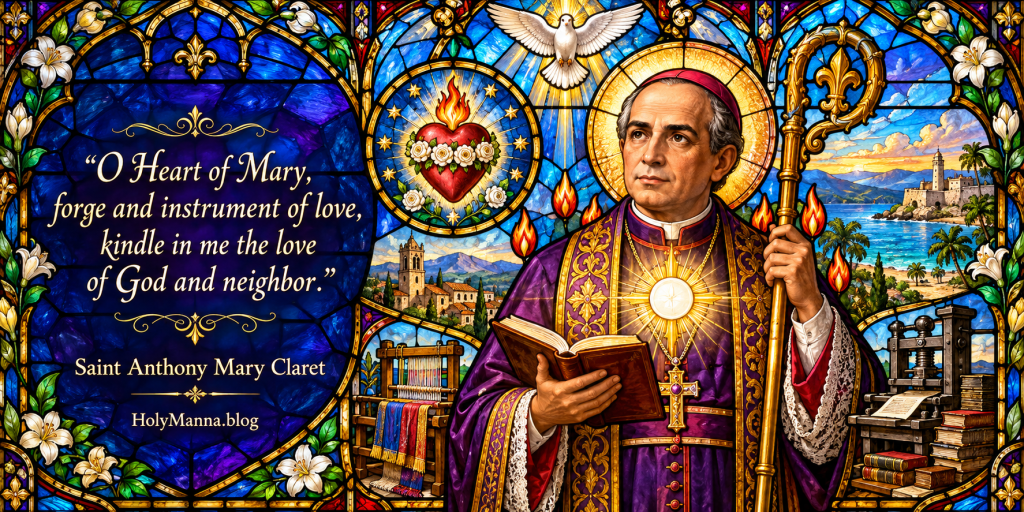
The Weaver Who Set the World on Fire
Some saints seem to live three or four lives in the span of one. Saint Anthony Mary Claret, celebrated on October 24th, is one of them. He was a Catalan weaver with a promising career in textile design, a parish priest, a barefoot missionary who crisscrossed Catalonia and the Canary Islands, the founder of a worldwide religious congregation, the reforming Archbishop of Santiago de Cuba, the reluctant confessor of a queen, a pioneer of the Catholic press who helped publish millions of books and pamphlets, a mystic who carried an extraordinary Eucharistic grace, a Council Father at the First Vatican Council, and finally an exile who died far from home with the words of the Psalms on his tombstone. He preached an estimated 10,000 sermons and wrote or published roughly 150 to 200 books and pamphlets, a figure that varies across sources but staggers the imagination either way.
The Church honors him as the patron of weavers and textile merchants, a nod to the trade of his youth; of savings, because he taught the poor to secure their own economic dignity and founded a savings bank in Cuba; of the Catholic press, which he practically invented in its modern Spanish form; and of the Claretian Missionaries, their students and educators, and the Dioceses of the Canary Islands. His life answers a question that haunts every believer who feels ordinary: what can God do with a tradesman’s hands and a willing heart? The answer, it turns out, is almost anything. As The Catechism teaches, CCC 2044 reminds the faithful that the witness of a Christian life has real power in the world: “The witness of a Christian life and good works done in a supernatural spirit have great power to draw men to the faith and to God.” Anthony Claret was that witness, multiplied across two continents.
From the Loom to the Altar
Antoni Maria Claret i Clarà was born on December 23rd, 1807, in Sallent, a small town in Catalonia in northeastern Spain, not far from Barcelona. He was the fifth of eleven children born to Juan Claret and Josefa Clará. His father ran a modest wool and textile workshop, and the clatter of wooden looms filled the family home from Anthony’s earliest days. The Clarets were not wealthy, but they were rich in faith. The family prayed the Rosary together, went to Mass, and made pilgrimages to a nearby Marian shrine. From that soil grew the two great loves of Anthony’s life, the Eucharist and the Blessed Virgin Mary.
Even as a small boy, Anthony was gripped by the thought of eternity. He would lie awake pondering the word “forever,” grieved by the idea that souls could be lost eternally, and moved to do something about it. Tradition recounts that when a bishop visited his school and asked the boy of about eleven what he wanted to be, Anthony answered without hesitation that he wanted to be a priest. The times, however, had other plans. Spain was convulsed by the Napoleonic invasion the year he was born and by political turmoil throughout his childhood. His schooling was interrupted, and by about age 12 he was working at his father’s looms.
At around 17, his father sent him to Barcelona to study the latest techniques in textile manufacturing. Anthony thrived. He excelled in textile design school, and large firms began courting him with offers. In his spare hours he studied Latin, French, and printing, skills that Providence was quietly stockpiling for later use. Yet success rang hollow. A series of disappointments, and a brush with death when a wave swept him into the sea, shook him awake. Above all, one sentence of Scripture kept resounding in his heart, the words of Our Lord in The Gospel of Matthew: “For what will it profit a man, if he gains the whole world and forfeits his life?” (Mt 16:26). That verse unraveled every ambition the looms had woven.
Anthony first dreamed of becoming a Carthusian monk, hidden in silence. The Bishop of Vic wisely counseled him to enter the diocesan seminary first, and in 1829 he did. He was ordained a priest on June 13th, 1835, the feast of Saint Anthony of Padua, and assigned to his home parish of Sallent. This was conversion in the deepest Catholic sense, not from unbelief to belief, but from a good life to a surrendered one. The Catechism describes this ongoing conversion as “an uninterrupted task for the whole Church” (CCC 1428), and Claret lived it. Years later, as Archbishop of Santiago de Cuba, he would add “Mary” to his name, sealing in his very identity the Mother who had formed him from childhood.
Ten Thousand Sermons and a Congregation Born of Fire
A single parish could not contain the fire in Claret’s chest. Feeling called to the missions, he traveled to Rome to offer himself to the Congregation for the Propagation of the Faith, and he even entered the Jesuit novitiate there. Ill health forced him to leave, and he returned to Spain, serving in the parishes of Viladrau and Girona, where he became known for his care of the poor and the sick. Then his bishop set him loose as an Apostolic Missionary, and Catalonia met a phenomenon it had rarely seen. Claret went on foot from town to town with little more than a map, a bundle, and his breviary, preaching popular missions, hearing confessions for hours on end, sometimes 15 hours in a day, and drawing enormous crowds. Accounts from his missions report that his preaching was accompanied by remarkable conversions and cures, and one devotional account describes a resplendent light seen shining from his face as he offered the Holy Sacrifice of the Mass. These reports of wonders during his missions come down as traditions attached to his preaching rather than as formally documented miracles, and they cannot be individually verified.
What is thoroughly documented is the fruit. Entire regions returned to the practice of the faith. From 1848 to 1849 he spent some 15 months preaching missions across the Canary Islands, where he is still remembered so warmly that their dioceses claim him as patron. He understood, long before anyone coined the phrase, that media is a mission field. In 1848 he helped found the Librería Religiosa in Barcelona, a Catholic publishing house that poured out millions of inexpensive books, pamphlets, and holy cards so that ordinary families could hold solid doctrine in their own hands. He himself wrote constantly, including a catechism and a system for teaching religion that was later approved for wider use in the Church.
Then came July 16th, 1849, the feast of Our Lady of Mount Carmel. In a room of the seminary at Vic, Claret gathered five young priests and founded the Congregation of Missionary Sons of the Immaculate Heart of Mary, known today as the Claretians. Pope Pius IX approved the congregation on December 22nd, 1865. Claret later wrote the passage that still defines his spiritual sons, found in Autobiography 494: “A Son of the Immaculate Heart of Mary is a man on fire with love, who spreads its flames wherever he goes. He desires mightily and strives by all means possible to set the whole world on fire with God’s love. Nothing daunts him; he delights in privations, welcomes work, embraces sacrifices, smiles at slander, and rejoices in suffering. His only concern is how he can best follow Jesus Christ and imitate Him in working, suffering, and striving constantly and single-mindedly for the greater glory of God and the salvation of souls.” That is not a job description; it is a portrait of the man who wrote it. His missionary heart simply obeyed what The Catechism calls the Church’s deepest identity, for “the Church on earth is by her very nature missionary” (CCC 850), sent so that all people might be drawn to the Father.
Days after the founding, Claret received news he dreaded: at the request of the Spanish crown, Pope Pius IX had named him Archbishop of Santiago de Cuba. Sources date the appointment variously to 1849, 1850, or 1851; he was consecrated at Vic in October 1850 and arrived in Cuba after a two month voyage, beginning his ministry by entrusting the island to Mary at the shrine of Our Lady of Charity of El Cobre, patroness of Cuba. The archdiocese had gone years without a resident shepherd, and it showed. Claret responded with a whirlwind of reform and mercy. He reorganized the seminary and restored discipline among the clergy. He visited his vast archdiocese town by town, multiple times, largely on foot or mule. In his first two years he validated over 9,000 marriages, many of them common-law and interracial unions that unjust custom and law had kept from the altar. He preached boldly against the evils of slavery and personally instructed enslaved people in the faith, which earned him powerful enemies. He brought in the Piarists, the Jesuits, and the Daughters of Charity to run schools and charitable institutions, founded a farm-school for poor children, established a savings bank with a strongly social character so the poor could escape economic bondage, promoted diversified farming so families would not be at the mercy of the sugar barons, and opened popular libraries. When an earthquake struck and a cholera epidemic followed in 1852, Claret and his priests risked their lives serving the suffering. In 1855, together with the Venerable María Antonia París, he founded the Claretian Missionary Sisters. Here was a bishop who took seriously the Church’s love of preference for the poor, which The Catechism roots in the very Gospel: “Those who are oppressed by poverty are the object of a preferential love on the part of the Church” (CCC 2448).
The Razor at Holguín
Holiness of that voltage attracts opposition, and Claret’s reforms in Cuba struck at entrenched sin and entrenched money. Tradition holds that his life was threatened or attempted as many as 14 or 15 times during his years on the island. That larger count is a tradition and cannot be verified in its details, but the most serious attack is documented beyond doubt, above all by Claret himself.
On February 1st, 1856, in the city of Holguín, during his fourth pastoral visitation, a would-be assassin who had stalked him from the port of Gibara struck. As the Archbishop raised a handkerchief to his mouth, the man slashed at him with a razor. Claret described the moment plainly in his Autobiography: “instead of slitting my throat as he had intended, he slashed my face across the left cheek, from the ear to the chin.” The blade cut to the bone of his upper and lower jaw, leaving him with a permanent scar and a lifelong difficulty in speaking clearly. Accounts link the attacker’s rage to Claret’s moral reforms, including the conversion of a woman who had been the man’s mistress and the Archbishop’s insistence on clerical discipline. False reports of the Archbishop’s death spread within moments.
What happened next separates the saints from the merely brave. Claret rejoiced. He wrote that the attack brought him “the long-desired goal of shedding my blood for the love of Jesus and Mary”, and when his attacker was condemned to death, the wounded Archbishop personally interceded and obtained the commutation of the sentence to imprisonment. He forgave the man who had tried to kill him and then fought to save that man’s life. It is difficult to imagine a more literal obedience to the Sermon on the Mount, where Our Lord commands, “Love your enemies and pray for those who persecute you” (Mt 5:44). The Catechism teaches that such witness is a transmission of the faith itself, for “martyrdom is the supreme witness given to the truth of the faith” (CCC 2473), and although Claret survived, he bore in his flesh the mark of a martyr’s offering for the rest of his days.
His hardships did not end in Cuba. Recalled to Spain in 1857 to serve as confessor to Queen Isabella II, Claret accepted the post with genuine reluctance. Court life repelled him. He refused to live in the palace, coming only to hear the queen’s confession and to instruct the royal children, and he poured his energy instead into preaching, writing, directing the Escorial, and spreading good books. Even so, the anticlerical press savaged him for years with caricatures and slanders, and he remained a target of plots in Madrid as he had been in Cuba. When the revolution of 1868 drove Isabella II from her throne, Claret followed her into exile in France rather than abandon a penitent. In 1869 he went to Rome for the First Vatican Council, where the aging missionary with the scarred face rose to speak in defense of papal infallibility, a doctrine the Council would define and which The Catechism presents in CCC 891. During this period he suffered a stroke. Hounded even in exile by agents of the Spanish revolution, he took refuge with the Cistercian monks at the abbey of Fontfroide near Narbonne. There, surrounded by the monks and a few of his missionaries, he died on October 24th, 1870, at the age of 62. His tombstone carries an epitaph that echoes Psalm 45 and the dying words of Pope Saint Gregory VII: “I have loved justice and hated iniquity; therefore I die in exile.”
A Living Tabernacle
Any account of Claret’s life has to reckon with the extraordinary grace he recorded in his own hand. On August 26th, 1861, while praying in the church of the Rosary at La Granja de San Ildefonso near Segovia, he received what he called the great grace of his life. He wrote in Autobiography 694: “the Lord granted me the great grace of keeping the sacramental species intact within me and of having the Blessed Sacrament always present, day and night, in my breast.” In other words, the Eucharistic species he received at Communion were preserved within him from one Communion to the next, making him, in the language of his spiritual family, a living tabernacle. Claretian tradition holds that this grace continued for the final nine years of his life. This is Claret’s own firsthand testimony of an interior mystical gift, recorded under obedience and weighed by the Church in his cause; by its very nature it cannot be externally verified, and that should be stated plainly. What can be verified is the shape of the life around it, a man so consumed by the Eucharist that The Catechism‘s teaching reads like his biography: “The Eucharist is ‘the source and summit of the Christian life’” (CCC 1324).
After his death, devotion to Claret spread quickly. The faithful of the Narbonne region venerated his burial place at Fontfroide until 1897, when his remains were solemnly transferred to Vic in Catalonia. They rest today in the crypt of the Claretian church there, a sanctuary that draws pilgrims seeking the intercession of the weaver-archbishop, and Fontfroide itself still commemorates him each October. Miracles attributed to his intercession were examined and approved through the Church’s rigorous processes, leading Pope Pius XI to beatify him on February 25th, 1934, and Pope Pius XII to canonize him on May 7th, 1950. The accessible sources record the fact of those approved miracles without preserving their case details, so no specific healing story is recounted here, in keeping with honesty about what can and cannot be verified. The measure of his posthumous impact is also institutional and cultural. By the time of his canonization, some 4,000 Claretians were serving in about 240 houses across 24 countries, and his sons and daughters continue his mission today on every inhabited continent, in parishes, schools, publishing houses, and the missions. Cuba still honors him as its spiritual father; Catalonia counts him among the figures who helped revive its language through his popular preaching and writing; and Catholic publishers and communicators around the world look to him as their forerunner and patron.
Lighting Fires in Ordinary Places
Anthony Claret’s life lands differently once it becomes clear how ordinary his beginnings were. He was a tradesman’s son with a good career ahead of him, and the question that changed everything was not exotic. It was simply Mt 16:26 taken seriously. What would it profit you to gain everything you are currently chasing and lose your soul in the process? That is a question worth sitting with in prayer this week, perhaps in front of the Blessed Sacrament, where Claret found the furnace of his strength.
His witness suggests several concrete practices. First, let the Eucharist become the center of gravity. Claret carried the Blessed Sacrament in his breast by an extraordinary grace, but every Catholic is invited into an ordinary version of the same intimacy through frequent Communion and adoration, for The Catechism teaches that Holy Communion “preserves, increases, and renews the life of grace received at Baptism” (CCC 1392). When was the last time you received Communion with the awareness that you were becoming a bearer of Christ into the world? Second, use the tools on the workbench. Claret evangelized with looms’ discipline, a printer’s savvy, and a walker’s stamina. The skills already in hand, spreadsheets, social media, cooking, coaching, languages, are raw material for mission, since “lay people also fulfill their prophetic mission by evangelization” (CCC 905). What one skill could be placed at God’s disposal this month? Third, practice Claret’s scandalous forgiveness. He pleaded for the life of the man who disfigured him. Most people will never face a razor, but everyone faces the slow temptation to nurse grudges. Is there one person who needs to be forgiven, by name, in prayer tonight? Fourth, love the poor practically. Claret did not only preach to the poor of Cuba; he built them schools, savings, and skills. Works of mercy are not extra credit; The Catechism calls giving alms to the poor “a witness to fraternal charity” and “a work of justice pleasing to God” (CCC 2462). Finally, expect opposition and refuse bitterness. Claret was slandered, caricatured, attacked, and exiled, and he died with a psalm of justice on his tomb and peace in his soul. Fidelity, not comfort, is the goal.
Engage With Us!
HolyManna would love to hear from readers: share thoughts, reflections, and favorite moments from the life of Saint Anthony Mary Claret in the comments below. To go deeper, consider these questions:
- Saint Anthony Claret walked away from a promising career after hearing Mt 16:26. What success, comfort, or ambition might God be asking you to hold more loosely right now?
- Claret forgave and defended the man who slashed his face. Who in your life is hardest to forgive, and what would it look like to pray for that person this week?
- He used the printing press, the newest technology of his day, to spread the Gospel. How could you use your own skills or platforms to share the faith?
- Claret received the grace of carrying the Blessed Sacrament within him day and night. How might more frequent Communion or a weekly holy hour change the way you carry Christ into your daily life?
- As Archbishop, he validated thousands of marriages and served the enslaved and the poor at great personal risk. Where is God inviting you to stand up for human dignity in your community?
Saint Anthony Mary Claret was a man on fire with love who spent every gift he had, from his weaver’s hands to his wounded face, to set the world ablaze with the love of God. May his intercession kindle that same fire in every heart that reads his story. Go out this week and live your faith boldly, generously, and joyfully, doing everything with the love and mercy that Jesus taught us.
Saint Anthony Mary Claret, pray for us!
Follow us on YouTube, TikTok, Instagram and Facebook for more insights and reflections on living a faith-filled life.


Leave a Reply