Saturday of the Twenty-ninth Week in Ordinary Time – Lectionary: 478
The House God Is Still Building
Every construction site tells a story of patience. Scaffolding goes up, seasons pass, and slowly something beautiful takes shape where there was once only dirt. The readings for October 24th, 2026 reveal that God is running the most patient construction project in history, and every baptized soul is part of the build. The central theme uniting today’s Scriptures is this: God is building a living house, and He gives each person grace, time, and cultivation so that the whole structure grows and bears fruit.
In the First Reading from Ephesians 4:7-16, Saint Paul describes the risen and ascended Christ pouring out gifts on His Church, appointing apostles, prophets, evangelists, pastors, and teachers so that the whole Body grows “to the extent of the full stature of Christ.” The Responsorial Psalm, Psalm 122, is a pilgrim song that generations of Israelites sang while climbing the dusty roads to Jerusalem for the great feasts, rejoicing that they were going up together to the house of the Lord. Then, in Luke 13:1-9, Jesus takes two tragic headlines from His own day and turns them into an urgent call to repentance, finishing with the parable of a barren fig tree and a gardener who begs for one more year to dig, fertilize, and coax fruit from it.
Grace is given. The pilgrimage is underway. The Gardener is still working the soil. The only question left is whether each soul will cooperate, grow, and bear the fruit it was planted to produce. That question deserves an honest answer, and today’s readings help provide one.
First Reading — Ephesians 4:7-16
The Ascended King Who Shares His Spoils
Ephesus was no sleepy village. It was a wealthy port city of Asia Minor, home to the Temple of Artemis, one of the seven wonders of the ancient world, and a crossroads of commerce, magic, and competing philosophies. Into that noisy marketplace of ideas, Saint Paul wrote a letter whose first three chapters soar through the mystery of God’s eternal plan, and whose last three chapters, beginning here in chapter 4, get practical about how to live it. This passage sits at the hinge. Paul has just begged his readers to preserve unity, and now he explains the engine of that unity: the ascended Christ Himself, who distributes grace and gifts so that His Body actually grows. The passage fits today’s theme perfectly, because it shows who supplies the materials for the house God is building.
Ephesians 4:7-16
Brothers and sisters:
Grace was given to each of us
according to the measure of Christ’s gift.
Therefore, it says:He ascended on high and took prisoners captive;
he gave gifts to men.What does “he ascended” mean except that he also descended
into the lower regions of the earth?
The one who descended is also the one who ascended
far above all the heavens,
that he might fill all things.And he gave some as Apostles, others as prophets,
others as evangelists, others as pastors and teachers,
to equip the holy ones for the work of ministry,
for building up the Body of Christ,
until we all attain to the unity of faith
and knowledge of the Son of God, to mature manhood
to the extent of the full stature of Christ,
so that we may no longer be infants,
tossed by waves and swept along by every wind of teaching
arising from human trickery,
from their cunning in the interests of deceitful scheming.
Rather, living the truth in love,
we should grow in every way into him who is the head, Christ,
from whom the whole Body,
joined and held together by every supporting ligament,
with the proper functioning of each part,
brings about the Body’s growth and builds itself up in love.
Detailed Exegesis
Verse 7: “Grace was given to each of us according to the measure of Christ’s gift.”
No believer is left out of the distribution. Grace here is not generic; it is measured out personally by Christ, the way a master builder assigns each worker a task suited to him. Saint John Chrysostom noted in his Homily 11 on Ephesians that Paul carefully avoids saying “according to the faith of each,” so that no one with small attainments falls into despondency. The measure belongs to Christ, not to human merit.
Verse 8: “Therefore, it says: He ascended on high and took prisoners captive; he gave gifts to men.”
Paul adapts Psalm 68, a victory hymn picturing a conquering king climbing to his throne with captives in tow, distributing spoils to his people. Jewish tradition applied that psalm to Moses ascending Sinai to receive the Law. Paul applies it to Christ ascending to heaven, where the spoils He distributes are nothing less than the gifts of the Holy Spirit.
Verse 9: “What does ‘he ascended’ mean except that he also descended into the lower regions of the earth?”
There is no Ascension without a descent first. Christ came down into human flesh, down into suffering, down into death itself. The Apostles’ Creed confesses that He descended to the dead, where, as the Church teaches, He opened heaven’s gates to the just who had gone before Him.
Verse 10: “The one who descended is also the one who ascended far above all the heavens, that he might fill all things.”
The same Person spans the whole distance from the grave to the highest heaven. Nothing in creation sits outside His reach, which means no human situation, no failure, and no corner of any life is beyond His filling presence.
Verse 11: “And he gave some as Apostles, others as prophets, others as evangelists, others as pastors and teachers,”
The gifts Christ gives turn out to be people. The ordained structure of the Church is not a human bureaucracy bolted onto the Gospel; it is Christ’s own Ascension gift, which is why Catholics can trust the apostolic ministry handed down through the bishops.
Verse 12: “to equip the holy ones for the work of ministry, for building up the Body of Christ,”
Pastors and teachers do not exist to do all the work while everyone else watches. They exist to equip the holy ones, meaning every baptized member, for ministry. The laity are not spectators at the construction site; they are crew.
Verse 13: “until we all attain to the unity of faith and knowledge of the Son of God, to mature manhood to the extent of the full stature of Christ,”
The target is staggering: full maturity measured against Christ Himself. Chrysostom wrote of this verse, “To the unity, says he, of the faith. Now, when we shall all believe alike, then shall there be unity.” Unity is not a vague feeling of togetherness; it is shared, mature faith.
Verse 14: “so that we may no longer be infants, tossed by waves and swept along by every wind of teaching arising from human trickery, from their cunning in the interests of deceitful scheming.”
Paul knew that spiritual infancy is dangerous. An untrained faith gets blown around by every clever argument and trend. The remedy is not cynicism but maturity, the kind formed by sound teaching and the sacraments.
Verse 15: “Rather, living the truth in love, we should grow in every way into him who is the head, Christ,”
Truth without love hardens into a weapon; love without truth dissolves into sentimentality. Growth happens only when both hold together, and the direction of growth is always toward the Head.
Verse 16: “from whom the whole Body, joined and held together by every supporting ligament, with the proper functioning of each part, brings about the Body’s growth and builds itself up in love.”
Every ligament matters. When one part stops functioning, the whole Body feels it. Chrysostom put the logic simply: “If there be one head, then is there one body.” The Church grows the way a healthy body grows, with every member doing its quiet, essential work in love.
Teachings
The Catechism gathers this entire passage into one luminous sentence. CCC 794 teaches, “Christ provides for our growth: to make us grow toward him, our head, he provides in his Body, the Church, the gifts and services through which we help one another along the way of salvation.” The gifts are real, and they are given for others. The Catechism returns to this very reading when describing the moral life of believers. CCC 2045 teaches, “Because they are members of the Body whose Head is Christ, Christians contribute to building up the Church by the constancy of their convictions and their moral lives. The Church increases, grows, and develops through the holiness of her faithful, until ‘we all attain to the unity of the faith and of the knowledge of the Son of God, to mature manhood, to the measure of the stature of the fullness of Christ.’” Holiness, in other words, is construction work. Every act of fidelity adds a brick, and every member who functions properly builds up the whole.
Reflection
It is easy to sit in a pew and assume that ministry belongs to the professionals. This reading demolishes that assumption. Christ measured out grace for you personally, and He did it on purpose. A practical step this week is to name one gift you actually have, whether teaching, hospitality, organization, music, or simple encouragement, and offer it to your parish or to one person who needs it. Another step is to invest in maturity: pick up the Catechism, join a Bible study, or finally ask the question about the faith you have been avoiding. What gift has Christ measured out to you, and where is it currently sitting unused? In what area of faith do you remain an infant, tossed by every wind, and what would growing up look like?
Responsorial Psalm — Psalm 122:1-5
The Song Pilgrims Sang on the Climb
Three times a year, according to Deuteronomy 16:16, Israelite men were to appear before the Lord in Jerusalem for the great feasts. Families would walk for days, and since Jerusalem sits on a ridge in the Judean hills, the last stretch was always a climb. For that climb, Israel had a playlist: the fifteen Songs of Ascents, Psalms 120 to 134, and Psalm 122 is the joyful heart of the collection. Attributed to David, it captures the electric moment when tired feet finally pass through the city gates. The psalm fits today’s theme because it shows God’s people going up together, rejoicing, to the very house the other readings describe being built.
Psalm 122:1-5
R. (1) Let us go rejoicing to the house of the Lord.
I rejoiced because they said to me,
“We will go up to the house of the LORD.”
And now we have set foot
within your gates, O Jerusalem.
R. Let us go rejoicing to the house of the Lord.
Jerusalem, built as a city
with compact unity.
To it the tribes go up,
the tribes of the LORD.
R. Let us go rejoicing to the house of the Lord.
According to the decree for Israel,
to give thanks to the name of the LORD.
In it are set up judgment seats,
seats for the house of David.
R. Let us go rejoicing to the house of the Lord.
Detailed Exegesis
Verse 1: “I rejoiced because they said to me, ‘We will go up to the house of the LORD.’”
The joy begins before the journey does, at the mere invitation. Worship in Israel was never a private hobby; neighbors summoned neighbors. The psalmist does not groan at the obligation of the feast. He lights up, which is itself a quiet examination of conscience for anyone who has ever groaned about Sunday Mass.
Verse 2: “And now we have set foot within your gates, O Jerusalem.”
The pilgrim stands still and savors arrival. After dusty roads and aching legs, the gates of the holy city are underfoot. The verse teaches the spiritual value of pausing at thresholds, of actually noticing the moment one steps into sacred space instead of rushing through it.
Verse 3: “Jerusalem, built as a city with compact unity.”
The Hebrew praises a city knit tightly together, walls and houses joined into one whole. The architecture becomes a parable: God’s city is compact, unified, nothing loose or fragmented. What Saint Paul says of the Body in Ephesians 4:16, joined and held together, the psalmist sees in stone.
Verse 4: “To it the tribes go up, the tribes of the LORD, according to the decree for Israel, to give thanks to the name of the LORD.”
Twelve tribes with twelve histories, rivalries, and accents all converge on one city because God decreed it. Unity among God’s people has never been natural; it is liturgical. They become one people precisely by going up together to give thanks, which is, beautifully, the literal meaning of Eucharist.
Verse 5: “In it are set up judgment seats, seats for the house of David.”
Jerusalem was not only the place of worship but the place of justice, where Davidic kings judged rightly. The verse quietly points forward, since the Son of David now reigns, and His Church is where mercy and judgment meet, above all in the confessional, which prepares the heart for the Gospel that follows.
Teachings
Saint Augustine preached on this psalm with the longing of a man homesick for heaven. In his Exposition on Psalm 122, he taught that these degrees are not of descent but of ascent, and that the true Jerusalem is the eternal one, writing, “But there is in heaven the eternal Jerusalem, where are our fellow-citizens, the Angels: we are wanderers on earth from these our fellow-citizens. We sigh in our pilgrimage; we shall rejoice in the city.” The Church formalizes this way of reading in CCC 117, which teaches of the anagogical sense of Scripture, “We can view realities and events in terms of their eternal significance, leading us toward our true homeland: thus the Church on earth is a sign of the heavenly Jerusalem.” Every Sunday procession up the aisle, then, is a rehearsal. The parish church is the city gate, the Mass is the feast, and the whole Christian life is one long Song of Ascents sung on the road home.
Reflection
Modern life trains people to attend worship the way they attend appointments, checking the time and calculating the commute. This psalm offers a different posture: rejoicing at the invitation itself. A concrete practice is to prepare for Sunday Mass the night before, reading the Gospel ahead of time, so that walking through the church doors feels like setting foot within the gates. Another is to recover the communal dimension by inviting someone, a friend, a sibling, a coworker drifting from the faith, with the psalmist’s own words: come to the house of the Lord. When was the last time you genuinely rejoiced on your way to Mass, and what stole that joy? Who in your life is waiting, perhaps without knowing it, for you to say, “We will go up to the house of the LORD”?
Holy Gospel — Luke 13:1-9
Two Headlines and a Fig Tree
By this point in The Gospel of Luke, Jesus has set His face toward Jerusalem, and the crowd around Him is buzzing with news. Two tragedies dominate the conversation. Pilate has slaughtered Galilean pilgrims in the middle of their sacrifices, mixing their blood with the blood of their offerings, and a tower near the pool of Siloam in Jerusalem has collapsed, killing eighteen people. Luke alone records these events, but the first fits everything the historian Josephus tells about Pilate’s documented brutality toward crowds. The crowd wants commentary. The common assumption of the day, visible in Job and again in John 9:2, was that suffering measured sin: the dead must have deserved it. Jesus refuses the math entirely and turns both headlines back on His listeners, then softens the blow with one of the most tender parables He ever told. The passage completes today’s theme, because the God who builds His house and gathers His pilgrims is also the Gardener who patiently cultivates every barren soul.
Luke 13:1-9
Some people told Jesus about the Galileans
whose blood Pilate had mingled with the blood of their sacrifices.
He said to them in reply,
“Do you think that because these Galileans suffered in this way
they were greater sinners than all other Galileans?
By no means!
But I tell you, if you do not repent,
you will all perish as they did!
Or those eighteen people who were killed
when the tower at Siloam fell on them–
do you think they were more guilty
than everyone else who lived in Jerusalem?
By no means!
But I tell you, if you do not repent,
you will all perish as they did!”And he told them this parable:
“There once was a person who had a fig tree planted in his orchard,
and when he came in search of fruit on it but found none,
he said to the gardener,
‘For three years now I have come in search of fruit on this fig tree
but have found none.
So cut it down.
Why should it exhaust the soil?’
He said to him in reply,
‘Sir, leave it for this year also,
and I shall cultivate the ground around it and fertilize it;
it may bear fruit in the future.
If not you can cut it down.’”
Detailed Exegesis
Verse 1: “Some people told Jesus about the Galileans whose blood Pilate had mingled with the blood of their sacrifices.”
The detail is deliberately horrifying: human blood mixed with sacrificial blood, likely in the Temple courts during a feast. The reporters probably expected Jesus, a Galilean Himself, to denounce Pilate or explain the victims’ guilt. He will do neither.
Verse 2: “He said to them in reply, ‘Do you think that because these Galileans suffered in this way they were greater sinners than all other Galileans?’”
Jesus names the assumption out loud. The question exposes a habit of the human heart that has not aged a day: using other people’s tragedies as evidence of other people’s sins, which conveniently leaves the observer feeling righteous.
Verse 3: “By no means! But I tell you, if you do not repent, you will all perish as they did!”
The answer is emphatic. Suffering is not a divine scoreboard. Then comes the turn: the real danger is not Pilate but impenitence. Jesus shifts the subject from “what did they do” to “what will you do,” and He means eternal perishing, not merely physical death.
Verse 4: “Or those eighteen people who were killed when the tower at Siloam fell on them, do you think they were more guilty than everyone else who lived in Jerusalem?”
Jesus adds a second case with no villain at all, a construction accident near the pool of Siloam. Random disaster raises the same question as political violence, and receives the same answer. Tragedy is not targeted punishment.
Verse 5: “By no means! But I tell you, if you do not repent, you will all perish as they did!”
The repetition is the point. Twice asked, twice denied, twice redirected. Every tragedy in the news is a memento mori, a reminder that life is fragile and that the time for conversion is now, because no one is guaranteed tomorrow.
Verse 6: “And he told them this parable: ‘There once was a person who had a fig tree planted in his orchard, and when he came in search of fruit on it but found none,’”
The fig tree was a classic image of Israel in the prophets, as in Hosea 9:10 and Jeremiah 8:13. This tree is privileged, deliberately planted in an orchard, given good soil and care. The owner’s search for fruit is entirely reasonable, since fruit is the whole purpose of a fig tree.
Verse 7: “he said to the gardener, ‘For three years now I have come in search of fruit on this fig tree but have found none. So cut it down. Why should it exhaust the soil?’”
Three years of patient visits have already passed before any talk of cutting. The complaint is not cruelty but stewardship: a barren tree drains soil that could feed a fruitful one. Grace received and never returned is not neutral; it occupies space.
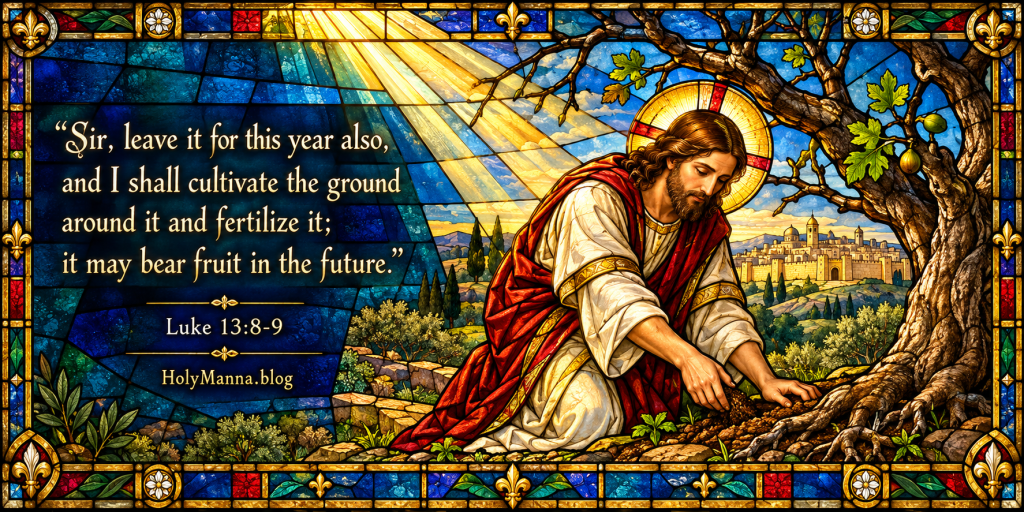
Verse 8: “He said to him in reply, ‘Sir, leave it for this year also, and I shall cultivate the ground around it and fertilize it;’”
Here is the heart of the parable. The gardener intercedes, asking for one more year, and offers to do the dirty work himself, digging and spreading fertilizer. The Church has long seen in this gardener the figure of Christ the intercessor, who pleads for sinners and labors over them personally.
Verse 9: “it may bear fruit in the future. If not you can cut it down.”
The parable ends unresolved, and that silence is deliberate. Every listener is the fig tree, standing in the middle of its extra year. Mercy is real, and so is the deadline. What happens next is not written, because it depends on the hearer.
Teachings
Saint Gregory the Great preached a famous homily on this parable, his Homily 31 on the Gospels, and saw the whole of salvation history in the owner’s three visits: “The lord of the vineyard came thrice to the fig-tree, for God hath come in hope, and in warning, seeking fruit from mankind under three successive dispensations, that is to say, before the law, under the law, and under grace.” He also issued one of the most sobering warnings in patristic literature about refusing the extra year: “He who will not by correction grow rich to fruitfulness, falls to that place from whence he is no more able to rise again by repentance.” The Catechism defines exactly what Jesus is asking for in this Gospel. CCC 1431 teaches, “Interior repentance is a radical reorientation of our whole life, a return, a conversion to God with all our heart, an end of sin, a turning away from evil, with repugnance toward the evil actions we have committed. At the same time it entails the desire and resolution to change one’s life, with hope in God’s mercy and trust in the help of his grace.” Repentance, in Catholic teaching, is not an emotion. It is a turning, and the Gardener stands ready to help.
Reflection
The modern temptation when disaster strikes is to scroll, speculate, and assign blame. Jesus suggests a different response: let every siren and every headline ask you about the state of your own soul. The most concrete step this Gospel offers is also the most obvious one: go to Confession, especially if it has been years, because the Sacrament of Penance is precisely where the Gardener digs around the roots. A second step is to identify the fruit that is actually missing, whether patience at home, honesty at work, generosity with money, or purity of heart, and ask Christ to fertilize that exact spot. If this year were your “one more year,” what fruit would the Lord find when He came looking? Whose tragedy have you quietly judged instead of letting it call you to conversion?
One More Year of Grace
Put the three readings side by side and a single story emerges. The ascended Christ stands at the top of it all, pouring out grace on every member of His Body, appointing shepherds and teachers, knitting His people together like a city with compact unity. His pilgrims climb toward His house singing, tribes and generations converging on one Jerusalem, rehearsing on earth the joy of the eternal city Augustine longed for. And down in the orchard, the same Christ kneels in the dirt as the Gardener, sleeves rolled up, pleading for one more year over every soul that has taken the grace and produced nothing yet.
That is the Gospel in miniature. God does not merely demand fruit; He supplies everything needed to bear it. He gives the grace, measured personally. He gives the Church, with her sacraments, her teachers, and her liturgy, the house where His people go up rejoicing. He gives the time, more patiently than anyone deserves. The readings of October 24th, 2026 refuse both despair and complacency at once. No one is too barren for the Gardener’s care, and no one is so secure that repentance can wait indefinitely.
So the call to action is simple and urgent. Receive the grace already given. Take up the gift measured out for the building of the Body, and put it to work this week. Walk through the gates of the Lord’s house on Sunday rejoicing rather than obliging. And before this extra year quietly slips away, kneel in the confessional and let Christ cultivate the soil. The house is still being built, the pilgrimage is still climbing, and the Gardener is still asking for you by name.
Engage With Us!
The conversation does not end with the final paragraph, so share your reflections in the comments below. Your experience of these readings may be exactly what another pilgrim on this road needs to hear today. To help spark that reflection, consider the following questions:
- In Ephesians 4:7-16, Saint Paul teaches that grace was given to each believer according to the measure of Christ’s gift. What specific gift has Christ entrusted to you, and how are you using it to build up the Body of Christ?
- In Psalm 122:1-5, the psalmist rejoices at the invitation to go up to the house of the Lord. What would need to change in your heart or your habits for Sunday Mass to become a source of genuine joy rather than routine?
- In Luke 13:1-9, Jesus warns that without repentance all will perish, yet the gardener pleads for one more year. What area of your life has remained barren despite years of God’s patient cultivation, and what is one concrete step toward fruitfulness this week?
- Taking all the readings together, how is God inviting you to see yourself as both a living stone in His house and a fig tree in His orchard, and what fruit do you believe He is waiting to find?
Whatever answers rise up, bring them to prayer, bring them to the sacraments, and bring them into Monday morning. A life of faith is built one faithful day at a time, with every task, every conversation, and every hidden sacrifice done with the love and mercy Jesus taught. The Gardener is patient, the gates are open, and the house of the Lord has room for every story, including yours.
Sacred Heart of Jesus, we trust in You!
Immaculate Heart of Mary, pray for us!
Saint Michael the Archangel, defend us in battle!
Follow us on YouTube, TikTok, Instagram and Facebook for more insights and reflections on living a faith-filled life.


Leave a Reply