The Last Roman
On October 23rd, the Church remembers a saint who does not fit the usual mold. Saint Severinus Boethius was not a monk, a bishop, or a desert hermit. He was a senator, a consul of Rome, a husband, a father of two boys, and one of the most brilliant minds the Western world has ever produced. He wore the toga, argued in court, managed the affairs of a kingdom, and translated Greek philosophy by lamplight. And then, at the height of his career, he lost everything. Stripped of his honors, falsely accused of treason, and locked in a prison cell at Pavia, he wrote a book called The Consolation of Philosophy that would shape the mind of Europe for a thousand years. He was tortured and put to death around the year 524, and from the eighth century onward the faithful of Pavia have honored him as a martyr.
Pope Benedict XVI devoted an entire general audience to him on March 12th, 2008, and described him with a memorable phrase, calling him “the last representative of ancient Roman culture and the first of the Medieval intellectuals.” The Church has given her own judgment on his holiness. In 1883, under Pope Leo XIII, the Sacred Congregation of Rites confirmed the ancient custom of the Diocese of Pavia of honoring Saint Severinus Boethius on October 23rd, and the Roman Martyrology commemorates him on that day as a martyr. His story speaks with surprising force to anyone who has ever watched a career, a plan, or a whole world collapse, and wondered where God was in the wreckage.
Born Into the Ruins of an Empire
Boethius was born in Rome around the year 480, though some older sources place his birth a few years earlier, between 470 and 475, and that disagreement among the sources is worth acknowledging honestly. Either way, the timing of his birth is staggering. In 476, the last Western Roman emperor was deposed, and the empire that had ruled the Mediterranean for centuries quietly ceased to exist in the West. Boethius drew his first breaths as the ancient world was drawing its last. He belonged to the Anicii, one of the most illustrious families of Rome and one long associated with the Christian faith, so he was raised a Catholic from the cradle; his was not a dramatic conversion story but a lifelong deepening, the steady work of grace in a soul that never stopped seeking God with both heart and mind.
Sorrow found him early. His father, Manlius Boethius, held the consulship in 487 and died while his son was still a boy. The orphaned child was taken in by another great patrician, Quintus Aurelius Memmius Symmachus, a man of deep learning who introduced him to philosophy and literature and formed him in virtue. The bond between them became the anchor of Boethius’s life. He later married Symmachus’s daughter, Rusticiana, and their marriage gave them two sons, named Symmachus and Boethius after their grandfather and father. A tradition going back to the historian Edward Gibbon claims that Boethius spent eighteen years studying in Athens, but scholars now consider this a misreading of the letters of Cassiodorus; what is certain is that he mastered Greek to a degree almost unheard of in the Latin West of his day.
His rise was meteoric. According to Benedict XVI, he entered public life while still young and was already a senator by the age of 25. In 510 he was named consul, the most prestigious office Rome could still bestow, under Theodoric, the Ostrogothic king who now ruled Italy. Twelve years later he watched his own two sons raised together to that same consulship, and he tells his readers in The Consolation of Philosophy that the day he sat between his boys amid the applause of the Senate was the summit of his earthly happiness. God gave him that memory, it seems, so that he would have something very heavy to surrender.
The Mind That Carried Rome Into the Middle Ages
Why does Boethius matter so much? Because he understood, with remarkable clarity, that a civilization was dying around him, and he decided to save what was best in it for the generations to come. Theodoric and his Goths were the new power; the old Roman learning was fading. Boethius set himself an audacious project: to translate all of Plato and all of Aristotle into Latin and to show that, rightly understood, they agreed with each other and could serve the truth. He never finished, but his translations of Aristotle’s works on logic became, for roughly 500 years, the primary access the Latin West had to Aristotle at all. He wrote handbooks on arithmetic, geometry, music, and astronomy, and he coined the very word “quadrivium” for those four liberal arts, a term the medieval schools and universities would use for centuries. When a student today studies logic or music theory, a quiet debt is owed to a Roman senator working by candlelight while an empire crumbled.
His service to the Church was just as profound. Under an Arian king, in an age when the divinity of Christ was openly denied by the rulers of Italy, Boethius wrote a series of short theological treatises defending the Catholic faith of Nicaea and Chalcedon, among them De Trinitate on the Holy Trinity and Contra Eutychen et Nestorium against the Christological heresies of his day. For a time, modern skeptics doubted that the author of The Consolation was even a Christian, but the testimony of his contemporary Cassiodorus, who recorded that Boethius wrote a book on the Holy Trinity, dogmatic chapters, and a book against Nestorius, settled the question; the Catholic Encyclopedia concludes that there can be no reasonable doubt that he died a Christian. In Contra Eutychen et Nestorium he gave the Church a gift she still uses: his famous definition of a person as “an individual substance of a rational nature.” Saint Thomas Aquinas took up that definition in his own theology of the Trinity and the Incarnation. The Catechism teaches that in order to articulate the dogma of the Trinity, the Church had to develop her own terminology “with the help of certain notions of philosophical origin” such as substance and person (CCC 251), and Boethius stands near the headwaters of that development. In him, faith and reason were never enemies, exactly as the Church teaches: The Catechism affirms that “though faith is above reason, there can never be any real discrepancy between faith and reason” (CCC 159).
Honesty requires saying something plainly here. The historical record preserves no miracles worked by Boethius during his lifetime, and no reliable Catholic source claims any. His sanctity was of a quieter kind, the kind most people are actually called to: fidelity in marriage and fatherhood, integrity in public office, courage in defending the innocent, and a mind placed wholly at the service of truth. God’s intervention in his life is seen not in wonders but in the astonishing fruitfulness He drew from one faithful man’s labor and, soon enough, from one faithful man’s suffering.
The Prison Cell That Became a Classroom
Around the year 522, Boethius reached the peak of his power as master of the offices, the head of Theodoric’s civil administration. Within a year, everything was gone. A senator named Albinus was accused of treasonous correspondence with the Eastern Roman court at Constantinople. Boethius, convinced of his innocence, rose to defend him, declaring that if Albinus was guilty then he himself and the whole Senate were guilty with him. The informers promptly turned on Boethius, producing accusations that he had hoped for the restoration of Roman liberty and even, absurdly, that he had practiced sorcery. Benedict XVI cuts through the pretexts: Theodoric, an Arian and a barbarian, suspected that Boethius was sympathizing with the Byzantine emperor. Boethius was tried without being allowed to appear in his own defense, condemned by a cowed Senate, stripped of his property, and imprisoned at Pavia to await death. His beloved father-in-law Symmachus was executed on similarly vague charges with him or within the following year, a detail the sources record with grim consistency.
And it was there, in that cell, that one of the great works of Western literature was born. The Consolation of Philosophy is a dialogue between the imprisoned Boethius and a majestic woman, Lady Philosophy, who appears to him in his despair as a physician of the soul. He pours out his complaint; he had served justice, and injustice had destroyed him. He gives voice to the oldest and sharpest of questions, asking in Book 1, “If God exists, whence comes evil? But whence comes good, if He does not exist?” Philosophy does not offer him easy comfort. She teaches him, step by step, that the gifts of Fortune, wealth, office, fame, even safety, were never truly his; they turn on a wheel, and the wheel always turns. What cannot be taken away is the highest good, and the highest good is God Himself. Benedict XVI summarized the heart of the book in a single luminous line: “It is possible to speak to Providence because Providence is God.” Even in prison, prayer remained. In Book 3, Boethius anchors this hope in Sacred Scripture, citing Wisdom 7:30 to 8:1: “Against wisdom evil does not prevail. She reaches mightily from one end of the earth to the other, and she orders all things well.”
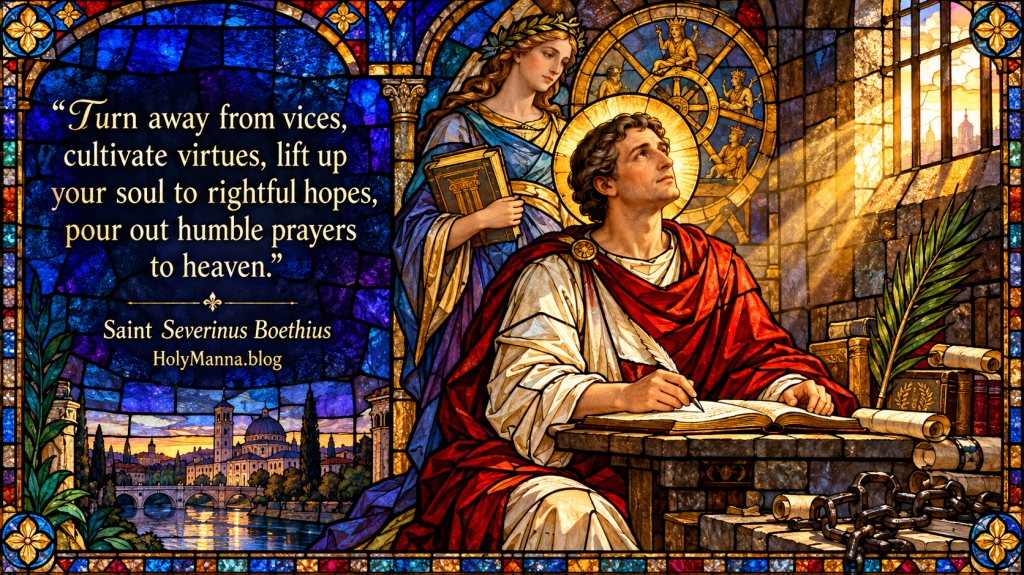
This is precisely what the Church believes about Providence. The Catechism teaches that “we firmly believe that God is master of the world and of its history” even when the ways of His providence remain hidden on this side of heaven (CCC 314), and it quotes Romans 8:28, “We know that in everything God works for good with those who love him” (CCC 313). Boethius saw the danger of the opposite error with his own eyes. In Book 5 he warns that a fatalistic surrender to suffering is spiritually deadly, because it destroys at the root the very possibility of prayer and of hope, which ground the human being’s relationship with God. His closing exhortation, written by a man counting down his final days, deserves to be read slowly: “Turn away from vices, cultivate virtues, lift up your soul to rightful hopes, pour out humble prayers to heaven. A great necessity of uprightness is laid upon you, if you will not hide it from yourselves, since you act before the eyes of a Judge who beholds all things” (The Consolation of Philosophy, Book 5).
The end, when it came, was brutal. The ancient account preserved in the Excerpta Valesiana reports that a cord was twisted around his head until his eyes nearly started from their sockets, and that he was then beaten with clubs until he died, while another old tradition says he was put to the sword; the sources genuinely conflict on the method, and that conflict should be stated rather than smoothed over. Benedict XVI gives the traditional date, saying he was executed on October 23rd, 524, at only 44 years old, though some sources place his death in 525. One more honest distinction must be made. The documentary record shows a political execution; the Catholic Encyclopedia itself admits that it is not easy to prove from the documents alone that he died formally for the faith. Yet the Christian people, beginning very early and taking definite shape by the eighth century, venerated him as a martyr, a Catholic put to death unjustly by an Arian king after a life spent defending Catholic truth with his pen. The Church has blessed that instinct. The 2004 Roman Martyrology commemorates him on October 23rd as a martyr who, illustrious for his learning and his writings, composed his treatise on the consolation of philosophy in prison and, in the Martyrology’s own words, “served God with integrity until his death inflicted on him by King Theodoric.” The Catechism teaches that “martyrdom is the supreme witness given to the truth of the faith” (CCC 2473), and in Boethius the Church honors a witness who held fast to God when every earthly consolation had been stripped away.
A Voice That Never Fell Silent
Boethius was first buried in the cathedral of Pavia, and his relics were later translated to the crypt of the church of San Pietro in Ciel d’Oro in that same city. Anyone who makes the pilgrimage there today encounters something extraordinary: in the same church rest the relics of Saint Augustine of Hippo, so that the great Doctor of grace and the martyred philosopher of Providence keep company under one golden ceiling. The sarcophagus of Boethius in the crypt bears the inscription identifying it as the body of Saint Severinus Boethius, Martyr. His tomb has been honored by kings and popes across the centuries. In 722, Liutprand, king of the Lombards, erected a tomb to his memory, and in 990 the Emperor Otto III replaced it with a more magnificent one, for which Pope Sylvester II himself composed the inscription.
A tradition is attached to that crypt. Beside the altar and the relics of the saint there is an ancient well, and its waters are said to have healing properties, so that pilgrims have long drawn from it with devotion. This is a pious tradition handed down at the shrine, and it cannot be verified. Another story comes from the same ancient source that described his death. The Excerpta Valesiana recounts that shortly after ordering the execution of Symmachus, King Theodoric was served a great fish at table, and in its head he seemed to see the accusing face of the man he had killed; seized with terror, the king took to his bed, lamented bitterly what he had done to Boethius and Symmachus, and died soon afterward, in 526. It is a haunting story of conscience from an ancient account, and it cannot be verified.
It must also be said plainly that the Church has not formally documented miracles of healing attributed to the intercession of Boethius in the way she has for saints canonized through the modern process; his cult rests on the ancient and continuous veneration of the faithful, confirmed by the Holy See in 1883. His true wonder worked after death is of another order, and it is enormous. The Consolation of Philosophy became one of the most copied, translated, and beloved books of the entire Middle Ages. King Alfred the Great rendered it into Old English, Geoffrey Chaucer into Middle English, and generations of monks, scholars, and sufferers found in it a school of hope. His definition of eternity in Book 5, that eternity is “the whole, simultaneous, and perfect possession of unending life,” passed into Saint Thomas Aquinas’s Summa Theologiae and remains the classic formulation in Catholic theology to this day. Dante gave him perhaps the most beautiful tribute of all. In Paradiso, Canto 10 of The Divine Comedy, Boethius shines among the twelve lights of the wise in the heaven of the sun, and Dante writes of him, in translation from the Italian, “The body from which it was driven lies below in Cieldauro, and from martyrdom and from exile it came to this peace.” Each October 23rd the Diocese of Pavia celebrates him in its liturgy, and Benedict XVI held him up to the whole Church as “the symbol of an immense number of people unjustly imprisoned in all ages and on all latitudes,” a man whose suffering opens a doorway to the contemplation of the Crucified One of Golgotha.
When Fortune’s Wheel Turns on You
The life of Saint Severinus Boethius refuses to stay safely in the sixth century. Everyone, sooner or later, sits in some version of his cell. The layoff that arrives out of nowhere, the diagnosis that rearranges every plan, the betrayal by people once trusted, the reputation shredded by accusations that are simply not true; these are the moments when the wheel of fortune turns, and they are the moments when his witness becomes personal. When your own wheel turned, did you rage at Fortune, or did you look for the face of Providence behind it? Boethius teaches that the question is not whether losses will come but what remains when they do. Wealth, status, applause, and security were on loan all along. God is not. The Catechism reminds the faithful that “the desire for God is written in the human heart” (CCC 27), and suffering has a terrible gift hidden inside it: it burns away the apparent goods until only the real one is left.
His example suggests concrete practices. First, pray when prayer feels most impossible, because Boethius insists that fatalism kills prayer and hope at the root, and The Catechism answers him across the centuries with the blunt statement that “prayer is a vital necessity” (CCC 2744). A person in crisis who keeps a daily holy hour, or even a daily decade of the Rosary, is doing exactly what Boethius did in his cell: refusing to let suffering have the last word. Second, invest in true goods now, before the trial comes. Boethius discovered in prison that genuine friendship, unlike flattery, does not evaporate when fortune changes; building deep friendships rooted in faith, honoring one’s marriage, and spending real time with one’s children are investments no king can confiscate. Third, serve the truth where God has placed you. Boethius sanctified spreadsheet-level work, administration, scholarship, and public office, and he defended an innocent man at the cost of his own life, living out the fortitude that The Catechism describes as the virtue that “strengthens the resolve to resist temptations and to overcome obstacles in the moral life” (CCC 1808). Where, in your daily work, is God asking you to hand on something good to the people who will come after you? The empire around Boethius collapsed; his fidelity did not. That is the whole lesson, and it is enough.
Engage With Us!
Saint Severinus Boethius has a way of finding people in their hardest seasons, and his readers across fifteen centuries have never been disappointed. Share your thoughts and reflections in the comments below; stories of how God met you when your own plans fell apart are a gift to everyone who reads them. To go deeper, consider these questions:
- Boethius lost his career, his reputation, and his freedom in a single year. What “goods of Fortune” do you hold most tightly, and what would remain if they were taken tomorrow?
- He asked, “If God exists, whence comes evil?” How has your own experience of suffering challenged or deepened your trust in God’s Providence?
- Boethius warns that fatalism destroys prayer and hope. When life feels out of control, do you turn toward prayer or away from it, and what is one step you could take this week to turn toward it?
- He spent his life handing on truth, beauty, and faith to generations he would never meet. What are you building right now that will outlast you?
- His cell became a classroom and his suffering became a book that consoled millions. How might God want to use your current trial for the good of someone else?
The wheel of fortune still turns, but the Judge who beholds all things still reigns, and He is not a blind force; He is a Father. Let the witness of Saint Severinus Boethius stir up courage to combat vice, cultivate virtue, lift the soul to rightful hopes, and pour out humble prayers to heaven. Go into this week resolved to live a life of faith, and to do everything, in prosperity and in adversity alike, with the love and mercy that Jesus taught us.
Saint Severinus Boethius, pray for us!
Follow us on YouTube, TikTok, Instagram and Facebook for more insights and reflections on living a faith-filled life.


Leave a Reply