The Lawyer Who Lost Everything and Won Europe
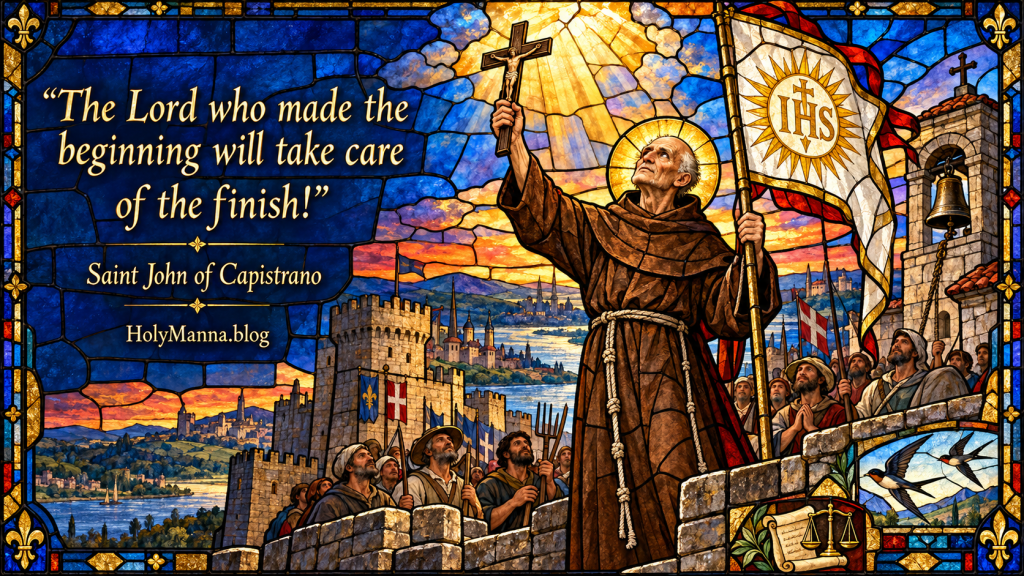
Every day at noon, in villages and cities across the Catholic world, church bells ring. Most people walking past have no idea why. The answer is a 70-year-old Franciscan friar standing on the walls of Belgrade in July of 1456, holding up a banner with the Holy Name of Jesus while an empire’s army broke against the city below him. That friar was Saint John of Capistrano, and his road to that wall is one of the most dramatic conversion stories the Church has ever recorded.
Saint John of Capistrano, celebrated on October 23rd with an Optional Memorial on the General Roman Calendar, packed several lifetimes into one. He was a star law student, a judge, and the governor of a major Italian city before the age of 30. Then he lost it all, entered prison a politician, and came out a man determined to belong entirely to God. He became a Franciscan friar, one of the most famous preachers of the 15th century, a reformer of his own religious order, a trusted envoy of 4 popes, and finally, in old age, the unlikely hero of a battle that shaped the history of Europe. He is the patron saint of jurists, and in 1984 Pope Saint John Paul II named him patron of military chaplains.
His story matters because it answers a question many people quietly carry: is it ever too late to give God everything? John of Capistrano’s answer, written in the second half of his life, is a resounding no. The Catechism teaches that God calls every single person to holiness without exception, for “all Christians in any state or walk of life are called to the fullness of Christian life and to the perfection of charity” (CCC 2013). John heard that call in a prison cell at 30 and was still answering it on a battlefield at 70.
From the Courtroom to the Cell
John was born on June 24, 1386 in the small town of Capestrano, nestled in the Abruzzo region of central Italy, in the Diocese of Sulmona. His father was a knight, likely of French origin, who had come to the Kingdom of Naples in the service of Louis of Anjou and settled in Capestrano, where he married a local woman. The Catholic Encyclopedia notes that his father died when John was still young, and that John owed his education to his mother, who first had him taught at home and then sent him to Perugia to study law.
In Perugia, John was brilliant. He studied both civil and Church law under the celebrated jurist Pietro de Ubaldis and distinguished himself so thoroughly that by 1412, at roughly 26 years of age, King Ladislaus of Naples appointed him governor of Perugia. By every worldly measure, he had made it. He held power, prestige, and a promising future, and he even married a wealthy young woman of Perugia. To his credit, he governed well; the Catholic Encyclopedia records that as governor he set himself firmly against civic corruption and bribery. A lawyer who could not be bought was rare in 15th century Italy, and it foreshadowed the integrity that would mark his whole life.
Then everything collapsed. In 1416 war broke out between Perugia and the powerful Malatesta family. John was sent as an ambassador to negotiate peace, and the Malatesta answered his diplomacy by throwing him into prison. Chained in a dungeon, stripped of his office, his wealth draining away in ransom demands, the young governor finally had nothing left to manage except his own soul. It was there, in captivity, that he began to think seriously about eternity. According to his biographers, he experienced a dream in which Saint Francis of Assisi himself appeared and warned him to enter the Franciscan Order.
John did not do things halfway. Upon his release he resolved to abandon the world entirely. Because his marriage had never been consummated, he obtained a dispensation to enter religious life, and on October 4, 1416, the feast of Saint Francis, the former governor of Perugia knocked on the door of the Franciscans.
A story handed down in traditional lives of the saint says that the friars, doubting the sincerity of so prominent a convert, tested him severely: he was made to ride backward through the streets of Perugia on a donkey, wearing a paper cap on which his sins were written, enduring the jeers of citizens who had once bowed to him as governor. He bore the humiliation gladly. This story appears consistently in traditional accounts of his life, but it cannot be verified from contemporary documents.
What is certain is that inside the Order, John found his true formation. He became a disciple of the great Saint Bernardine of Siena, who taught him theology, and his fellow student was Saint James of the Marches. Imagine that classroom: 3 future saints under one roof. From Bernardine, John absorbed the two fires that would define his preaching: devotion to the Holy Name of Jesus and zeal for the strict observance of the Rule of Saint Francis. He began preaching as a deacon in 1420 and was ordained a priest in 1425. The Catechism describes exactly the kind of interior revolution John underwent: “Interior repentance is a radical reorientation of our whole life, a return, a conversion to God with all our heart, an end of sin, a turning away from evil, with repugnance toward the evil actions we have committed” (CCC 1431).
The Thunder of God Across Europe
Once ordained, John of Capistrano became a phenomenon. For over 30 years he crisscrossed Italy and then central Europe on foot, preaching to crowds so enormous that no church could contain them; sermons were held in town squares and open fields, with reports of tens of thousands gathering at a time. He preached in Latin while interpreters translated, yet eyewitnesses insisted the power of his presence carried further than the words. In Vienna, the faithful still point to the Capistrano pulpit preserved at the outdoor wall of Saint Stephen’s Cathedral, where tradition holds he preached to the city.
His message was not entertainment. He called cities to repentance, reconciled feuding factions, preached against usury and vanity, and held up the Holy Name of Jesus as the banner of Christian life. When his beloved teacher Saint Bernardine was accused before the Holy See over the devotion to the Holy Name, John traveled to Rome and defended him successfully. He also labored tirelessly for the reform of his own order, becoming one of the chief architects of the Observant Franciscan movement, which sought to live the Rule of Saint Francis in its original poverty and simplicity. Successive popes, Martin V, Eugenius IV, Nicholas V, and Callixtus III, entrusted him with sensitive missions, including efforts surrounding the Council of Florence to heal the division between the Eastern and Western Churches.
Why should anyone remember him today? Because John shows what a converted professional looks like. He did not throw away his legal mind when he put on the habit; he consecrated it. The precision, the discipline, and the courage of the courtroom became instruments of the Gospel. Pope Saint John Paul II, in his General Audience of October 23, 2002, praised him as a priest who “gave himself with great generosity for the salvation of souls.”
His near contemporary biographers, Nicholas of Fara, Christopher of Varese, and Jerome of Udine, men who knew him personally, recorded that his preaching tours were accompanied by numerous healings. In Germany, Bohemia, and Poland, the sick were carried to him in great numbers, and many cures were attributed to his prayers and to his blessing the sick with a relic of Saint Bernardine of Siena that he carried with him. These accounts come from men close to the events, though the individual cures cannot be independently verified today. Traditional lives go further still, telling stories that he raised the dead and that he once crossed a river with companions by spreading his mantle upon the waters. Those stories belong to the devotional tradition surrounding the saint, and they cannot be verified.
What needs no verification is the fruit. Entire cities reformed their morals after his missions. Hardened enemies reconciled. Vocations multiplied, and the Observant reform spread across Europe largely on the strength of his preaching and organization. The Catechism reminds the faithful where such power comes from: the ordained priest acts in the person of Christ, for “in the ecclesial service of the ordained minister, it is Christ himself who is present to his Church as Head of his Body” (CCC 1548). John never mistook the thunder for his own.
The Last March to Belgrade
John’s life was not an unbroken parade of triumphs. He endured the suspicion of his own confreres at his entrance, the exhaustion of decades of travel on foot, constant opposition from the powerful whose corruption he denounced, and the crushing weight of papal missions in lands seething with conflict. As a papal legate and inquisitor he was sent against the heretical movements of his day, the Fraticelli in Italy and the Hussites in Bohemia, and he pursued those missions with the severity of his century.
Honesty requires saying plainly that this severity had a dark side. History records that his preaching in central Europe also stirred persecution of Jewish communities, most notoriously in connection with the trials at Breslau in 1453. A devotional blog does not exist to put saints on trial, but neither does it exist to airbrush them. The Church canonizes a person’s heroic virtue and confirms that they are with God; she does not declare every act of their life sinless or every judgment of their era correct. On this point the Church’s own teaching is the measure: “The act of faith is of its very nature a free act” and “nobody is to be forced to embrace the faith against his will” (CCC 160). Readers can hold both truths at once, grateful for John’s holiness and clear eyed about the wounds of his age, trusting that God’s mercy is the final word over every century, including this one.
Then came the crisis that defined his final years. In 1453 Constantinople, the ancient capital of Eastern Christendom, fell to Sultan Mehmet II. The shock rolled across Europe like an earthquake. The Ottoman armies turned next toward Hungary, and the key to Hungary was the fortress city of Belgrade. Pope Callixtus III called for the defense of Christendom, and while kings hesitated and princes made excuses, a friar in his 70th year answered.
John of Capistrano marched through southern Hungary preaching the cross, and the people who responded were not knights in shining armor. They were peasants and farmers, armed with little more than scythes, slings, and faith, who flocked by the tens of thousands to the banner of the Holy Name. Alongside the brilliant Hungarian general John Hunyadi, John brought this unlikely army to Belgrade as Mehmet II invested the city with a massive force and a river fleet. The siege ran from July 4th to July 22nd, 1456. On July 14th, Hunyadi’s flotilla smashed through the Ottoman naval blockade on the Danube; accounts of the battle describe the Christian boats attacking at the signal of loud cries of “Jesus! Jesus!” while the elderly friar was seen lifting high the banner of the Cross and imploring Heaven’s aid.
On July 22nd, a skirmish between the crusaders and the besiegers unexpectedly escalated. The peasant crusaders poured out against the Ottoman lines, and John, finding himself surrounded by some 2,000 of his men eager to engage and unwilling to retreat, chose to lead them forward. The accounts of the battle, drawn from his early biographers, report him crying out, “The Lord who made the beginning will take care of the finish!” The counterattack overran the Ottoman positions, the wounded Sultan lifted the siege, and the army that had taken Constantinople retreated from Belgrade. Christendom erupted in thanksgiving, and the advance of the Ottoman Empire into central Europe was halted for roughly 70 years.
John was not martyred, but his death was a soldier’s death all the same. Plague broke out in the camps after the battle. Hunyadi himself died of it within weeks, and John preached his funeral sermon. Then the sickness took hold of the old friar too. After months of painful illness, borne with patience, Saint John of Capistrano died on October 23, 1456 at Ilok, a town on the Danube in what is today Croatia. Devotional accounts relate that the last word on his lips was the name he had preached his whole life, “Jesus.” That detail rests on the devotional tradition and cannot be verified, but no one who knew him would have expected anything else. The Catechism teaches that “the way of perfection passes by way of the Cross. There is no holiness without renunciation and spiritual battle” (CCC 2015). John’s entire life after Perugia was that battle, embraced freely and fought to the final breath.
Noon Bells, Lost Relics, and Swallows in the Eaves
The veneration of John of Capistrano began the moment he died. His tomb at Ilok immediately became a place of pilgrimage, and the faithful of the region reported healings and graces received through his intercession. These reports were gathered in the investigations that supported his cause, as the Church carefully examined his life and the favors attributed to him. The individual miracle accounts from the tomb at Ilok belong to the records and traditions of his cause, and most cannot be independently verified today, which the Church’s own rigorous process exists to weigh. His relics were venerated at Ilok for decades, until the Ottoman conquest of the town in the following century, after which the relics were scattered and their fate remains uncertain. That loss is stated plainly because it is the truth, and because the saint himself would insist that his power was never in his bones but in his Lord.
The Church formally raised him to the altars in two stages, which sources sometimes report differently: Pope Alexander VIII canonized him on October 16, 1690, and Pope Benedict XIII issued the solemn bull of canonization on June 4, 1724. Both dates are legitimate parts of the record. In canonizing him, the Church exercised exactly what The Catechism describes: “By canonizing some of the faithful, i.e., by solemnly proclaiming that they practiced heroic virtue and lived in fidelity to God’s grace, the Church recognizes the power of the Spirit of holiness within her and sustains the hope of believers by proposing the saints to them as models and intercessors” (CCC 828).
His most audible legacy rings out daily. During the siege of Belgrade, Pope Callixtus III ordered the bells of every church to be rung at noon, calling all Christians to pray for the city’s defenders. In many lands, news of the victory arrived before the order itself, so the noon bell was received as a proclamation of the triumph, and the custom was never rescinded. To this day, when church bells ring at noon, they echo the prayer and the victory of 1456. In Hungary the memory is treasured as part of the national story, and the victory of Belgrade, known there as Nándorfehérvár, remains one of the proudest moments of Hungarian history.
Half a world away, his name is written into the map of America. In 1776, Saint Junípero Serra founded Mission San Juan Capistrano in California, named in the friar’s honor. Its Serra Chapel is among the oldest churches still in use in California, and the mission became world famous for the cliff swallows that traditionally return to nest in its eaves around the feast of Saint Joseph on March 19th and begin their migration south in October, around the feast of San Juan Capistrano itself. The swallows are a charming providence rather than a miracle, yet generations of pilgrims have seen in them a small parable: creatures faithfully returning home, year after year, to a house built for God. Pilgrims today also honor the saint at the Franciscan shrine in Ilok, Croatia, which keeps his memory at the place of his death, and in his birthplace of Capestrano in the Abruzzo, where the town still celebrates its most famous son.
What a 70-Year-Old Friar Says to a Restless Generation
It is tempting to read John of Capistrano’s life as a highlight reel for spiritual overachievers, but that misses the point. The real lesson begins in the prison cell. John spent his first 30 years building the resume: elite education, prestigious career, political power, advantageous marriage. Modern readers between 20 and 45 know this script intimately, because the world still preaches it daily. And then God permitted the whole structure to collapse, not to destroy John, but to free him. Has there been a failure, a loss, or a closed door in your life that God may be using to get your attention?
His second lesson is that conversion is not retirement from excellence. John brought his trained legal mind, his administrative skill, and his personal discipline into the service of Christ and became more effective, not less. Whatever work fills the day, spreadsheets or sales calls, classrooms or courtrooms, it can be consecrated. The Catechism teaches that lay people are called to “seek the kingdom of God by engaging in temporal affairs and directing them according to God’s will” (CCC 898). The question is never whether a person’s gifts are too worldly for God; it is whether they have been handed over to Him. What skill or talent are you currently using only for yourself that God might be asking you to place at His service?
The third lesson is the one engraved on the walls of Belgrade: it is never too late, and no one is too old, too ordinary, or too outnumbered to matter in God’s plan. The victory of 1456 was won by an elderly priest and an army of farmers, because courage, in the Church’s understanding, is not a feeling but a virtue. “Fortitude is the moral virtue that ensures firmness in difficulties and constancy in the pursuit of the good” (CCC 1808). A practical way to grow in it is small and daily: say grace openly in the lunchroom, defend the person being torn apart in the group chat, keep a commitment to prayer when the week gets loud. Pray the Angelus when the clock strikes noon; every bell at midday is already an invitation with John’s fingerprints on it. And speak the Holy Name of Jesus with reverence, as he did, letting it be the first word in the morning and the last word at night. When the moment comes to stand for Christ in front of others, what will you do with it?
Finally, John’s flaws teach too. He was a saint of his century, and his century left scars. His story invites honest humility: every generation, including this one, has blind spots that only grace can heal, which is why the Church begs God’s mercy for all and trusts the saints to intercede for her children still, for “being more closely united to Christ, those who dwell in heaven fix the whole Church more firmly in holiness… they do not cease to intercede with the Father for us” (CCC 956).
Engage With Us!
Saint John of Capistrano went from a prison cell to the walls of Belgrade, and his noon bells are still ringing. Now the conversation turns to you. Share your thoughts and reflections in the comments below; your story of a setback that became a setup for grace might be exactly what another reader needs to hear today.
- John’s conversion began when his career and plans collapsed in prison. What setback in your own life might God be using to redirect you toward Him?
- John consecrated his legal training to the service of the Gospel. What professional skill or natural talent could you intentionally offer to God this week?
- At 70 years old, John answered a call most younger men refused. What excuse related to age, timing, or ability have you been using to delay something God is asking of you?
- The noon bells began as a worldwide call to prayer in a moment of crisis. Could you commit to pausing at noon each day, even for 60 seconds, to pray the Angelus or simply speak the name of Jesus?
- John held the banner of the Holy Name over a frightened city. Where in your daily life, at work, online, or among friends, is God asking you to raise that banner visibly?
Saint John of Capistrano spent 40 years proving that one surrendered life can move cities, armies, and centuries. The same Lord who made the beginning of your story will take care of the finish, if you let Him lead. Live this day with courage, speak the name of Jesus without shame, and do everything, from the smallest task to the hardest sacrifice, with the love and mercy that Jesus taught us.
Saint John of Capistrano, pray for us!
Follow us on YouTube, TikTok, Instagram and Facebook for more insights and reflections on living a faith-filled life.


Leave a Reply