Friday of the Twenty-ninth Week in Ordinary Time – Lectionary: 477
When the Forecast Calls for Grace
Everyone checks the weather. A glance at a phone before leaving the house, a look at the clouds before a cookout, a quick scan of the radar before a road trip. Human beings are remarkably good at reading the sky. The readings for Friday, October 23rd, 2026, the Friday of the Twenty-ninth Week in Ordinary Time, ask a harder question: can a person read the moment God has placed in front of them?
The central theme uniting these readings is that the present moment is the acceptable time. God’s call is not a someday project. In the First Reading, Saint Paul writes from a Roman prison and pleads with the Ephesians to live right now in a manner worthy of their calling, preserving the unity that the Holy Spirit has already given. The Responsorial Psalm, drawn from Psalm 24, is an ancient entrance liturgy sung at the Temple gates, asking who may ascend the mountain of the Lord today, and answering with clean hands and a pure heart. In the Gospel, Jesus, walking the road to Jerusalem, rebukes crowds who can forecast rain from a western cloud yet cannot recognize the Messiah standing in their midst, and He urges them to settle their accounts while still on the way.
As the liturgical year moves toward its close, the Church places urgency before the faithful. Paul in chains, pilgrims at the gates, and debtors on the road to court all hear the same summons. The forecast is clear, grace is pouring down today, and the only question is whether anyone will step into it.
First Reading — Ephesians 4:1-6
A Prisoner’s Plea for the One Family of God
Saint Paul wrote The Letter to the Ephesians around the year 62 AD, during his house arrest in Rome, chained to a soldier while awaiting trial before Caesar. Ephesus itself was a dazzling and difficult place to be a Christian. It was a wealthy port city in Asia Minor, home to the Temple of Artemis, one of the seven wonders of the ancient world, and its church gathered Jewish and Gentile converts under one roof, people whose cultures had despised each other for centuries. The first three chapters of the letter lay out the breathtaking doctrine of God’s plan to unite all things in Christ. Chapter 4 opens the practical half of the letter, and today’s passage is the hinge. Having told the Ephesians who they are, Paul now tells them how to live, and he does it from prison, which makes his plea for unity and patience land with real weight. This reading fits the day’s theme perfectly, because the worthy life Paul describes is not scheduled for later. It begins now.
Ephesians 4:1-6
Brothers and sisters:
I, a prisoner for the Lord,
urge you to live in a manner worthy of the call you have received,
with all humility and gentleness, with patience,
bearing with one another through love,
striving to preserve the unity of the spirit
through the bond of peace;
one Body and one Spirit,
as you were also called to the one hope of your call;
one Lord, one faith, one baptism;
one God and Father of all,
who is over all and through all and in all.
Detailed Exegesis
Verse 1
“Brothers and sisters: I, a prisoner for the Lord, urge you to live in a manner worthy of the call you have received”
Paul opens with his credentials, and they are chains. He does not appeal to his education or his apostolic office but to his imprisonment for Christ, which Saint John Chrysostom considered more glorious than miracles. The Greek word for “worthy,” axios, comes from the image of a balance scale. Paul is asking that the weight of a Christian’s daily life match the weight of the calling received at baptism. The call came first, as pure gift, and the conduct is the response.
Verse 2
“with all humility and gentleness, with patience, bearing with one another through love,”
The worthy life begins with virtues the ancient world found embarrassing. Greek and Roman culture treated humility, tapeinophrosyne, as the mindset of a slave, yet Christ crowned it by washing feet and mounting a cross. Gentleness here is praus, strength under control, the same word Jesus used of Himself. Patience translates makrothymia, literally a long temper, the capacity to absorb irritation without exploding. Unity is not preserved in grand gestures but in bearing with real, annoying, beloved people through love.
Verse 3
“striving to preserve the unity of the spirit through the bond of peace;”
The verb “striving” carries eagerness and diligence, the energy of someone racing to protect something precious. Notice that Paul does not ask anyone to create unity. The Holy Spirit has already given it. The Christian’s job is to preserve it, to guard a treasure already in hand, and the instrument is the bond of peace, the daily choice to reconcile rather than rupture.
Verse 4
“one Body and one Spirit, as you were also called to the one hope of your call;”
Here begins one of the most majestic sentences in the New Testament, a sevenfold confession of oneness. The Church is one Body, the Body of Christ, animated by one Spirit the way a soul animates flesh. Jew and Gentile, slave and free, all share one hope, the vision of God in heaven, which means no Christian’s destiny competes with another’s.
Verse 5
“one Lord, one faith, one baptism;”
Many scholars hear in this verse an early baptismal creed, words the Ephesians may have professed at the font. One Lord, Jesus Christ, stands against the many lords of the Roman world. One faith refers to the single deposit of truth handed down from the Apostles, believed everywhere and by all. One baptism is the unrepeatable seal, the sacrament that can never be redone because it marks the soul permanently.
Verse 6
“one God and Father of all, who is over all and through all and in all.”
The sevenfold litany climaxes in the Father, confessing both His transcendence, over all, and His intimate presence, through all and in all. Israel’s ancient creed, the Shema of Deuteronomy 6, resounds here with a new depth, because the one God has revealed Himself as Father, and His fatherhood is the deepest root of the Church’s unity. Christians are one family because they have one Dad.
Teachings
The Church reads this passage as a portrait of her own soul. The Catechism teaches, “The Church is one because of her source: ‘the highest exemplar and source of this mystery is the unity, in the Trinity of Persons, of one God, the Father and the Son in the Holy Spirit’” (CCC 813). That same paragraph quotes Saint Clement of Alexandria, who marveled, “What an astonishing mystery! There is one Father of the universe, one Logos of the universe, and also one Holy Spirit, everywhere one and the same; there is also one virgin become mother, and I should like to call her ‘Church.’” The Catechism also acknowledges the struggle beneath Paul’s plea, noting that “sin and the burden of its consequences constantly threaten the gift of unity. And so the Apostle has to exhort Christians to ‘maintain the unity of the Spirit in the bond of peace’” (CCC 814). The summary paragraph is built directly on this reading: “The Church is one: she acknowledges one Lord, confesses one faith, is born of one Baptism, forms only one Body, is given life by the one Spirit, for the sake of one hope, at whose fulfillment all divisions will be overcome” (CCC 866). Saint John Chrysostom, Doctor of the Church, preached on this very passage in his Homilies on Ephesians and lingered on the image of binding: “Thus he wants us to be bound together with one another, not only to be at peace, not only to be friends, but to be all one, a single soul. Beautiful is this bond. With this bond we bind ourselves together both to one another and to God. This is not a chain that bruises. It does not cramp the hands. It leaves them free, gives them ample room and greater courage” (Homily IX on Ephesians). The chain on Paul’s wrist and the bond of peace are, for Chrysostom, the same freedom.
Reflection
Unity sounds lovely until it has a face, the coworker who talks too much, the relative who votes the other way, the parishioner who sits in your pew. Paul’s words move unity out of the abstract and into the practical. Living worthy of the call this week might mean biting back one sarcastic reply, sending the text that reopens a frozen friendship, or praying by name for the person in the parish who grates on you most. It might mean refusing to treat a fellow Catholic as an enemy over a disagreement that heaven will not remember. Which relationship in your life most needs the bond of peace right now? When humility feels like weakness, what would it look like to trust that Christ made it strength? Does the weight of your daily life balance the weight of your baptismal calling?
Responsorial Psalm — Psalm 24:1-6
The Question at the Temple Gates
Psalm 24 is one of the oldest liturgical texts in the Bible, and scholars have long connected it with the day King David brought the Ark of the Covenant up to Jerusalem in procession, with dancing, trumpets, and shouts of joy, as recounted in 2 Samuel 6. The psalm is structured as an entrance liturgy, a sacred question and answer exchanged at the Temple gates. Pilgrims arriving for the great feasts would hear the question called out, who may ascend the mountain of the Lord, and the answer sung back, the one with sinless hands and a clean heart. In the ancient Near East, temples posted entrance requirements, but Israel’s requirements were strikingly moral rather than ritual. God did not ask for the right offerings so much as the right life. The refrain the Church sings today, “Lord, this is the people that longs to see your face,” names the deep desire driving the whole psalm, and it ties directly into the day’s theme. The longing is for now, and the climb begins today.
Psalm 24:1-6
R. (see 6) Lord, this is the people that longs to see your face.
The LORD’s are the earth and its fullness;
the world and those who dwell in it.
For he founded it upon the seas
and established it upon the rivers.
R. Lord, this is the people that longs to see your face.
Who can ascend the mountain of the LORD?
or who may stand in his holy place?
He whose hands are sinless, whose heart is clean,
who desires not what is vain.
R. Lord, this is the people that longs to see your face.
He shall receive a blessing from the LORD,
a reward from God his savior.
Such is the race that seeks for him,
that seeks the face of the God of Jacob.
R. Lord, this is the people that longs to see your face.
Detailed Exegesis
Verse 1
“The LORD’s are the earth and its fullness; the world and those who dwell in it.”
The psalm opens with a thunderclap of ownership. Everything belongs to God, the planet, its abundance, and every person on it. In a world where Canaanite neighbors parceled out territory among competing gods, Israel confessed one Lord of everything. This verse quietly demolishes every claim of absolute human ownership. People are stewards and guests on God’s earth, never final proprietors.
Verse 2
“For he founded it upon the seas and established it upon the rivers.”
Ancient peoples saw the sea as chaos itself, untamable and menacing. The psalmist declares that God founded the dry land upon those very waters, meaning His order stands sovereign over every chaotic force. The ground under every human foot is held steady by God’s creative word, and the same power that steadies continents can steady a restless heart.
Verse 3
“Who can ascend the mountain of the LORD? or who may stand in his holy place?”
Here comes the great question of the gate liturgy. The mountain is Zion, the Temple mount, but the question reaches beyond geography. Who is fit to come into the presence of the all-holy God who owns everything? Every honest soul feels the weight of that question, because no one climbs into holiness casually.
Verse 4
“He whose hands are sinless, whose heart is clean, who desires not what is vain.”
The answer covers the whole person. Hands stand for deeds, the heart stands for intentions, and desire stands for the loves that steer a life. God asks for integrity, an inside that matches the outside. The phrase about vain desires targets idolatry, the chasing of empty things, which in every generation simply changes costumes, from carved images to curated images.
Verse 5
“He shall receive a blessing from the LORD, a reward from God his savior.”
The climb is not a performance that earns God’s presence. The one who ascends receives blessing as a gift, and the title “savior” gives the whole game away. Even the clean hands and pure heart are themselves God’s work in the soul, which is why the verse speaks of receiving rather than achieving.
Verse 6
“Such is the race that seeks for him, that seeks the face of the God of Jacob.”
The psalm ends by describing a whole people defined by seeking. Not a people that has fully arrived, but a generation that longs, searches, and keeps climbing. To seek the face of God is Hebrew idiom for desiring personal communion with Him, not merely His gifts. This is the verse behind today’s refrain, and it describes the Church on pilgrimage in every age.
Teachings
Saint Augustine, Doctor of the Church, read this psalm through the lens of Easter, introducing his exposition with the words, “A Psalm of David himself, touching the glorifying and resurrection of the Lord, which took place early in the morning on the first day of the week, which is now called the Lord’s Day” (Exposition on Psalm 24). For Augustine, the true ascent of the Lord’s mountain is Christ’s own Resurrection and Ascension, and the Church ascends in Him. Commenting on the fourth verse, he asked and answered, “Who then shall ascend there, and abide there, but the guiltless in deed, and pure in thought?” The Catechism carries this teaching into the Beatitudes: “The sixth beatitude proclaims, ‘Blessed are the pure in heart, for they shall see God.’ ‘Pure in heart’ refers to those who have attuned their intellects and wills to the demands of God’s holiness, chiefly in three areas: charity; chastity or sexual rectitude; love of truth and orthodoxy of faith” (CCC 2518). The next paragraph adds that the pure in heart are promised the face-to-face vision of God and likeness to Him, even now granting the ability to see according to God and to see others as neighbors rather than objects (CCC 2519). The psalm’s gate liturgy finds its fulfillment at every Mass, where the faithful ascend the mountain of the Lord in the liturgy, approach the Holy of Holies in the Eucharist, and are purified for the climb through confession and grace. The longing to see God’s face, which the refrain places on the Church’s lips, is what the Tradition calls the desire for the beatific vision, the destiny for which every human heart was built.
Reflection
Everyone climbs toward something, a promotion, a follower count, a finish line. This psalm asks you to audit the climb. Clean hands might mean returning what was taken, correcting the dishonest shortcut at work, or making a long-delayed confession. A clean heart might mean closing the app that feeds envy or lust before it opens again tomorrow. Desiring not what is vain might mean one honest hour asking which pursuits would survive being placed next to the face of God. Concretely, consider getting to confession this week, arriving ten minutes early to Mass to ask for a purified heart, or fasting from one vanity that has quietly become a god. What are your hands holding that needs to be released before you can climb? If seeking God’s face became your definition of success, what would change by Sunday?
Holy Gospel — Luke 12:54-59
The Forecast Everyone Missed
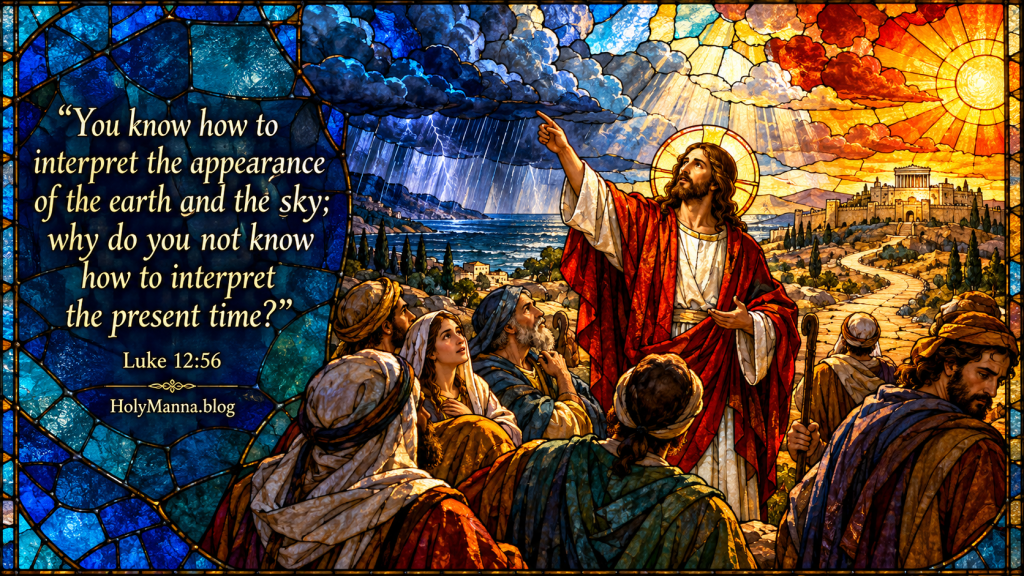
This passage sits in the heart of The Gospel of Luke, within the long travel narrative that begins when Jesus resolutely sets His face toward Jerusalem. Chapter 12 is a sustained discourse on readiness, covering fearless witness, freedom from greed, vigilant servants, and the fire Jesus longs to kindle on the earth. Today’s verses close the chapter with two sharp images, a weather forecast and a courtroom. The crowds of first-century Palestine were skilled amateur meteorologists out of necessity, since farming and fishing depended on it. Clouds rolling in from the west came off the Mediterranean carrying rain, the very sign Elijah’s servant watched for on Carmel in 1 Kings 18. Wind from the south blew in from the Negev and the Arabian desert, bringing the scorching sirocco. Jesus grants the crowd their skill and then turns it against them. The decisive moment of history, the arrival of the Messiah foretold by the Law and the Prophets, is unfolding in front of them, and they cannot, or will not, read it. The passage delivers the day’s theme at full strength, because the present time is the one thing nobody can afford to misread.
Luke 12:54-59
Jesus said to the crowds,
“When you see a cloud rising in the west
you say immediately that it is going to rain–and so it does;
and when you notice that the wind is blowing from the south
you say that it is going to be hot–and so it is.
You hypocrites!
You know how to interpret the appearance of the earth and the sky;
why do you not know how to interpret the present time?“Why do you not judge for yourselves what is right?
If you are to go with your opponent before a magistrate,
make an effort to settle the matter on the way;
otherwise your opponent will turn you over to the judge,
and the judge hand you over to the constable,
and the constable throw you into prison.
I say to you, you will not be released
until you have paid the last penny.”
Detailed Exegesis
Verse 54
“When you see a cloud rising in the west you say immediately that it is going to rain–and so it does;”
Jesus begins with observable, uncontested competence. The crowd’s forecasting works, and He says so. Notice the word “immediately.” No committee meets, no debate occurs, the cloud appears and the conclusion follows at once. Jesus is establishing that these are not stupid people. Their failure, when He names it, will not be a failure of intelligence but of willingness.
Verse 55
“and when you notice that the wind is blowing from the south you say that it is going to be hot–and so it is.”
The second example completes the pair, rain from the sea and heat from the desert, water and fire, the two directions a Galilean sky could turn. The repetition drives home how habitual and reliable this skill is. Human beings are wired to read patterns and act on them, which is exactly what makes the coming rebuke sting.
Verse 56
“You hypocrites! You know how to interpret the appearance of the earth and the sky; why do you not know how to interpret the present time?”
The word “hypocrites” originally meant stage actors, people performing a role. The crowd performs ignorance. They apply sharp discernment to crops and travel plans while suspending it entirely before the miracles, the preaching, and the mercy of Jesus. The “present time” is the kairos, the decisive, grace-laden moment of God’s visitation. Scripture had marked the signs, and the signs were standing in front of them, healing lepers and forgiving sinners.
Verse 57
“Why do you not judge for yourselves what is right?”
Jesus appeals to conscience. The crowd waited for religious authorities to rule on Him, but He insists that each person bears responsibility for recognizing the truth. The question honors human freedom and dignifies the listener. God does not want spectators of a verdict but souls who personally weigh the evidence of grace and respond.
Verse 58
“If you are to go with your opponent before a magistrate, make an effort to settle the matter on the way; otherwise your opponent will turn you over to the judge, and the judge hand you over to the constable, and the constable throw you into prison.”
The scene shifts to a debtor dragged to court, a familiar terror in the ancient world, where debtors’ prison awaited the insolvent. Luke’s legal vocabulary mirrors Roman procedure, magistrate, judge, and constable, the officer who collected what was owed. The spiritual meaning is urgent. Every soul is on the way, and the wise debtor settles before arrival. Reconciliation with God and neighbor is possible now, on the road, and foolish to postpone.
Verse 59
“I say to you, you will not be released until you have paid the last penny.”
The coin Luke names is the lepton, the smallest coin in circulation, the same tiny copper the poor widow would drop into the Temple treasury. Divine justice is exact, down to the last fraction, which is precisely why divine mercy is offered first. The verse has echoed through the Tradition as a sober warning about judgment and as one of the scriptural threads the Church has long associated with purification after death. The takeaway Jesus intends is not despair but urgency. Settle now, while mercy is still negotiating.
Teachings
Saint Cyril of Alexandria, Doctor of the Church, preached directly on this passage: “People focus their attention on things of this kind. From long observation and practice they tell beforehand when rain will fall or violent winds will blow. One especially sees that sailors are very skillful in this matter. He says that it would be suitable for those who can calculate things of this sort and may foretell storms that are about to happen to focus the penetrating eyes of the mind also on important matters” (Commentary on Luke, Homily 95). For Cyril, the Law itself was the forecast, pointing to the Lamb who would be sacrificed for the salvation of all. Saint Augustine gave the courtroom image its most famous Catholic interpretation, identifying the opponent on the road: “If you sin, the word of God is your adversary… It is the adversary of your will, till it become the author of your salvation” (Sermon 59 on the New Testament). In the same sermon he explained the road itself, teaching that “the way, is this life,” and promising that the one who agrees with the adversary will find, “instead of a judge… a father, instead of a cruel officer, an Angel taking you away into Abraham’s bosom, instead of a prison, paradise.” The Church never stopped hearing this Gospel’s command. The Second Vatican Council taught that “the Church has always had the duty of scrutinizing the signs of the times and of interpreting them in the light of the Gospel” (Gaudium et Spes 4). And the Catechism frames the urgency perfectly: “The message of the Last Judgment calls men to conversion while God gives them ‘the acceptable time, the day of salvation’” (CCC 1041).
Reflection
Most people can read a room, a market, a group chat, and a radar map, all before breakfast. Jesus asks whether you can read your own moment of grace. Concretely, that might mean treating the nudge toward confession as a western cloud, visible and meaningful, and acting on it this week rather than this year. It might mean settling on the way, making the apology or extending the forgiveness that has been waiting for a convenient season that never comes. It might mean a nightly examen, five minutes asking where God showed up today and whether anyone noticed. The word of God will keep contradicting your favorite sins, and that opposition is love. What sign of God’s action in your life have you been explaining away? Who is the opponent you need to settle with while you are still on the way? If this season of your life is a forecast, what is it telling you to do before the storm?
Settle It on the Way Home
Picture the three scenes side by side. A chained apostle in Rome, dictating a letter about freedom, begging his friends to guard a unity more precious than his own release. A crowd of pilgrims at the Temple gates, hearing the question ring out over the crowd, who can ascend, and feeling their own hearts answer. A debtor on a dusty road, court documents in hand, realizing with a jolt that the time to settle is not at the courthouse but here, on the way. Every one of those scenes is happening right now, in ordinary lives, in ordinary cities, this very Friday.
The readings refuse to let faith drift into the future tense. Paul says live worthy of the call you have received, not the one you will someday grow into. The psalmist describes the people that longs to see God’s face, present tense, hungry today. Jesus points at the sky and asks why a generation so good at forecasts cannot see the grace raining down in front of them. The answer, uncomfortable and freeing all at once, is that seeing requires willingness, and willingness can begin in a single moment.
So begin. Make the act of contrition tonight. Book the confession. Send the message that mends the friendship. Choose humility in the next conversation where pride wants the last word. Guard the unity of your parish, your family, and your own divided heart, because the Spirit has already supplied the bond, and all that remains is to hold it. The earth and its fullness belong to the Lord, the mountain is open, and the Judge who waits at the end of the road is, for everyone who settles on the way, a Father waiting with open arms.
Engage With Us!
These readings have a way of finding everyone exactly where they are, the peacemaker, the climber, the procrastinator, and the forecaster alike. Share your reflections in the comments below, because someone else walking this same road needs to hear how God is working in your life. To get the conversation started, pray with these questions.
- In Ephesians 4:1-6, Saint Paul pleads from prison for humility, gentleness, patience, and unity. Which of those four virtues costs you the most right now, and what would practicing it look like in one specific relationship this week?
- In Psalm 24:1-6, the gatekeepers ask who may ascend the mountain of the Lord, and the answer is sinless hands and a clean heart. What is one concrete step, perhaps confession, restitution, or a changed habit, that would clean your hands for the climb?
- In Luke 12:54-59, Jesus marvels that people who read the sky perfectly cannot read the present time. Where might God be acting in your life right now in a way you have been too busy or too hesitant to interpret?
- Taking all the readings together, the message is that the present moment is the acceptable time. If you truly believed that today is the day to live your calling, seek God’s face, and settle your accounts, what would you do before the sun goes down?
Living a life of faith is not about having every answer. It is about reading the signs, trusting the One who sends them, and taking the next step with courage. Whatever today holds, do it all with the love and mercy Jesus taught us, and watch what God does with a heart that finally said yes.
Sacred Heart of Jesus, we trust in You!
Immaculate Heart of Mary, pray for us!
Saint Michael the Archangel, defend us in battle!
Follow us on YouTube, TikTok, Instagram and Facebook for more insights and reflections on living a faith-filled life.


Leave a Reply