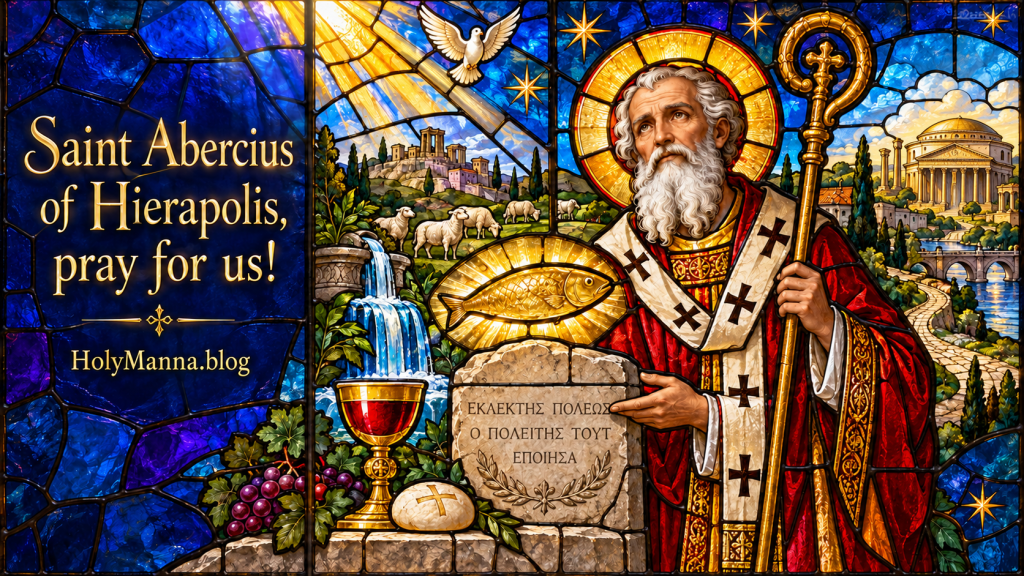
A Voice Speaking from the Stone
Every October 22, the Church remembers a bishop whose most enduring homily was not preached from a pulpit but carved into stone. Saint Abercius of Hierapolis was a second century shepherd of souls in Phrygia, in what is now modern Turkey, who governed his flock during the reign of the Roman emperor Marcus Aurelius. The Christian East honors him with two remarkable titles, calling him both “Equal to the Apostles” and “Wonderworker,” because tradition remembers him as a tireless missionary and healer whose labors stretched from the heart of Asia Minor all the way to Rome and back across the Euphrates. The Roman Martyrology likewise commemorates him on October 22 as a holy bishop who flourished in the days of Marcus Aurelius.
Yet what makes Abercius truly extraordinary is something he left behind. Before his death, he composed his own epitaph, a sixteen verse Greek poem written in deliberately veiled, symbolic language that only a fellow believer could fully understand. That epitaph, known today as the Inscription of Abercius, is one of the oldest surviving stone monuments of the Christian faith, and Giovanni Battista de Rossi, the great founding father of Christian archaeology, is widely credited with calling it the queen of ancient Christian inscriptions. In a handful of lines, a bishop who lived within living memory of the apostles bears witness to Baptism, to the Eucharist as the true food of believers, to the universal spread of the Church, and to the honored place of the Church of Rome. The Catechism of the Catholic Church teaches that “the Eucharist is the source and summit of the Christian life” (CCC 1324), and the astonishing thing is that this truth is already shining out of a tombstone from the second century.
For Catholics between twenty and forty five who sometimes wonder whether the Church’s teachings on the Eucharist, Baptism, and the papacy are later inventions, Abercius is a quiet, immovable answer. His stone has been touched, measured, photographed, and displayed; fragments of it rest today in the Vatican Museums. He is not a legend invented to win an argument. He is a witness who planned, even in death, to keep preaching. What would it look like to live a faith so deep that it outlasts you by eighteen centuries?
A Shepherd Raised Up in the Land of the Apostles’ Heirs
History is honest about what it does not know, and the Church can be honest too. The documented record tells us nothing certain about the birthplace, parents, or childhood of Abercius. No near contemporary biography of his early years survives, and the sources say nothing about his family or his formation before he appears, already a mature man, as a bishop. What can be said with confidence is this: Abercius lived in the second century in the Roman province of Phrygia, in the interior of Asia Minor, and he served as bishop of a town called Hieropolis in the district known as Phrygia Salutaris, near the city of Synnada. Careful Catholic scholarship, led by the historian Louis Duchesne and confirmed in The Catholic Encyclopedia, has shown that his city was this smaller Hieropolis, and not the famous Hierapolis of the white terraces near Laodicea, which later accounts sometimes confused with it. Tradition lists him as the successor of Papias, the renowned early bishop who had gathered the memories of those who knew the apostles themselves. Abercius therefore stood only one or two generations removed from the apostolic age, breathing the air of a Church that still remembered the voices of eyewitnesses.
Because he was born into a Christian community rather than converted dramatically out of paganism, his story is less about a single conversion and more about a lifelong deepening of faith in a hostile world. Phrygia in his day was saturated with pagan worship, especially the cults of Apollo and the mother goddess Cybele, and it was also troubled by the Montanist movement, an early heresy of false prophecy that was spreading through the region. A writer of that very era, named Abercius Marcellus, is connected with a treatise against the Montanists, fragments of which the historian Eusebius preserved, and The Catholic Encyclopedia identifies this writer with the saint himself. If that identification holds, as most scholars believe, then Abercius was not only a pastor but an early defender of sound doctrine, guarding his people against both idolatry and heresy at the same time.
A later account of his life, composed by an anonymous author around the fourth century and retold in the tenth century by Symeon Metaphrastes, fills in the silence with a dramatic story. In that account, an angel appears to Abercius in his sleep and commands him to destroy the idols in the temple of Apollo, which the bishop does by night with zeal and without fear. This story comes from the later tradition rather than from the documented record, and it cannot be verified. What the tradition captures truthfully, however, is the shape of the man: a bishop utterly convinced that “you shall have no other gods before me” (Exodus 20:3), and willing to stake his life on it.
The Wonderworker Who Went Everywhere
The later tradition remembers Abercius as a man through whom God worked wonders. According to the account preserved in the Eastern synaxaria and in the Life of the saint, when the pagans of Hieropolis discovered their shattered idols and rushed to seize the bishop, three young men in the crowd were suddenly tormented by evil spirits. Abercius prayed over them, cast out the demons, and restored the youths to their right minds before the eyes of the whole city. The crowd that had come to kill him stayed to listen to him, and the tradition holds that great numbers of the townspeople asked for instruction in the faith and received Holy Baptism. The same tradition relates that he went out from his city into the surrounding towns and villages, healing the sick and preaching the Kingdom of God, and that through his prayer warm healing springs burst forth near Hieropolis, where the sick came to bathe. These stories come from the later account of his life and cannot be verified. It is worth noting, though, that when the archaeologist William Ramsay went searching for the real Hieropolis in the 1880s, he found actual hot springs beside the city, exactly where the old account had placed them.
What can be verified is even more remarkable, because it comes from the saint’s own hand. In his epitaph, Abercius describes himself as “the disciple of a holy shepherd who feeds flocks of sheep both on mountains and on plains, who has great eyes that see everywhere.” The shepherd is Christ, who said of Himself, “I am the good shepherd; I know my own and my own know me” (The Gospel of John, Jn 10:14). Abercius then testifies to his travels: “And I saw the land of Syria and all its cities, Nisibis I saw when I passed over Euphrates. But everywhere I had brethren.” In two short lines, a second century bishop confirms what the Church has always claimed about herself, that she was already catholic, already universal, already one family spread across the known world. He found the same faith, the same brethren, and the same Eucharist from Rome to Mesopotamia.
And it is the Eucharist that stands at the center of his testimony. Faith, he writes, “everywhere provided as my food a fish of exceeding great size, and perfect, which a holy virgin drew with her hands from a fountain and this it ever gives to its friends to eat, it having wine of great virtue, and giving it mingled with bread.” The Fish is Christ Himself, for the Greek word for fish, ICHTHYS, was the early Church’s hidden acronym for Jesus Christ, Son of God, Savior. The holy Virgin who draws Him forth is Mary, who gave the world its living Bread. The wine and the bread are the Blessed Sacrament. This is why Abercius matters and why he deserves to be remembered and imitated. The Catechism teaches that in the Eucharist, “what material food produces in our bodily life, Holy Communion wonderfully achieves in our spiritual life” (CCC 1392), and Abercius lived on that food across thousands of miles. He also saw in Rome “a queen golden-robed and golden-sandalled,” an image long understood as the Church of Rome herself, which The Catechism, quoting Saint Ignatius of Antioch, calls the Church “which presides in charity” (CCC 834). A man does not travel across an empire to contemplate an institution he considers optional.
Standing Firm in the Empire of Marcus Aurelius
Abercius was not a martyr. He died in peace in his own city, and this needs to be said clearly, because holiness does not require a violent death; it requires fidelity. Yet his life unfolded in one of the most dangerous seasons the early Church ever faced. Marcus Aurelius is remembered by the world as a philosopher emperor, but under his reign Christians suffered fiercely. Saint Justin Martyr was beheaded in Rome around the year 165, and the martyrs of Lyons were tortured to death in 177. To stand up publicly as a bishop in that empire was to paint a target on your own back. Some accounts state that Abercius himself was imprisoned or detained under Marcus Aurelius because his preaching against paganism was seen as a threat to civil order, and while the details cannot be confirmed, the hostile climate itself is beyond doubt.
The later tradition tells a dramatic story about this period, and it deserves to be told as the story it is. According to the Life of Abercius, the fame of the wonderworking bishop reached the imperial household, and Marcus Aurelius summoned him to Rome because his sixteen year old daughter Lucilla, who was betrothed to the co-emperor Lucius Verus, was tormented by a demon that no one could expel. Abercius came, prayed, and cast the demon out in the name of Jesus Christ. Then, as a penance, he commanded the spirit to carry a massive stone altar, used for pagan rites in Rome, all the way back to Hieropolis, and the crowd watched in amazement as the stone was borne away. The same account says the empress Faustina, in gratitude, endowed baths at the hot springs and provided grain for the poor of the bishop’s city, and that the stone from Rome was later set upon the saint’s own tomb. This entire episode comes from the later account of his life and cannot be verified.
What the documented record does show is a subtler kind of endurance, and in some ways a more relatable one. Abercius wrote his epitaph in code. He never names Christ, the Church, or the Eucharist outright; he speaks of the shepherd, the queen, the seal, and the fish, and he closes with a sentence aimed only at insiders: “He that discerneth these things, every fellow-believer namely, let him pray for Abercius.” This is the discipline of a Church under pressure, protecting her sacred mysteries from mockery and her members from denunciation, while still refusing to stay silent. He also tells us his age with touching simplicity: “Verily I was passing through my seventy-second year.” Here is a man who carried his faith through decades of suspicion, danger, heresy, and hard travel, and arrived at old age still pointing to the Fish. There is a flag worth noting for honesty’s sake: some traditions place his death around the year 167, while The Catholic Encyclopedia, dating his epitaph and the anti-Montanist treatise connected with his name, places it near the close of the second century. The sources conflict, and the later dating rests on the firmer documentary ground.
The Queen of Inscriptions and the Romance of the Spade
Unlike many ancient saints, Abercius left behind no recorded catalog of healings worked at his tomb, and Catholic sources preserve no list of documented posthumous miracles attributed to his intercession. The tradition that a pagan altar stone carried from Rome was placed over his grave as a trophy of Christ’s victory belongs to the later account of his life, and it cannot be verified. Yet what God worked through Abercius after his death is, in its own way, astonishing, because the saint’s greatest gift to the Church arrived seventeen centuries after he was buried.
For ages, the epitaph of Abercius survived only as a text copied inside the manuscripts of his Life, and skeptical scholars such as Ernest Renan dismissed both the biography and the inscription as pious fiction. Then the ground itself answered. In 1881 and 1882, the Scottish archaeologist William Ramsay, exploring Phrygia, discovered a Christian grave stele erected for a man named Alexander, son of Anthony, dated to the year 216. Its opening and closing verses matched the epitaph of Abercius almost word for word, proving that the text existed and was being imitated locally within a generation or two of the saint’s death. In 1883, Ramsay returned and found two fragments of the actual tombstone of Abercius, built into the masonry of the public baths at the hot springs beside Hieropolis. Catholic scholars have called the rediscovery a romance of archaeology. The fragments were presented to Pope Leo XIII, and they rest today in the Museo Pio Cristiano of the Vatican Museums, where any pilgrim to Rome can stand before them; a full reconstruction of the monument is also displayed in the Museum of Roman Civilization in Rome. The saint who once traveled to Rome to see the golden-robed queen now rests, in fragment, at her very heart.
The impact of that discovery on the Church’s confidence can hardly be overstated. Rationalist critics tried for years to explain the inscription away, proposing that Abercius was really a pagan priest of Cybele or of Attis, but the great Catholic archaeologists De Rossi and Duchesne, joined by Franz Cumont, dismantled those theories, and the Christian reading of the stone stands secure. The epitaph is now cited constantly in catechesis and apologetics as some of the earliest physical evidence for the Real Presence of Christ in the Eucharist, for the baptismal seal, and for the standing of the Church of Rome. The Catechism teaches that the faithful departed who dwell with Christ “do not cease to intercede with the Father for us” (CCC 956), and it is easy to imagine Abercius interceding with particular delight for archaeologists, apologists, and every doubting young Catholic who needs to touch something solid. His feast on October 22 is kept in the Roman Martyrology and across the Byzantine churches of East and West, a rare bond of shared veneration, and his inscription continues to catechize scholars, skeptics, and pilgrims alike.
Writing Your Own Epitaph While You Are Still Alive
Abercius composed his epitaph before he died, which means he decided, while still breathing, what his life was going to say. Most people let their lives write themselves and hope the summary turns out well. Abercius did the opposite. He chose the message first, Christ the Shepherd, the Eucharist, the Church everywhere, and then he spent seventy two years making it true. That is the first lesson of his life, and it lands squarely on anyone in their twenties, thirties, or forties who is still deciding what their story will be about. If a single paragraph had to be carved over your life today, what would it honestly say, and what would you want it to say instead?
The second lesson is Eucharistic. Everywhere Abercius went, from Phrygia to Rome to the banks of the Euphrates, he was fed by the same Fish drawn from the same fountain. The Catechism teaches that “the Eucharist is the source and summit of the Christian life” (CCC 1324), and Abercius quietly proves that this was not a medieval invention but the lived conviction of the second century. A practical application follows naturally. Travel the way Abercius traveled. Before a work trip or a vacation, look up a parish and a Mass time near the destination, and make the Blessed Sacrament the one constant on the itinerary. He found brethren everywhere because he went looking for them; the same is true today in any city with a tabernacle. When was the last time the Eucharist, rather than convenience, set the schedule for a week?
The third lesson is about baptismal identity. Abercius saw in Rome “a people bearing a shining mark,” and The Catechism teaches that “Baptism seals the Christian with the indelible spiritual mark (character) of his belonging to Christ” (CCC 1272). That seal does not fade between Sundays. It is worn in the office, in the group chat, on the apps, and in the checkout line. Living it can look wonderfully ordinary: honesty when a small lie would be easier, generosity to the poor the way Faustina’s grain is remembered in the old story, praying grace over lunch in public, and refusing to treat the faith as a private hobby. And when speaking openly is costly, Abercius models a holy creativity. He wrote in symbols that drew the curious in rather than shoving them away, which is exactly what Saint Peter asks: “Always be prepared to make a defense to any one who calls you to account for the hope that is in you” (1 Peter 3:15). Finally, he teaches endurance without martyrdom. He simply stayed faithful, against idols, against heresy, against fatigue, into his seventy second year, trusting the command of the Lord: “Go therefore and make disciples of all nations” (The Gospel of Matthew, Mt 28:19), a mission The Catechism says belongs to the whole Church by her very nature (CCC 849). What idol, comfort, or fear is quietly asking for the loyalty that belongs to Christ alone?
Engage With Us!
Saint Abercius wrote his testimony in stone and then asked one small favor of everyone who would ever read it: “let him pray for Abercius.” In that same spirit of communion, share your thoughts and reflections in the comments below. Your story might be exactly the encouragement another reader needs today. To help the conversation begin, here are some questions to pray with and discuss.
- Abercius wrote his epitaph before he died. If you wrote yours today, what would it say about what you have truly loved?
- The epitaph testifies that faith provided the Fish, the Eucharist, everywhere Abercius traveled. What is one concrete change you could make this month to put the Mass at the center of your schedule?
- Abercius found brethren everywhere he went. Where in your daily life, at work, online, or in your neighborhood, might God be asking you to seek out or build Christian community?
- He spoke of Christians as a people bearing a shining mark. When has your baptismal identity been visible to others, and when have you been tempted to hide it?
- Abercius used veiled symbols to intrigue a hostile culture rather than retreat from it. What creative, inviting way could you share the hope that is in you this week?
The Church that Abercius served is the same Church alive today, fed by the same Eucharist and sealed by the same Baptism, and The Catechism reminds every believer that “the Eucharist is the source and summit of the Christian life” (CCC 1324). So go to the fountain. Receive the Fish. Find the brethren. Live this day, and every day, so that your whole life becomes a testimony worth carving in stone, and do everything with the love and mercy that Jesus taught us.
Saint Abercius of Hierapolis, pray for us!
Follow us on YouTube, TikTok, Instagram and Facebook for more insights and reflections on living a faith-filled life.


Leave a Reply