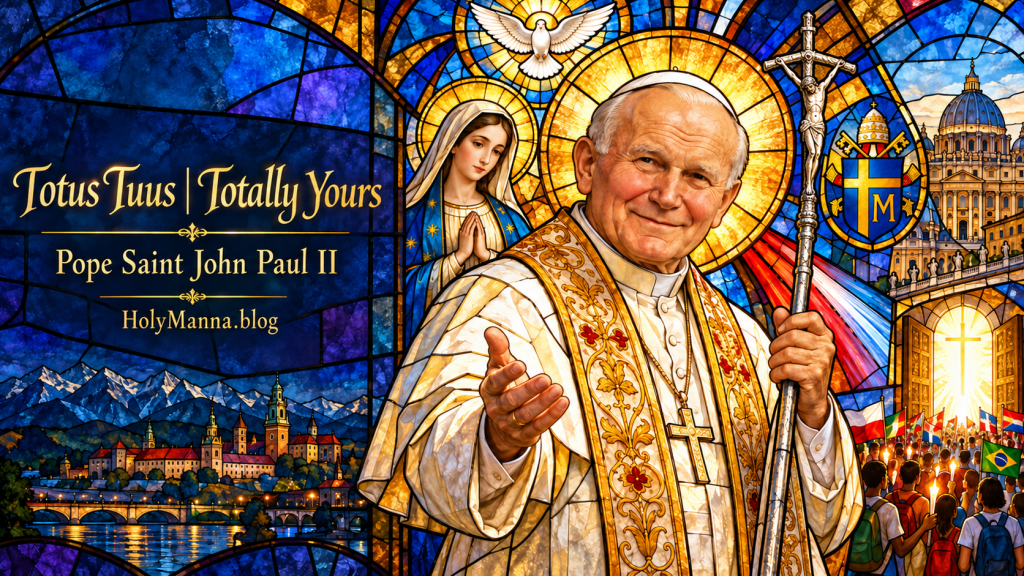
Be Not Afraid
On October 22nd, 1978, a 58-year-old Polish cardinal stood before 300,000 people in St. Peter’s Square and before millions more watching on television, and he gave the world a command that would define the next quarter century: “Be not afraid! Open wide the doors for Christ!” The man who spoke those words had buried his entire family by the age of 20, had dodged the Gestapo, had hauled limestone in a quarry, and had studied for the priesthood in secret under the shadow of a death sentence. He knew exactly what fear was. That is precisely why the world believed him when he told it not to be afraid.
Pope Saint John Paul II, born Karol Józef Wojtyła, reigned as the Successor of Peter from 1978 until his death on April 2nd, 2005, one of the longest pontificates in the history of the Church. He was the first non-Italian pope in 455 years, a philosopher, a poet, an actor, a mystic, a sportsman, and above all a witness. He helped bring down an empire without firing a shot, gave the Church the Catechism of the Catholic Church, founded World Youth Day, survived an assassin’s bullet and then forgave the man who fired it, and taught a youth-obsessed culture how to grow old and die with dignity. The Church celebrates him each year on October 22nd, the anniversary of his papal inauguration, as an Optional Memorial on the General Roman Calendar.
He is honored as a patron of World Youth Day, of families, of young Catholics, and of the Archdiocese of Kraków. When the Church canonizes a saint, she does so by solemnly proclaiming that the person “practiced heroic virtue and lived in fidelity to God’s grace” (CCC 828), holding that life up as a model and an intercessor for the whole Church. Few lives in the modern era fit that description as visibly as his.
Lolek of Wadowice
Karol Wojtyła was born on May 18th, 1920, in Wadowice, a small town in southern Poland about 30 miles from Kraków, and was baptized on June 20th of that year. His father, Karol Sr., was an administrative officer in the Polish Army, a quiet and disciplined man of deep prayer. His mother, Emilia Kaczorowska, was a schoolteacher’s daughter whose health was fragile. The family called the boy “Lolek.”
Sorrow arrived early and kept coming. Emilia died on April 13th, 1929, when Karol was only 8 years old. Three years later his beloved older brother Edmund, a young physician, contracted scarlet fever from one of his own patients and died in 1932. Then, in February 1941, with Poland crushed under Nazi occupation, Karol came home from work to find his father dead. At 20 years old, he knelt beside the body and prayed through the night. He had no immediate family left in the world. Many biographers, including his Catholic biographers, note that he later said he had never felt so alone. Out of that loneliness grew a radical dependence on God and a profound devotion to the Blessed Mother, the mother who could never be taken from him. The Church teaches that Mary’s motherhood of the faithful “continues uninterruptedly” until the eternal fulfillment of all the elect (CCC 969), and the orphaned young man from Wadowice clung to that truth for the rest of his life.
Karol had enrolled at the Jagiellonian University in Kraków in 1938 to study Polish philology. He loved language, theater, and poetry, and during the occupation he performed with the clandestine Rhapsodic Theatre, keeping Polish culture alive in living rooms while the Nazis tried to erase it. When the occupiers shut down the university, he took manual labor jobs, first in the Zakrzówek limestone quarry and then in the Solvay chemical plant, work that saved him from deportation and that later gave the world a pope who wrote about human labor from the inside.
Two encounters during those dark years changed everything. The first was with Jan Tyranowski, a layman and tailor who ran clandestine youth groups called the Living Rosary. Tyranowski introduced Karol to the writings of St. John of the Cross and to St. Louis de Montfort’s True Devotion to Mary. From de Montfort, Karol took the phrase that would become his episcopal and papal motto: “Totus tuus”, meaning “totally yours,” an act of total consecration to Jesus through Mary. The second encounter was with his own vocation. In 1942, Karol knocked on the door of the Archbishop of Kraków, Cardinal Adam Sapieha, and entered his clandestine seminary. Studying for the priesthood was punishable by death. Seminarians lived double lives, working their factory shifts by day and studying theology in secret by night.
Providence guarded him in ways that are a matter of documented history. In February 1944 he was struck by a German truck and left unconscious in the road; a passerby and a German officer got him to a hospital, and he recovered. On August 6th, 1944, the day Poles remember as “Black Sunday,” the Gestapo swept Kraków and rounded up thousands of young men to prevent an uprising. Karol hid in his basement apartment as soldiers searched the building, and then made his way to the archbishop’s residence, where Sapieha sheltered his seminarians until the end of the war. On November 1st, 1946, the Solemnity of All Saints, Cardinal Sapieha ordained Karol Wojtyła a priest. He celebrated his first Masses in the crypt of Wawel Cathedral, over the tombs of Poland’s kings.
From the Quarry to the Chair of Peter
The young Father Wojtyła was sent to Rome for doctoral studies at the Angelicum under the great Dominican theologian Fr. Réginald Garrigou-Lagrange, writing his dissertation on faith in St. John of the Cross. Back in Poland, he served as a parish priest and university chaplain, and became a professor of ethics. He took students hiking and kayaking, heard their confessions around campfires, and celebrated Mass on overturned kayaks, pastoral work that was illegal under communism and that he carried out anyway, with young people calling him “Wujek,” or “Uncle,” to protect his identity. His 1960 book Love and Responsibility, born from those years of accompanying young couples, defended the full Catholic vision of human love and anticipated by decades the catechesis he would later give the whole Church.
In 1958, at only 38 years old, he was named auxiliary bishop of Kraków, the youngest bishop in Poland. He became Archbishop of Kraków in 1964 and a cardinal in 1967 under Pope St. Paul VI. As a Council Father at the Second Vatican Council, he contributed significantly to Gaudium et Spes and to Dignitatis Humanae, the declaration on religious freedom, a document he would spend his papacy turning into history. Then, on October 16th, 1978, after the sudden death of Pope John Paul I, the College of Cardinals stunned the world by electing the Archbishop of Kraków. He took the name John Paul II, and at his inauguration Mass on October 22nd he began with Peter’s own confession from The Gospel of Matthew: “You are the Christ, the Son of the living God” (Mt 16:16). Then came the words that became the banner of his pontificate: “Brothers and sisters, do not be afraid to welcome Christ and accept his power.” And again: “Open, I say open wide the doors for Christ. To his saving power open the boundaries of states, economic and political systems, the vast fields of culture, civilization and development.”
It must be said plainly and honestly: the Church has not formally attributed any miracles to John Paul II during his earthly life. The two miracles approved for his beatification and canonization both occurred after his death, and they are told in full below. What the faithful witnessed during his life was something different, the visible power of grace working through a man wholly surrendered to God. He made 104 apostolic journeys outside Italy, reaching, by most Catholic counts, well over 120 countries, and no pope before him had ever been seen in person by so many human beings. He established World Youth Day in 1985, gathering millions of young people around the Eucharist on every continent. He delivered the 129 Wednesday audiences now known as the Theology of the Body, a catechesis on love, the human person, and the meaning of the body that continues to transform marriages and vocations today. He promulgated the Catechism of the Catholic Church in 1992, calling it a sure norm for teaching the faith, and the revised Code of Canon Law in 1983. He wrote 14 encyclicals, among them Redemptor Hominis, Dives in Misericordia, Veritatis Splendor, Evangelium Vitae, and Fides et Ratio. He canonized 482 saints and beatified well over 1,300 men and women, more than all of his predecessors of recent centuries combined, because he wanted the world to see that holiness is possible in every state of life. The Catechism teaches that the witnesses who have preceded us into the Kingdom “contemplate God, praise him and constantly care for those whom they have left on earth” (CCC 2683), and John Paul II canonized so many precisely to surround the modern world with that cloud of witnesses.
And then there is Poland. In June 1979, barely eight months into his pontificate, he returned home. The communist government could not refuse him and could not control him. In Victory Square in Warsaw, before an enormous crowd, he prayed aloud for the Holy Spirit to descend and renew the face of the earth, of that very land. A third of the nation saw him in person during those nine days. Within a year, the Solidarity movement was born in the Gdańsk shipyards, and within a decade the Iron Curtain had fallen without a world war. Historians, including secular ones, credit that pilgrimage as a decisive spark. Catholics see in it something more, the fulfillment of what he had preached at his inauguration, that when the doors are opened wide to Christ, no political system built on the denial of God can endure. The Catechism teaches that “the dignity of the human person is rooted in his creation in the image and likeness of God” (CCC 1700), and that truth, proclaimed fearlessly, proved stronger than tanks.
Why should anyone remember and emulate this man? Because he demonstrated, on the largest stage the modern world could provide, that sanctity is not a retreat from history but the engine of it. He did not defeat communism with armies. He defeated it with the truth about the human person, spoken by a man who prayed for hours a day, often prostrate on the floor of his chapel, and who went to confession weekly.
The Bullet and the Hand That Guided It
On May 13th, 1981, the feast of Our Lady of Fatima, John Paul II was riding through St. Peter’s Square greeting pilgrims when a Turkish gunman named Mehmet Ali Ağca shot him at close range. The bullet tore through his abdomen, missing his main abdominal artery by millimeters. He underwent more than five hours of surgery and lost a great quantity of blood, and his survival astonished his own doctors. The pope himself never doubted what had happened. He noted that the attempt had occurred on the very anniversary of Our Lady’s first apparition at Fatima in 1917, and he later reflected that one hand fired, and another hand guided the bullet. In thanksgiving, he traveled to Fatima in 1982 and had the bullet placed in the crown of the statue of Our Lady of Fatima, where it remains to this day. The Catechism teaches that the Church’s devotion to the Blessed Virgin “is intrinsic to Christian worship” (CCC 971), and no modern pope embodied that devotion more visibly.
What he did next stunned the world even more than his survival. On December 27th, 1983, John Paul II walked into Rebibbia prison in Rome, sat down in a cell with the man who had tried to kill him, took his hand, and forgave him. He asked the world to pray for Ağca, whom he called a brother. Photographs of the white-robed pope leaning toward his would-be assassin became one of the most powerful images of mercy in the 20th century. This was no sentimental gesture. It was obedience to the Lord’s own command, for as the Catechism teaches, “Christian prayer extends to the forgiveness of enemies”, and such forgiveness “bears witness that, in our world, love is stronger than sin” (CCC 2844).
John Paul II was not a martyr, but his hardships were lifelong and they did not end with the assassination attempt. He had been formed in suffering from childhood: an 8-year-old at his mother’s grave, a 12-year-old at his brother’s, a 20-year-old orphan under Nazi terror, a bishop harassed and surveilled for decades by a communist secret police that bugged his rooms and planted informers around him. In his final decade, a new cross arrived, Parkinson’s disease. The most athletic pope of modern times, the skier and mountain climber, slowly lost control of his own body before the cameras of the entire world. His hands trembled. His speech slurred. His face stiffened. Advisers reportedly urged him to limit his public appearances. He refused to hide. He had written in his 1984 apostolic letter Salvifici Doloris that human suffering, united to Christ, becomes redemptive, and now he lived that teaching in front of billions. The Catechism teaches that by his Passion, Christ “has given a new meaning to suffering: it can henceforth configure us to him and unite us with his redemptive Passion” (CCC 1505). An old man trembling in his chair, still blessing crowds, still whispering the name of Jesus, preached that paragraph more eloquently than any homily could.
He died in his apartment in the Apostolic Palace at 9:37 p.m. on April 2nd, 2005, as tens of thousands of young people kept vigil in the square below, on the eve of Divine Mercy Sunday, the very feast he himself had instituted for the universal Church in the year 2000. According to the Vatican’s official account, those at his bedside reported that among his final words, spoken in Polish, were these: “Let me go to the house of the Father.”
Santo Subito
At his funeral on April 8th, 2005, one of the largest gatherings in Christian history, the crowds in St. Peter’s Square chanted “Santo subito!”, meaning “Sainthood now!” Pope Benedict XVI waived the customary five-year waiting period and opened the cause within weeks. Heaven, it seems, did not wait long either.
The first approved miracle came almost immediately. Sister Marie Simon-Pierre Normand, a French religious sister of the Congregation of Catholic Maternity Wards, had been diagnosed in 2001 with Parkinson’s disease, the same illness that had afflicted John Paul II. Her condition deteriorated until she could barely write or carry out her work as a maternity nurse. After the pope’s death, her community began praying for his intercession. On June 2nd, 2005, exactly two months after his death, her superior asked her to write the name of John Paul II on a piece of paper. That night she woke feeling completely changed, and her symptoms were gone. Four days later her neurologist confirmed that the disease had disappeared. After years of rigorous medical and theological investigation, the Church declared the healing scientifically inexplicable and attributable to the intercession of John Paul II. Pope Benedict XVI beatified him in St. Peter’s Square on May 1st, 2011, Divine Mercy Sunday, before more than a million pilgrims.
The second approved miracle occurred on the very day of that beatification, an ocean away. Floribeth Mora Díaz, a wife and mother from Costa Rica, had suffered a brain aneurysm that her doctors judged inoperable, and she had been sent home to die. On May 1st, 2011, too weak to travel, she watched the beatification of John Paul II on television and begged his intercession. She later testified publicly, with her bishop beside her, that as she rested afterward her gaze fell on a photograph of the pope in a magazine, and she heard his voice say to her, “Rise, do not be afraid.” She rose. Subsequent medical examinations, conducted under conditions designed to guarantee objectivity, found that the aneurysm had vanished without explanation. The Church approved the healing as a miracle, and on April 27th, 2014, once again Divine Mercy Sunday, Pope Francis canonized John Paul II together with Pope St. John XXIII, with Floribeth Mora present in the square. The pattern of dates is itself worth contemplating: he died on the vigil of Divine Mercy, was beatified on Divine Mercy Sunday, and was canonized on Divine Mercy Sunday. The Catechism teaches that “the Gospel is the revelation in Jesus Christ of God’s mercy to sinners” (CCC 1846), and the apostle of Dives in Misericordia was raised to the altars wrapped entirely in that feast.
Beyond the two formally approved miracles, countless private reports of graces and healings attributed to his intercession have poured in from around the world since 2005, which is why the faithful continue to seek his prayers; these individual accounts have not been formally verified by the Church. Devotion to him now has permanent homes. His tomb rests in the Chapel of St. Sebastian in St. Peter’s Basilica, where pilgrims pray daily. The Sanctuary of St. John Paul II in Kraków, built near the Divine Mercy Shrine in Łagiewniki, houses a relic of his blood and draws pilgrims from every continent. The National Shrine of Saint John Paul II in Washington, D.C., serves the faithful of North America, and his family home in Wadowice has become a museum visited by hundreds of thousands each year. In Poland he remains a national father figure, and on October 22nd, 2014, the Church began celebrating his Optional Memorial on the General Roman Calendar, fixed not on the date of his death, which usually falls in Lent or Eastertide, but on the anniversary of the day he first told the world to open wide the doors. The Catechism reminds the faithful that the saints’ “intercession is their most exalted service to God’s plan” and that “we can and should ask them to intercede for us and for the whole world” (CCC 2683).
Opening Your Own Doors
It is tempting to admire John Paul II the way one admires a mountain, from a distance, as something too large to imitate. That instinct should be resisted, because everything heroic in his life began in circumstances that were ordinary and often crushing. He was a grieving son before he was a saint. He was a tired factory worker before he was a pope. The question his life puts to every believer is not can you topple an empire, but can you trust God with the next door in front of you.
Start with his first word to the world: be not afraid. Fear is the quiet dictator of most lives, fear of what others think, fear of commitment, fear of suffering, fear of what God might ask if given full permission. John Paul II insisted that Christ never takes anything away from the person who surrenders to him, and that he gives everything instead. What door in your life is still closed to Christ, and what are you afraid would happen if you opened it?
Learn from his Marian consecration. “Totus tuus” was not a slogan; it was a daily decision to belong entirely to Jesus through Mary, made by a boy who had lost his mother and discovered that he had never been motherless at all. A simple, practical step is to pray the Rosary daily, even one decade, and to consider the consecration of St. Louis de Montfort that shaped him. The Catechism affirms that the Church rightly honors Mary with special devotion and has expressed it in the Rosary, the “epitome of the whole Gospel” (CCC 971).
Learn from his forgiveness. He did not wait until he felt ready to forgive Ağca; he chose to forgive, and he went in person. Forgiveness in daily life rarely involves assassins. It involves a parent, an ex, a coworker, a friend who disappeared. Who is the one person you have quietly decided not to forgive, and what would it look like to pray for that person by name this week?
Learn, finally, from his suffering. The culture treats weakness as something to hide and old age as something to apologize for. John Paul II trembled in public and called it a pulpit. For anyone carrying chronic illness, caring for a declining parent, or simply enduring a season that will not end, his witness teaches that suffering offered to Christ is never wasted, for the baptized are called to “unite themselves to the passion and death of Christ” and so contribute “to the good of the People of God” (CCC 1521). What suffering in your life right now could you stop merely enduring and start offering?
Engage With Us!
HolyManna would love to hear from you. Share your thoughts, your favorite memory or teaching of John Paul II, and your own reflections in the comments below, and consider these questions as a starting point.
- John Paul II’s papacy began with the words “Be not afraid.” What fear is currently keeping you from following Christ more completely, and what is one concrete step you could take against it this week?
- His motto was “Totus tuus,” totally yours. What would change in your daily routine if you gave God genuinely everything, your schedule, your relationships, and your plans?
- He forgave the man who shot him. Is there someone in your life you need to forgive, and what has been holding you back?
- He allowed the world to watch him suffer with Parkinson’s disease rather than hide it. How do you respond to weakness, in yourself and in others, and what might redemptive suffering look like in your own circumstances?
- He entrusted the young Church to World Youth Day and believed deeply in the mission of young people. How can you encourage or mentor a younger Catholic in your parish, family, or friend group?
Pope Saint John Paul II spent 26 years begging the world to open wide the doors for Christ, and that invitation did not expire with him; it is addressed to you, today, in your home, your work, and your heart. Be not afraid. Open the doors. And in everything you do this week, do it with the love and mercy that Jesus taught us, trusting that the God who guided a quarry worker from Wadowice to the Chair of Peter can do more with your surrendered life than you could ever ask or imagine.
Pope Saint John Paul II, pray for us!
Follow us on YouTube, TikTok, Instagram and Facebook for more insights and reflections on living a faith-filled life.


Leave a Reply