Thursday of the Twenty-ninth Week in Ordinary Time – Lectionary: 476
When Love Catches Fire
There are moments in prayer when words run out and only fire remains. On this Thursday, October 22nd, the Church hands over three readings that trace a single burning line: the love of God is not a polite sentiment but a fullness that fills and a fire that consumes. In the First Reading, Saint Paul, writing in chains in Rome around the year 61, falls to his knees and begs that the Christians of Ephesus be “filled with all the fullness of God.” The Responsorial Psalm answers that this fullness is already spilling over creation, for “of the kindness of the LORD the earth is full.” Then the Holy Gospel reveals what that love costs and what it demands. Jesus, walking the road to Jerusalem and to his Cross, cries out that he has come to set the earth on fire and longs to see it blazing, even though that fire will divide households down the middle. Ordinary Time can feel like a quiet stretch of the liturgical year, yet these October weekday readings, drawn from the semi-continuous reading of The Letter to the Ephesians and The Gospel of Luke, are anything but quiet. Both texts were first received by Christians living as small minorities in cities devoted to other gods, people who knew exactly what it meant for faith to cause friction at the dinner table. The theme that unites the day is this: God’s love is immeasurable, it already fills the earth, and once it takes hold of a heart it burns like fire, refusing to leave anything untouched. What would it look like to let that fire catch today?
First Reading — Ephesians 3:14-21
On Bended Knee: The Prayer That Asks for Everything
Saint Paul wrote The Letter to the Ephesians while under Roman guard, most likely between the years 60 and 62. Ephesus was a glittering port city in Asia Minor, home to the Temple of Artemis, and its Christians formed a small community surrounded by wealth, superstition, and pagan devotion. Across the first three chapters, Paul has been unveiling what he calls the mystery hidden for ages: that in Christ, Jew and Gentile are made one body, one family, one dwelling place for God. Today’s passage is the summit of that teaching. Having finished explaining the mystery, Paul starts begging. He drops to his knees, a posture of unusual intensity since standing was the ordinary Jewish position for prayer, and asks the Father for the very thing that holds this whole day of readings together: that believers would be filled to the brim with the love of God.
Ephesians 3:14-21
Brothers and sisters:
I kneel before the Father,
from whom every family in heaven and on earth is named,
that he may grant you in accord with the riches of his glory
to be strengthened with power through his Spirit in the inner self,
and that Christ may dwell in your hearts through faith;
that you, rooted and grounded in love,
may have strength to comprehend with all the holy ones
what is the breadth and length and height and depth,
and to know the love of Christ that surpasses knowledge,
so that you may be filled with all the fullness of God.Now to him who is able to accomplish far more than all we ask or imagine,
by the power at work within us,
to him be glory in the Church and in Christ Jesus
to all generations, forever and ever. Amen.
Detailed Exegesis
Verse 14: “Brothers and sisters: I kneel before the Father,”
He kneels, and in the ancient world that gesture belonged to moments of desperation or awe. Saint John Chrysostom, preaching on this passage in Homily 7 on Ephesians, observes that Paul “does not say simply, ‘I pray,’ but manifests the supplication to be heartfelt, by the ‘bowing of the knees.’” The body itself becomes part of the prayer, a truth the Church still honors every time the faithful kneel at Mass.
Verse 15: “from whom every family in heaven and on earth is named,”
In Greek there is a wordplay here between pater, father, and patria, family or fatherhood. Every family, whether the angelic orders in heaven or the household down the street, takes its name and its very existence from the Fatherhood of God. The Church teaches this plainly: “The divine fatherhood is the source of human fatherhood; this is the foundation of the honor owed to parents” (CCC 2214). Human fatherhood is not the model that God imitates; God’s Fatherhood is the original that every earthly father reflects.
Verse 16: “that he may grant you in accord with the riches of his glory to be strengthened with power through his Spirit in the inner self,”
Paul asks God to give in accord with his riches, not merely out of them, the way a king gives royally rather than sparing change. The gift is interior strength through the Holy Spirit, planted in the inner self, the hidden place where conversion actually happens. The whole Trinity appears: the Father grants, the Spirit strengthens, and the Son comes to dwell.
Verse 17: “and that Christ may dwell in your hearts through faith; that you, rooted and grounded in love,”
The Greek verb for dwell describes settling down permanently, not visiting. Christ does not want a guest room in the heart; he wants the deed to the house. Paul then stacks two images: rooted like a tree and grounded like a building on its foundation. Chrysostom adds that Christ “dwells in those hearts that are faithful, in those that are ‘rooted’ in His love, those that remain firm and unshaken.”
Verse 18: “may have strength to comprehend with all the holy ones what is the breadth and length and height and depth,”
The love of Christ has dimensions that no instrument can measure, and Paul prays for strength even to begin comprehending them. A long tradition among the Church Fathers has seen in these four dimensions the shape of the Cross, stretching wide, reaching high, and sinking deep. This comprehension is never a private achievement; it happens with all the holy ones, inside the communion of the Church.
Verse 19: “and to know the love of Christ that surpasses knowledge, so that you may be filled with all the fullness of God.”
Here is the glorious paradox: Paul prays that believers would know what surpasses knowing. Chrysostom resolves it beautifully, explaining that “although the love of Christ lies above the reach of all human knowledge, yet shall you know it, if you shall have Christ dwelling in you.” God does not offer a sample of himself; he offers his own fullness.
Verse 20: “Now to him who is able to accomplish far more than all we ask or imagine, by the power at work within us,”
The prayer erupts into a doxology. Chrysostom marvels that God “will do works greater than all we ask, not simply ‘greater,’ nor ‘abundantly greater,’ but ‘exceeding abundantly.’” God is never outdone by the boldness of a prayer; he outgives it.
Verse 21: “to him be glory in the Church and in Christ Jesus to all generations, forever and ever. Amen.”
Glory is given to God in two places, in Christ Jesus and in the Church. Chrysostom notes with wonder that “the Church alone can last on to eternity.” The Body of Christ endures, and this prayer has been prayed inside it ever since.
Teachings
The Catechism reaches for this very passage when it describes the deepest form of prayer: “Contemplative prayer is also the pre-eminently intense time of prayer. In it the Father strengthens our inner being with power through his Spirit ‘that Christ may dwell in [our] hearts through faith’ and we may be ‘grounded in love’” (CCC 2714). What Paul begged for the Ephesians happens whenever a believer sits silently before the Lord. Chrysostom draws out the pastoral urgency in the same homily: “Be it our care therefore, beloved, to understand the love of God. A great thing indeed is this; nothing is so beneficial to us, nothing so deeply touches us: more availing this to convince our souls than the fear of hell itself.” Chrysostom, a Doctor of the Church who died in exile in 407, insists that love, not fear, is the engine of conversion.
Reflection
Paul’s prayer is ready-made for daily life. Tonight, before bed, kneel down physically, the way Paul did, and pray verses 16 through 19 slowly, placing the name of someone you love into Paul’s words. Interceding with inspired words for a spouse, a child, or a friend who has drifted is a powerful habit. Then let the prayer turn back on your own heart. Does Christ dwell in your heart as the owner of the house, or as an occasional guest? When was the last time you asked God for something as enormous as being filled with all his fullness? Ask for it today, because verse 20 promises that he can do far more than you imagine.
Responsorial Psalm — Psalm 33:1-2, 4-5, 11-12, 18-19
A Song for People Who Trust the Composer
Psalm 33 is one of the great hymns of praise in the Psalter, sung in the Temple liturgy with the very instruments it names. Its structure moves like a well-built argument: praise God for his upright word, for his creation, for his plan that outlasts the nations, and for his tender gaze on those who hope in him. The refrain the Church places on the lips of the faithful today, “The earth is full of the goodness of the Lord,” uses the rich Hebrew word hesed, the covenant kindness and steadfast mercy of God. Set between Paul’s prayer to be filled with God’s fullness and Jesus’ longing to set the earth ablaze, this Psalm is the hinge of the day. It announces that the filling has already begun, since creation itself is soaked in the kindness of its Maker. Saint Augustine, who preached through the entire Psalter in his Expositions on the Psalms, heard in this song the voice of the redeemed Church, and his verse-by-verse insights guide the exegesis below.
Psalm 33:1-2, 4-5, 11-12, 18-19
R. (5b) The earth is full of the goodness of the Lord.
Exult, you just, in the LORD;
praise from the upright is fitting.
Give thanks to the LORD on the harp;
with the ten-stringed lyre chant his praises.
R. The earth is full of the goodness of the Lord.
For upright is the word of the LORD,
and all his works are trustworthy.
He loves justice and right;
of the kindness of the LORD the earth is full.
R. The earth is full of the goodness of the Lord.
But the plan of the LORD stands forever;
the design of his heart, through all generations.
Blessed the nation whose God is the LORD,
the people he has chosen for his own inheritance.
R. The earth is full of the goodness of the Lord.
But see, the eyes of the LORD are upon those who fear him,
upon those who hope for his kindness,
To deliver them from death
and preserve them in spite of famine.
R. The earth is full of the goodness of the Lord.
Detailed Exegesis
Verse 1: “Exult, you just, in the LORD; praise from the upright is fitting.”
The Psalm opens with a command to rejoice, but the location of the joy matters. Augustine puts it memorably: “rejoice, O you righteous, not in yourselves, for that is not safe; but in the Lord.” Self-congratulation is fragile; joy anchored in God cannot fail. Praise is called fitting because a creature thanking its Creator is simply reality spoken out loud.
Verse 2: “Give thanks to the LORD on the harp; with the ten-stringed lyre chant his praises.”
Worship in Israel was embodied, loud, and beautiful, the ancient root of the Church’s love of sacred music. Augustine reads the instruments spiritually, writing that to praise the Lord with the harp means “presenting unto Him your bodies a living sacrifice.” The finest instrument anyone ever plays for God is a life offered to him.
Verse 4: “For upright is the word of the LORD, and all his works are trustworthy.”
God’s word is upright, meaning straight and reliable, with no gap between what he says and what he does. Human promises bend under pressure; the word of the Lord does not. Every work of God can be trusted because it flows from that unbending word.
Verse 5: “He loves justice and right; of the kindness of the LORD the earth is full.”
Justice and mercy are not rivals in God; he loves both at once. Augustine gives this verse a breathtaking twist, seeing in it the mercy of redemption: “throughout the whole world are sins forgiven unto men by the Mercy of the Lord.” The earth is full of God’s kindness not only in sunsets and harvests but in every confessional on the planet.
Verse 11: “But the plan of the LORD stands forever; the design of his heart, through all generations.”
The previous verse, not read today, says the Lord foils the plans of nations. Empires draft strategies that crumble within a generation, while the design of God’s heart stands forever. Notice the tenderness of the phrase: God governs history not from a cold blueprint but from the design of his heart.
Verse 12: “Blessed the nation whose God is the LORD, the people he has chosen for his own inheritance.”
Israel first heard these words about itself, chosen by sheer grace rather than merit. Augustine sees the verse reaching further, toward one blessed nation “belonging to the heavenly city,” the people God gathers from every land. Baptism makes a person a citizen of that nation, which is a greater identity than any passport.
Verse 18: “But see, the eyes of the LORD are upon those who fear him, upon those who hope for his kindness,”
The fear of the Lord here is not terror but reverence, and it travels with hope. Augustine notes that God’s gaze rests on those “that hope not in their own strength, but in His mercy.” The eyes of the Lord look for something smaller and braver: trust.
Verse 19: “To deliver them from death and preserve them in spite of famine.”
God’s providence is not an abstract idea; it delivers and it feeds. Augustine hears a deeper nourishment beneath the literal one, the gift of “the nourishment of the Word, and of Everlasting Truth.” The Christian cannot read a promise about being preserved in famine without thinking of the Bread of Life who feeds his people at every Mass.
Teachings
This Psalm is a sung catechism on divine providence, and the Catechism echoes it almost line for line. The Church teaches that “with creation, God does not abandon his creatures to themselves. He not only gives them being and existence, but also, and at every moment, upholds and sustains them in being” (CCC 301), and that “the solicitude of divine providence is concrete and immediate; God cares for all, from the least things to the great events of the world and its history” (CCC 303). The Catechism adds: “the prayer of the Psalms is the great school of this trust” (CCC 304). In that same section the Church quotes Saint Catherine of Siena, a Doctor of the Church, who told those scandalized by their circumstances: “Everything comes from love, all is ordained for the salvation of man, God does nothing without this goal in mind” (The Dialogue, cited in CCC 313). The Psalm and the saints agree: the plan standing behind every generation is a plan drawn by love.
Reflection
Trust in providence is built the way the Psalm is built, by naming God’s goodness out loud. Try a simple practice: before dinner, name three concrete places where the earth was full of the Lord’s kindness for you today. Gratitude spoken becomes praise, and praise becomes trust. When anxiety about the future rises, return to verse 11 and remember whose plan actually stands forever. Where in your life are you still hoping in your own strength rather than in God’s kindness? What would change this week if you believed that his eyes are upon you, not in surveillance but in love?
Holy Gospel — Luke 12:49-53
The Fire He Could Not Wait to Light
This passage sits in the heart of what scholars call the travel narrative of The Gospel of Luke, the long journey that begins in chapter 9 when Jesus “resolutely determined to journey to Jerusalem.” Every step of this road leads to the Cross, and Jesus knows it. That awareness explains the almost unbearable intensity of these five verses, where the Lord opens his heart about the fire he longs to cast and the baptism he dreads and desires at once. Fire runs through all of Scripture as the sign of God’s presence and purifying power, from the burning bush to Sinai to the tongues of flame at Pentecost in The Acts of the Apostles. The words about family division landed even harder in the first century, when family loyalty was the supreme social bond, the source of a person’s name, honor, and livelihood. Jesus deliberately echoes the prophet Micah’s description of a society in collapse to describe what his own coming will provoke. The reading completes the day’s theme by showing the cost of the love Paul prayed for: a love this total cannot remain lukewarm, and it will not share first place.
Luke 12:49-53
Jesus said to his disciples:
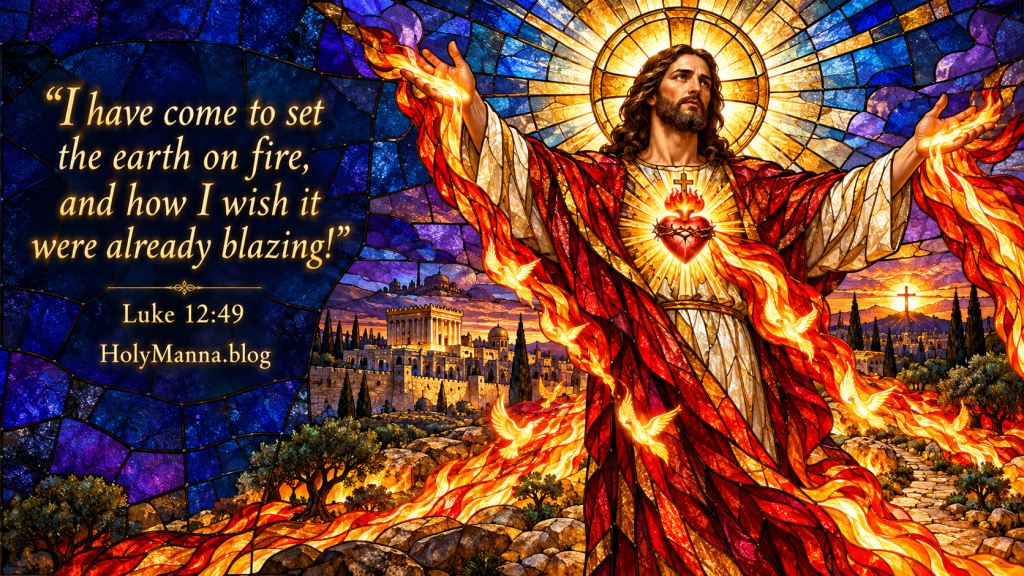
“I have come to set the earth on fire,
and how I wish it were already blazing!
There is a baptism with which I must be baptized,
and how great is my anguish until it is accomplished!
Do you think that I have come to establish peace on the earth?
No, I tell you, but rather division.
From now on a household of five will be divided,
three against two and two against three;
a father will be divided against his son
and a son against his father,
a mother against her daughter
and a daughter against her mother,
a mother-in-law against her daughter-in-law
and a daughter-in-law against her mother-in-law.”
Detailed Exegesis
Verse 49: “I have come to set the earth on fire, and how I wish it were already blazing!”
Jesus does not merely bring fire; the Greek verb means to hurl or cast it down. Saint Cyril of Alexandria, the great fifth-century Doctor of the Church, asks in Commentary on Luke, Sermon 94 what kind of fire this is and answers: “the fire which is sent forth by Christ is for men’s salvation and profit… For the fire here is, I say, the saving message of the Gospel, and the power of its commandments.” The Catechism identifies it with the Holy Spirit himself, teaching that “fire symbolizes the transforming energy of the Holy Spirit’s actions” (CCC 696), and that same paragraph quotes this very verse. Most striking of all is the longing: the Lord aches for hearts to catch.
Verse 50: “There is a baptism with which I must be baptized, and how great is my anguish until it is accomplished!”
Jesus had already been baptized in the Jordan, so this baptism means something else. Cyril states it plainly: “By his baptism, he means his death in the flesh.” The Passion will be an immersion into suffering and death on behalf of sinners. The Church reads it the same way: “In his Passover Christ opened to all men the fountain of Baptism. He had already spoken of his Passion, which he was about to suffer in Jerusalem, as a ‘Baptism’ with which he had to be baptized” (CCC 1225). The anguish here is not reluctance but holy urgency, for “the desire to embrace his Father’s plan of redeeming love inspired Jesus’ whole life, for his redemptive passion was the very reason for his Incarnation” (CCC 607). The fire cannot fall until the Cross is accomplished.
Verse 51: “Do you think that I have come to establish peace on the earth? No, I tell you, but rather division.”
This verse stuns readers who remember the angels at Bethlehem and Isaiah’s Prince of Peace. There is no contradiction. Christ gives true peace, the reconciliation of sinners with God, but he refuses to give false peace, the kind purchased by pretending truth does not matter. His presence forces a decision, and decisions divide. A Gospel that offends no one and changes nothing is not the Gospel he hurled onto the earth.
Verse 52: “From now on a household of five will be divided, three against two and two against three;”
The household of five reflects a typical home of the time: father, mother, son, daughter, and daughter-in-law under one roof. Jesus is describing what the earliest Christians lived through, as conversion to Christ sometimes cost them their place at the family table. Luke’s first readers did not hear this as theory; many of them were the two standing against the three.
Verse 53: “a father will be divided against his son and a son against his father, a mother against her daughter and a daughter against her mother, a mother-in-law against her daughter-in-law and a daughter-in-law against her mother-in-law.”
Jesus is quoting the prophet Micah, who used these exact pairings in Micah 7:6 to describe Israel’s moral collapse before God’s intervention. By placing the prophecy on his own lips, Jesus announces that the decisive hour of God’s intervention has arrived, and he himself is the dividing line running through every household.
Teachings
The Church refuses to soften this passage, and refuses equally to let it justify coldness toward family. The Catechism holds both truths together: “Family ties are important but not absolute… They must be convinced that the first vocation of the Christian is to follow Jesus” (CCC 2232). Love of family is a commandment; worship of family is an idolatry. This fire also blazed through Saint Catherine of Siena, a Doctor of the Church who faced fierce family opposition to her own vocation. In Letter 368, she wrote that a soul fully given to God would set fire to all of Italy. Pope Saint John Paul II carried her words to the youth of the world at the closing Mass of World Youth Day in the Jubilee Year 2000, proclaiming: “If you are what you should be, you will set the whole world ablaze!” Providentially, October 22nd is also the Optional Memorial of Saint John Paul II, who spent his pontificate fanning that fire in young hearts.
Reflection
Most believers will never face martyrdom, but nearly everyone knows the quieter divisions this Gospel describes: the eye-roll at the mention of Mass, the tense holiday conversation, the friendship that cooled after a conversion. Jesus is not commanding hostility toward loved ones; he is warning that fidelity to him sometimes provokes it, and that his claim comes first even then. He asks for firmness wrapped in charity, holding the truth while never ceasing to love those who oppose it. Begin with the fire itself. Spend ten minutes before the Blessed Sacrament this week and ask the Holy Spirit to rekindle what has grown lukewarm. Where have you chosen false peace over faithfulness in order to avoid conflict? Is there someone who opposes your faith whom you need to love more visibly this week, without surrendering an inch of the truth?
Where the Fire Falls Next
Step back and watch the three readings become one story. It begins in a Roman prison, where an apostle in chains sinks to his knees and prays the boldest prayer imaginable, that ordinary believers would be “filled with all the fullness of God” and come to know “the love of Christ that surpasses knowledge.” The story continues in the Temple, where harps and ten-stringed lyres carry the answer heavenward: the prayer is already being granted, because “of the kindness of the LORD the earth is full,” and his plan of love stands firm through every generation. Then the story reaches the dusty road to Jerusalem, where the Son of God reveals what that kindness will cost him, a baptism of blood, and what it will ignite in the world, a fire he can hardly wait to see blazing, even when it burns straight through the middle of a family. The love of God is immeasurable, it saturates creation, and it is combustible. The only question the day leaves open is where the fire falls next, and it falls wherever a heart stops resisting it. Saint Paul knelt. The psalmist sang. Christ embraced the Cross. Each one shows a posture the fire can work with. So take the invitation seriously today. Kneel beside Paul tonight and pray his prayer for someone by name. Sing with the psalmist by naming God’s kindness out loud at the dinner table. Stand with Christ by choosing faithfulness over false peace in one concrete situation this week. The Lord who accomplishes far more than anyone can ask or imagine is not waiting for perfect people. He is waiting for willing kindling.
Engage With Us!
These readings were made to be wrestled with in community, so share your reflections in the comments below. Your experience of praying through today’s Scriptures may be exactly the encouragement another reader needs. To get the conversation started, here are a few questions drawn from each reading:
- In Ephesians 3:14-21, Saint Paul prays that Christ may dwell in your heart and that you would be rooted and grounded in love. What is one concrete habit you could begin this week to give Christ fuller ownership of your heart?
- In Psalm 33:1-2, 4-5, 11-12, 18-19, the psalmist declares that the earth is full of the kindness of the Lord. Where did you see that kindness in your own life in the past twenty-four hours?
- In Luke 12:49-53, Jesus says he has come to set the earth on fire and to bring division rather than false peace. Where has following Christ created tension in your relationships, and how might you respond with both firmness and charity?
- Taking all three readings together, if the love of God truly fills the earth and burns like fire, what is one thing you would do differently tomorrow if you let that fire catch in you?
However you answer, do not keep the fire to yourself. A life of faith is built one small act of love at a time: a prayer offered on bended knee, a word of praise spoken aloud, a hard conversation handled with gentleness. Go light something today, and do everything with the love and mercy Jesus taught.
Sacred Heart of Jesus, we trust in You!
Immaculate Heart of Mary, pray for us!
Saint Michael the Archangel, defend us in battle!
Follow us on YouTube, TikTok, Instagram and Facebook for more insights and reflections on living a faith-filled life.


Leave a Reply