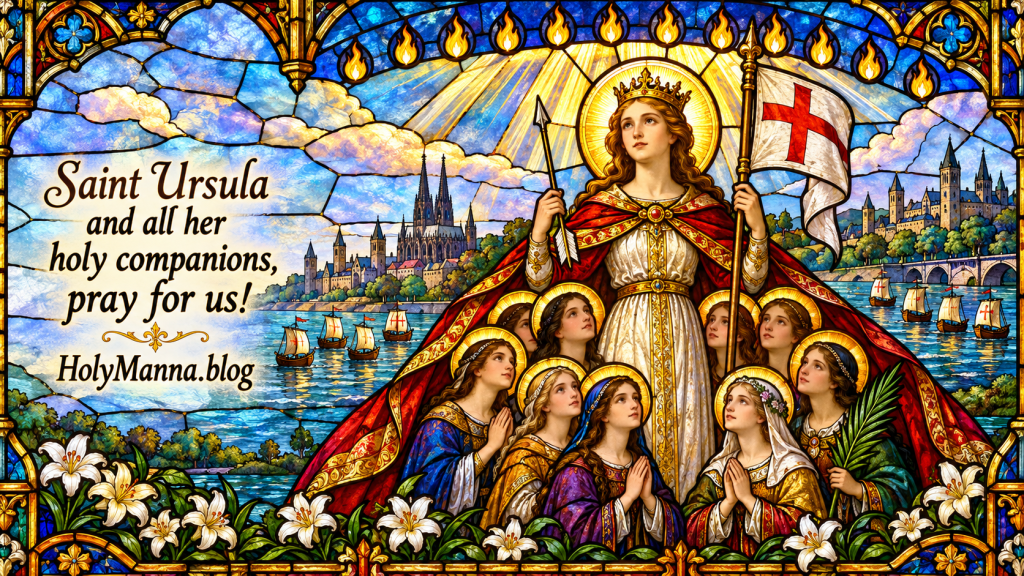
The Virgin Martyrs of Cologne
On October 21st, the Church remembers Saint Ursula and her companions, the virgin martyrs of Cologne. Their story is one of the most beloved and most debated in all of Christian tradition, a story of a princess, a pilgrimage, eleven ships, and a massacre on the banks of the Rhine. It is also a story the Church herself handles with remarkable honesty. The Roman Martyrology still commemorates on this day the virgin saints who ended their life in martyrdom for Christ at Cologne, naming the young girl Ursula as the one looked upon as their leader. At the same time, when the General Roman Calendar was revised in 1969, their commemoration was removed from the universal calendar because, as the official commentary admitted, nothing, not even their names, is known with certainty about these martyrs. What remains certain is this: real Christian virgins really died for Jesus Christ at Cologne in the early centuries of the Church, and the faithful have honored them there for more than 1,600 years. The Catechism teaches that martyrdom is the supreme witness given to the truth of the faith, a witness borne even unto death (CCC 2473). That witness is the heart of this feast, whatever the number of the witnesses turns out to be.
Saint Ursula holds patronages that have shaped the Church to this day. Through the work of Saint Angela Merici and the Ursuline order, she is honored as a patroness of students, schoolgirls, teachers, and Catholic education, especially the education of young women. She is also venerated as a patroness of the city of Cologne and of the British Virgin Islands, which Christopher Columbus named in honor of her and her companions.
A Stone That Speaks
The one undisputed historical anchor of this feast is a block of stone. In the choir of the Basilica of Saint Ursula in Cologne stands a Latin inscription dating from around the year 400. It records that a nobleman named Clematius, prompted by heavenly visions, rebuilt from its foundations a ruined basilica on his own property, on the very site where holy virgins had shed their blood for the name of Christ. Famously, the Catholic Encyclopedia observed that the entire history of these martyrs rests on ten lines, and these are open to question. The inscription gives no names, no number of martyrs, and no date. Yet it proves something precious: by the year 400, the Christians of Cologne already venerated a group of virgin martyrs at that spot, and their cult was old enough that the original shrine had crumbled and needed rebuilding. The martyrdom itself, then, belongs to the age of Roman persecution, with later sources proposing dates as varied as 238, 383, and the mid 400s. The Church flags this conflict honestly rather than choosing a date she cannot prove.
Everything about Ursula’s early life comes from later tradition rather than documented history. According to the tradition that took shape in the Passio Ursulae of the 900s and reached its most famous form in The Golden Legend of Blessed Jacobus de Voragine, Ursula was the daughter of a Christian king of Britain. She was renowned for her beauty, her intelligence, and above all her consecration of her virginity to Christ. A powerful pagan prince sought her hand in marriage for his son, and her father, fearing war, did not dare refuse. Ursula, guided in the tradition by a divine dream, agreed to the betrothal on conditions designed to win time for heaven: a delay of three years, the baptism and instruction of her bridegroom, and the company of ten noble maidens, each of whom, like Ursula herself, would be accompanied by a thousand virgins. This story of her origins and betrothal cannot be verified.
What is worth noticing, even inside an unverifiable story, is what medieval Christians believed holiness looked like in a young woman. The tradition presents Ursula as someone who treated her life as belonging first to God. The Catechism teaches that from apostolic times Christian virgins, called by the Lord to cling only to Him, have been consecrated to God and are betrothed mystically to Christ (CCC 922 to 923). It teaches as well that the bond with Christ takes precedence over all other bonds, familial or social (CCC 1618). Ursula’s tradition is a dramatized portrait of exactly that teaching.
Courage Aboard Eleven Ships
The traditional story continues with one of the most striking images in all of hagiography: eleven ships filled with eleven thousand young women, sailing under the banner of Christ. In the tradition, the company trained at sea for three years, and when the time of the marriage drew near, a sudden wind carried the fleet away from Britain altogether. The ships sailed up the Rhine to Cologne, then on to Basel, and from there the virgins traveled on foot across the Alps to Rome as pilgrims, praying at the tombs of the Apostles Peter and Paul. In Cologne, the tradition says, an angel appeared to Ursula and revealed that the company would return to that city and there receive the crown of martyrdom; Ursula announced this to her companions, and they continued the pilgrimage anyway, choosing the road that led to heaven. The tradition adds that in Rome a pope named Cyriacus was so moved by the virgins that he resigned his office to join them. No pope of that name appears anywhere in the papal records, which is one of the clearest signs that this narrative is a later pious composition. None of this voyage narrative can be verified.
The sober history behind the story is leaner but still luminous. The earliest liturgical books of Cologne list small groups of virgin martyrs, sometimes five, sometimes eight, sometimes eleven, with names like Pinnosa, Martha, Saula, and Ursula. A martyrology compiled around 850 by Wandalbert of Prüm speaks of several thousand virgins, and scholars have long suggested that the famous figure of eleven thousand arose from a copyist’s error, perhaps a misreading of an abbreviation meaning eleven martyred virgins as eleven thousand virgins. The Church does not stake her credibility on the number. She stakes it on the martyrdom itself, and that is attested by the Clematius stone.
Why should the reader remember and emulate these martyrs when so little is known about them? Precisely because the Church has always understood that the power of a martyr does not come from biographical detail. It comes from Christ. The Catechism teaches that the Church has collected with great care the records of those who persevered to the end in witnessing to their faith, and calls these the archives of truth written in letters of blood (CCC 2474). At Cologne, the archive is not a parchment but a church built over graves. The virgins of Cologne matter because they show that holiness is possible for the young, for the unknown, and for those whose names history forgets but heaven records. Scripture promises of such souls that they follow the Lamb wherever he goes (Revelation 14:4). No miracles during their lifetimes are recorded in any verifiable source; their one great sign was the gift of their lives.
The Arrows of Cologne
The martyrdom is the center of the tradition, and it deserves to be told as the Church received it, clearly labeled as tradition. When the virgins returned down the Rhine, the story says, they found Cologne besieged by the Huns. The barbarians fell upon the defenseless company, and the maidens were slaughtered, most by the sword. The tradition tells that the Huns were astonished that young women met death with such calm, singing and encouraging one another, refusing every offer of escape that came at the price of their purity or their faith. When the slaughter was finished, only Ursula remained. The chief of the Huns, struck by her beauty, offered to spare her life and make her his wife. Ursula refused him, declaring her fidelity to Christ her true Bridegroom, and the chieftain shot her through with an arrow. The arrow became her emblem forever; to this day she is painted as a serene young woman holding an arrow, sheltering her companions beneath her wide cloak. One tradition adds a final grace note: when the Huns attempted to plunder the ships, they beheld eleven legions of shining soldiers aboard, heavenly protectors of the dead, and fled from Cologne in terror. Another tradition, connected with the later visions of Elizabeth of Schönau, honors a companion named Cordula, who hid during the massacre out of fear, repented through the night, and presented herself to the Huns the next morning to receive the crown she had briefly fled. None of these martyrdom narratives can be verified.
What the Church can affirm without hesitation is the meaning of what happened at Cologne, whenever and however it happened. Virgins died there rather than deny Christ. Scripture says, Precious in the sight of the LORD is the death of his saints (Psalm 116:15). The Catechism teaches that the martyr bears witness to Christ who died and rose, to whom the martyr is united by charity, and endures death through an act of fortitude (CCC 2473). Jesus Himself prepared His followers for this when He said, And do not be afraid of those who kill the body but cannot kill the soul (The Gospel of Matthew, Mt 10:28). The maidens of Cologne, named and unnamed, took Him at His word. Like the wise virgins of the parable in The Gospel of Matthew, chapter 25, they kept their lamps burning and went out to meet the Bridegroom when He came at an hour no one expected.
Bones That Preach
The afterlife of this devotion is one of the most extraordinary in Church history. In the year 1106, as Cologne expanded its city walls, workers broke into an ancient Roman burial ground near the church of the virgins. The field yielded an enormous quantity of human remains, and the faithful of the age, already convinced of the eleven thousand, received the bones as the relics of Ursula’s whole company. Soon afterward, the Benedictine visionary Elizabeth of Schönau reported revelations in which the martyrs identified themselves by name and filled out their story, and these accounts, written down by her brother Egbert, spread across Europe. The Church teaches that private revelations of this kind, even when reported by holy people, do not belong to the deposit of faith and never improve upon or complete the definitive Revelation given in Christ (CCC 67). Modern scholarship has shown that the burial field contained ordinary Roman era graves, including those of men and children, and the names given in the visions match no ancient record. These revelations and the relic identifications that flowed from them cannot be verified.
Yet the devotion they fed produced real and lasting fruit. The Romanesque Basilica of Saint Ursula, one of the twelve great Romanesque churches of Cologne, rose over the ancient site, and in the 1600s a chapel called the Goldene Kammer, the Golden Chamber, was built beside it. Its walls are lined floor to ceiling with bones arranged in patterns and even in Latin words, one of the most arresting memento mori in the Christian world, and pilgrims still visit it today. The city of Cologne took the virgins as its patrons, and tradition connects the eleven black flames on the city’s coat of arms with their memory. Saint Hildegard of Bingen, the great twelfth century abbess and Doctor of the Church, composed a cycle of chants in honor of Ursula and her companions, among the most soaring music of the Middle Ages. Hans Memling painted their story on the famous reliquary shrine of Saint Ursula in Bruges, and Vittore Carpaccio devoted an entire cycle of canvases to her in Venice.
The devotion crossed oceans. In 1493, Christopher Columbus, sighting a scattered archipelago in the Caribbean, named the islands after Saint Ursula and her companions; they are called the Virgin Islands to this day, and the martyrs are honored as patrons of the British Virgin Islands. In 1520, Ferdinand Magellan named Cape Virgenes, at the entrance to his strait, in their honor, having reached it on their feast day. Greatest of all, in 1535 Saint Angela Merici placed the company of consecrated women she founded in Brescia under Ursula’s patronage. The Ursulines became the first religious order of women dedicated to the education of girls, carrying schools, and with them the name of Ursula, to nearly every continent. Through them Ursula became patroness of students and of Catholic education. It is a beautiful irony of Providence that a saint about whom almost nothing can be historically taught became the heavenly protector of teaching itself. Individual companions are venerated as well; Saint Odilia, one of the company in tradition, is honored as principal patroness of the Crosier Fathers and Brothers. No specific posthumous healings attributed to Ursula survive in verifiable records; her great miracle after death has been the centuries of faith, scholarship, music, art, and education poured out under her name. The Catechism teaches that the veneration of relics and pilgrimages to sanctuaries are treasured forms of popular piety that extend the liturgical life of the Church (CCC 1674), and that the witness of the saints in heaven strengthens the whole Church in holiness (CCC 956 to 957).
What the Virgins of Cologne Ask of You
A saint wrapped in uncertainty might seem to have little to say to the modern reader, but the opposite is true. Saint Ursula and her companions pose the one question that no historical debate can soften: if your faith cost you everything, would you still hold it? The maidens of Cologne, whoever they were, answered yes. They answered yes without fame, without recorded last words, without even leaving their names behind. The Catechism teaches that God’s grace and the witness of a holy life make the Church herself a sign of credibility before the world (CCC 828), and the anonymous martyrs of Cologne have been exactly that sign for sixteen centuries.
Their feast also teaches something about honesty. The Church did not panic when scholars questioned the eleven thousand. She examined the evidence, trimmed the calendar, kept the martyrs in the Roman Martyrology, and kept praying. Faith does not need inflated numbers, and it does not fear the truth. The reader can imitate that confidence by loving both the traditions of the faith and the facts, telling the stories of the saints with reverence while naming honestly what is history and what is pious tradition.
There are practical ways to weave these lessons into daily life. The reader can pray for students, teachers, and Catholic schools, the special charge of Saint Ursula’s patronage, and perhaps thank a teacher who formed their faith. The reader can defend purity and chastity in a culture that mocks both, remembering that the virgins of Cologne considered fidelity to Christ worth more than life itself. The reader can embrace the hidden faithfulness that the companions model, the ten thousand anonymous acts of love, patience, and witness that no one will ever record but God will never forget. And the reader can keep their lamp lit, confessing sins promptly, receiving the Eucharist worthily, and living each day ready to meet the Bridegroom. Where is God asking you to be faithful right now, even if no one ever knows your name? Is there a compromise being offered to you, at work, in a relationship, or online, that would cost you your integrity before Christ? Who taught you the faith, and have you ever thanked God for them by name?
Engage With Us!
The story of Saint Ursula and her companions has stirred hearts for more than sixteen centuries, and HolyManna would love to hear how it stirs yours. Share your thoughts, questions, and reflections in the comments below, especially if you are a student, a teacher, or someone learning to be faithful in hidden ways. To help the conversation begin, consider these questions:
- The virgins of Cologne are honored even though their names are lost; how does their anonymity challenge the modern hunger to be seen and remembered?
- Saint Ursula is patroness of students and teachers; who has been the most important teacher of the faith in your life, and what did they hand on to you?
- The tradition says Ursula learned of her coming martyrdom and continued her pilgrimage anyway; is there a hard path you sense God inviting you to walk with similar trust?
- The Church honestly distinguishes documented history from pious tradition in this feast; how can that same honesty strengthen, rather than weaken, your own faith?
- The martyrs valued purity and fidelity to Christ above life itself; what is one concrete step you can take this week to guard your own heart for God?
Whatever brought you to this page today, know that the same Lord who gave courage to a company of young women on the Rhine offers that courage to you. Live this week as they lived their last pilgrimage, with lamps burning, hearts undivided, and eyes fixed on the Bridegroom. Do everything, the small and the great, the seen and the unseen, with the love and mercy that Jesus taught us, and one day, like Ursula and her companions, you will follow the Lamb wherever He goes.
Saint Ursula and all the Virgin Martyrs of Cologne, pray for us!
Follow us on YouTube, TikTok, Instagram and Facebook for more insights and reflections on living a faith-filled life.


Leave a Reply