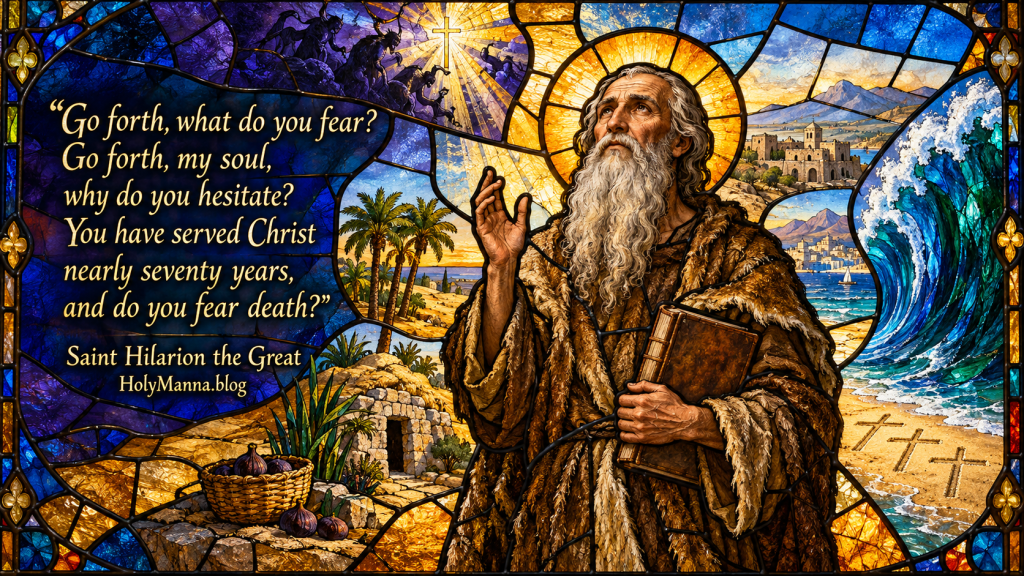
The Hermit Who Could Not Hide
Some saints change the world by building institutions. Others change it by walking away from everything and letting God do the building. Saint Hilarion the Great, whose feast the Church celebrates on October 21st, belongs firmly to the second group. Born around the year 291 near Gaza and dying in Cyprus around 371, this quiet, stubborn, fiercely holy man became the founder of monastic life in the Holy Land. Before him, there were no monks in Palestine. After him, monasteries covered the countryside, and the whole tradition of Holy Land monasticism traces back to a teenager who built a reed hut in a bandit-infested wasteland and refused to leave.
The Church knows his story primarily through Vita Sancti Hilarionis, the biography written by Saint Jerome around the year 390, less than twenty years after Hilarion’s death. Jerome, a Doctor of the Church, drew on a letter from Saint Epiphanius of Salamis, who knew Hilarion personally during his final years. The historian Sozomen adds independent testimony, recording in his Ecclesiastical History that his own grandfather was converted to Christianity by Hilarion. The Roman Martyrology for October 21st honors him with beautiful simplicity: “In Cyprus, the birthday of the holy abbot Hilarion. His life, full of virtues and miracles, was written by Saint Jerome.”
Hilarion holds a formal patronage to this day. He is the patron saint of Caulonia, a town in Calabria in southern Italy, where he is venerated as Sant’Ilarione, a devotion the Cauloniese community carried as far as Adelaide, where the Festa di Sant’Ilarione remains the largest Italian religious festival in South Australia every October. Not bad for a man who spent his entire life trying to disappear.
Jerome opens the story with an image that captures the whole thing. Hilarion’s parents were pagans, and so, Jerome writes, “the rose blossomed on the thorn.” Holiness does not need a holy pedigree. It needs a heart that says yes.
Fifteen Years Old and All In
Hilarion was born in the village of Thabatha, about five miles south of Gaza in Roman Palestine. His pagan parents clearly had means and ambition, because they sent their gifted son to Alexandria, the intellectual capital of the ancient world, to be educated under a grammarian. Jerome reports that the boy excelled and became an accomplished speaker. But something far more important happened in Alexandria than a good education. Hilarion encountered Jesus Christ and believed. Jerome notes that the young student took no pleasure in the madness of the circus, the blood of the arena, or the excesses of the theater; instead, “his whole pleasure was in the assemblies of the Church.”
Then came the encounter that set the course of his life. The fame of Saint Anthony of Egypt, the father of desert monasticism, was in the mouth of everyone in Egypt, and Hilarion burned to see him. He traveled into the desert, found the great hermit, and stayed with him for about two months, studying his constant prayer, his humility with the brethren, and his unbending fasting. But Anthony’s hermitage had grown crowded with visitors, and Hilarion found it strange to endure city crowds in the desert. He reasoned that he should begin as Anthony had begun, saying, “Antony is reaping the reward of victory like a hero who has proved his bravery. I have not entered on the soldier’s career.”
So the fifteen-year-old went home. His parents had died, and Hilarion then did something that should stop every modern reader cold. He divided his inheritance, giving part to his brothers and part to the poor, and kept absolutely nothing for himself. Jerome records that he was mindful of the Lord’s words in The Gospel of Luke: “whosoever he be of you that renounces not all that he has, he cannot be my disciple” (Luke 14:33). This is exactly the detachment the Church still teaches today. The Catechism states plainly: “Detachment from riches is necessary for entering the Kingdom of heaven” (CCC 2556). Hilarion did not negotiate with that teaching. He lived it at an age when most teenagers are negotiating curfews.
Stripped of everything, armed, as Jerome puts it, with the weapons of Christ, the boy walked into the wilderness seven miles from Majuma, the port of Gaza, a region notorious for robbery and bloodshed. Friends and relatives warned him he was walking toward death. Jerome’s answer for them rings like a bell across seventeen centuries: he despised death that he might escape death.
The Desert Starts to Bloom
What followed was one of the most intense ascetic lives in the history of the Church, and Jerome records it in almost uncomfortable detail. Hilarion wore a sackcloth shirt and a cloak of skins that Anthony himself had given him. His food was fifteen dried figs, eaten only after sunset. From ages twenty to twenty-seven he lived on half a pint of lentils moistened with cold water, then on dry bread with salt, supporting himself by weaving baskets. His cell was five feet high, shorter than Hilarion himself; Jerome remarks that one might suppose it a tomb rather than a house. He cut his hair once a year, on Easter, and he had committed the Sacred Scriptures to memory, reciting them aloud after his prayers as if standing in the presence of God.
The battles came early and hard. The devil assaulted the teenage hermit with temptations of the flesh, and Hilarion answered with a line that has made readers smile for sixteen centuries. Beating his own chest, he addressed his body like a stubborn farm animal: “Ass! I’ll stop your kicking, I will not feed you with barley, but with chaff. I will weaken you with hunger and thirst, I will lade you with heavy burdens, I will drive you through heat and cold, that you may think more of food than wantonness.” There is deep spiritual wisdom hiding inside the humor. Hilarion understood what The Catechism teaches: “The way of perfection passes by way of the Cross. There is no holiness without renunciation and spiritual battle” (CCC 2015). Jerome describes demonic terrors by night, phantom armies, wailing voices, even a spectral chariot charging him in the moonlight, which vanished into the earth when Hilarion called on the name of Jesus.
One story from these years deserves telling in full. When Hilarion was eighteen, robbers hunted him through the night, searching the marshes until daybreak. When they finally found the boy, they asked, half mocking, what he would do if robbers came to him. His answer: “He that has nothing does not fear robbers.” They pressed him: he could still be killed. He replied, “I might; and therefore I do not fear robbers because I am prepared to die.” Jerome records that the robbers, astonished at his firmness and faith, promised to lead better lives. A penniless teenager had disarmed armed men with nothing but freedom from fear.
For twenty-two years Hilarion lived this hidden life, known throughout Palestine by reputation only. Then God decided the lamp had sat under the basket long enough. Jerome records that his first miracle came when a woman of Eleutheropolis, childless for fifteen years and despised by her husband, threw herself at the hermit’s feet and begged his prayers. Hilarion wept over her, bade her have faith, and within a year she returned carrying a son. Soon after came a greater wonder. Aristaenete, the wife of a future praetorian prefect, found her three sons dying of fever at Gaza, given up by the physicians. She begged the hermit by the blood of Christ to restore them. Hilarion, who never entered cities, finally relented, came to Gaza after sunset, made the sign of the cross over each fevered body, and called on the name of Jesus. Jerome exclaims at the result: “Marvellous efficacy of the Name!” The boys broke into a healing sweat, took food, and kissed the saint’s hands that very hour.
The floodgates opened. The sick, the possessed, and the desperate streamed into the desert from Syria and Egypt, and with them came men who wanted to live as Hilarion lived. Around the year 329 the first monastery in Palestine took shape around his cell. Jerome states it directly: before Hilarion, no one had known a monk in those lands, and he sums up God’s plan in a single unforgettable sentence: “The Lord Jesus had in Egypt the aged Antony: in Palestine He had the youthful Hilarion.” Anthony himself honored the younger hermit, writing letters to him and telling sick pilgrims from Syria, “Why have you taken the trouble to come so far, when you have there my son Hilarion?”
Jerome’s catalogue of miracles reads like a fourth-century Gospel echo. A woman of Facidia, blind for ten years, who had spent everything on physicians, first received a correction, “If you had given to the poor what you have wasted on physicians, the true physician Jesus would have cured you,” and then received her sight. The strongman Marsitas, so violent he was dragged to the monastery in chains like a wild bull, was freed from his demon in seven days. Orion, a wealthy man of Aila possessed by a legion, was delivered, and when he returned with gifts, the saint refused every one of them, telling him, “No one better spends than he who keeps nothing for himself.”
And then there is the chariot race, perhaps the most cinematic scene in all of Jerome’s writings. A Christian of Majuma named Italicus raced horses in the Gaza circus against a pagan magistrate devoted to the idol Marnas, and the pagan had hired a sorcerer to hex the Christian’s team. Italicus asked the hermit for protection. Hilarion smiled at the request, suggested Italicus give the price of the horses to the poor instead, but finally ordered his own drinking cup filled with water. Italicus sprinkled it over his stable, his horses, his charioteers, and the starting gates. When the signal dropped, the Christian’s team flew while the pagan’s horses faltered, and the whole crowd, pagans included, roared with one voice that “Marnas is conquered by Christ.” Jerome says the furious losers demanded that Hilarion be executed as a Christian magician, while the victory drew many souls to the faith. These miracle accounts rest on Jerome’s biography rather than on independent documentation, and the Church has received them on the authority of a Doctor of the Church writing within living memory of the events.
Famous Against His Will
Here Hilarion’s story takes the turn that makes him strangely relevant today. Most people suffer because they cannot get attention. Hilarion suffered because he could not escape it. By his sixty-third year he stood at the head of a vast monastery, with bishops, clergy, judges, and crowds pressing in on him daily for blessed bread and oil. And the old man wept. When a brother asked why, he answered with devastating honesty: “I have returned again to the world and have received my reward in my lifetime.” The man who had given up everything feared that fame was quietly handing it all back.
So he ran. When word spread that he meant to leave, Jerome says ten thousand people gathered to stop him, and Hilarion refused food and drink for seven days until they released him. Around the year 360 he set out for Egypt with forty monks, praying at Anthony’s mountain and meeting the confessor bishops Dracontius and Philo, exiled under the Arian-leaning Emperor Constantius. In Egypt, after a three-year drought, Jerome records that the rain fell the moment Hilarion raised his hands to heaven.
Then persecution found him. When Julian the Apostate took the throne and began his campaign to restore paganism, the city of Gaza, still smarting from decades of conversions, petitioned the emperor for the death of Hilarion and his disciple Hesychius. The saint’s monastery was destroyed, a warrant went out for his arrest, and the old man slipped away to a remote oasis in the Libyan desert. Even when news came that Julian was dead and a Christian emperor reigned, Hilarion refused to return to the ruins of his fame. He crossed to Sicily instead, and Jerome preserves a priceless detail from the voyage. Halfway across, Hilarion prepared to pay his fare with the only valuable thing he owned, a copy of the Gospels he had copied out by hand in his youth. The ship’s master, seeing that the old man and his companion owned nothing but that book and the clothes they wore, refused to take it. Jerome says Hilarion rejoiced to be accounted a beggar.
In Sicily he hid in the interior, selling bundles of firewood for bread, until, in a story Jerome tells without blinking, a possessed man in the basilica of Saint Peter in Rome cried out that Hilarion was hiding in Sicily, sailed there, and was healed at the hermit’s hut. The faithful disciple Hesychius, who had searched the coasts and deserts of the known world for three years, finally found his master there. But the crowds found him too, so Hilarion moved on to Epidaurus in Dalmatia, where two of his most famous wonders took place. Jerome recounts that an enormous serpent, so large the locals called it a boa, was devouring herds and herdsmen across the province; Hilarion ordered a pyre built, prayed to Christ, commanded the beast onto the woodpile, and burned it before the whole people. Then, around the year 366, after the great earthquake that followed Julian’s death, the sea itself rose against the town, with waves like mountains threatening to drown Epidaurus. The people placed the old man on the shore like a weapon of war. Hilarion traced three signs of the cross in the sand, stretched out his hands, and Jerome testifies that the swelling sea stood up like a wall before him, roared against the invisible barrier, and slowly sank back. Jerome adds that in his own day Epidaurus still told the story, and mothers taught it to their children. On the voyage to Cyprus that followed, pirates bore down on his ship, and while the sailors panicked, the old man stretched out his hand toward the raiders and said, “Thus far and no farther.” Their boats, Jerome writes, bounded backward to the shore.
Hilarion was never martyred; he was a confessor whose entire life was a slow martyrdom of fasting, flight, and the surrender of reputation. His final refuge was Cyprus. Even there two hundred afflicted people found him within weeks, so he climbed with Hesychius to an all-but-inaccessible mountain site twelve miles from the sea, near the ruins of a pagan temple echoing, he said, with the voices of demons; he was pleased to have his enemies for neighbors. There he spent his last five years, befriended by Saint Epiphanius of Salamis, still healing those who crawled up the cliffs to reach him. In his eightieth year, sensing death approaching, he wrote a short testament leaving Hesychius all his riches: a Gospel book, a sackcloth tunic, a cowl, and a cloak. As his body grew cold, the old warrior preached one final sermon to his own soul: “Go forth, what do you fear? Go forth, my soul, why do you hesitate? You have served Christ nearly seventy years, and do you fear death?” With those words, he breathed his last.
Two Lands, One Saint
Hilarion asked to be buried immediately, just as he was, in his garden, and his wish was honored. But the story of his body was not over. Jerome relates that about ten months later Hesychius, pretending he wished to live in that same garden, secretly took up his master’s body at great personal risk and carried it home to Majuma, where the monks and townsfolk received it in solemn procession. Jerome records the remarkable condition of the remains: the tunic, cowl, and cloak were uninjured, and the whole body was as perfect as if alive, so fragrant with sweet odors that one might have thought it embalmed. This account of incorruption comes from Jerome’s biography and cannot be verified by independent documentation.
Jerome also preserves the story of Constantia, a holy woman of Cyprus whose daughter and son-in-law Hilarion had saved from death, and who kept whole night vigils at his tomb. When the message reached her that his body had been carried to Palestine, she died on the spot, and Jerome saw in her death the proof of her love for the servant of God. That story, too, rests on Jerome’s telling and cannot be verified.
What followed is one of the most charming rivalries in the history of the communion of saints. Jerome describes a strange dispute still running in his own day between the people of Palestine and the people of Cyprus, the one claiming to possess Hilarion’s body, the other his spirit. And yet, Jerome notes, great miracles were reported daily in both places, though more abundantly in the little garden in Cyprus, perhaps because the saint loved that spot best. Sozomen likewise attests that Hilarion’s tombs became places of veneration and wonders. This is precisely what The Catechism teaches about the saints in glory: “they do not cease to intercede with the Father for us” (CCC 956). The veneration of his relics belongs to the healthy piety of the faithful that the Church has always cherished (CCC 1674).
Hilarion’s legacy also left footprints on the map. Near Nuseirat in the Gaza Strip stand the ruins of the Monastery of Saint Hilarion, known locally as Tell Umm Amer, regarded as the home of the first monastic community in the Holy Land and one of the largest monasteries of the ancient Middle East, with five successive churches, mosaics, and a great crypt. On July 26th, 2024, UNESCO inscribed the site simultaneously on the World Heritage List and the List of World Heritage in Danger, using an emergency procedure because of the war in Gaza. Seventeen centuries after a teenager built a hut in that wilderness, the nations of the world formally recognized what he planted there. Hilarion is honored as a pre-congregation saint, venerated from antiquity, and the Church continues to propose such saints to the faithful, in the words of The Catechism, as “models and intercessors” (CCC 828).
What a 4th Century Hermit Says to a Scrolling World
It would be easy to file Hilarion under “impressive but irrelevant.” Nobody reading this is going to move into a five-foot hut and live on fifteen figs a day. But the Church did not preserve his story for imitation of the details. She preserved it for imitation of the direction. The Catechism teaches that hermits “devote their life to the praise of God and salvation of the world through a stricter separation from the world, the silence of solitude and assiduous prayer and penance” (CCC 920), and then says something stunning about what that hidden life means for the rest of the Church: “the life of the hermit is a silent preaching of the Lord, to whom he has surrendered his life simply because he is everything to him” (CCC 921). Hilarion’s whole existence was that silent sermon. Every ordinary Catholic life is called to preach the same homily in a quieter font.
Start with his detachment. At fifteen, Hilarion gave away everything because he took Luke 14:33 at face value. Most people will never be asked to liquidate their possessions, but everyone is asked, daily, which master they serve. How much of your anxiety this week traces back to protecting things you could actually live without? A practical step in Hilarion’s spirit is small and concrete: give away one thing this month that still has value, not the junk, and give it quietly.
Then there is his spiritual combat. Hilarion did not treat temptation as a mood to be managed but as a battle to be fought, and he fought it with the classic weapons the Church still hands out: fasting, prayer, and almsgiving, the three forms of penance that Scripture and the Fathers insist on above all (CCC 1434). When temptation comes, do you negotiate with it, or do you fight it with an actual plan? Pick one concrete mortification, a fast from snacking, from complaining, from the phone after nine at night, and offer it for one specific person.
And then there is the hardest lesson, the one that cuts closest to the modern bone: his war against his own reputation. Hilarion wept when he became famous and crossed the Mediterranean repeatedly to become nobody again, because he feared receiving his reward in this life instead of the next. The present age is built on the opposite instinct; it hands every person a platform and whispers that visibility is worth. Hilarion’s witness says that the applause of heaven and the applause of the crowd are two different currencies, and a soul can only bank in one. If every good thing you did this year remained completely unseen, would you still do it? Try one hidden act of charity this week, genuinely hidden, told to no one, and let God alone hold the receipt.
Finally, his death. A man who had renounced everything had nothing left for death to take, so he met it preaching courage to his own soul after nearly seventy years of service. That fruit of a lifetime of small renunciations is on offer to everyone who starts small today.
Engage With Us!
Saint Hilarion’s story has crossed deserts, seas, and seventeen centuries to reach this page, and now the conversation belongs to you. Share your thoughts and reflections in the comments below; your experience of wrestling with distraction, detachment, or the hunger for recognition may be exactly the encouragement another reader needs today. To get the discussion started, consider these questions:
- Hilarion gave away his entire inheritance at fifteen because of a single verse of Scripture. What is one possession, habit, or comfort God might be asking you to release right now?
- The saint treated temptation as a battle requiring real weapons, fasting, prayer, and almsgiving. Which of these three is weakest in your life, and what is one concrete way you could strengthen it this week?
- Hilarion fled fame because he feared receiving his reward in this life. In an age of likes, follows, and personal brands, how do you guard your heart against doing good things to be seen?
- Crowds pursued Hilarion because holiness is magnetic. Who in your life radiates Christ in a way that draws you, and have you ever told them?
- On his deathbed, Hilarion told his soul not to fear after seventy years of serving Christ. What small, daily act of faithfulness could you begin today that you would want to look back on at the end of your life?
The world told Hilarion that a boy with nothing was nothing, and God used that boy to plant monasteries across the Holy Land, calm the sea, and conquer idols without raising a sword. The same God is not finished working through hidden, faithful lives. So go into this week unafraid of smallness. Pray in secret, give in secret, fight your battles with joy, and do everything with the love and mercy that Jesus taught us.
Saint Hilarion the Great, pray for us!
Follow us on YouTube, TikTok, Instagram and Facebook for more insights and reflections on living a faith-filled life.


Leave a Reply