Wednesday of the Twenty-ninth Week in Ordinary Time – Lectionary: 475
The Treasure That Was Never Meant to Stay Buried
Some secrets are kept to hide something. Others are kept until the perfect moment arrives to give them away. On this Wednesday of the Twenty-ninth Week in Ordinary Time, the Church sets before her children a day built entirely around that second kind of secret, and around the question of what a person does once the secret has been handed over.
The central theme uniting the readings for October 21st is the stewardship of God’s grace. The Lord entrusts His people with treasure that belongs to Him alone, and He expects that treasure to be drawn, enjoyed, and distributed rather than hoarded or neglected. In the First Reading, Saint Paul describes the stewardship of God’s grace given to him, the once-hidden mystery that the Gentiles are full coheirs in Christ. The Responsorial Psalm, which is actually a canticle from The Book of the Prophet Isaiah, sings of drawing water joyfully from the springs of salvation, the very grace that every steward is meant to carry to others. In the Holy Gospel, Jesus tells Peter exactly what faithful stewardship looks like, what its betrayal looks like, and how much is expected of those entrusted with much.
Historically, these texts span the whole sweep of salvation. Isaiah sang in the 8th century before Christ, when Judah’s survival hung by a thread. Paul wrote from Roman custody around the year 62, still astonished that a former persecutor had been made herald of the mystery. Luke recorded a Master on the road to Jerusalem, preparing servants for a long wait. Across all three, one question echoes: what has God placed in these hands, and what is being done with it?
First Reading — Ephesians 3:2-12
A Prisoner Announces the Best-Kept Secret in History
Saint Paul wrote The Letter to the Ephesians while under Roman custody, most likely around the year 62, addressing churches in and around Ephesus composed largely of Gentile converts. Two Greek words drive this passage. The first is oikonomia, translated as stewardship, which described the management of a household entrusted to a servant who owned none of it. The second is mysterion, which in Scripture does not mean a puzzle to be solved but a divine plan hidden in God until He chooses to reveal it. Paul, writing in chains, claims both words for himself: he is the steward of a secret God has finally told. That secret, scandalous to many first-century ears, is that the Gentiles now stand as full heirs alongside Israel. This reading anchors the day’s theme because Paul never once speaks as an owner. Everything he has, the revelation and the ministry alike, arrived as a gift placed in his hands for the benefit of others.
Ephesians 3:2-12
Brothers and sisters:
You have heard of the stewardship of God’s grace
that was given to me for your benefit,
namely, that the mystery was made known to me by revelation,
as I have written briefly earlier.
When you read this
you can understand my insight into the mystery of Christ,
which was not made known to human beings in other generations
as it has now been revealed
to his holy Apostles and prophets by the Spirit,
that the Gentiles are coheirs, members of the same Body,
and copartners in the promise in Christ Jesus through the Gospel.Of this I became a minister by the gift of God’s grace
that was granted me in accord with the exercise of his power.
To me, the very least of all the holy ones, this grace was given,
to preach to the Gentiles the inscrutable riches of Christ,
and to bring to light for all what is the plan of the mystery
hidden from ages past in God who created all things,
so that the manifold wisdom of God
might now be made known through the Church
to the principalities and authorities in the heavens.
This was according to the eternal purpose
that he accomplished in Christ Jesus our Lord,
in whom we have boldness of speech
and confidence of access through faith in him.
Detailed Exegesis
Verse 2: “You have heard of the stewardship of God’s grace that was given to me for your benefit.”
Paul opens with the key to the entire passage. Grace was given to him, yet it was given for your benefit. In God’s economy, gifts are never terminal; they pass through the one who receives them on their way to someone else.
Verse 3: “Namely, that the mystery was made known to me by revelation, as I have written briefly earlier.”
Paul did not reason his way to the Gospel or inherit it from a school of thought. It was revealed to him, beginning on the road to Damascus, and he points back to what he wrote earlier in the letter, where he first named God’s plan to sum up all things in Christ.
Verse 4: “When you read this you can understand my insight into the mystery of Christ.”
The letter was meant to be read aloud in the assembly. Paul’s insight is not private property; it becomes the possession of the whole Church the moment it is proclaimed.
Verse 5: “Which was not made known to human beings in other generations as it has now been revealed to his holy Apostles and prophets by the Spirit.”
The prophets of Israel glimpsed the nations streaming toward Zion, but the full shape of the plan waited for the apostolic age. The Holy Spirit is the revealer, and the Apostles and prophets are the foundation on which the household stands.
Verse 6: “That the Gentiles are coheirs, members of the same Body, and copartners in the promise in Christ Jesus through the Gospel.”
Here is the mystery stated plainly. In Greek, Paul stacks three compound words that all begin with the prefix meaning together: co-heirs, co-members, co-partners. No second-class citizenship exists in the Body of Christ. The dividing wall between Jew and Gentile has come down.
Verse 7: “Of this I became a minister by the gift of God’s grace that was granted me in accord with the exercise of his power.”
Even the ministry itself is grace. Paul attributes nothing to his own talent or training, though he had plenty of both. The power at work is God’s, exercised through a willing servant.
Verse 8: “To me, the very least of all the holy ones, this grace was given, to preach to the Gentiles the inscrutable riches of Christ.”
Paul coins a word here, a comparative stacked on a superlative, something like lesser than the least. The man entrusted with the greatest commission insists on the lowest place, and the riches he preaches are inscrutable, beyond any ledger or inventory.
Verse 9: “And to bring to light for all what is the plan of the mystery hidden from ages past in God who created all things.”
The plan was hidden in the Creator Himself from before the ages. Salvation was never an emergency repair; it was the blueprint all along, woven into the purpose of creation itself.
Verse 10: “So that the manifold wisdom of God might now be made known through the Church to the principalities and authorities in the heavens.”
The Church is God’s chosen classroom, and the angelic powers are the students. Through the unity of Jew and Gentile in one Body, the heavens themselves learn how many-sided the wisdom of God truly is.
Verse 11: “This was according to the eternal purpose that he accomplished in Christ Jesus our Lord.”
The purpose is eternal, and it is accomplished, not merely proposed. In the Cross and Resurrection, the plan hidden from ages past became historical fact.
Verse 12: “In whom we have boldness of speech and confidence of access through faith in him.”
The passage ends where every steward must begin, at the door of the King. Through faith in Christ, believers approach God with the boldness of children, not the terror of trespassers.
Teachings
Saint John Chrysostom, preaching on this very passage in Homily 7 on Ephesians, marveled at the pairing of Paul’s lowliness with the size of his commission: “And this too was of grace, that he that was least should have the greatest things entrusted to him; that he should be made the herald of these tidings.” For Chrysostom, the humility and the mission are one gift. On the phrase about the unsearchable wealth of Christ, he adds: “If His riches are unsearchable, and that too after his appearing, much more is His essence.” The Catechism confirms that Paul’s mystery finds its home in the Church. CCC 772 teaches: “It is in the Church that Christ fulfills and reveals his own mystery as the purpose of God’s plan: ‘to unite all things in him.’” The Catechism cites Ephesians 3:9-11 directly at this point, making today’s reading one of the foundation stones of the Church’s self-understanding.
Reflection
Every baptized person holds a stewardship. The faith you received came through parents, catechists, friends, or perhaps a stranger’s witness, and none of them owned it either. A practical step for today is to name one person who handed the faith to you and thank God for them, then name one person who might receive it from you and pray for an opening. Consider also the quieter gifts: a skill, an income, a listening ear. Each one carries the same label Paul read on his own life, given for the benefit of others. Who first carried the mystery of Christ to you, and who is waiting to receive it through you? Where has ownership quietly replaced stewardship in your heart?
Responsorial Psalm — Isaiah 12:2-6
The Song Israel Saved for the Day of Salvation
Today’s responsorial is not drawn from The Book of Psalms at all but from The Book of the Prophet Isaiah. Scholars call it the First Song of Isaiah, and it closes the opening section of the book, the so-called Book of Immanuel, which spans chapters 1 through 12. After eleven chapters of judgment, invasion, and the promise of a child called Immanuel, chapter 12 breaks into pure thanksgiving. Its opening line deliberately echoes the Song of Moses at the Red Sea in Exodus 15, so that Israel’s future deliverance is framed as a new Exodus. A later Jewish tradition connected verse 3 to the joyful water-drawing ceremony celebrated during the Feast of Tabernacles. That tradition forms the backdrop for the moment in The Gospel of John when Jesus stands up during that very feast and cries out, “Let anyone who thirsts come to me and drink” (John 7:37). The Church sings this canticle at the Easter Vigil, the night when the springs of salvation are opened in Baptism. Within today’s theme, Isaiah supplies the middle step: before a steward can distribute anything, the steward must first draw from the well.
Isaiah 12:2-6
R. (see 3) You will draw water joyfully from the springs of salvation.
God indeed is my savior;
I am confident and unafraid.
My strength and my courage is the LORD,
and he has been my savior.
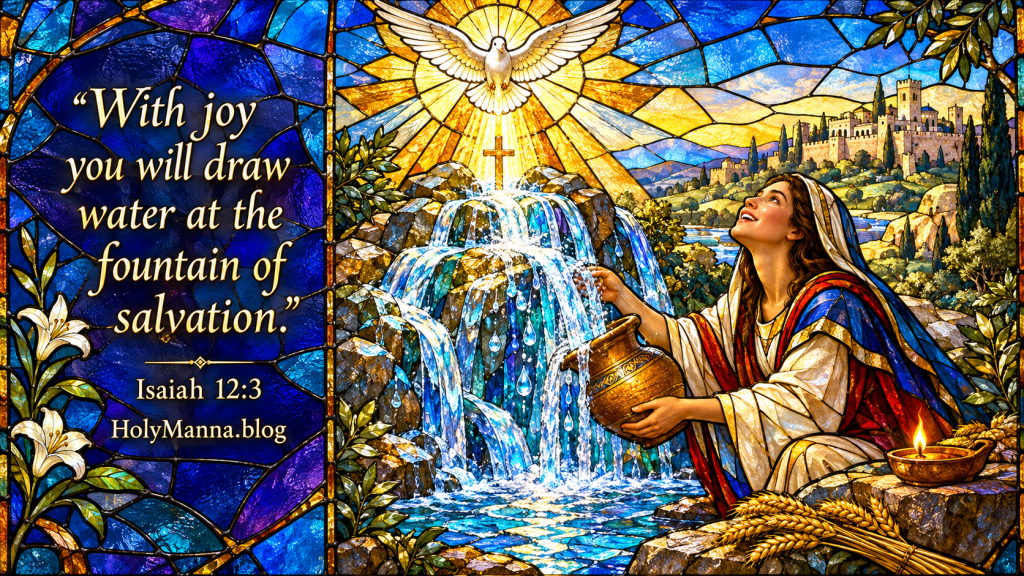
With joy you will draw water
at the fountain of salvation.
R. You will draw water joyfully from the springs of salvation.
Give thanks to the LORD, acclaim his name;
among the nations make known his deeds,
proclaim how exalted is his name.
R. You will draw water joyfully from the springs of salvation.
Sing praise to the LORD for his glorious achievement;
let this be known throughout all the earth.
Shout with exultation, O city of Zion,
for great in your midst
is the Holy One of Israel!
R. You will draw water joyfully from the springs of salvation.
Detailed Exegesis
Verse 2: “God indeed is my savior; I am confident and unafraid. My strength and my courage is the LORD, and he has been my savior.”
The verse nearly quotes Exodus 15:2, the song sung on the far shore of the Red Sea. Salvation here is intensely personal, repeated twice in a single breath. The Hebrew word for salvation, yeshuah, is the root of the holy name of Jesus, the name given because He will save His people from their sins.
Verse 3: “With joy you will draw water at the fountain of salvation.”
In the arid hill country of Judah, drawing water was daily, unglamorous labor. Isaiah takes that chore and floods it with joy, because the well in question never runs dry. The Church has always heard in this verse the waters of Baptism and the gift of the Holy Spirit, freely available and meant to be drawn again and again.
Verse 4: “Give thanks to the LORD, acclaim his name; among the nations make known his deeds, proclaim how exalted is his name.”
The song pivots outward. Thanksgiving refuses to stay private; it must be proclaimed among the nations. Seven centuries before Paul, Isaiah already glimpsed the missionary horizon that the First Reading announces in full, the Gentiles drawn into the praise of the one God.
Verse 5: “Sing praise to the LORD for his glorious achievement; let this be known throughout all the earth.”
The achievement is God’s alone, and its proper audience is all the earth. Grace received in secret becomes a song performed in public.
Verse 6: “Shout with exultation, O city of Zion, for great in your midst is the Holy One of Israel!”
The canticle ends not with water but with presence. The Holy One dwells in the midst of His city. Christians recognize the fulfillment of this line in the Incarnation and, above all, in the Eucharist.
Teachings
The Catechism places this canticle’s imagery at the very wellsprings of the spiritual life. CCC 2652 teaches: “The Holy Spirit is the living water ‘welling up to eternal life’ in the heart that prays. It is he who teaches us to accept it at its source: Christ.” On the sacramental meaning of the water, CCC 694 teaches that “the Spirit is also personally the living water welling up from Christ crucified as its source and welling up in us to eternal life.” Taken together, these paragraphs reveal why Isaiah commands joy rather than merely permitting it. The fountain is not a doctrine or a program but a Person, the Holy Spirit poured out from the pierced side of Christ. Every sacrament, every page of Scripture prayed with an open heart, and every moment of honest prayer is a bucket lowered into that spring.
Reflection
Many believers treat grace like a cistern, something stored up once at Baptism or Confirmation and slowly rationed over the years. Isaiah insists it is a spring, replenished every single day for anyone willing to draw. A concrete way to live this verse is to choose one well and return to it daily this week: ten minutes with The Gospel of Luke, a weekday Mass, a visit to the tabernacle, or the Rosary prayed slowly. Notice whether the drawing feels like a chore at first, and ask the Lord to turn the chore into joy. Which well has gone unused in your life, and what would it cost to lower the bucket this week? When was the last time gratitude to God moved from your heart to your lips in front of another person?
Holy Gospel — Luke 12:39-48
When the Master Hands Over the Keys
This passage sits in the heart of the great travel narrative of The Gospel of Luke, the long journey to Jerusalem that begins in chapter 9. Jesus has just told the parable of the rich fool and commanded His little flock to gird their loins and light their lamps like servants awaiting their master’s return. Peter then interrupts with a very practical question: is this teaching for the Twelve or for everyone? The Lord’s answer introduces the figure of the oikonomos, the steward, the same household word Paul uses of himself in today’s First Reading. Luke wrote for a generation learning to wait for a Lord who had not yet returned in glory. The temptation of that generation, and of every generation since, is the quiet thought that the master is delayed, so the rules can relax. Jesus answers that temptation with a portrait of two servants, one found faithfully feeding the household and one found abusing it, and He closes with a principle that has shaped Christian conscience ever since: responsibility rises with the gift.
Luke 12:39-48
Jesus said to his disciples:
“Be sure of this:
if the master of the house had known the hour
when the thief was coming,
he would not have let his house be broken into.
You also must be prepared,
for at an hour you do not expect, the Son of Man will come.”Then Peter said,
“Lord, is this parable meant for us or for everyone?”
And the Lord replied,
“Who, then, is the faithful and prudent steward
whom the master will put in charge of his servants
to distribute the food allowance at the proper time?
Blessed is that servant whom his master on arrival finds doing so.
Truly, I say to you, he will put him
in charge of all his property.
But if that servant says to himself,
‘My master is delayed in coming,’
and begins to beat the menservants and the maidservants,
to eat and drink and get drunk,
then that servant’s master will come
on an unexpected day and at an unknown hour
and will punish the servant severely
and assign him a place with the unfaithful.
That servant who knew his master’s will
but did not make preparations nor act in accord with his will
shall be beaten severely;
and the servant who was ignorant of his master’s will
but acted in a way deserving of a severe beating
shall be beaten only lightly.
Much will be required of the person entrusted with much,
and still more will be demanded of the person entrusted with more.”
Detailed Exegesis
Verse 39: “Be sure of this: if the master of the house had known the hour when the thief was coming, he would not have let his house be broken into.”
Jesus reaches for a jarring image, His own coming compared to a burglary, and the point is unpredictability rather than menace. Paul borrows the same picture in The First Letter to the Thessalonians, writing that the day of the Lord comes like a thief at night.
Verse 40: “You also must be prepared, for at an hour you do not expect, the Son of Man will come.”
The title Son of Man evokes the glorious figure of Daniel 7 who receives everlasting dominion. Preparation, not prediction, is the Christian posture.
Verse 41: “Then Peter said, ‘Lord, is this parable meant for us or for everyone?’”
Peter’s question is the hinge of the passage. Jesus does not answer directly; He responds with a question of His own that widens and sharpens the teaching.
Verse 42: “And the Lord replied, ‘Who, then, is the faithful and prudent steward whom the master will put in charge of his servants to distribute the food allowance at the proper time?’”
The steward is defined by two virtues, fidelity and prudence, and by one task, feeding the household at the proper time. The Fathers of the Church heard in this verse a description of the apostles and their successors, charged with distributing the Word and the sacraments.
Verse 43: “Blessed is that servant whom his master on arrival finds doing so.”
This is a beatitude for ordinary faithfulness. The blessed servant is not caught performing something spectacular, only doing the assigned task when nobody appeared to be watching.
Verse 44: “Truly, I say to you, he will put him in charge of all his property.”
The reward for faithful stewardship is greater stewardship. Heaven is not pictured as retirement but as enlarged trust, responsibility transfigured into joy.
Verse 45: “But if that servant says to himself, ‘My master is delayed in coming,’ and begins to beat the menservants and the maidservants, to eat and drink and get drunk.”
The collapse begins invisibly, with a sentence spoken only in the heart. Once the master is presumed absent, the steward treats the household as his own. Every abuse of authority in history has started with that same silent sentence.
Verse 46: “Then that servant’s master will come on an unexpected day and at an unknown hour and will punish the servant severely and assign him a place with the unfaithful.”
The underlying Greek verb for the punishment is brutally vivid, meaning to cut in two. A steward who betrays the trust does not merely lose a job; he loses his place in the household altogether.
Verse 47: “That servant who knew his master’s will but did not make preparations nor act in accord with his will shall be beaten severely.”
Knowledge binds. The servant who knows the will and ignores it bears the heavier judgment, a sobering word for everyone formed by years of catechesis, homilies, and easy access to Scripture.
Verse 48: “And the servant who was ignorant of his master’s will but acted in a way deserving of a severe beating shall be beaten only lightly. Much will be required of the person entrusted with much, and still more will be demanded of the person entrusted with more.”
Genuine ignorance lessens culpability, a principle the Church still applies in her moral teaching, though it never erases responsibility entirely. The closing sentence states the law of the whole chapter: gifts are weighed as well as counted.
Teachings
Saint Cyril of Alexandria, in his Commentary on Luke, read the steward as a portrait of those called to teach and shepherd: “The Savior has ordained faithful men of great understanding, and well instructed in the sacred doctrines, as stewards over his servants who have been won by faith to the acknowledgment of his glory.” He noted that the food in question is “spiritual food, as is sufficient and fitting for each individual,” distributed at its proper season, a reminder that good teaching is measured by the hearer’s need and not the teacher’s display. The Catechism translates vigilance into the language of prayer. CCC 2612 teaches: “In prayer the disciple keeps watch, attentive to Him Who Is and Him Who Comes, in memory of his first coming in the lowliness of the flesh, and in the hope of his second coming in glory.” And CCC 1036, quoting Lumen Gentium, makes the Gospel’s urgency explicit: “Since we know neither the day nor the hour, we should follow the advice of the Lord and watch constantly so that, when the single course of our earthly life is completed, we may merit to enter with him into the marriage feast and be numbered among the blessed.”
Reflection
An honest inventory is the first act of a faithful steward. Take a few quiet minutes today and list what has actually been entrusted to you: the faith, an education, an income, influence over children or coworkers, health, and time itself. Beside each item, ask one question: is this being distributed at the proper time, or stored for a master presumed to be delayed? A nightly examination of conscience is the steward’s best tool, five minutes to review the day before the Master’s eyes rather than waiting for the audit. For those entrusted with authority over others, verse 45 deserves special attention, since the slide from steward to tyrant begins with a single unspoken thought. What has been entrusted to you that you have quietly begun to treat as your own? If the Son of Man arrived at an hour you did not expect, what would He find you doing?
The Blessing of Being Found Faithful
Set side by side, today’s readings tell one continuous story. A God who hid a magnificent plan from all eternity finally reveals it, entrusts it to the least likely steward, and fills the wells so that everyone may drink. Paul stands at the beginning of the story, shackled yet overflowing, amazed that the mystery of the Gentiles’ inclusion passed through his unworthy hands. Isaiah stands in the middle, bucket in hand, teaching God’s people that drawing grace is meant to feel like a festival rather than a tax. And Jesus stands at the end of the story, the Master who will one day walk back through the door and look first at the pantry, asking whether the household was fed.
The beautiful surprise of this Wednesday is that the audit and the joy are the same event. The servant found faithfully doing the ordinary work is not merely spared; he is called blessed and handed more. That is the heart of the Christian life in Ordinary Time: unglamorous fidelity, repeated daily, quietly storing up a joy that will one day be made public.
So draw from the springs today. Go to the well of the Mass, of Scripture, of honest prayer, and draw deeply. Then distribute what has been drawn: a word of encouragement, a shared meal, a truth spoken gently, the faith handed on to someone younger. The mystery hidden from ages past is now carried in ordinary vessels, and the Master has deliberately left His household in those hands. May He find every reader of these words doing so.
Engage With Us!
Reflections like these only come fully alive when they become a conversation, so please share your thoughts, questions, and experiences in the comments below. Someone else drawing from the same well may need exactly the insight God has given you today. To help start that conversation, consider the following questions:
- In Ephesians 3:2-12, Paul calls himself the very least of all the holy ones, yet he was entrusted with preaching the inscrutable riches of Christ. Where in your own life has God paired a deep sense of unworthiness with a real mission, and how have you responded?
- In Isaiah 12:2-6, the prophet promises that God’s people will draw water joyfully from the springs of salvation. Which spring, whether the Eucharist, Confession, Scripture, or daily prayer, is God inviting you to return to this week, and what has kept you away?
- In Luke 12:39-48, Jesus warns that the unfaithful steward’s fall began with the silent thought that the master was delayed. In what area of your life have you been living as if the Master were not coming back?
- Taken together, the readings present grace as a treasure entrusted rather than owned. If Jesus reviewed your stewardship today, which gift would He say you have distributed well, and which one is still buried?
Keep drawing, keep distributing, and keep watch with joy rather than fear, because the Master who returns is the same Lord who filled the wells in the first place. Live this day as a faithful steward, doing everything with the love and mercy Jesus taught.
Sacred Heart of Jesus, we trust in You!
Immaculate Heart of Mary, pray for us!
Saint Michael the Archangel, defend us in battle!
Follow us on YouTube, TikTok, Instagram and Facebook for more insights and reflections on living a faith-filled life.


Leave a Reply