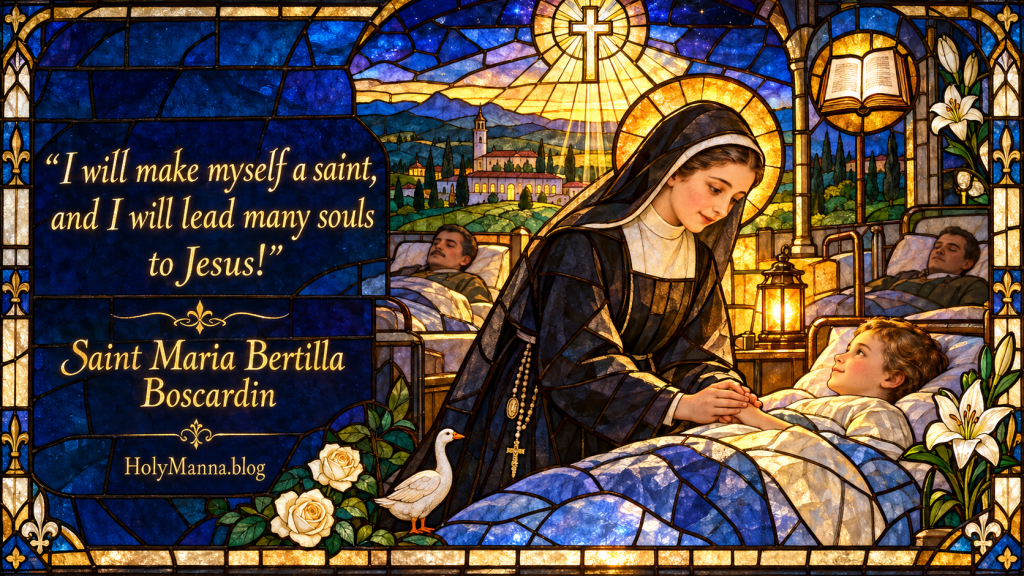
A Saint for Everyone Who Has Ever Been Overlooked
Every generation produces saints who dazzle. They found religious orders, write theological masterpieces, convert nations, and work wonders that fill volumes. And then there is Saint Maria Bertilla Boscardin, celebrated each year on October 20th, who did almost none of those things. She peeled potatoes. She scrubbed laundry. She emptied bedpans and changed bandages and sat beside sick children through the night. Her neighbors, her classmates, and reportedly even her parish priest considered her so dull that they nicknamed her “the goose.” Yet on May 11th, 1961, Pope Saint John XXIII raised this supposedly slow peasant girl to the altars of Saint Peter’s Basilica, and in the crowd that day stood people she had once nursed with her own hands.
Her story is a living commentary on Saint Paul’s words in 1 Corinthians 1:27: “God chose what is foolish in the world to shame the wise, God chose what is weak in the world to shame the strong.” Bertilla is the saint of everyone who has been told they are not smart enough, not talented enough, not impressive enough to matter. She is popularly invoked as a patroness of those who are rejected, mocked, or ridiculed for their faith, and nurses and the sick have long turned to her intercession as well; these patronages arise from widespread popular devotion rather than a formal papal decree, but they fit her life perfectly. The Catechism teaches that “all Christians in any state or walk of life are called to the fullness of the Christian life and to the perfection of charity” (CCC 2013). Bertilla took that call seriously in a hospital ward, and the Church now holds her up as proof that the universal call to holiness really is universal.
The Girl They Called the Goose
Anna Francesca Boscardin was born on October 6th, 1888, in Brendola, a small farming town near Vicenza in the Veneto region of northern Italy. Her family was poor, and her home was not a safe one. Her father, Angelo Boscardin, was a violent man given to jealousy and heavy drinking, and the detail is not pious gossip; Angelo himself testified to his own jealousy, violence, and frequent drunkenness during the official process for his daughter’s beatification. Catholic accounts record that Anna and her mother sometimes had to flee the house for their own safety. Anyone who has grown up in the shadow of an angry or addicted parent will recognize the fear that marked her childhood, and it matters that the Church canonized a woman who came from exactly that kind of home.
Her schooling was cut short so that she could help in the fields and work as a servant in nearby houses. The little education she received left her peers unimpressed. She was teased, dismissed, and labeled slow, and the nickname that stuck to her, “the goose,” was repeated even by local clergy according to the accounts gathered about her life. What the mockers missed was the interior life quietly growing in her. Annetta, as she was called, loved her parish. She joined the Daughters of Mary, taught catechism to younger children, and treasured the small catechism her parish priest gave her as a gift. That humble book became the map of her entire spiritual life.
At sixteen, in 1904, she presented herself to the Sisters Teachers of Saint Dorothy, Daughters of the Sacred Hearts, in Vicenza. One account reports that another religious order had already turned her away because of her perceived slowness, though this detail is not uniformly documented across sources. Her own parish priest doubted she would amount to much in religious life. The Sisters of Saint Dorothy accepted her anyway, and she received the religious name Maria Bertilla. Catholic sources report that on entering she told her superiors, with complete sincerity, “I’m a poor thing, a goose. Teach me. I want to become a saint.” There was no false modesty in the statement and no ambition for recognition. She simply named what the world said about her and then named what God was calling her to anyway. Pope Pius XII, at her beatification, would later quote the vow that governed her life: “I will make myself a saint, and I will lead many souls to Jesus!”
The community assigned her to the kitchen, the bakery, and the laundry, and she served there for roughly three years. It is worth sitting with that. A young woman announces that she wants to become a saint, and the Church hands her a potato peeler. Bertilla did not sulk, and she did not campaign for something more visible. The Catechism teaches that “humility is the foundation of prayer” (CCC 2559), and those hidden years in the kitchen were the foundation on which everything else was built.
Holiness in a Hospital Ward
Her superiors eventually sent Bertilla to train as a nurse at the hospital her congregation staffed in Treviso, and it was there, around 1907, that her true vocation came into focus. She was assigned to the children’s ward, including children suffering from diphtheria, one of the most dreaded childhood diseases of that era. The work was exhausting, contagious, and emotionally brutal, and Bertilla was extraordinarily good at it. The children loved her. Accounts of her life agree that her simple, gentle, patient manner made her the favorite of her little patients, and that she became, in the words of one who knew her work, a mother to them all.
What did her holiness actually look like on an ordinary Tuesday? It looked like showing up. It looked like treating a feverish child not as a case but as Christ. Our Lord’s words in The Gospel of Matthew were the engine of her days: “As you did it to one of the least of these my brethren, you did it to me” (Mt 25:40). The Catechism echoes this when it teaches that Christ’s compassion toward the sick is a sign of the Kingdom, and that the Church has received his charge: “Heal the sick!” The Church “strives to carry it out by taking care of the sick as well as by accompanying them with her prayer of intercession” (CCC 1509). Bertilla lived that paragraph before it was ever written.
Her interior program was just as simple as her exterior work. At the end of a spiritual retreat in 1914, according to the Vatican’s own account of her life, she wrote out her rule in a single line: “Jesus as my model, God as my goal, Mary as my support, myself as an offering.” Fourteen words, and a complete spirituality. Catholic sources also note her devotion to Saint Thérèse of Lisieux and her Little Way, which should surprise no one. Thérèse taught that sanctity is found in doing small things with great love, and Bertilla, who would never write a memoir or found an order, was perhaps the Little Way’s most literal practitioner. Pius XII later observed that in her humility she described her own path as “the way of the carts, the most common one,” the plain rutted road of the catechism that any soul can walk. He also preserved another of her sayings, a small window into her recollected spirit: “When I keep silence, I pray well and I am well.”
It should be said plainly, because content integrity demands it, that Bertilla is not remembered for spectacular miracles worked during her lifetime. There are no accounts of her multiplying bread or raising the dead. Her contemporaries instead testified to something the Church weighs just as carefully: heroic virtue, sustained for years, in circumstances that would have broken most people. Her miracle during life was fidelity, and the healings associated with her would come later, at her tomb and through her intercession. In an age addicted to the extraordinary, the Church canonized her precisely because her ordinary life was extraordinary in its love.
Bombs Overhead and a Cross Within
Bertilla was not a martyr, but her life was a long apprenticeship in suffering, and it came at her from three directions at once: her health, her community, and a world war.
Her health broke first. From childhood she was never strong, and around 1910 she underwent surgery for a tumor; sources differ on the exact nature of the growth, with one Catholic account specifying an operation at that time and others speaking more generally of a painful tumor that afflicted her for many years. Whatever its precise diagnosis, the pain never fully left her. She nursed the sick while she herself was sick, which gives her compassion a weight that no healthy caregiver can quite claim. The Catechism observes that “illness can lead to anguish, self-absorption, sometimes even despair and revolt against God. It can also make a person more mature, helping him discern in his life what is not essential so that he can turn toward that which is” (CCC 1501). Bertilla’s illness matured her. She did not pretend the pain away, and she did not let it curdle into bitterness. She offered it.
Then came the war. When Italy entered the First World War in 1915, the hospital in Treviso was taken over by the military, and the city itself came under aerial bombardment. Hospitals in the path of air raids emptied fast, and patients who could walk were moved to shelter. Bertilla made her choice about the ones who could not. Account after account records that during the raids she stayed at the bedsides of the patients who were too ill or too wounded to be moved, praying with them while the bombs fell. Her diary entry from that period has been preserved and quoted in Catholic accounts of her life: “Here I am, Lord, to do your will, whatever comes, be it life, death or terror.” That is not the sentence of a goose. That is the sentence of a soul formed in the virtue the Church calls fortitude, which “ensures firmness in difficulties and constancy in the pursuit of the good” and which “can even enable one to renounce and sacrifice his own life in defense of a just cause” (CCC 1808). The wounded soldiers she served never forgot her, and when the front collapsed after Caporetto and the hospital was evacuated toward Como, she carried the same steadiness into exile.
The third suffering may have been the hardest, because it came from inside the Church. A superior, reportedly envious of how beloved Bertilla had become among the patients, pulled her off the wards and reassigned her to the laundry. Picture it honestly. A trained nurse, proven under bombardment, adored by the sick, sent back to washing linens because her goodness made someone uncomfortable. Bertilla did not protest, did not politick, and did not nurse a grievance. She washed the laundry. When the mother general of the congregation learned what had happened, she reversed the injustice, restored Bertilla to nursing, and in 1919 placed her in charge of the children’s ward in Treviso. The episode matters because many believers carry wounds inflicted not by the world but by people within the Church, and Bertilla shows a path through that particular pain that is neither denial nor departure. She stayed, she obeyed, she trusted, and God vindicated her without her ever lifting a finger in her own defense.
Her final hardship was the one her body had been promising for years. In October of 1922 the tumor that had shadowed her adult life demanded a last operation. She underwent the surgery, and three days later, on October 20th, 1922, Sister Maria Bertilla Boscardin died in Treviso. She was thirty-four years old. She left behind no writings of note beyond her diary, no institutions, and no famous disciples. She left behind only the memory of her charity, and it turned out to be more than enough. The Catechism teaches that “the way of perfection passes by way of the Cross. There is no holiness without renunciation and spiritual battle” (CCC 2015), and her short life traced that way from beginning to end.
From a Quiet Grave to the Altars of Saint Peter’s
What happened after her death is the part of the story no one in Brendola could have predicted, except perhaps Bertilla herself, who had promised to lead many souls to Jesus. Crowds began coming to her grave in Treviso almost immediately. The ordinary faithful, who often recognize sanctity long before formal processes begin, simply knew what she had been. A memorial plaque placed at her tomb called her “a chosen soul of heroic goodness … an angelic alleviator of human suffering in this place.”
Her remains were later transferred to Vicenza, to the motherhouse of the Sisters Teachers of Saint Dorothy, Daughters of the Sacred Hearts, where a chapel was built for her in 1952, and her tomb there became a true pilgrimage site. Several healings were reported by pilgrims at her tomb in the years after the transfer; these accounts circulated widely and drew still more pilgrims, though as popular reports they cannot be individually verified. The formal processes of the Church, however, moved forward on their own rigorous track. Her cause required miracles examined and approved by the Holy See, and the Church, after that scrutiny, judged that God had confirmed her sanctity through healings granted at her intercession. The surviving summaries available do not preserve the medical details of the approved cures, and nothing should be invented to fill that silence; what stands is the Church’s judgment itself.
Pope Pius XII beatified her on June 8th, 1952, at Saint Peter’s Basilica. In his address to the pilgrims the following day, he placed her in remarkable company, alongside Saint John Bosco, Saint Pius X, and Saint Maria Goretti, as another flower of the Christian countryside of Italy, and he held up her catechism-rooted simplicity as a model that frightens no one because any soul can imitate it. Nine years later, on May 11th, 1961, the Solemnity of the Ascension that year, Pope Saint John XXIII canonized her. The scene in Saint Peter’s that day was itself a kind of testimony. Among the crowd stood members of her own family and, most movingly, some of the very patients she had nursed decades before. It is rare in the history of the Church for the beneficiaries of a saint’s charity to witness the canonization with their own eyes, and it happened for the girl everyone had called the goose.
Her memory has sunk deep roots in her home region. Churches in and around Vicenza have been dedicated to her, including one in the village of Cagnano that bears her statue, and her feast on October 20th, recorded in The Roman Martyrology, continues to draw the faithful to her tomb. The Martyrology summarizes her in a single luminous line: “At Treviso in Italy, Saint Maria Bertilla Boscardin, virgin of the Congregation of the Sisters of Saint Dorothy of the Sacred Hearts, who in her hospital work showed solicitude for the bodily and spiritual health of the sick.” The Church’s confidence in invoking her rests on what the Catechism teaches about all the saints, that “they do not cease to intercede with the Father for us” and that “their intercession is their most exalted service to God’s plan” (CCC 956). When the Church canonizes, she “recognizes the power of the Spirit of holiness within her and sustains the hope of believers by proposing the saints to them as models and intercessors” (CCC 828). Bertilla is both, a model for the overlooked and an intercessor for the suffering.
What the Goose Teaches the Wise
So what does a Millennial or Gen Z Catholic, scrolling through a world obsessed with talent, metrics, and personal branding, actually do with Saint Maria Bertilla Boscardin?
Start with the labels. Bertilla was labeled early and labeled hard, and the labels came from the people whose opinions should have mattered most: family, neighbors, clergy. She did not spend her life fighting the label, and she did not build an identity out of being wounded by it. She simply refused to let other people’s assessment of her ceiling become her own. The world said goose, and she answered saint, not with argument but with decades of quiet fidelity. What label has someone stuck on you, and have you quietly accepted it as the truth about what God can do with your life?
Then look at her workplace. Bertilla’s path to the altars ran through a kitchen, a laundry room, and a hospital ward, which means it ran through exactly the kind of places most people spend their days. The cubicle, the classroom, the clinic, the kitchen at home with small children underfoot, these are not obstacles to holiness but the very material of it. Her retreat resolution offers a portable rule anyone can adopt tomorrow morning: “Jesus as my model, God as my goal, Mary as my support, myself as an offering.” A practical way to live it is to choose, each day, the one task most likely to be done resentfully, and to do that task deliberately for Jesus, in silence, without announcing it. That was Bertilla’s entire method. The Catechism insists that the call to “the fullness of the Christian life and to the perfection of charity” belongs to “all Christians in any state or walk of life” (CCC 2013), and Bertilla is what that paragraph looks like wearing a nurse’s apron.
Consider also her response to injustice inside the Church. When a jealous superior buried her in the laundry, she neither exploded nor walked away. She kept serving and let God handle her reputation, and God did. For anyone who has been hurt by a fellow Catholic, a parish conflict, or an unjust decision from someone in authority, Bertilla offers a hard but liberating word: personal holiness does not wait for institutional fairness. When you are treated unfairly, is your first instinct to defend your reputation or to entrust it to God?
Finally, learn from her relationship with suffering. She nursed the sick while sick herself, stayed under the bombs with those who could not flee, and met her own early death with the same sentence she had written in wartime: “Here I am, Lord, to do your will, whatever comes, be it life, death or terror.” The Church teaches that life and physical health are “precious gifts entrusted to us by God” and that they call for reasonable care (CCC 2288), and Bertilla honored that teaching in her patients even as she offered her own diminishing health back to the Giver. Practically, this might mean visiting a sick relative this week instead of sending a text, volunteering with a parish ministry to the homebound, or simply sitting with a suffering friend without trying to fix anything. Compassion, in her school, is mostly presence. Who in your life is sick, lonely, or immobilized, and what would it cost you to simply stay at their bedside the way Bertilla stayed?
Engage With Us!
Saint Maria Bertilla Boscardin took the most ordinary road imaginable, the way of the carts, and it carried her all the way to heaven. Share your thoughts and reflections in the comments below; this community grows stronger every time someone has the courage to tell their own story. Here are some questions to pray with this week:
- Bertilla was mocked and nicknamed “the goose” by the very people who should have encouraged her. When has someone underestimated you, and how did you respond? How might God be inviting you to respond now?
- Her life program was fourteen words long: “Jesus as my model, God as my goal, Mary as my support, myself as an offering.” If you wrote a one-sentence rule of life today, what would it say?
- Bertilla found her sanctity in kitchens, laundries, and hospital wards. What is the most ordinary, repetitive part of your week, and what would change if you began doing it deliberately for Jesus?
- When an envious superior demoted her unjustly, Bertilla obeyed, kept serving, and let God vindicate her. Where in your life are you being asked to trust God with an injustice instead of fighting for your own reputation?
- She stayed at the bedsides of patients who could not be moved while bombs fell on Treviso. Who are the people in your life who “cannot be moved,” and how can you stay with them this month?
The world will always have categories for people, and some of those categories are cruel. God has only one category that matters, and it is sainthood. Whatever anyone has ever called you, whatever you have been told you lack, the life of Saint Maria Bertilla Boscardin stands as proof that heroic love is within reach of the simplest soul who wants it. So go and love the way she loved: quietly, stubbornly, one bedside and one hidden task at a time, doing everything with the love and mercy that Jesus taught us.
Saint Maria Bertilla Boscardin, pray for us!
Follow us on YouTube, TikTok, Instagram and Facebook for more insights and reflections on living a faith-filled life.


Leave a Reply