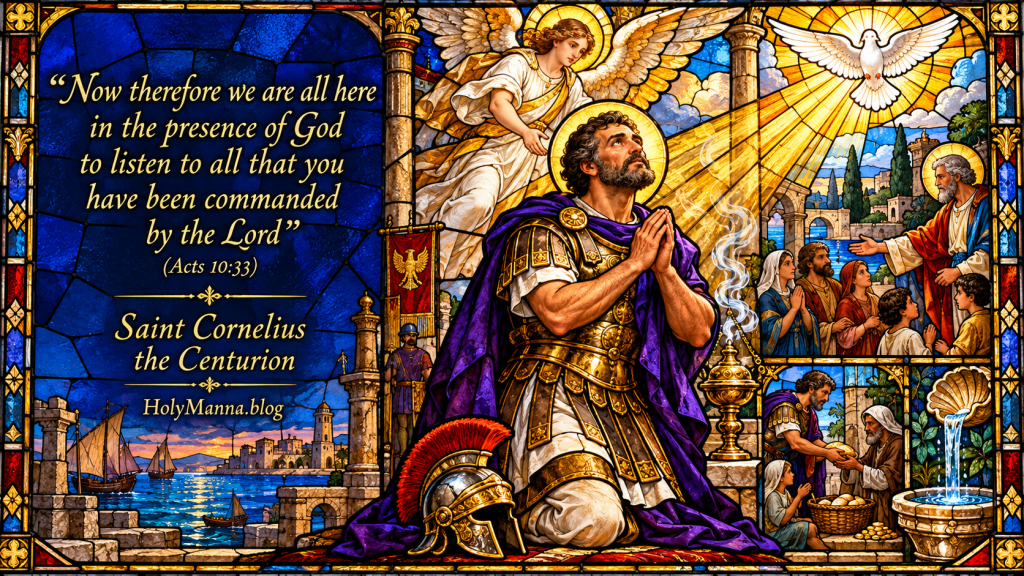
The Soldier Who Opened the Door
Every Catholic alive today who does not have Jewish ancestry owes a quiet debt of gratitude to a Roman soldier most people have never heard of. On October 20th, the Roman Martyrology commemorates Saint Cornelius the Centurion with a single, breathtaking line: “The commemoration of Saint Cornelius the centurion, whom the Apostle Peter baptized at Caesarea in Palestine, the first fruits of the Church from the gentiles.” First fruits. That is the Church’s official word for him, and it is worth sitting with. Before Cornelius, the infant Church was wrestling with a question that would determine the destiny of billions of souls: is salvation in Jesus Christ meant for the Jewish people alone, or for every nation on earth? God answered that question in the living room of a career military officer stationed in a Roman port city.
Cornelius is one of the few saints whose story is told almost entirely by Sacred Scripture itself. The tenth chapter of The Acts of the Apostles is devoted to him, the eleventh chapter defends him, and the fifteenth chapter builds the Church’s first council on what happened in his house. He was not a martyr in the historical record, not a scholar, not a bishop by any account that can be verified, at least not with certainty. He was a praying father, a generous giver, a man who took God seriously long before he knew God’s name in full. The Church holds him up because his story proves something the Catechism teaches plainly: “All men are called to enter the kingdom” (CCC 543). Cornelius was the first Gentile to walk through that open door with an Apostle holding it for him, and the door has never closed since.
A God Fearing Soldier in Caesar’s Army
Scripture introduces Cornelius with unusual detail. Acts 10:1-2 tells the reader that in Caesarea there was “a centurion of the Cohort called the Italica, devout and God-fearing along with his whole household, who used to give alms generously to the Jewish people and pray to God constantly.” Every phrase in that introduction matters, so it is worth unpacking slowly.
Caesarea Maritima was no backwater. Built by Herod the Great and named for Caesar Augustus, it was the gleaming Roman administrative capital of the province of Judaea, a harbor city of marble, theaters, and imperial power. A centurion stationed there commanded roughly a hundred men and held real social standing. The Catholic Encyclopedia notes that his cohort was probably the Cohors II Italica civium Romanorum, a unit of Roman citizens that an ancient inscription places in Syria before the year 69, and that the name Cornelius suggests a connection to the distinguished Roman gens Cornelia, most likely through descent from one of that great family’s freedmen. In other words, Cornelius was a Roman’s Roman. His paycheck, his career, his identity, and his social world all belonged to the empire and to the pagan religious system woven through it.
And yet. Scripture calls him “devout and God-fearing” (Acts 10:2). The term “God-fearer” described a specific kind of person in the 1st century: a Gentile who had come to believe in the one true God of Israel, who attended synagogue, prayed, and kept parts of the moral law, but who had not become a full proselyte through circumcision. The Catholic Encyclopedia is careful on this point, observing that Cornelius worshipped the one true God and observed some prescriptions of the Mosaic Law without being affiliated to the Jewish community by circumcision. He stood at the threshold of the covenant, close enough to see the light, not yet invited inside.
What did his devotion look like in practice? Two things, according to Acts 10:2: constant prayer and generous almsgiving. Notice that these are not exotic spiritual feats. They are the two most ordinary, repeatable, unglamorous habits of a serious believer, and they are exactly what the Church still asks of every Catholic today. The Catechism teaches that “giving alms to the poor is one of the chief witnesses to fraternal charity: it is also a work of justice pleasing to God” (CCC 2447). Cornelius did not know the Catechism, but he lived that paragraph, and heaven noticed. One afternoon, at about three o’clock, the hour of prayer, an angel of God appeared to him and called him by name. Cornelius, terrified, asked what it was, and the angel answered with words every believer should memorize: “Your prayers and almsgiving have ascended as a memorial offering before God” (Acts 10:4). The angel then instructed him to send men to Joppa to summon a man named Simon, called Peter. Cornelius did not hesitate, did not wait a day to think it over, did not ask for a second sign. Acts 10:7-8 says that when the angel left, he immediately called two servants and a devout soldier and sent them to Joppa. The conversion of the Gentile world began with one man’s instant obedience.
When Heaven Fell on a Gentile Household
While the messengers traveled, God was preparing the other half of the encounter, because the obstacle to Cornelius’s conversion was never Cornelius. It was the Church’s own uncertainty. Around noon the next day, Peter went up to a rooftop in Joppa to pray and fell into a trance. He saw heaven opened and something like a large sheet lowered to the earth, filled with all the earth’s four-legged animals, reptiles, and birds, clean and unclean together, and a voice said to him, “Get up, Peter. Slaughter and eat” (Acts 10:13). Peter, a faithful Jew his whole life, refused; he had never eaten anything profane or unclean. The voice answered a second time: “What God has made clean, you are not to call profane” (Acts 10:15). This happened three times, and while Peter was still puzzling over it, the men from Cornelius arrived at the gate, and the Holy Spirit told him to go with them without hesitation.
The meeting of these two men is one of the most moving scenes in the New Testament. When Peter entered Caesarea, Cornelius had gathered his relatives and close friends, essentially staking his reputation and his household on a message he had not yet heard. He fell at Peter’s feet in homage, and Peter, a Galilean fisherman standing in the home of a Roman officer, lifted him up and said, “Get up. I myself am also a human being” (Acts 10:26). Then Peter named the barrier out loud: everyone present knew it was unlawful for a Jewish man to associate with or visit a Gentile. “But God has shown me that I should not call any person profane or unclean” (Acts 10:28). The sheet was never really about food. It was about people.
Cornelius then recounted his vision and finished with one of the most beautiful expressions of docility in all of Scripture: “Now therefore we are all here in the presence of God to listen to all that you have been commanded by the Lord” (Acts 10:33). Imagine a room full of Roman military families saying that. Peter opened his mouth and preached the Gospel, beginning with the words the Church has treasured ever since: “In truth, I see that God shows no partiality. Rather, in every nation whoever fears him and acts uprightly is acceptable to him” (Acts 10:34-35).
Then came the miracle, the moment tradition has lovingly called the Gentile Pentecost. Peter did not even finish his homily. Acts 10:44 records that while Peter was still speaking, the Holy Spirit fell upon all who were listening to the word, and the circumcised believers who had come with Peter were astounded, because they heard these Gentiles speaking in tongues and glorifying God, exactly as the Apostles themselves had on Pentecost morning. God had rendered His verdict before any human committee could meet. Peter drew the only possible conclusion: “Can anyone withhold the water for baptizing these people, who have received the Holy Spirit even as we have?” (Acts 10:47). He ordered them baptized in the name of Jesus Christ, household and all. The Catechism teaches that “from the very day of Pentecost the Church has celebrated and administered holy Baptism” (CCC 1226), and it also recalls that from the beginning the core of the Church was often made up of whole households who became believers together (CCC 1655). The house of Cornelius is the great Gentile example of both truths at once: a domestic church born in a single afternoon.
Why does this matter so much? Because the Church is catholic, universal by her very nature, and Cornelius is the proof. The Catechism teaches that “all men are called to belong to the new People of God” (CCC 804), and that the Church’s missionary mandate flows from God’s desire “that all men should be saved and come to the knowledge of the truth” (CCC 849). Those paragraphs have a birthplace, and it is a soldier’s home in Caesarea.
Faithful to the End
Cornelius’s hardships began almost immediately, though the first blows fell on Peter. When news reached Jerusalem that the Gentiles had accepted the word of God, Peter was not congratulated. Acts 11:2-3 reports that the circumcised believers confronted him, saying, “You entered the house of uncircumcised people and ate with them.” Peter had to defend the baptism of Cornelius step by step, retelling both visions, and only when he finished did the objectors fall silent and glorify God, concluding, “God has then granted life-giving repentance to the Gentiles too” (Acts 11:18). Even then, the controversy did not fully die. It smoldered until the Council of Jerusalem in Acts 15, where Peter stood up and appealed directly to what God had done in Cornelius’s house, reminding the assembly that God, who knows the heart, bore witness to the Gentiles by granting them the Holy Spirit just as He had to the Jewish believers, making no distinction between them. The first doctrinal crisis in Church history was settled by pointing at Cornelius. A convert’s living room became the evidence file for the catholicity of the Church.
What happened to Cornelius himself after Acts 10? Here the documented record goes quiet, and honesty requires saying so plainly. Scripture never mentions him again. The Catholic Encyclopedia preserves two competing traditions: one holds that Cornelius became the first Bishop of Caesarea, and another that he became Bishop of Scepsis in Mysia, a town in Asia Minor near ancient Troas. These traditions cannot both be confirmed, and neither can be historically verified.
The Eastern Christian tradition tells the fuller story, and it deserves to be heard as the venerable tradition it is. According to this account, preserved in the Orthodox synaxaria and in the Prologue from Ohrid, Cornelius left everything after his baptism and accompanied Peter in preaching the Gospel. Peter consecrated him a bishop and, after lots were drawn, Cornelius was sent to the thoroughly pagan city of Scepsis. There, the tradition says, he endured humiliation, imprisonment, and torture for the name of Christ. The local ruler, named Demetrius, demanded that Cornelius sacrifice to the idols. Cornelius asked to be shown these gods, entered the temple of Apollo, turned to the east, and prayed; by the power of God the temple collapsed. The tradition adds that members of the ruler’s own family were trapped in the ruins and then freed unharmed through the saint’s prayer, and that Demetrius, overwhelmed, believed in Christ and was baptized along with 277 other pagans. This entire account is a tradition handed down in later hagiography, and it cannot be verified.
One point needs careful handling, because the sources genuinely conflict. The Eastern calendars honor Cornelius with the title of hieromartyr, a priest-martyr, on September 13th. Yet the same Eastern tradition states that Cornelius, forewarned by God of the day of his death, gathered the Christians of Scepsis, counseled them, prayed for them, and then died peacefully in honorable old age. The current Roman Martyrology, for its part, does not style him a martyr at all. The most honest summary is this: Cornelius was not martyred according to any account that survives, but he suffered real persecution for the faith, and he persevered to the end. The Church calls that kind of man a confessor, and his quiet endurance is no less heroic for lacking a sword. He died owning nothing that mattered to the empire he once served and possessing everything that mattered to the Kingdom he had entered.
A Forgotten Grave That Would Not Stay Forgotten
The story of Cornelius after his death comes entirely from the same Eastern tradition, and it carries a strange and tender detail: the first Gentile convert was forgotten. According to the tradition, Cornelius was buried near the ruined pagan temple at Scepsis, and in time his grave site was neglected and its location lost. Then, the account continues, the saint appeared in a vision to Silvanus, the Bishop of Troas, revealed where his body lay, and commanded that a church be built over the spot. The bishop carried this out with the help of a wealthy and devout citizen named Eugenius, and the tradition holds that many miracles of healing and divine intervention were worked through the relics of Saint Cornelius at that church. This story of the appearance to Silvanus, the building of the church, and the miracles at the relics is a tradition from later hagiography, and it cannot be verified.
Even setting aside what cannot be confirmed, the verifiable impact of Cornelius after his death is enormous, because his impact is doctrinal rather than devotional. Every time the Church baptizes a convert from any nation on earth, she is standing on the precedent set in his house. Every missionary who has ever crossed a border carries Acts 10 in his bones. The Catechism grounds the Church’s universality in exactly the truth God demonstrated through Cornelius, teaching that the Church “is sent out to all peoples” and “speaks to all men” (CCC 831). The decision ratified at the Council of Jerusalem, built on his conversion, is the reason a young professional in Houston, a grandmother in Manila, and a student in Lagos can all kneel at the same altar rail.
His veneration crosses ancient boundaries in a way few saints can match. He is honored in the Roman Catholic Church on October 20th in the current Roman Martyrology, while the older editions of the Roman Martyrology commemorated him on February 2nd, where Butler’s Lives of the Saints also treats him; the Eastern Orthodox and Byzantine Catholic churches keep September 13th, and the Armenian Apostolic and Anglican traditions venerate him as well. While no major pilgrimage is attached to his name today, Christian pilgrims to the Holy Land still walk the excavated streets and harbor of Caesarea Maritima, the very city where the events of Acts 10 unfolded, and sacred art has returned to his story again and again, most famously in Francesco Trevisani’s 1709 painting of Saint Peter baptizing the centurion. Cornelius has no basilica, no famous shrine, no wonder-working image. His monument is the Gentile Church herself.
Living Like Cornelius Today
Cornelius is a saint tailor-made for people who feel like outsiders to holiness, and if that describes you, take heart, because it described him first. He was the wrong nationality, the wrong religion, the wrong profession, and heaven sought him out anyway. His life offers a handful of lessons that fit remarkably well into a modern schedule.
Start with the two habits the angel named. Before Cornelius knew Christ, he already prayed constantly and gave alms generously, and the angel told him those two things had “ascended as a memorial offering before God” (Acts 10:4). God sees hidden faithfulness. The prayers offered in a parked car before a shift, the recurring donation nobody knows about, the rosary decade squeezed between meetings; none of it is wasted, and all of it rises. The practical application is almost embarrassingly simple: pick a fixed hour of daily prayer and keep it like a soldier keeps watch, and attach a concrete act of generosity to your regular income rather than to your leftover change. What would an angel say your prayers and your giving look like from heaven’s side right now?
Next, imitate his speed. Cornelius obeyed the angel immediately, sending for Peter the same hour, and he gathered his whole family and his friends to hear a message he had not yet heard himself. Most people treat a spiritual prompting like an email to answer eventually. Cornelius treated it like an order from a commanding officer. When God last nudged you toward confession, reconciliation with someone, or a deeper commitment, how long did you make Him wait?
Then, learn from his humility and his hospitality. A Roman officer fell at the feet of a fisherman, and when corrected, he did not sulk; he listened. He also opened his home, which meant opening his reputation. Evangelization in the 1st century ran on households, and the Catechism still calls the Christian family the domestic church (CCC 1655). Inviting a coworker to Mass, hosting a Bible study, or simply letting friends see a crucifix on the wall and grace before meals continues what Cornelius started. Who in your life is standing at the threshold the way Cornelius once stood, close to God and waiting for someone to open the door?
Finally, let his story demolish any quiet prejudice about who belongs in the Church. Peter needed a triple vision to accept that no person is profane or unclean, and the Church needed a council to ratify it. God’s verdict has not changed: “In truth, I see that God shows no partiality” (Acts 10:34). The person you are tempted to write off as too far gone, too hostile, too different, or too late may be the next Cornelius, already praying in ways you cannot see.
Engage With Us!
Saint Cornelius proves that God is always moving toward the person who honestly seeks Him, and his feast is a perfect day to ask where that movement is happening in your own life. Share your thoughts and reflections in the comments below; your story might be exactly what another reader standing at the threshold needs to hear. To guide the conversation, here are some questions for prayer and discussion.
- Cornelius prayed constantly and gave alms generously before he ever heard the Gospel. Which of those two habits needs the most strengthening in your life right now, and what is one concrete step you can take this week?
- Peter had to overcome a lifetime of assumptions to walk into a Gentile’s home. What assumption about who “belongs” in the Church might God be asking you to surrender?
- Cornelius gathered his relatives and close friends to hear Peter preach. Who could you invite into an encounter with Christ this month, and what is holding you back?
- The angel told Cornelius that his prayers and alms had risen as a memorial before God. How does it change your motivation to know that God sees and remembers every hidden act of faithfulness?
- Tradition says Cornelius left his career and comfort behind to serve the Church in a hostile city. What comfort or status might God be inviting you to hold more loosely?
Saint Cornelius heard heaven speak in the middle of an ordinary afternoon of prayer, and he answered without delay. The same God who sent an angel to a soldier’s house in Caesarea is seeking every heart that seeks Him today, including yours. Go to Mass this week with the expectancy of Cornelius, pray with his persistence, give with his generosity, and open your door the way he opened his. Live this day, and every day, with the love and mercy that Jesus taught us, and watch what God does with a willing heart.
Saint Cornelius the Centurion, pray for us!
Follow us on YouTube, TikTok, Instagram and Facebook for more insights and reflections on living a faith-filled life.


Leave a Reply