Tuesday of the Twenty-ninth Week in Ordinary Time – Lectionary: 474
When Peace Moves Into the Neighborhood
Picture coming home after years away and finding the porch light on, the door unlocked, and a place already set at the table. That is the feeling running through the readings for Tuesday of the Twenty-ninth Week in Ordinary Time, and the Church names it with one word: peace.
The Responsorial Psalm sets the key signature: “The Lord speaks of peace to his people.” Psalm 85 was composed after Israel’s return from exile in Babylon, when the people were home but still hurting, and it promises a day when “justice and peace shall kiss.” In the First Reading, Saint Paul announces that the day has arrived. Writing from prison to Gentile converts who had once been outsiders to everything God promised Israel, he declares that Christ “is our peace,” that the dividing wall of enmity has been demolished in His flesh, and that strangers have become family, living stones in the very house of God. Then the Holy Gospel shows what that family does now. The Gospel of Luke presents servants with belts cinched and lamps burning, waiting through the night for a Master who will do the unthinkable when He arrives, seating them at table and serving them Himself.
Historically, these texts span centuries, from a weary post-exilic Jerusalem to a Roman prison cell to a teaching given on the dusty road toward Calvary. Spiritually, they tell one story. God has drawn near to make peace, He has built His people into a home, and He asks only that the household stay awake for His knock. Today’s liturgy is an invitation to live like people who know the Master is coming, and to want Him to come.
First Reading — Ephesians 2:12-22
The Wall Came Down and a Home Went Up
In the Jerusalem Temple of Paul’s day there stood a low stone barrier called the soreg, sealing off the outer Court of the Gentiles from the inner courts. Posted along it were inscriptions warning that any foreigner who passed beyond it would have only himself to blame for his death, and archaeologists recovered one of these very inscriptions in 1871. The division between Jew and Gentile was something a visitor could literally touch. Writing during his Roman imprisonment, likely around the years 61 to 63, Saint Paul tells the largely Gentile churches of Asia Minor that in Christ the wall is gone. The Letter to the Ephesians celebrates God’s plan to unite all things in Christ, and this passage is its beating heart. It fits the day’s theme perfectly, because the peace the psalmist longed to hear has now been spoken in flesh and blood.
Ephesians 2:12-22
Brothers and sisters:
You were at that time without Christ,
alienated from the community of Israel
and strangers to the covenants of promise,
without hope and without God in the world.
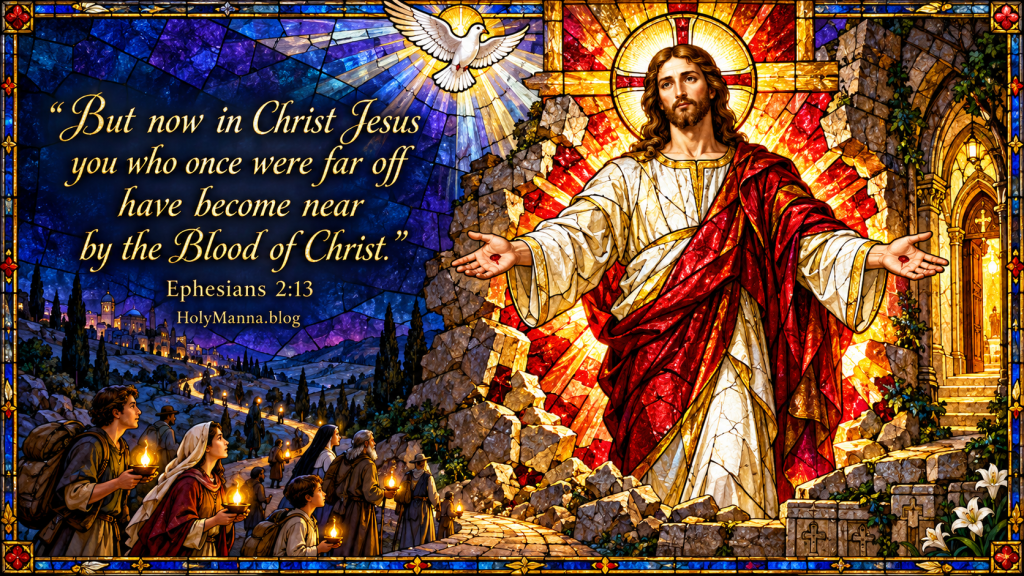
But now in Christ Jesus you who once were far off
have become near by the Blood of Christ.For he is our peace, he made both one
and broke down the dividing wall of enmity, through his Flesh,
abolishing the law with its commandments and legal claims,
that he might create in himself one new person in place of the two,
thus establishing peace,
and might reconcile both with God,
in one Body, through the cross,
putting that enmity to death by it.
He came and preached peace to you who were far off
and peace to those who were near,
for through him we both have access in one Spirit to the Father.So then you are no longer strangers and sojourners,
but you are fellow citizens with the holy ones
and members of the household of God,
built upon the foundation of the Apostles and prophets,
with Christ Jesus himself as the capstone.
Through him the whole structure is held together
and grows into a temple sacred in the Lord;
in him you also are being built together
into a dwelling place of God in the Spirit.
Detailed Exegesis
Verse 12: “You were at that time without Christ, alienated from the community of Israel and strangers to the covenants of promise, without hope and without God in the world.”
Paul does not soften the diagnosis. Before Christ, the Gentiles stood outside every covenant God had made with Israel and outside the hope those promises carried. Remembering that former distance is not shame for its own sake; it is the only honest way to measure the size of the gift.
Verse 13: “But now in Christ Jesus you who once were far off have become near by the Blood of Christ.”
The phrase “but now” is the hinge of the whole passage. Nearness to God was not earned by effort or inherited by ancestry; it was purchased at the price of the Cross, fulfilling the promise of peace to the far and the near in Isaiah 57:19.
Verse 14: “For he is our peace, he made both one and broke down the dividing wall of enmity, through his Flesh.”
Peace is not merely something Christ gives; it is something Christ is. The dividing wall evokes the Temple barrier, yet Saint John Chrysostom saw something deeper, the enmity of sin that walled off Jew and Gentile alike from God Himself.
Verse 15: “abolishing the law with its commandments and legal claims, that he might create in himself one new person in place of the two, thus establishing peace.”
Christ did not simply promote the Gentiles to Israel’s status. He created something new, one new humanity in Himself, so that the ceremonial prescriptions which once fenced Israel off from the nations no longer divide the one family of God.
Verse 16: “and might reconcile both with God, in one Body, through the cross, putting that enmity to death by it.”
The Cross kills what was killing humanity. Hostility toward God and neighbor was nailed there and died there, and the one Body that rises from that death is both the crucified Body of Jesus and His Church.
Verse 17: “He came and preached peace to you who were far off and peace to those who were near.”
The risen Christ keeps preaching this peace through His Church, both to lifelong believers and to those who have wandered farthest away. Nobody stands outside the sound of His voice.
Verse 18: “for through him we both have access in one Spirit to the Father.”
The Trinity appears in a single breath: through the Son, in the Spirit, to the Father. Access once reserved for the high priest on one day a year is now the daily privilege of every baptized soul at prayer.
Verse 19: “So then you are no longer strangers and sojourners, but you are fellow citizens with the holy ones and members of the household of God.”
Paul piles up images of belonging: citizenship, communion with the saints, family membership. The Church is not a club that admits members but a household that adopts children.
Verse 20: “built upon the foundation of the Apostles and prophets, with Christ Jesus himself as the capstone.”
The Church rests on the apostolic foundation and is held in place by Christ, the stone that determines the shape and strength of everything built upon Him, fulfilling Psalm 118:22 and Isaiah 28:16.
Verse 21: “Through him the whole structure is held together and grows into a temple sacred in the Lord.”
The new temple is alive and still under construction. Every generation of believers becomes another course of stones rising on the same unshakable foundation.
Verse 22: “in him you also are being built together into a dwelling place of God in the Spirit.”
The passage ends where the Temple imagery was always pointing. God does not merely admit His people into His house; He makes His people the house He lives in.
Teachings
The Catechism places this passage at the very center of its teaching on peace: “Earthly peace is the image and fruit of the peace of Christ, the messianic ‘Prince of Peace.’ By the blood of his Cross, ‘in his own person he killed the hostility,’ he reconciled men with God and made his Church the sacrament of the unity of the human race and of its union with God. ‘He is our peace.’” (CCC 2305). Saint John Chrysostom, preaching on this text in his Homilies on Ephesians, marveled that Christ did not simply lift the Gentiles up to Israel’s dignity: “He does not mean this, that He has raised us to that high descent of theirs, but that he has raised both us and them to a yet higher.” On the wall itself, Chrysostom taught that the enmity of sin “is a common barrier, cutting us off alike from God.” The Catechism also gathers up Paul’s building imagery, teaching that the Church “is called the building of God” and that from her foundation “the Church receives durability and consolidation” (CCC 756). What Paul announced to a handful of house churches, the Church has guarded for two thousand years: peace is a Person, and His house has no dividing walls.
Reflection
Every parish has its invisible walls: the pew cliques, the grudges that outlast their causes, the quiet certainty that certain people do not belong. This reading insists that Christ has already demolished every wall His blood touched, so a Christian who keeps one standing is defending rubble. A practical start is to name the one person who feels “far off,” perhaps an estranged relative, a coworker written off, or a parishioner avoided after Mass, and to take one concrete step toward that person this week with a message, an invitation, or prayer by name. Another step is to thank God daily for the gift of belonging, since gratitude for adoption is the surest cure for treating the household of God like a members-only club. Where in life has a wall been left standing that Christ already tore down? Does the parish feel like a household of God, and what one act of welcome could make it feel that way for someone else this Sunday?
Responsorial Psalm — Psalm 85:9-14
Four Virtues Meet on the Road Home
Psalm 85 is a homecoming song written by people who discovered that coming home is not the same as being healed. Attributed to the sons of Korah, the Levitical singers of the Temple, it most likely dates to the years after 538 BC, when Israel returned from exile in Babylon to a ruined Jerusalem, struggling harvests, and the ache of promises not yet fulfilled. The first half of the psalm pleads for restoration. Then, at verse 9, the psalmist goes quiet and listens, and what he hears is the Lord proclaiming peace. The liturgy places this psalm between Ephesians and Luke because it is the bridge between them. It voices the longing for peace that Paul declares fulfilled, and it models the posture of expectant listening that Jesus asks of His servants in the Gospel.
Psalm 85:9-14
R. (see 9) The Lord speaks of peace to his people.
I will hear what God proclaims;
the LORD–for he proclaims peace.
Near indeed is his salvation to those who fear him,
glory dwelling in our land.
R. The Lord speaks of peace to his people.
Kindness and truth shall meet;
justice and peace shall kiss.
Truth shall spring out of the earth,
and justice shall look down from heaven.
R. The Lord speaks of peace to his people.
The LORD himself will give his benefits;
our land shall yield its increase.
Justice shall walk before him,
and salvation, along the way of his steps.
R. The Lord speaks of peace to his people.
Detailed Exegesis
Verse 9: “I will hear what God proclaims; the LORD–for he proclaims peace.”
The psalmist’s first act is not speaking but listening. After a long lament, he falls silent before God, and the word that comes back is shalom, the rich Hebrew word for peace that means wholeness, harmony, and every relationship set right.
Verse 10: “Near indeed is his salvation to those who fear him, glory dwelling in our land.”
Salvation is described as near, the very word Paul uses for the Gentiles brought near by the Blood of Christ. The phrase about glory dwelling in the land recalls the cloud of God’s presence filling the Temple, and it quietly points ahead to the Incarnation, when glory took up residence in human flesh.
Verse 11: “Kindness and truth shall meet; justice and peace shall kiss.”
This is one of the most beloved images in the entire Psalter. Four divine attributes are personified as travelers converging on a single meeting point and embracing like long-separated friends. The verse admits what honest hearts know, that mercy and justice can seem opposed, and it promises that only God can wed them.
Verse 12: “Truth shall spring out of the earth, and justice shall look down from heaven.”
Earth and heaven answer one another. Truth rises like a seed breaking through soil while justice bends down from above, and the Church’s tradition has always seen in this meeting of heaven and earth the mystery of Christ Himself.
Verse 13: “The LORD himself will give his benefits; our land shall yield its increase.”
For a community staring at failed harvests, this was concrete hope rather than poetry. God’s peace is never merely spiritual; it bears fruit in real fields, real homes, and real daily bread.
Verse 14: “Justice shall walk before him, and salvation, along the way of his steps.”
The psalm ends with God on the move. Justice goes ahead of Him like a herald, and salvation follows in His footprints, an image the Gospel will complete when the Master Himself comes walking to the door in the night.
Teachings
Saint Augustine could not read verse 12 without seeing Bethlehem. In his Expositions on the Psalms he wrote plainly: “Truth hath sprung out of the earth: Christ is born of a woman.” He returned to the verse in his celebrated Christmas homily, Sermon 185, in words the Church still treasures: “Truth, which heaven is not big enough to hold, has sprung from the earth, in order to be placed in a manger.” From that same sermon comes his thunderclap of an invitation: “Wake up, mankind, for your God became man!” The Catechism anchors the psalm’s paired virtues in God’s own self-revelation to Moses, teaching that “In all his works God displays not only his kindness, goodness, grace, and steadfast love, but also his trustworthiness, constancy, faithfulness, and truth” (CCC 214). What the psalmist personified, the Gospel made personal. Kindness and truth met in a manger, and justice and peace kissed on a Cross.
Reflection
The psalmist’s move at verse 9 is one anyone can copy tonight: stop talking and listen. Modern life treats prayer as a message sent rather than a word received, yet the psalm begins with the resolve, “I will hear what God proclaims.” A simple practice is to end each day with two minutes of silence after the last petition, asking God to proclaim His peace over the day’s worries. Another is to look for the “near” salvation hiding in ordinary places, such as the reconciliation that is one phone call away or the sacrament of Confession that is one Saturday afternoon away. What would change if listening came before asking in daily prayer? Where are kindness and truth being kept apart in life right now, perhaps by telling comfortable half-truths or by wielding the truth without love, and what would it take to let them finally meet?
Holy Gospel — Luke 12:35-38
Dressed for Work in the Dead of Night
By chapter 12 of The Gospel of Luke, Jesus is on His long road to Jerusalem, teaching a growing crowd about fear, greed, and trust in the Father. He has just told His listeners not to be afraid, because the Father is pleased to give the little flock the Kingdom. Now He tells them how to wait for it. The imagery comes straight from daily life in first-century Palestine. Men wore long, flowing garments that had to be pulled up and belted before anyone could work, run, or fight, and Israel ate the first Passover in exactly that posture, with loins girt, sandals on, and staff in hand, as Exodus 12:11 commands. Household oil lamps needed constant tending through a night that custom divided into watches, so the second or third watch means the deepest, coldest hours before dawn. Wedding feasts ran late, and the master’s return time was anyone’s guess. Into that ordinary picture Jesus plants an extraordinary promise, and the day’s theme reaches its destination. The God who made peace and built a household now tells the household how to live until He knocks.
Luke 12:35-38
Jesus said to his disciples:
“Gird your loins and light your lamps
and be like servants who await their master’s return from a wedding,
ready to open immediately when he comes and knocks.
Blessed are those servants
whom the master finds vigilant on his arrival.
Amen, I say to you, he will gird himself,
have them recline at table, and proceed to wait on them.
And should he come in the second or third watch
and find them prepared in this way,
blessed are those servants.”
Detailed Exegesis
Verse 35: “Gird your loins and light your lamps.”
Two commands create one posture: be ready to move and be a source of light. The Church Fathers heard in the girded loins the discipline of self-mastery and in the burning lamps the shining of good works. Readiness for Christ is never passive; it dresses for action and glows in the dark.
Verse 36: “and be like servants who await their master’s return from a wedding, ready to open immediately when he comes and knocks.”
The master is away at a wedding feast, a favorite biblical image for the joy of the Kingdom. The servants have one job, immediacy, opening at the first knock with no scrambling, no excuses, and no time needed to hide anything. A soul in a state of grace can open the door the moment it hears His voice.
Verse 37: “Blessed are those servants whom the master finds vigilant on his arrival. Amen, I say to you, he will gird himself, have them recline at table, and proceed to wait on them.”
Here the parable explodes every social convention of the ancient world. No master served his own servants, yet this Master girds Himself with the very verb of verse 35, seats His servants as honored guests, and waits on them personally. Jesus will embody this at the Last Supper, declaring, “I am among you as the one who serves” (Luke 22:27), and kneeling to wash the feet of His Apostles. The reward for watching through the night is a seat at the banquet where God Himself serves the meal.
Verse 38: “And should he come in the second or third watch and find them prepared in this way, blessed are those servants.”
The repetition of “blessed” frames the passage like bookends. The second and third watches are the hours when eyelids grow heaviest and hope runs thinnest, which is to say, the hours when fidelity costs the most and therefore shines the brightest. The Master blesses perseverance, not a flashy start.
Teachings
Saint Gregory the Great preached on this very passage in Homily 13 on the Gospels, and his reading became the Church’s classic interpretation: “we gird our loins when by continence we control the lusts of the flesh,” and “we hold burning lamps in our hands, when by good works we show forth bright examples to our neighbors.” Purity without charity is incomplete, and charity without purity is compromised, so the Lord asks for both at once. Gregory also described what true vigilance looks like: “He watches who keeps the eyes of his mind open to behold the true light; who by his works maintains that which he beholds, who drives from himself the darkness of sloth and carelessness.” In the same homily he read the night watches as the seasons of a human life, childhood, adulthood, and old age, so that no one who still draws breath has missed the chance to begin watching. Saint Augustine handed on the same twin lesson in On Continence: “What is it, to gird the loins? To restrain lusts, which is the work of continence. But to have lamps burning is to shine and glow with good works, which is the work of righteousness.” The Catechism carries this vigilance into the life of prayer, teaching that in the Our Father Christ “urges us to vigilance of the heart in communion with his own” (CCC 2849). And the banquet the Master serves is not only future. The Church prays of the Eucharist: “O sacred banquet in which Christ is received as food, the memory of his Passion is renewed, the soul is filled with grace and a pledge of the future life is given to us” (CCC 1402). Every Mass is the Master girding Himself to feed His watching servants.
Reflection
Vigilance sounds dramatic, yet it is built from small, repeatable choices. Girding the loins today might mean naming the one habit that dulls the soul, whether endless scrolling, gossip, or the second drink, and belting it tight with a concrete limit. Lighting the lamp might mean one visible act of mercy before bedtime, since Gregory insists the lamp exists to light the way for neighbors. Keeping watch might mean returning to Confession so the door can open “immediately,” or arriving at Mass ten minutes early to wait in silence for the Master who truly comes to the table. The second and third watches arrive in every life in the form of dry prayer, long suffering, or years of unanswered petitions, and those are precisely the hours Jesus singles out for blessing. Which watch of life is it right now, and is the lamp still lit? If the Master knocked tonight, would the door open immediately, or is something blocking the hallway? What one act of humble service this week would imitate the Master who waits on His own servants?
Keep a Lamp in the Window
Today’s readings tell one story in three movements. Psalm 85 is the longing: a weary people leaning forward in the silence to hear God proclaim peace. Ephesians 2 is the fulfillment: peace spoken not in words but in wounds, as Christ’s own flesh absorbed the enmity, demolished the dividing wall, and turned strangers into family, living stones in the Father’s house. The Gospel of Luke is the response: a household so sure of the Master’s love that it waits up for Him, belts cinched and lamps burning through the darkest watches, knowing that the knock at the door ends not in inspection but in a feast where He serves them with His own hands.
That is the Gospel in miniature. God is not far away, grudging, or indifferent. He has spent Blood to bring the far-off near, and He is coming back for His own. The only tragedy still possible is a servant asleep in a house this loved.
So tonight, before sleep, light one small lamp. Speak to the Lord honestly, listen longer than usual, and ask for the grace to be found watching. Return to the sacraments, where the Master already girds Himself at every altar to feed His people. Tear down one wall this week, forgive one debt, and welcome one stranger, and the peace the psalmist heard from far off will sound again, close by, in an ordinary home where somebody stayed awake for God. The Master is worth waiting up for, and His own word seals the promise: “Blessed are those servants whom the master finds vigilant on his arrival.”
Engage With Us!
The conversation does not end with the final paragraph, and the comments below are an open door. Share what struck the heart in today’s readings, how God has torn down a wall in life, or how He has kept a lamp burning through a long night. Stories of grace encourage the whole household of God.
- In Ephesians 2:12-22, Saint Paul announces that Christ broke down the dividing wall of enmity through His Flesh. What wall, whether between God and the soul or between neighbor and neighbor, still needs to come down, and what first step could begin the demolition this week?
- In Psalm 85:9-14, the psalmist resolves, “I will hear what God proclaims.” What practical change would make daily prayer more about listening than talking, and what might God be proclaiming over this season of life?
- In Luke 12:35-38, Jesus blesses the servants found vigilant even in the second or third watch. Which watch best describes this stage of the journey, and what does a burning lamp look like in it right now?
- Taking all the readings together, the Lord speaks peace, makes peace in His own Flesh, and returns to reward those who waited for Him in peace. Where is Jesus inviting a deeper trust that His peace is truly near, and how can that trust be lived out before this week ends?
Keep walking the road of faith with eyes open and lamps lit. Every small act of vigilance, every wall torn down, and every quiet moment of listening builds the dwelling place of God a little higher. Live this week with the love and mercy Jesus taught, serve the way the Master serves, and be found watching when He knocks.
Sacred Heart of Jesus, we trust in You!
Immaculate Heart of Mary, pray for us!
Saint Michael the Archangel, defend us in battle!
Follow us on YouTube, TikTok, Instagram and Facebook for more insights and reflections on living a faith-filled life.


Leave a Reply