Blood on the Snow
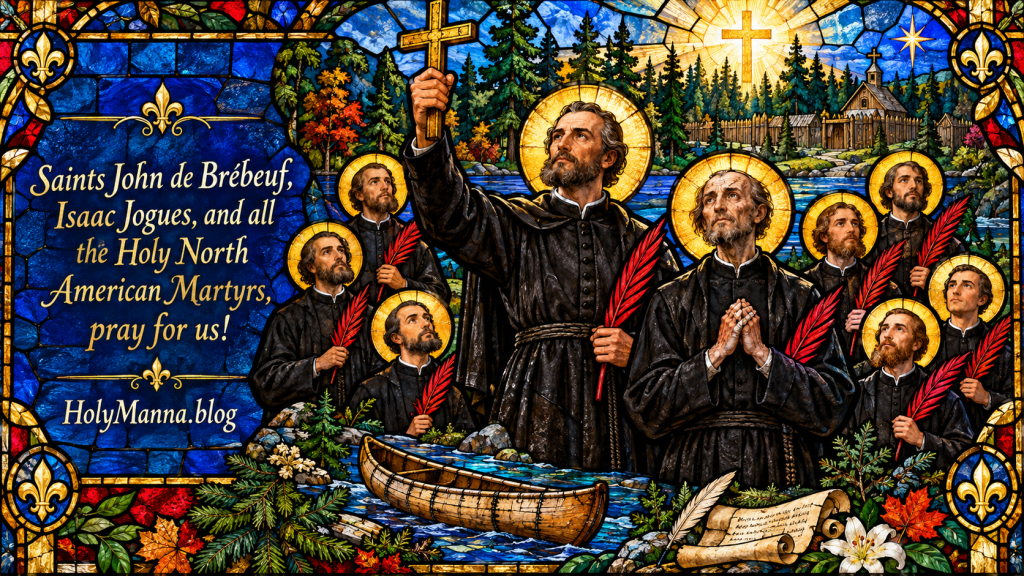
Every October 19th, the Church lifts up 8 men whose blood soaked the soil of North America before the United States or Canada even existed. Saints John de Brébeuf, Isaac Jogues, and their 6 companions, known together as the North American Martyrs, were members of the Society of Jesus, 6 priests and 2 lay volunteers, who left the comfort of 17th century France to bring the Gospel to the Huron, Iroquois, and Mohawk peoples of New France. Between 1642 and 1649, every one of them was killed for the faith; 5 died in what is now Canada, and 3 died in what is now upstate New York. They are the first martyrs of the North American continent officially recognized by the Church, and to this day they remain the only canonized martyrs of North America.
Their story matters because the Church on this continent was not planted by comfort or conquest. It was planted the way the Church has always been planted. The Catechism teaches, quoting Tertullian, that “the blood of martyrs is the seed of Christians” (CCC 852), and nowhere is that more literally true than in the Mohawk Valley and along Georgian Bay, where the deaths of these men prepared the ground for generations of believers, including a young Mohawk girl named Kateri Tekakwitha, who would be born on the very spot where 3 of them died.
The North American Martyrs hold real patronage in the life of the Church. Pope Pius XII proclaimed them the secondary patrons of Canada on October 16th, 1940, with Saint Joseph remaining that nation’s primary patron, and Saint John de Brébeuf is individually honored as a patron saint of Canada. Canadians celebrate them on September 26th in their national calendar, while the universal Church keeps their memorial on October 19th. Whichever date a Catholic keeps, the message is the same: this continent is holy ground, purchased at a price.
From the Fields of Normandy to the Forests of New France
Jean de Brébeuf was born on March 25th, 1593, the feast of the Annunciation, in Condé-sur-Vire in Normandy, France, into a farming family. He grew into a tall, physically powerful man, yet his road to the missions was anything but smooth. He entered the Jesuit novitiate at Rouen in 1617, and during his studies his health collapsed so badly that his formation was nearly cut short. God had other plans. Brébeuf was ordained a priest in February of 1622, and 3 years later, over the objections of Huguenot traders and colonial officials who wanted no Jesuits in the fur country, he sailed for Quebec, arriving in June of 1625 at the age of 32. He would spend roughly a quarter of a century laboring among the Huron people, interrupted only when English forces captured Quebec in 1629 and forced the missionaries back to France until the colony was restored.
Isaac Jogues was born on January 10th, 1607, in Orléans, France, the fifth of 9 children in a comfortable, well-to-do family. A man of genuine learning and culture, he taught literature in France as a young Jesuit, having entered the novitiate at 17 years of age in 1624 under the famed spiritual director Father Louis Lallemant. When his novice master asked him why he wished to join the Society of Jesus, the accounts of his life tell us that his heart was already set on the missions. Ordained early in 1636, he sailed for New France that same year, carrying with him a Mass kit given to him by his mother, and he arrived in Quebec under the leadership of the veteran Brébeuf himself.
The 6 companions came from the same soil of faith. René Goupil, born in 1608 in Anjou, had tried to become a Jesuit, but deafness and poor health forced him to leave the novitiate; refusing to give up on God’s call, he trained as a surgeon and offered himself to the missions as a donné, a consecrated lay volunteer. Jean de Lalande, an experienced young woodsman who had settled in New France, likewise gave his services freely to the Jesuits as a layman. Antoine Daniel left a promising path in France to serve the Huron mission alongside Brébeuf. Gabriel Lalemant, the frail, scholarly nephew of that same Father Louis Lallemant who had formed Jogues, begged for years to be sent to Canada despite his weak constitution. Charles Garnier, son of a well-placed Parisian family, renounced his inheritance for the missions. Noël Chabanel had entered the Jesuit novitiate at Toulouse at only 17 and was a professor of rhetoric at several Jesuit colleges in France before he, too, heard the call to the New World.
None of these men were running away from failure. They were educated, capable, and in several cases born into comfort. What drew them across the Atlantic was not adventure but obedience to the Lord’s command in The Gospel of Matthew: “Go, therefore, and make disciples of all nations” (Mt 28:19). The Catechism teaches that the Church is missionary by her very nature, for “she has her origin in the mission of the Son and the Holy Spirit” (CCC 850), and these 8 men took that identity personally, at the cost of everything.
Giants Among the Huron
Why should anyone remember these men nearly 4 centuries later? Because they show what total self-gift looks like when it is lived out, not just talked about. Brébeuf did not arrive among the Huron demanding that they become Frenchmen. He learned their language so thoroughly that he is remembered as the author of the first dictionary of the Huron tongue, and he translated a catechism into Huron so the faith could be received in the people’s own words. The Huron gave him the name Echon, and his detailed accounts of Huron life, preserved in the Jesuit Relations, remain an invaluable source of early Canadian history; he has even been called Canada’s first serious ethnographer. The harvest was slow and painful. Brébeuf waited roughly 6 years before he was able to baptize a single healthy adult, yet by the late 1640s, the missionaries counted about 7,000 Huron converts, and the mission center of Sainte-Marie among the Hurons stood as the first European settlement in what is now Ontario.
Brébeuf’s love for the Huron produced something tender in the middle of all that hardship. Around 1642, he composed Jesous Ahatonhia, meaning “Jesus, He Is Born,” written in the Huron language and known today as the Huron Carol, Canada’s first Christmas carol. It is still sung every Advent. One honest note for modern readers: the familiar English lyrics beginning “‘Twas in the moon of wintertime” are a poetic paraphrase written by Jesse Edgar Middleton in 1926, not a direct translation of Brébeuf’s original Huron text.
Isaac Jogues, whom the Huron named Ondessonk, meaning “bird of prey,” served the mission outposts for years, helped build Sainte-Marie in 1639, and explored westward as far as Sault Sainte-Marie. After his first captivity, which will be told below, he became, according to the Catholic accounts of the period, the first Catholic priest ever to set foot in the settlement of New Amsterdam, the future New York City. In 1646, while on a peace embassy to the Mohawks, he passed a beautiful lake on the eve of the feast of Corpus Christi and named it the Lake of the Blessed Sacrament; the world now calls it Lake George, but a priest gave it its first Christian name.
The missionaries did not leave behind a catalogue of spectacular wonders worked by their own hands, and HolyManna will not invent one. Their lives were themselves the sign. The most striking grace story of Jogues’ life came not in the forest but in Rome. After his escape from captivity, his hands were so mutilated that he could no longer hold the Host with the thumb and forefinger, the canonical digits required by Church law for celebrating Mass. Pope Urban VIII, who called him a living martyr, granted him a dispensation to offer the Holy Sacrifice with his broken hands, declaring, “It would be shameful that a martyr of Christ not be allowed to drink the Blood of Christ.” The accounts of his life note that this was the first time such a concession had ever been granted. In these men, the words of The Catechism were made visible: “The disciple of Christ must not only keep the faith and live on it, but also profess it, confidently bear witness to it, and spread it” (CCC 1816).
Eight Deaths, One Victory
The suffering began long before the killing did. The missionaries endured brutal canoe journeys of hundreds of miles, near starvation, smallpox epidemics that decimated entire Huron villages, and the constant suspicion that fell on them when disease struck, since the medicine men blamed the Blackrobes and their “magic” for every misfortune. Brébeuf lived for years under open death threats. Yet he had already settled the question of fear in his own soul. In his spiritual journal, preserved for the Church in the Relation of 1649, he recorded an extraordinary private vow: “I make a vow to you never to fail, on my side, in the grace of martyrdom, if by your infinite mercy you offer it to me some day.” A tradition handed down among the Jesuits also recounts that Brébeuf once saw a great cross in the sky over Iroquois country and, when asked how large it was, answered that it was large enough to crucify them all. The vision is reported in Jesuit missionary tradition, but the exact wording of his reply varies across retellings and cannot be verified.
The first to die was the gentle surgeon. In August of 1642, Jogues, Goupil, and a party of Huron converts were ambushed and captured by Mohawk warriors. The captives were forced to run the gauntlet, beaten with clubs, and mutilated; Jogues had fingers cut, chewed, and burned off, and one account records that a woman cut off his thumb. Facing death, Goupil asked Jogues to receive him into the Society of Jesus, and Jogues accepted his religious vows in captivity. On September 29th, 1642, at the village of Ossernenon, René Goupil was struck down with a tomahawk for having made the Sign of the Cross on the brow of some children. In the written account Jogues later composed of his companion’s death, he honored Goupil as a true martyr of Jesus Christ.
Jogues himself remained a slave of the Mohawks for 13 months, led from village to village, beaten and tortured, forced to watch his Huron converts be mangled and killed. Even then he kept baptizing, teaching, and praying. Dutch settlers at Fort Orange, near present day Albany, finally helped him escape, and he returned to France bearing the marks of his sufferings. Welcomed as a hero and granted that famous dispensation by Pope Urban VIII, he could have stayed home in honor. Instead, within months he sailed back. Before his final journey into Mohawk country, he wrote to a fellow Jesuit with sober clarity: “My heart tells me that, if I am the one to be sent on this mission, I shall go but I shall not return.” He was right. When sickness and crop failure struck the Mohawks, blame fell on a box of religious objects Jogues had left behind, and on October 18th, 1646, at Ossernenon, Father Isaac Jogues was tomahawked and beheaded. His young lay companion, Jean de Lalande, who had freely chosen to accompany him knowing the danger, was killed the next day, on October 19th, 1646.
The Huron missions then fell one by one as the Iroquois wars engulfed the region. On July 4th, 1648, Father Antoine Daniel stood at the door of his burning mission chapel at Teanaostayé, absolving and baptizing his people and buying them time to flee, until the attackers cut him down. On March 16th, 1649, an Iroquois war party overran the village of Saint-Louis and captured Brébeuf and the frail Gabriel Lalemant. What followed is among the best documented martyrdoms in the history of the missions, because the lay brother Christophe Regnault later examined the recovered bodies and recorded his findings, preserved in the Jesuit Relations. Brébeuf was bound to a stake, scalded with boiling water in a hideous mockery of baptism, girded with a collar of red-hot hatchet heads, and burned with torches, and strips of his flesh were cut away. The received narrative of his death recounts that he continued preaching to his torturers and encouraging the Christian captives until his tongue was cut out, and that he died after roughly 4 hours without uttering a cry of complaint. The eyewitness record further reports that his captors drank his blood and that a chief consumed his heart, hoping to acquire the courage of the man they could not break. Gabriel Lalemant, the weakest in body of all the missionaries, endured similar tortures for roughly 17 hours before dying on March 17th, 1649.
Before that terrible year ended, 2 more had joined them. On December 7th, 1649, Father Charles Garnier was shot and tomahawked during an attack on his mission among the Petun people; the accounts of his death record that, mortally wounded, he was last seen dragging himself toward a dying man to give absolution. The very next day, December 8th, 1649, Father Noël Chabanel was killed by an apostate Huron while traveling. Chabanel’s martyrdom carries a special poignancy: he had found the Huron language nearly impossible to learn and the missionary life repugnant to his refined nature, yet he had bound himself by a vow of perpetual stability in the mission precisely so that his revulsion could never become his excuse to leave. The Catechism gives the Church’s definition of what these 8 men accomplished: “Martyrdom is the supreme witness given to the truth of the faith: it means bearing witness even unto death” (CCC 2473).
The Seed That Became a Harvest
The Lord’s own words in The Gospel of John explain what happened next: “unless a grain of wheat falls to the ground and dies, it remains just a grain of wheat; but if it dies, it produces much fruit” (Jn 12:24). The bodies of Brébeuf and Lalemant were recovered a few days after their deaths, and the bones, including Brébeuf’s skull, were carefully preserved by the surviving missionaries. Those relics became the treasure of the Church in Canada. Today, the major surviving relics of the martyrs are the skull of Saint Jean de Brébeuf and bones of Saint Charles Garnier and Saint Gabriel Lalemant; of the 8 martyrs, these 3 are the only ones whose relics survive. They are kept at the Martyrs’ Shrine in Midland, Ontario, and in 1992 half of Brébeuf’s skull was solemnly transferred from Quebec City to Midland so that the shrine nearest his place of death could venerate him. The Catechism affirms this ancient instinct of the faithful, listing among the legitimate forms of popular piety “the veneration of relics” (CCC 1674).
The Church moved with remarkable unity in raising these men to the altars. All 8 were beatified together by Pope Pius XI on June 21st, 1925, and the same pope canonized them together on June 29th, 1930. Pope Pius XII then proclaimed them secondary patrons of Canada on October 16th, 1940. The 2 great shrines that guard their memory draw enormous crowds to this day. The Martyrs’ Shrine at Midland, opened in 1926 near the reconstructed mission of Sainte-Marie among the Hurons, welcomes roughly 100,000 pilgrims each year, and Pope Saint John Paul II made a historic visit there on September 15th, 1984, pausing to pray over the skull of Brébeuf. Over the decades, pilgrims to Midland have left behind crutches and canes in thanksgiving for cures they attribute to the martyrs’ intercession; these healings are reported and cherished in tradition, but they have not been individually verified by formal decrees of the Church, and that must be said plainly.
In the United States, the Shrine of Our Lady of Martyrs rises over the Mohawk Valley at Auriesville, New York, on ground encompassing the old village of Ossernenon where Jogues, Goupil, and Lalande shed their blood. Pilgrims have been coming there for nearly 140 years, and its Coliseum Church, built in 1931, can hold nearly 10,000 worshippers, making it one of the largest church buildings in the Western Hemisphere. In January of 2025, the United States Conference of Catholic Bishops formally designated it a national shrine, and each October a pilgrimage honoring the martyrs culminates on their feast.
The most astonishing fruit of their sacrifice, however, is a person. In 1656, just 10 years after Isaac Jogues was martyred there, a girl was born at Ossernenon: Kateri Tekakwitha, the Lily of the Mohawks, daughter of a Mohawk chief and a Christian Algonquin mother. She was baptized in 1676, lived a life of heroic purity and penance, and was canonized by Pope Benedict XVI in 2012 as the first Native American saint. The blood of the martyrs quite literally became the seed of a saint from the very people among whom they died. Their cultural impact endures as well: the Huron Carol remains a beloved part of Canadian Christmas, the Jesuit Relations they wrote stand among the founding documents of Canadian history, and schools across North America, such as Collège Jean-de-Brébeuf in Montreal, carry the name of Echon to new generations.
What the Martyrs Ask of You
It is tempting to file the North American Martyrs away as heroes from an unrepeatable age, men of iron from a world of canoes and palisades. That would be a mistake. Their witness translates directly into ordinary life, because the thing that made them saints was not the tomahawk; it was the daily, hidden surrender that came first. Brébeuf made his vow of martyrdom in a quiet moment of prayer years before anyone laid a hand on him. Chabanel took his vow of stability precisely because he hated the work and refused to let his feelings decide his fidelity. Goupil, rejected from religious life by his own body, simply found another door and kept serving. Jogues went back. The martyrdom at the end was only the harvest of a thousand small yeses.
You are probably not called to die for Christ in the woods of Ontario, but you are certainly called to the same interior offering. The Catechism teaches that “The duty of Christians to take part in the life of the Church impels them to act as witnesses of the Gospel and of the obligations that flow from it” (CCC 2472). That witness might look like staying faithful to a vocation, a marriage, a job, or a parish ministry on the days when every feeling screams to quit, the way Chabanel stayed. It might look like learning the “language” of the people God has placed in front of you, the way Brébeuf spent years mastering Huron, which today could mean patiently entering the world of a coworker, a teenager, or a skeptical friend instead of demanding they enter yours. It might look like going back to a place of past hurt to love again, the way Jogues returned to the very people who had maimed him.
Practical steps make it concrete. Offer one small, deliberate sacrifice each day and unite it to the Cross. Pray for the people who have wounded you by name, since the martyrs prayed for their executioners. Make a weekly holy hour before the Blessed Sacrament, remembering the priest who was told it would be shameful for a martyr of Christ not to drink the Blood of Christ. Support the missions, or become one in your own office and home. When was the last time your faith actually cost you something? Is there a “vow of stability” you need to make, a commitment to stay and love where you would rather walk away? And if God asked of you what he asked of Echon and Ondessonk, what would your answer be?
Engage With Us!
The story of the North American Martyrs belongs to everyone who calls this continent home, and HolyManna would love to hear what it stirred in you. Share your thoughts and reflections in the comments below, especially if you have ever made a pilgrimage to Midland or Auriesville, and consider these questions as you pray with their witness this week.
- Which of the 8 martyrs speaks most directly to your own season of life right now, and why?
- Brébeuf vowed never to refuse the grace of martyrdom if God offered it. What grace might God be offering you that you have been hesitant to accept?
- Saint Noël Chabanel stayed in a mission he found repugnant because he had promised God he would. Where is God asking you to persevere when your feelings say otherwise?
- Saint Isaac Jogues returned to the people who had tortured him. Who in your life is hardest to forgive, and what would “going back” in love look like for you?
- Saint Kateri Tekakwitha was born from the soil the martyrs watered with their blood. What seeds are you planting today that someone else may harvest long after you?
The martyrs did not set out to be remembered; they set out to love, and God did the rest. Let their courage steady you this week. Live your faith out loud, stay faithful in the hidden things, and do everything, from the smallest chore to the hardest sacrifice, with the love and mercy that Jesus taught us.
Saints John de Brébeuf, Isaac Jogues, and all the Holy North American martyrs, pray for us!
Follow us on YouTube, TikTok, Instagram and Facebook for more insights and reflections on living a faith-filled life.


Leave a Reply