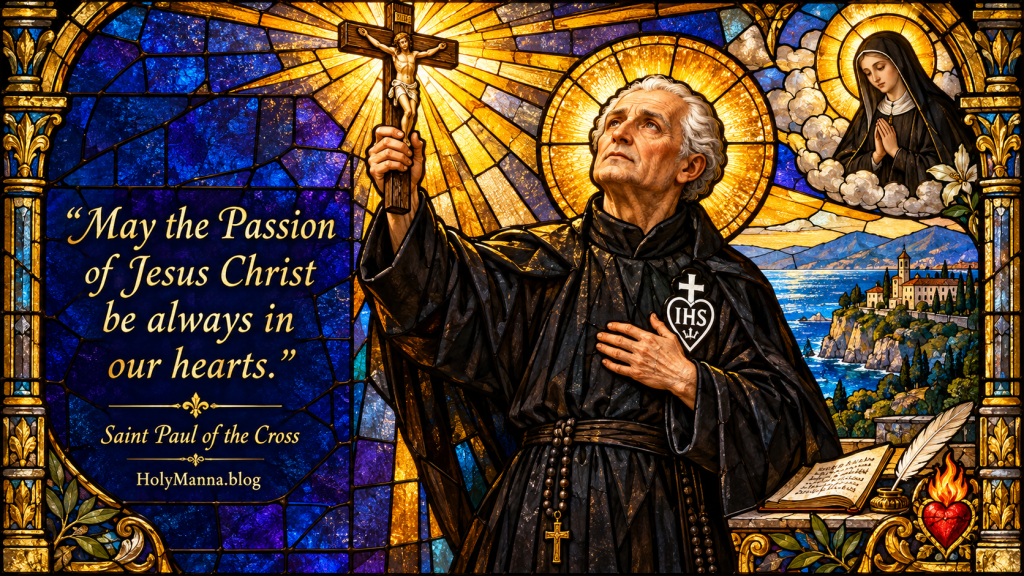
The Man Who Carried Calvary in His Heart
Every so often, God raises up a soul whose entire life becomes a single, sustained answer to one question: how much does God love us? For Saint Paul of the Cross, the answer was never abstract. It hung on a cross outside Jerusalem, and he spent 81 years making sure the world would never forget it. Born Paolo Francesco Danei in 1694 and dying in Rome on October 18th, 1775, he was a priest, a mystic, one of the most powerful mission preachers of the 18th century, and the founder of the Congregation of the Passion of Jesus Christ, known to the world as the Passionists. He gave his spiritual sons a motto that still defines them today: “May the Passion of Jesus Christ be always in our hearts.” His feast is celebrated on the General Roman Calendar on October 19th, the day after his death, since October 18th belongs to Saint Luke the Evangelist. In the United States, his memorial is kept on October 20th, because American Catholics honor the North American Martyrs on October 19th. Whichever day the calendar assigns, the Church holds him up for one reason above all. He understood, more deeply than almost anyone of his age, that the Cross is not a tragedy to be mourned but the supreme proof of divine love. He called the Passion of Jesus “the greatest and most overwhelming work of God’s love” in his letters, a phrase Pope Francis has quoted back to the Passionists in our own day. The Catechism teaches the same truth in sober theological language: “The cross is the unique sacrifice of Christ, the ‘one mediator between God and men’” (CCC 618). Paul of the Cross simply set that doctrine on fire.
A Merchant’s Son
Paolo Francesco Danei was born on January 3rd, 1694, in Ovada, a small town then belonging to the Republic of Genoa, in what is today the Piedmont region of northern Italy. He was the second of 16 children born to Luca Danei, a merchant of modest means and reputed noble descent, and his wife Anna Maria. Only 6 of those 16 children survived infancy, and biographers note that Paul learned early the reality of death and the fragility of life. When Paul was about 10, the family moved to Castellazzo, near Alessandria, and he received his early schooling from a priest who ran a small school for boys in Cremolino. From childhood, the crucifix was his favorite book and the Crucified his model, as the Catholic Encyclopedia records.
A story from his childhood, preserved in Butler’s Lives of the Saints, recounts that while the boy was praying in church, a heavy bench fell on his foot. He took no notice of the bleeding wound and spoke of it only as “a rose sent from God.” This story comes from later devotional tradition and cannot be independently verified. Another story from the same tradition tells that as a young man he received the vision of a scourge with the word love written on its lashes, assuring him that his thirst for penance would be satisfied. This story also cannot be verified.
What is documented is his conversion. At 19 years old, in 1713, Paul heard a sermon that pierced him to the heart, and from that day he gave himself to a serious life of prayer, penance, and frequent reception of the sacraments. He was a normal young man in many ways; around 1715 he even enlisted in the Venetian army to fight against the Turks, hoping perhaps to die for the faith. Within a year he understood that soldiering was not his calling and returned home. Tradition holds that a voice from the Tabernacle during Eucharistic adoration told him he was to serve Christ alone; that detail cannot be verified, but his departure from the army and his deepened devotion afterward are matters of record. He refused an advantageous marriage and declined an inheritance, choosing poverty freely before any rule required it of him.
Then came the summer of 1720. Returning home after Mass and Holy Communion, Paul was caught up in a profound mystical experience. He saw Our Lady clothed in a black habit of mourning, bearing on the breast a sign with the holy name of Jesus and a cross in white. She made known to him that he was to found a congregation that would dress in this habit of mourning and continually grieve over the Passion and Death of her Son. Paul did what every authentic mystic does. He submitted everything to the Church. His bishop, Francesco Arborio di Gattinara of Alessandria, heard his general confession, questioned him at length, and judged the experience credible. On November 22nd, 1720, the bishop clothed the 26-year-old layman in a plain black tunic, and Paul withdrew to a damp little cell beside the church of Saint Charles in Castellazzo for a retreat of 40 days. During that retreat, he wrote the Rule of his future congregation in only 5 days, and he kept a record of his prayer that we now call the Spiritual Diary, one of the treasures of Catholic mysticism. In its pages, the young man cries out to the Crucified: “Your pains, dear God, are pledges of your love!” The whole Passionist charism is already contained in that one sentence.
Preaching with Tears
Why should you remember Paul of the Cross? Because he shows what happens when a person takes the love of God with total seriousness. The Catechism teaches that “by his passion and death on the cross Christ has given a new meaning to suffering: it can henceforth configure us to him and unite us with his redemptive Passion” (CCC 1505). Paul built an entire way of life, and eventually a worldwide religious family, on that single truth.
The road was anything but smooth. In 1721, believing he needed Rome’s approval, Paul made his first journey to the Eternal City, only to be turned away at the door of the papal palace without even an audience. He did not grow bitter. Instead, he walked to the Basilica of Saint Mary Major, knelt before the ancient icon of Our Lady Salus Populi Romani, and vowed to promote the memory of the Passion of Jesus for the rest of his life. His first biographer, Saint Vincent Mary Strambi, records the vow. His first and most faithful companion was his own younger brother, John Baptist, who shared his austerities and his dream. In 1727, Pope Benedict XIII ordained the two brothers to the priesthood in Saint Peter’s Basilica in Rome. After ordination they devoted themselves to preaching missions in parishes, especially in remote country districts and among the neglected poor of the Tuscan Maremma, places where priests were few and faith had grown cold.
Paul settled his tiny community on the lonely heights of Monte Argentario on the Tuscan coast, and in 1737 the first Passionist house opened there. He insisted on calling his monasteries Retreats rather than monasteries, to underline the life of solitude and contemplation that he believed was necessary for anyone who wished to preach the message of the Cross. The life was severe; many early novices left because of its austerity, and Paul famously preferred a slow and even painful growth to anything spectacular. In 1741, Pope Benedict XIV approved a moderated form of the Rule, and the congregation, formally the Discalced Clerics of the Most Holy Cross and Passion of Our Lord Jesus Christ, began to spread through Italy. Pope Clement XIV confirmed the institute in 1769, and Pope Pius VI gave it solemn and final confirmation with the bull Praeclara virtutum exempla on September 15th, 1775, just weeks before the founder’s death. To the three ordinary vows of religion, the Passionists add a distinctive fourth vow: to keep alive in their own hearts, and in the hearts of the faithful, the memory of the Passion of Christ. At the first general chapter, held on Monte Argentario on April 10th, 1747, Paul was unanimously elected the first Superior General, entirely against his own wishes, and he carried that burden until the day he died.
As a preacher, he had almost no equal in his century. Contemporary accounts describe him preaching on the sufferings of Christ with such intensity that he and his hearers wept together, and the most hardened hearts in the crowd were moved to repentance. Bandits, soldiers, and public sinners who had resisted every other appeal broke down at his missions and returned to the sacraments. The lessons of the Roman Breviary for his feast credit him with extraordinary gifts: prophecy, the reading of hearts, power over evil spirits, and miraculous healings of the sick. Catholic sources such as the Catholic Encyclopedia affirm that numerous miracles attested the favor he enjoyed with God during his lifetime, while noting that the greatest miracles of all were miracles of grace, the conversion of sinners who had seemed hardened and hopeless. The brief of Blessed Pius IX for his beatification put it this way: “Although continually occupied with the cares of governing his religious society, and of founding everywhere new houses for it, yet he never left off preaching the word of God, burning as he did with a wondrous desire for the salvation of souls.”
He was also one of the great spiritual directors of his age. More than 2,000 of his letters survive, most of them letters of direction to laypeople, priests, and religious, full of practical wisdom about prayer, suffering, and trust in God. In 1771, after decades of effort, he founded the cloistered Passionist Nuns at Corneto, now Tarquinia, giving the Church a contemplative community wholly devoted to the memory of the Passion. And in one of the most touching devotions of his life, Paul prayed for more than 50 years for the return of England to the Catholic faith, remembering that intention at Mass daily and leaving it as a legacy to his sons. He never saw England. He never needed to. God was playing a longer game, as the next chapters of this story will show.
Saint Vincent Mary Strambi, who knew him and wrote his first biography, summed up the man: “It seemed that God Almighty had chosen Father Paul, in a special way, to teach people how to seek him in the interiority of their own heart.”
Fifty Years of Pain and the Long Dark Night
Paul of the Cross was not a martyr, but his life reads like a slow martyrdom freely embraced. The first hardship was rejection. The man who would found one of the Church’s great congregations was turned away from the papal palace in 1721 without a hearing, and years of patient waiting, revisions of the Rule, and ecclesiastical skepticism stood between the vision of 1720 and the first papal approval of 1741. Twenty-one years passed between the writing of the Rule and its approval. Paul answered every delay with obedience rather than rebellion, trusting that a work truly from God did not need to be forced. He wrote into the Rule of 1775 a principle he had lived the whole time: “The love of God is ingenious and is proved not so much by the words, as by the deeds and examples of those who love.”
The second hardship was the sheer severity of the life. The early Passionists went barefoot, kept long fasts, rose in the night to pray, and embraced a poverty that frightened away many candidates. Paul watched novices leave and houses struggle, and he bore the humiliation of slow growth while flashier movements flourished. The third hardship was physical. Biographers and the old liturgical accounts speak of roughly 50 years of nearly constant bodily pain and illness, which he united quietly to the sufferings of his Crucified Lord. The fourth, and by his own account the heaviest, was interior. For some 45 years, Paul endured a prolonged spiritual darkness, a dark night in which the felt consolations of God withdrew and he was left to walk by naked faith. The mystic who had seen Our Lady in 1720 spent most of his life feeling nothing at all, and loving God anyway. In this he is a brother to every believer who prays without feeling, and he proves the teaching of The Catechism that “the way of perfection passes by way of the Cross. There is no holiness without renunciation and spiritual battle” (CCC 2015).
A tradition preserved in Butler’s Lives of the Saints says that Paul, moved by the same impulse as Blessed Henry Suso and Saint Jane Frances de Chantal, branded the Holy Name of Jesus on his side as a secret and permanent sign of his love, and that its characters were found on his body after death. This story comes from devotional tradition and cannot be verified.
His death was as fitting as his life. In 1773, Pope Clement XIV gave the community the ancient Basilica of Saints John and Paul on Rome’s Celian Hill, and it was there, after a long final illness, that Paul died on October 18th, 1775, at the age of 81. In his last testament, dictated weeks earlier, he commended to his religious “the poor Congregation, which is the fruit of your Cross, of your Passion, of your Death!”, addressing the Crucified Lord directly even in his farewell. Tradition recounts that at the very end, at his own request, the account of the Lord’s Passion was read aloud at his bedside, and that he died as it was being read, passing with Jesus from the cross to glory. The exact circumstances of that final hour come from the accounts of his community and from later devotional retellings, and the detail of dying during the reading itself cannot be independently verified. At his death, the congregation he had planted in tears numbered about 180 priests and brothers living in 12 Retreats, mostly in the Papal States. It looked small. It was a mustard seed.
From a Roman Deathbed to the Ends of the Earth
The fame of Paul’s sanctity, already widespread in Italy during his life, only grew after his death. The Church, with her usual rigor, examined his life, writings, and the miracles attributed to his intercession. Blessed Pius IX beatified him on October 1st, 1852, and canonized him on June 29th, 1867. The Catholic Encyclopedia records that numerous miracles, beyond those specially examined and approved for the beatification and canonization, were attributed to him; the formal processes required verified miraculous healings, which the Church judged authentic, though the detailed case records are not widely accessible today, and this post will not invent particulars where the sources are silent. That restraint matters, because the canonization itself is the Church’s solemn testimony. The Catechism explains: “By canonizing some of the faithful, i.e., by solemnly proclaiming that they practiced heroic virtue and lived in fidelity to God’s grace, the Church recognizes the power of the Spirit of holiness within her and sustains the hope of believers by proposing the saints to them as models and intercessors” (CCC 828).
His body rests beneath the altar of a chapel in the Basilica of Saints John and Paul in Rome, where pilgrims still venerate his relics, and the room in which he died is preserved nearby. His birthplace in Ovada is likewise a shrine, and Monte Argentario, cradle of the congregation, remains a place of pilgrimage and retreat. In 1876, a statue of the founder by Ignazio Iacometti took its place among the founders honored in Saint Peter’s Basilica. In 1983, a titular church in Rome, San Paolo della Croce a Corviale, was dedicated under his name. His feast entered the General Roman Calendar in 1869 on April 28th and was moved in 1969 to October 19th, with the United States keeping it on October 20th.
The most astonishing fruit of his intercession, though, may be England. Remember those 50 years of daily prayer for a nation he never visited. In the early 1840s, roughly 65 years after his death, his spiritual son Blessed Dominic Barberi brought the Passionists to England, arriving poor, mocked, and undeterred. On a rainy October night in 1845, at Littlemore, Blessed Dominic received into the Catholic Church an Oxford scholar named John Henry Newman, who is now himself a canonized saint and was recently named a Doctor of the Church. It is hard to read that sequence and not hear the words of Scripture: “For as the rain and the snow come down from heaven, and do not return there until they have watered the earth… so shall my word be that goes out from my mouth; it shall not return to me empty” (Isaiah 55:10 to 11). Today the Passionists serve on every inhabited continent, and the congregation has given the Church a constellation of holy ones, among them Saint Vincent Mary Strambi, Saint Gabriel of Our Lady of Sorrows, Saint Charles of Mount Argus, and Saint Gemma Galgani, a laywoman formed by Passionist spirituality. One man’s 40-day retreat in a damp cell in 1720 became all of that.
Keeping the Passion in Your Heart
What does an 18th-century Italian mystic have to say to you, scrolling through this on a Monday? More than you might think. Paul’s genius was not that he suffered much, though he did. His genius was that he looked at the Cross and saw love first. He read the Passion the way the Church reads it, as The Catechism does when it teaches that Christ’s sacrifice is “the unique sacrifice of Christ” and quotes Saint Rose of Lima that “apart from the cross there is no other ladder by which we may get to heaven” (CCC 618). If the Passion really is the greatest work of God’s love, then your crosses, the diagnosis, the layoff, the broken relationship, the prayer that feels like talking to a ceiling, are not evidence that God has forgotten you. They are the very places where you can be configured to Christ (CCC 1505).
Paul also teaches persistence in prayer on a scale that shames our impatience. He prayed 50 years for England and died without an answer. The answer came anyway, 70 years later, in a form more glorious than he could have imagined. What intention have you given up on because God seemed slow? Pick it back up. Pray it daily, at Mass if you can, and leave the timeline to God.
Here are some practical ways to bring his charism into ordinary life. Spend 10 minutes a day this week meditating on one scene of the Passion, perhaps with The Gospel of John, chapters 18 and 19, since The Catechism reminds us that meditation engages “thought, imagination, emotion, and desire” (CCC 2708). Pray the Sorrowful Mysteries of the Rosary on Tuesday and Friday. When pain arrives, large or small, resist the reflex to numb it instantly, and instead say with Paul, “Your pains, dear God, are pledges of your love!”, offering it for someone who needs grace. And remember his Rule: love is proved by deeds, so let your meditation on the Crucified send you toward the crucified people around you, the sick, the lonely, the poor, as Paul’s preaching always did. When you look at a crucifix, what do you honestly see first: an instrument of death, or the price of your worth?
Engage With Us!
Saint Paul of the Cross spent his whole life answering one question, and now that question is passed to you. Share your thoughts and reflections in the comments below; this community grows when you bring your story to it. To get the conversation started, consider these questions:
- Saint Paul of the Cross saw the Passion as the greatest work of God’s love. When you meditate on the Cross, do you tend to see suffering or love first, and what might change if you reversed the order?
- Paul endured decades of spiritual dryness after a single luminous vision. How do you stay faithful to prayer when you feel nothing at all?
- He prayed for the conversion of England for more than 50 years and never saw the answer. What long-term intention is God inviting you to commit to, even if you never see the result?
- Paul began as an ordinary young man who heard one sermon and let it change everything. What is one concrete way God has been trying to get your attention lately?
- The Passionists take a vow to keep the memory of the Passion alive in the world. What is one practical way you can keep that memory alive in your home, your workplace, or your parish this week?
Whatever crosses this week lays on your shoulders, carry them the way Paul did, with your eyes fixed on the One who carried His first. Live your faith boldly, love without counting the cost, and do everything with the love and mercy that Jesus taught us.
Saint Paul of the Cross, pray for us!
Follow us on YouTube, TikTok, Instagram and Facebook for more insights and reflections on living a faith-filled life.


Leave a Reply