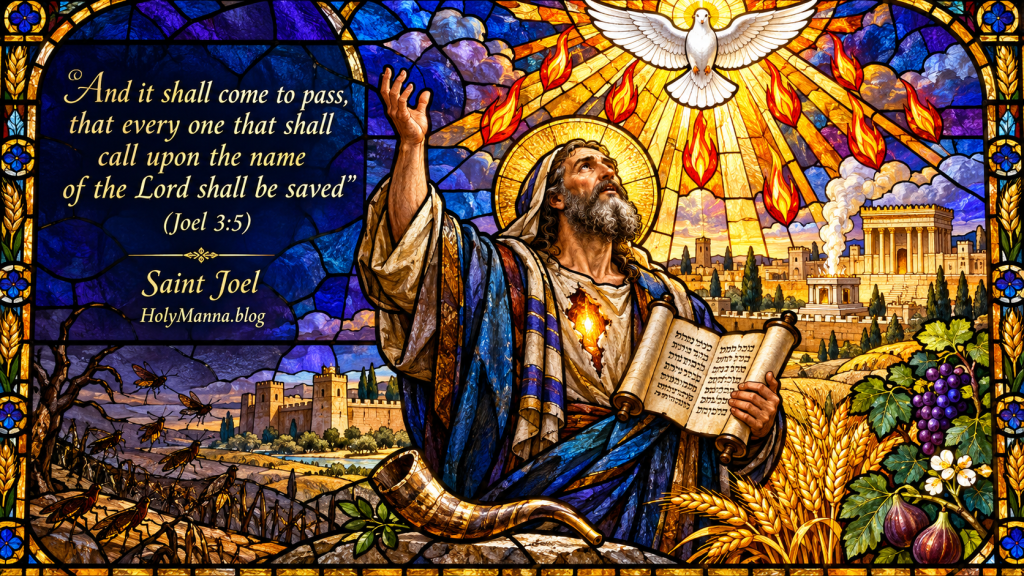
The Prophet of Pentecost
Every Ash Wednesday, in parishes from Houston to Hanoi, a priest stands at the ambo and proclaims words first spoken well over two thousand years ago: “Be converted to me with all your heart, in fasting, and in weeping, and in mourning. And rend your hearts, and not your garments” (Joel 2:12 to 13). And every Pentecost, the Church returns to the same small book to explain the fire that fell on the Apostles. Few Catholics could pick the man behind those words out of a lineup, yet his voice frames the two great hinges of the liturgical year, repentance and the gift of the Holy Spirit. That man is Saint Joel, the second of the twelve minor prophets and the author of The Book of Joel.
The Church commemorates Saint Joel on October 19th in the 2004 Roman Martyrology, which honors him in these words, translated from the Latin: “The commemoration of Saint Joel, the prophet, who foretold the great day of the Lord and the mystery of the outpouring of his Spirit upon all flesh, which the divine majesty wondrously brought to fulfillment in Christ on the day of Pentecost.” That single sentence is the whole shape of his sanctity. Joel is not venerated for miracles, for a dramatic conversion, or for a martyr’s death. He is venerated because God spoke through him, and because God kept the promise he spoke.
The Catechism teaches that “through the prophets, God forms his people in the hope of salvation” (CCC 64), and it names the prophetic books, Joel’s among them, as a permanent and irreplaceable part of God’s word, since the Old Testament retains its own intrinsic value as divine revelation (CCC 121 to 123). Joel’s book runs barely four chapters, short enough to read in fifteen minutes. Yet within those chapters lies the summons that opens Lent, the promise that explains Pentecost, and the vision of the day when the Lord will judge the nations. For a prophet about whom almost nothing personal is known, that is an astonishing legacy.
The Son of Pethuel
Here is everything Scripture tells about the man himself: “The word of the Lord, that came to Joel the son of Phatuel” (Joel 1:1). One verse. One name, rendered Pethuel in most modern editions. No hometown, no tribe, no king named to date his ministry, no account of his call, no record of his death. In an age obsessed with personal branding, where even saints’ lives are sometimes retold like influencer biographies, Joel stands as the prophet who disappears entirely behind his message.
His name, however, is itself a sermon. The Hebrew Yo’el joins the covenant name of God with the word El, and means “the Lord is God.” The man’s very identity was a confession of faith, a one word creed carried through life. Whatever else his parents gave him, they gave him that.
What can be responsibly said about his origins comes from reading his book the way the Church teaches Scripture should be read, attentive to “the content and unity of the whole Scripture” and to the living Tradition of the Church (CCC 112 to 113). Joel speaks constantly of Judah, of Jerusalem, of Zion, of priests, of grain offerings and libations, and of the house of the Lord. He knows the Temple’s rhythms intimately, the ministers who serve “between the porch and the altar” (Joel 2:17), the fasts, the solemn assemblies. For this reason Catholic scholarship, including the Catholic Encyclopedia tradition, has long concluded that Joel was a man of Judah, almost certainly ministering in or near Jerusalem, and possibly connected closely to Temple worship itself.
When he lived is honestly disputed, and the dispute deserves to be stated plainly rather than papered over. Some commentators, following an older tradition reflected in the Eastern churches, place Joel around the 9th century before Christ, which would make him one of the earliest writing prophets. Others, noting that his book mentions no king, presumes a functioning Temple, and refers to the scattering of Israel among the nations, place him after the Babylonian exile, in the 5th or 4th century before Christ. The book itself gives no date, and faithful Catholics have held both views. What matters for the believer is not the century but the word, for as The Catechism teaches, the books of Scripture “firmly, faithfully, and without error teach that truth which God, for the sake of our salvation, wished to see confided” to them (CCC 107).
One ancient tradition does attempt to fill the silence. The non-canonical Lives of the Prophets, an early collection of short prophet biographies long attributed to Epiphanius, relates that Joel came from the territory of the tribe of Reuben and died there in peace. It is told here as the old tradition it is; it sits uneasily beside the strong Judean character of his book, and it cannot be verified.
There is no conversion story to tell, because Joel’s whole recorded life is already a life turned toward God. In that, he resembles the countless faithful whose interior drama never makes the historical record. His book opens not with autobiography but with urgency: “Hear this, ye old men, and give ear, all ye inhabitants of the land: did this ever happen in your days, or in the days of your fathers? Tell ye of this to your children, and let your children tell their children, and their children to another generation” (Joel 1:2 to 3). From his first breath on the page, Joel is doing the one thing prophets exist to do, handing on what God has done so that no generation forgets.
When the Locusts Came
Honesty requires saying it clearly at the outset: no miracles are recorded of Saint Joel during his lifetime. He parted no seas, raised no dead, called down no fire. The Catholic record attributes to him no wonders at all. Why, then, should anyone remember him, let alone emulate him? Because Joel’s gift was in some ways rarer than wonder working. He was given eyes to see God acting inside an ordinary catastrophe, and the courage to say so out loud.
The catastrophe was a locust plague. His book describes it in waves of ruin: “That which the palmerworm hath left, the locust hath eaten: and that which the locust hath left, the bruchus hath eaten: and that which the bruchus hath left, the mildew hath destroyed” (Joel 1:4). Vineyards stripped bare, fig trees splintered white, grain offerings cut off from the house of the Lord, drought and fire behind the swarm. For an agricultural people, this was total economic and spiritual collapse; when the harvest died, even the daily sacrifices in the Temple failed for want of grain and wine.
Where his neighbors saw bad luck or bad weather, Joel saw a summons. He called the whole nation, priests first, to repentance: “Blow the trumpet in Sion, sanctify a fast, call a solemn assembly, gather together the people, sanctify the church, assemble the ancients, gather together the little ones, and them that suck at the breasts” (Joel 2:15 to 16). Everyone, from nursing infants to newlyweds, was to stand before God together. And then came the words the Church has never stopped repeating: “Rend your hearts, and not your garments, and turn to the Lord your God: for he is gracious and merciful, patient and rich in mercy” (Joel 2:13).
This is precisely where The Catechism places Joel in the Church’s living teaching. In its treatment of interior penance, it cites Joel 2:12 to 13 directly and teaches that the call to conversion, in the prophets as in Jesus, “does not aim first at outward works… but at the conversion of the heart, interior conversion” (CCC 1430). Tearing one’s garments was the ancient gesture of grief; Joel insisted God wanted the tearing to happen deeper, in the will, in the heart. Saint Jerome, Doctor of the Church, wrote an entire commentary on The Book of Joel (PL 25, 967 to 968), a portion of which the Church still reads in the Liturgy of the Hours. Commenting on this very verse, Jerome urges the sinner, however burdened, “do not despair of his mercy, no matter how great your sins.” Saint Cyprian of Carthage, preaching in the third century to Christians who had fallen during persecution, likewise reached for Joel’s words, calling the faithful to return to the Lord with the whole heart and to seek his mercy through fasting, weeping, and mourning.
Then comes the turn that makes Joel’s book one of the most hope-filled in the Old Testament. God answers the repentant people not merely with restored crops but with a promise that overshoots agriculture entirely. First the tender consolation: “And I will restore to you the years which the locust, and the bruchus, and the mildew, and the palmerworm hath eaten” (Joel 2:25). God does not only forgive; he restores wasted years. And then the promise that defines Joel forever: “And it shall come to pass after this, that I will pour out my spirit upon all flesh: and your sons and your daughters shall prophesy: your old men shall dream dreams, and your young men shall see visions” (Joel 3:1, numbered 2:28 in some editions). Upon servants and handmaids too, upon everyone, the Spirit would be poured out, and “every one that shall call upon the name of the Lord shall be saved” (Joel 3:5).
The Catechism counts this oracle among the great prophetic texts that directly concern the sending of the Holy Spirit, promises by which God speaks to the heart of his people in the language of love and fidelity, cited explicitly at CCC 715. For centuries the promise waited. Then, on a Pentecost morning in Jerusalem, Saint Peter stood up before a bewildered crowd and announced that the waiting was over: “This is that which was spoken of by the prophet Joel” (Acts 2:16), and he quoted Joel’s oracle at length. The Catechism teaches that this fullness of the Spirit, promised by Christ, was fulfilled first on Easter and then more strikingly on the day of Pentecost, when the Apostles, filled with the Holy Spirit, proclaimed the mighty works of God (CCC 1287). Saint Paul sealed Joel’s place in the Gospel by quoting him again: “For whosoever shall call upon the name of the Lord, shall be saved” (Romans 10:13). A man who worked no miracles became the prophet whose words explain the greatest outpouring of divine power the Church has ever known. That is why he matters, and that is why he is worth emulating: fidelity to God’s word, spoken in dark times, outlasts every spectacle.
The Burden of Calling a Nation Home
Saint Joel was not a martyr. No tradition, Eastern or Western, records a violent death, imprisonment, or persecution, and the one ancient tradition that speaks of his end, the Lives of the Prophets, says simply that he died in peace; as noted above, even that cannot be verified. His hardships were of another kind, and they deserve to be taken seriously, because they are the hardships most believers actually face.
First, Joel lived through national disaster. The locust plague was not a sermon illustration he invented; it was his daily reality. He watched his own land stripped, his neighbors’ livelihoods devoured, the joy of the harvest festivals fall silent: “The vineyard is confounded, and the fig tree hath languished… joy hath withered away from the children of men” (Joel 1:12). Prophets are not spared the catastrophes they interpret. Joel grieved inside the same ruin he was called to explain.
Second, he carried the burden of the preacher of repentance. It is never popular to tell a suffering people that the moment calls for fasting rather than complaint, for examination of conscience rather than blame. Joel summoned priests to weep publicly for the people’s sins: “Between the porch and the altar the priests the Lord’s ministers shall weep, and shall say: Spare, O Lord, spare thy people: and give not thy inheritance to reproach” (Joel 2:17). To call clergy and elders to public penance requires a courage quieter than a martyr’s, but real. The prophetic vocation itself, as the Church understands it, was a long formation in hope conducted against constant resistance, for through the prophets God taught his people to hope for salvation, to await a new and everlasting covenant meant for all and written on their hearts (CCC 64).
Third, Joel bore the weight of the message no one wants to deliver: judgment. His book announces “the day of the Lord”, great and terrible, when God will gather the nations into the valley of Josaphat and sit in judgment. The Catechism teaches that Jesus himself, announcing the judgment of the Last Day, followed in the steps of the prophets, and it cites Joel’s oracles of judgment among the texts behind that preaching (CCC 678). To speak of judgment honestly, without cruelty and without softening, while holding out mercy in the same breath, is one of the hardest balances any teacher of the faith ever strikes. Joel struck it. The same chapter that thunders about darkness and clouds pleads, in God’s own voice, “Be converted to me with all your heart” (Joel 2:12), and immediately reminds the people why conversion is safe: because the God they are returning to is “gracious and merciful, patient and rich in mercy” (Joel 2:13).
He endured, so far as the record shows, the most common hardship of all: obscurity. No shrine was built for him in his lifetime, no school of disciples preserved his biography, no chronicler thought his life worth narrating. He planted words and never saw the harvest. Centuries would pass before Peter stood up in Jerusalem and declared his prophecy fulfilled. Joel is the patron figure, informally speaking, of everyone who labors faithfully without ever seeing results, and his book quietly promises that God wastes none of it, for the Lord is the God who restores even “the years which the locust… hath eaten” (Joel 2:25).
From Galilee to the Sistine Chapel
Just as no miracles are recorded of Joel in life, none are attributed to him after death. Catholic sources record no healings at his grave, no translations of relics, no apparitions. The post states that plainly, because the truth about this saint is more interesting than any invented wonder: the great event following Joel’s death was not a miracle worked through his relics but the fulfillment of his prophecy in the upper room at Pentecost, when, as the Roman Martyrology says, the divine majesty “wondrously brought to fulfillment in Christ” the outpouring he foretold.
One burial tradition does survive, and it is told here as a tradition. According to a long-standing account, Joel was buried at Gush Halav, the ancient Gischala, in the Upper Galilee of the Holy Land, about seven kilometers northwest of Safed. On the western outskirts of the modern village, known in Arabic as Jish and today home to a largely Maronite Catholic Christian community, stands a structure containing ancient rock-cut tombs that has long been venerated as the tomb of the prophet Joel, a site held sacred by Jewish pilgrims as well. Pilgrims still visit it. The tradition is centuries old and the veneration is real, but the identification of the tomb cannot be verified. It also sits in tension with the Lives of the Prophets tradition of a burial in the territory of Reuben, east of the Jordan; the conflict between the two accounts is itself a reminder of how little is actually known, and neither can be verified.
What can be verified is the extraordinary reach of Joel’s words through the Church’s life. The Byzantine churches have kept his feast on October 19th from ancient times, honoring him with the other prophets who foretold Christ. The older Roman Martyrology commemorated him on July 13th, and readers may still find that date repeated online; the revised Martyrologium Romanum of 2004 moved his commemoration to October 19th, so that East and West now honor him together on the same day. The Armenian Apostolic tradition remembers him with the other minor prophets on July 31st.
His cultural afterlife is remarkable for a man of one short book. When Michelangelo frescoed the Sistine Chapel ceiling between 1508 and 1512, he seated the prophet Joel among the seven great prophets flanking the scenes of creation, an intense, balding figure absorbed in an open scroll, painted a few yards from where the cardinals of the Roman Church still gather in conclave. Every papal election since has unfolded beneath Joel’s gaze, which is fitting for the prophet of the Holy Spirit’s outpouring, since the Church prays precisely for that Spirit to guide the choice of Peter’s successor.
Above all, Joel lives in the liturgy. His summons opens Lent each year as the First Reading of Ash Wednesday (Joel 2:12 to 18), so that the whole Church begins its great fast with his voice in its ears. His oracle of the Spirit returns at Pentecost, both in the readings and in the Church’s understanding of the feast itself, for The Catechism presents Pentecost as the fulfillment of the promise that the Messiah’s Spirit would be communicated to the whole messianic people (CCC 1287). Saint Jerome’s commentary on his book is still read in the Office of Readings. Few Old Testament figures of any size shape the Church’s annual rhythm so directly. The locusts ate his harvest; God gave him a harvest of twenty-eight centuries and counting.
Rend Your Hearts
Joel’s life offers almost nothing to imitate in its externals, because almost nothing external survives. That turns out to be his gift to you. Stripped of biography, what remains is pure vocation, and his vocation translates directly into yours.
Start with his hardest word: “rend your hearts, and not your garments” (Joel 2:13). It is remarkably easy to perform repentance, to post the right things, to say the expected words, to go through Lent changing habits without changing direction. The Catechism calls what Joel demands by its proper name: interior repentance, “a radical reorientation of our whole life”, a return to God with all one’s heart, a turning away from evil joined to the desire to change one’s life with hope in God’s mercy (CCC 1431). The Sacrament of Penance exists precisely so that this interior tearing can meet God’s mercy concretely (CCC 1446). When was the last time repentance actually cost something interior, a grudge surrendered, a habit named out loud in confession, a pattern of thought dragged into the light? Joel’s counsel is that the tearing should happen there, where only God sees.
Then take his great promise personally. Joel foretold the Spirit poured out on “all flesh”, on sons and daughters, old and young, servants and handmaids. The Church teaches that this outpouring did not end at Pentecost; it is renewed in every Baptism and sealed in every Confirmation, by which the baptized are more perfectly bound to the Church and enriched with the special strength of the Holy Spirit (CCC 1285, 1302 to 1303). For Catholics in their twenties, thirties, and forties, Joel’s line about young men seeing visions is not poetry about someone else. It is a description of what the Spirit intends to do in ordinary working lives, in apartments and cubicles and family kitchens. What vision has the Spirit been trying to give that keeps getting postponed for a more convenient season?
Learn also from Joel’s relationship with disaster. He did not waste his locust plague. He asked what God was saying through it, and he led his community to answer together, fasting and praying as one body, elders and infants side by side. Modern life privatizes suffering; Joel communalizes it. The practical application is concrete: when hardship strikes, bring it to the parish, to the Mass, to shared prayer, rather than carrying it alone. Join the communal penances of the Church, the Friday abstinences, the Ember day spirit, the parish holy hour, instead of treating penance as a private hobby. And when God restores, as he promised to “restore… the years which the locust… hath eaten” (Joel 2:25), tell the next generation, exactly as Joel commanded: “Tell ye of this to your children, and let your children tell their children” (Joel 1:3). Faith that is not handed on was never fully received.
Finally, imitate his obscurity. Joel accepted a vocation with no visible payoff, trusting that God’s word does its work on God’s schedule. Where is God asking for faithfulness right now without offering any guarantee of visible results? The answer to that question is probably the exact place where sanctity is waiting.
Engage With Us!
Saint Joel spoke into a ruined harvest and promised a Pentecost, and his words are still doing their work today. Share your thoughts and reflections in the comments below; this community grows when readers tell their own stories of repentance, restoration, and the quiet work of the Holy Spirit. To guide the conversation, consider these questions:
- Joel insisted that God wants hearts torn open rather than garments; what would “rending the heart” honestly look like in this season of life, and what one step toward the Sacrament of Penance could make it concrete this week?
- The locusts devoured years of harvest, yet God promised to restore the years the locust had eaten; what “eaten years” still need to be handed over to God in trust that he can restore them?
- Joel’s prophecy of the Spirit poured out on all flesh was fulfilled at Pentecost and is renewed in Baptism and Confirmation; how actively are the gifts of Confirmation being asked for and used in daily decisions, work, and relationships?
- Joel called the entire community, from elders to infants, to fast and pray together; what communal practice of prayer or penance could replace a purely private approach to hardship this month?
- Joel labored in total obscurity and never saw his words fulfilled; where is God asking for faithfulness right now without any promise of visible results, and what would it take to persevere there?
Saint Joel’s whole life fit inside a single verse, yet God made his words the doorway to Lent and the key to Pentecost. No life offered to God is too small, too hidden, or too ordinary for him to fill with his Spirit. Go into this week resolved to tear open the heart rather than the garment, to call on the name of the Lord who saves all who call on him, and to do everything, in every hidden corner of life, with the love and mercy that Jesus taught us.
Saint Joel, prophet of the great day of the Lord, pray for us!
Follow us on YouTube, TikTok, Instagram and Facebook for more insights and reflections on living a faith-filled life.


Leave a Reply