Memorial of Saints John de Brébeuf and Isaac Jogues, Priests, and Companions, Martyrs – Lectionary: 473
The Day Heaven Asks for Everything Back
Some mornings the Church hands her people a mirror, and October 19th is one of those mornings. On this Monday of the 29th Week in Ordinary Time, the liturgy keeps the Memorial of Saints John de Brébeuf and Isaac Jogues, Priests, and their Companions, eight Jesuit missionaries who left the comforts of France for the forests of New France and were martyred among the Huron and Iroquois peoples between 1642 and 1649. Pope Pius XI canonized them on June 29th, 1930, and the Church in North America honors them as her protomartyrs. Against that backdrop, the readings of Lectionary 473 press a single question into the heart: to whom does a human life actually belong?
Saint Paul answers first. In Ephesians 2, he tells a story of corpses raised to life, insisting that salvation is pure gift: “For by grace you have been saved through faith, and this is not from you; it is the gift of God.” Psalm 100 then turns that gift into a song of ownership: “he made us, his we are; his people, the flock he tends.” Finally, in The Gospel of Luke, Jesus tells of a rich man who lived as though his harvest, his barns, and even his soul were his own private property, until God called the loan due in a single night.
The central theme uniting these readings is this: life is not a possession but a gift on loan from a God who is rich in mercy, and the only wise response is thanksgiving that spends itself. The martyrs understood that ledger perfectly. The rich fool never opened it.
First Reading — Ephesians 2:1-10
From the Grave to the Throne Room
Saint Paul wrote The Letter to the Ephesians while chained in Roman custody, most likely around the year 62. Ephesus was a wealthy harbor city, home to the Temple of Artemis, one of the seven wonders of the ancient world, and famous across the empire as a center of magic and the occult. The Acts of the Apostles records that converts there publicly burned their spell books, worth fifty thousand silver pieces (Acts 19:19). For readers who once feared the spirits believed to crowd the lower air, Paul’s phrase about “the ruler of the power of the air” landed with real force. In the Greek, verses 1 through 7 form one long, breathless sentence that piles up humanity’s hopeless condition before exploding into two of the most beautiful words in Scripture: “But God.” Before anyone can sing the Psalm’s gratitude or escape the Gospel’s greed, this reading establishes the foundation: every believer was once a corpse, and everything that followed was gift.
Ephesians 2:1-10
Brothers and sisters:
You were dead in your transgressions and sins
in which you once lived following the age of this world,
following the ruler of the power of the air,
the spirit that is now at work in the disobedient.
All of us once lived among them in the desires of our flesh,
following the wishes of the flesh and the impulses,
and we were by nature children of wrath, like the rest.
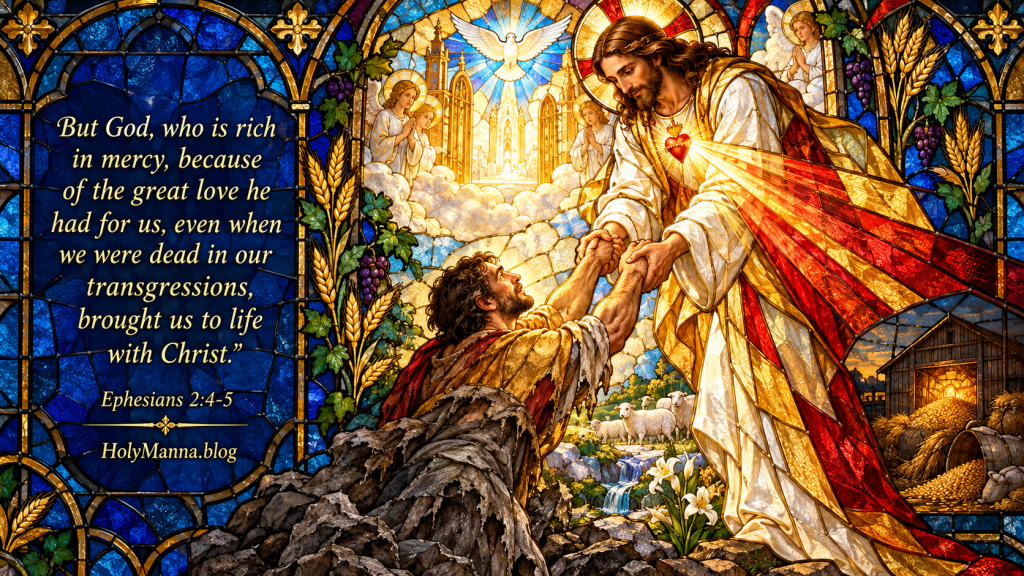
But God, who is rich in mercy,
because of the great love he had for us,
even when we were dead in our transgressions,
brought us to life with Christ (by grace you have been saved),
raised us up with him,
and seated us with him in the heavens in Christ Jesus,
that in the ages to come
he might show the immeasurable riches of his grace
in his kindness to us in Christ Jesus.
For by grace you have been saved through faith,
and this is not from you; it is the gift of God;
it is not from works, so no one may boast.
For we are his handiwork, created in Christ Jesus for good works
that God has prepared in advance,
that we should live in them.
Detailed Exegesis
Verse 1. “You were dead in your transgressions and sins.”
Paul opens with a diagnosis, not an insult. He does not say humanity was sick, wounded, or struggling; he says it was dead. Spiritual death means separation from the very life of God, and a corpse cannot revive itself. The entire passage hangs on the honesty of this first line.
Verse 2. “in which you once lived following the age of this world, following the ruler of the power of the air, the spirit that is now at work in the disobedient.”
Paul names the old masters: the fallen pattern of the world and the devil himself, whom ancient Jews pictured as ruling the lower air where demons were thought to dwell. For former practitioners of Ephesian magic, this was not poetry. It was their autobiography.
Verse 3. “All of us once lived among them in the desires of our flesh, following the wishes of the flesh and the impulses, and we were by nature children of wrath, like the rest.”
Notice the shift to “all of us.” Paul includes himself, the Pharisee of Pharisees, in the obituary. The phrase “children of wrath” points to the wounded nature every person inherits from the Fall, which the Church names original sin. No one earns an exemption, which means no one may boast.
Verse 4. “But God, who is rich in mercy, because of the great love he had for us,”
Here is the hinge of the whole passage. The only wealth this liturgy will praise belongs to God, and his riches are mercy. Saint John Paul II loved this verse so deeply that he titled his 1980 encyclical on divine mercy Dives in Misericordia, taken straight from its Latin wording.
Verse 5. “even when we were dead in our transgressions, brought us to life with Christ (by grace you have been saved),”
The corpse contributed nothing to its own resurrection. God acted first, while humanity was still dead, and Paul is so overwhelmed by the thought that he interrupts his own sentence with a parenthesis of praise. Grace always arrives before any human response is possible.
Verse 6. “raised us up with him, and seated us with him in the heavens in Christ Jesus,”
The believer’s story is mapped directly onto Christ’s own: death, resurrection, ascension, and enthronement. Through Baptism, the Christian is buried and raised with Christ (Romans 6:4), and in hope is already seated where the Head of the Body reigns. Heaven is not a distant wish; it is a present belonging.
Verse 7. “that in the ages to come he might show the immeasurable riches of his grace in his kindness to us in Christ Jesus.”
God’s purpose reaches past time itself. Redeemed humanity becomes the eternal exhibit of divine generosity, a trophy case of mercy displayed for all ages. The saved are not merely rescued; they are made evidence.
Verse 8. “For by grace you have been saved through faith, and this is not from you; it is the gift of God;”
This is one of the most quoted verses in the New Testament, and the Catholic Church affirms it without hesitation. Salvation is entirely gift, and even the faith that receives it is itself a grace. Nothing in the exchange begins with man.
Verse 9. “it is not from works, so no one may boast.”
No one earns the first grace of justification. The Council of Trent taught exactly this in its Decree on Justification of 1547, insisting that nothing preceding justification, neither faith nor works, merits that grace. Boasting dies at the foot of the Cross.
Verse 10. “For we are his handiwork, created in Christ Jesus for good works that God has prepared in advance, that we should live in them.”
The Greek word for “handiwork” is poiema, the root of the English word poem. Each believer is God’s work of art, fashioned for good works that God himself prepared beforehand. Works are not the price of grace; they are its fruit, which dissolves the false war between faith and works.
Teachings
The Catechism gathers this entire reading into its definition of grace: “Our justification comes from the grace of God. Grace is favor, the free and undeserved help that God gives us to respond to his call to become children of God, adoptive sons, partakers of the divine nature and of eternal life” (CCC 1996). It then describes what that gift actually is: “The grace of Christ is the gratuitous gift that God makes to us of his own life, infused by the Holy Spirit into our soul to heal it of sin and to sanctify it” (CCC 1999).
Saint Augustine, Doctor of the Church, stood in awe before this mystery. The Catechism records his judgment that “the justification of the wicked is a greater work than the creation of heaven and earth,” because heaven and earth will pass away while the salvation of the elect will not (CCC 1994). The Jesuit martyrs honored on October 19th built their whole mission on this conviction. They crossed an ocean not to earn grace but because grace had already seized them, and Ephesians 2:10 reads like their job description: handiwork of God, sent into works he had prepared in advance among the Huron people.
Reflection
Every conversion story has a “But God” moment, the point where mercy interrupted the sentence sin was writing. Honoring that moment begins with remembering it. Consider looking up the date of your Baptism this week and marking it on your calendar as a second birthday, because that was the day you were raised from the dead with Christ. If serious sin has crept back in, the Sacrament of Reconciliation is the place where the God who is rich in mercy raises the dead again, and no appointment with him ever requires a résumé.
Then live verse 10 on purpose. Somewhere in this ordinary Monday sits a good work God prepared in advance with your name on it, perhaps a phone call, an apology, or an hour given away. Where in your story did God’s mercy interrupt you, and have you ever thanked him for it out loud? What good work might God have prepared in advance for you today, and what would it cost to walk into it?
Responsorial Psalm — Psalm 100:1-5
The Song Sung at the Gate
Psalm 100 is one of the shortest psalms in the Psalter and one of the most joyful. Known by its Latin opening as the Jubilate Deo, it was composed as a processional hymn, sung by pilgrims as they climbed toward the Temple in Jerusalem and passed through its gates for worship. Its Hebrew superscription marks it as a psalm for the todah, the thanksgiving sacrifice offered by someone whose life God had rescued, which makes it unique in the entire book. The Church has prayed it for centuries in the Liturgy of the Hours, often at morning prayer, so that each day begins the way the pilgrims entered the Temple. Today the liturgy places it between Paul’s hymn to grace and Jesus’ warning about greed, because its central line answers both: the one who knows that God made him, and that he belongs to God, has every reason for gratitude and no room left for hoarding.
Psalm 100:1-5
R. (3b) The Lord made us, we belong to him.
Sing joyfully to the LORD all you lands;
serve the LORD with gladness;
come before him with joyful song.
R. The Lord made us, we belong to him.
Know that the LORD is God;
he made us, his we are;
his people, the flock he tends.
R. The Lord made us, we belong to him.
Enter his gates with thanksgiving,
his courts with praise.
R. The Lord made us, we belong to him.
Give thanks to him; bless his name, for he is good:
the LORD, whose kindness endures forever,
and his faithfulness, to all generations.
R. The Lord made us, we belong to him.
Detailed Exegesis
Verses 1 and 2. “Sing joyfully to the LORD all you lands; serve the LORD with gladness; come before him with joyful song.”
The summons goes out not to Israel alone but to “all you lands,” every nation on earth. Service and joy stand side by side in the same breath, which corrects a common misunderstanding: serving God is not the tax a believer pays for blessings; it is the dance of someone who has been given everything. The Hebrew word behind this service is the same word used for liturgical worship, so the verse is an invitation to the liturgy itself.
Verse 3. “Know that the LORD is God; he made us, his we are; his people, the flock he tends.”
Here is the creed of the whole day compressed into one verse. To know that the Lord is God is to admit that nobody else is, including the self. The declaration “he made us, his we are” settles the question of ownership before the rich fool of the Gospel ever opens his mouth, and the image of the flock adds tenderness to the claim. A sheep owns nothing, yet it lacks nothing, because the shepherd carries the responsibility.
Verse 4. “Enter his gates with thanksgiving, his courts with praise.”
The pilgrim does not wander into God’s presence; he enters through gates, deliberately, with thanksgiving as his entrance fee. For the Catholic, this verse describes the walk from the parking lot to the pew. Every Mass is an entrance into the true courts of God, and the Church’s greatest prayer takes its very name from gratitude, since the word Eucharist comes from the Greek for thanksgiving.
Verse 5. “Give thanks to him; bless his name, for he is good: the LORD, whose kindness endures forever, and his faithfulness, to all generations.”
The psalm closes with the reason beneath all gratitude. The word translated “kindness” is the Hebrew hesed, God’s steadfast covenant love, the mercy that Paul called riches in the First Reading. His goodness is not a mood that passes; it endures forever and reaches every generation, including this one.
Teachings
The Catechism teaches that this kind of prayer touches something deeper than petition: “Praise is the form of prayer which recognizes most immediately that God is God. It lauds God for his own sake and gives him glory, quite beyond what he does, but simply because HE IS” (CCC 2639). Psalm 100 never asks God for a single thing. It simply rejoices that he is God and that his people belong to him, which is why the Church never tires of singing it.
Saint Augustine, Doctor of the Church, turned verse 3 into the most famous sentence of his Confessions, a line the Catechism itself quotes near its opening: “You have made us for yourself, and our heart is restless until it rests in you” (CCC 30). Being made by God means being made for God, and every restless heart chasing bigger barns is really homesick for its Shepherd.
Reflection
Gratitude is a muscle, and this psalm is its workout. Try arriving at Mass a few minutes early this week and praying Psalm 100 quietly at the door before walking in, so that you literally enter his gates with thanksgiving. At night, before sleep, name three specific gifts from the day out loud and bless God for each one by name, because vague gratitude evaporates while specific gratitude takes root. When you walk into Mass, do you enter like an owner inspecting property or like a sheep coming home to its shepherd? What three gifts from this past week deserve a spoken thank you to God tonight?
Holy Gospel — Luke 12:13-21
The Man Who Talked Only to Himself
This scene unfolds on the road to Jerusalem, where Jesus has just finished urging the crowd to fearless faith under persecution (Luke 12:4-12). In first-century Judaism, it was normal to bring inheritance disputes to a rabbi, since the Torah governed such matters and granted the firstborn a double portion (Deuteronomy 21:17). So the man’s request was not strange; what was strange was his timing. Jesus had been speaking of souls, hell, and the Holy Spirit, and this listener heard only an opening to talk about money. Jesus responds with the parable of the rich fool, found only in The Gospel of Luke, the evangelist most attentive to wealth and poverty. On the memorial of eight missionaries who stored up nothing and gave away everything, including their lives, the parable reads like a photographic negative of sanctity, showing exactly what the martyrs refused to become.
Luke 12:13-21
Someone in the crowd said to Jesus,
“Teacher, tell my brother to share the inheritance with me.”
He replied to him,
“Friend, who appointed me as your judge and arbitrator?”
Then he said to the crowd,
“Take care to guard against all greed,
for though one may be rich,
one’s life does not consist of possessions.”Then he told them a parable.
“There was a rich man whose land produced a bountiful harvest.
He asked himself, ‘What shall I do,
for I do not have space to store my harvest?’
And he said, ‘This is what I shall do:
I shall tear down my barns and build larger ones.
There I shall store all my grain and other goods
and I shall say to myself, “Now as for you,
you have so many good things stored up for many years,
rest, eat, drink, be merry!”’
But God said to him,
‘You fool, this night your life will be demanded of you;
and the things you have prepared, to whom will they belong?’
Thus will it be for the one who stores up treasure for himself
but is not rich in what matters to God.”
Detailed Exegesis
Verse 13. “Teacher, tell my brother to share the inheritance with me.”
The man does not ask a question; he issues instructions. He wants Jesus not as Lord but as leverage, a religious authority to deploy against his own brother. Greed has already done its quiet work, turning family into litigation.
Verse 14. “Friend, who appointed me as your judge and arbitrator?”
Jesus’ reply echoes the words thrown at Moses in Egypt, “Who has appointed you ruler and judge over us?” (Exodus 2:14). He refuses to shrink his mission to probate court. He did not come to divide inheritances; he came to free hearts from the greed that makes inheritances worth dividing families over.
Verse 15. “Take care to guard against all greed, for though one may be rich, one’s life does not consist of possessions.”
The Greek word for greed, pleonexia, means the hunger for ever more. Jesus commands vigilance against it in all its forms, because it disguises itself as prudence, planning, and success. Then comes the thesis of the parable: a life cannot be measured by what it owns.
Verse 16. “There was a rich man whose land produced a bountiful harvest.”
Notice who does the producing: the land, which is to say God working through soil, rain, and sun. The man was already rich before the windfall, and the parable accuses him of no crime, no fraud, no theft. That is precisely the warning. A soul can be lost without ever breaking a law.
Verse 17. “What shall I do, for I do not have space to store my harvest?”
Abundance becomes his anxiety. It never occurs to him that overflow already has an address, the empty stomachs outside his gate. Saint Basil the Great preached an entire homily on this one question, marveling that a man could stand before such plenty and see only a storage problem.
Verse 18. “This is what I shall do: I shall tear down my barns and build larger ones. There I shall store all my grain and other goods.”
His solution is demolition and expansion, the ancient version of renting a bigger storage unit. Count the pronouns in his little speech: I and my tumble out roughly ten times across these verses. He consults no one, thanks no one, and considers no one, because greed has left him utterly alone.
Verse 19. “and I shall say to myself, ‘Now as for you, you have so many good things stored up for many years, rest, eat, drink, be merry!’”
He addresses his own soul as if it were a dinner guest that grain could satisfy. The words echo the despairing slogan recorded by Isaiah, “Let us eat and drink, for tomorrow we die!” (Isaiah 22:13). He has planned for many years while owning not even one more night.
Verse 20. “You fool, this night your life will be demanded of you; and the things you have prepared, to whom will they belong?”
In Scripture, the fool is the one who lives as though there were no God (Psalm 14:1). The Greek behind “will be demanded” carries the sense of a loan being called in. His soul was never his property; it was a deposit, and the Owner has come to collect. The final question hangs unanswered forever.
Verse 21. “Thus will it be for the one who stores up treasure for himself but is not rich in what matters to God.”
Jesus ends with the only investment advice that survives death. There is a wealth God counts: grace, charity, mercy given away, the good works of Ephesians 2:10. The man who dies full of grain and empty of these dies bankrupt.
Teachings
Saint Basil the Great, Doctor of the Church, preached his famous homily I Will Tear Down My Barns on this very parable, and his words still sting sixteen centuries later: “The bread you are holding back is for the hungry, the clothes you keep put away are for the naked, the shoes that are rotting away with disuse are for those who have none, the silver you keep buried in the earth is for the needy.” Saint John Chrysostom, Doctor of the Church, pressed the same point in his homilies gathered as On Wealth and Poverty: “In truth he took down his barns; for the safe barns are not walls but the stomachs of the poor.” The Catechism carries the teaching forward: “The Lord grieves over the rich, because they find their consolation in the abundance of goods” (CCC 2547).
Saint Isaac Jogues shows what being rich toward God looks like in flesh and blood. Captured and tortured in 1642, his fingers mutilated, he escaped to France, where Pope Urban VIII granted him a dispensation to celebrate Mass despite his damaged hands, since the rubrics of the time required intact fingers to touch the Host. A story handed down in Jesuit accounts attributes to the Pope the reply that it would be shameful for a martyr of Christ not to drink the Blood of Christ. Jogues then chose to return to the very people who had tortured him, and he was martyred at Ossernenon on October 18th, 1646. He stored up nothing, and he lacked nothing that mattered.
Reflection
Everyone owns a few barns. They look like closets that no longer close, garages that no longer hold cars, and accounts that quietly became identities. This week, take a slow walk through your own storage and let Luke 12 narrate the tour. Then empty something. Choose one coat, one bag of groceries, one unused possession, and deliver it personally to someone who needs it, because almsgiving is the one transfer death cannot tax. Consider also writing a will or reviewing one prayerfully, since nothing clarifies ownership like naming who gets everything when the loan is called. If God asked for your life tonight, what would your barns reveal about what you truly loved? What is one thing sitting unused in your home right now that could feed, clothe, or warm someone this week?
Building Altars Instead of Barns
Laid side by side, the readings of October 19th tell one story with three chapters. Ephesians 2 reveals where every life begins: dead in sin, raised purely by the mercy of a God who is “rich in mercy.” Psalm 100 teaches the raised what to sing: “he made us, his we are.” And Luke 12 warns what happens when the gift forgets the Giver, when a man mistakes the loan for the principal and builds barns for a life that was never his.
The martyrs honored today read that ledger and chose accordingly. Saint John de Brébeuf, the towering Norman Jesuit who mastered the Huron language and, according to a cherished tradition, composed the Huron Carol, the first Christmas hymn of the New World, wrote in his spiritual diaries the vow the whole Church now reads every October 19th in the Office of Readings: “in truth I vow to you, Jesus my Savior, that as far as I have the strength I will never fail to accept the grace of martyrdom, if some day you in your infinite mercy should offer it to me, your most unworthy servant.” He kept that vow on March 16th, 1649. The rich fool and the martyr looked at the same short life; one built barns, and the other built an altar.
The invitation of this Monday is wonderfully simple. Receive everything, from the morning coffee to the next heartbeat, as grace. Hold it all with open hands. Enter his gates with thanksgiving, give away what the barns were hoarding, and become, before nightfall, rich in what matters to God. That is a harvest no night can demand back, because it is already stored in heaven.
Engage With Us!
The conversation does not end when the post does. Share your reflections in the comments below, because your experience of grace, gratitude, or even a barn you finally emptied might be exactly the encouragement another reader needs today. Here are a few questions to pray with before you write:
- In Ephesians 2:1-10, Saint Paul declares that God, rich in mercy, made us alive with Christ even when we were dead in our transgressions. Where in your own story did God’s mercy interrupt you, and how has that moment shaped the way you treat others who are still struggling?
- In Psalm 100:1-5, the psalmist sings that the Lord made us and that we are his people, the flock he tends. What would change about your week if you began each morning by telling God that your time, your talents, and your possessions belong to him?
- In Luke 12:13-21, the rich fool stores up treasure for himself but is not rich in what matters to God. What is one barn in your life, whether a closet, an account, or a calendar, that God might be inviting you to empty for someone in need this week?
- Taken together, these readings insist that life itself is a gift on loan from a generous God. What is one concrete step you can take before Sunday to become richer in what matters to God?
Keep walking this road of faith one grateful day at a time. Live generously, forgive quickly, and do everything with the love and mercy Jesus taught us, because a life spent for God is the only treasure that lasts forever.
Sacred Heart of Jesus, we trust in You!
Immaculate Heart of Mary, pray for us!
Saint Michael the Archangel, defend us in battle!
Follow us on YouTube, TikTok, Instagram and Facebook for more insights and reflections on living a faith-filled life.


Leave a Reply