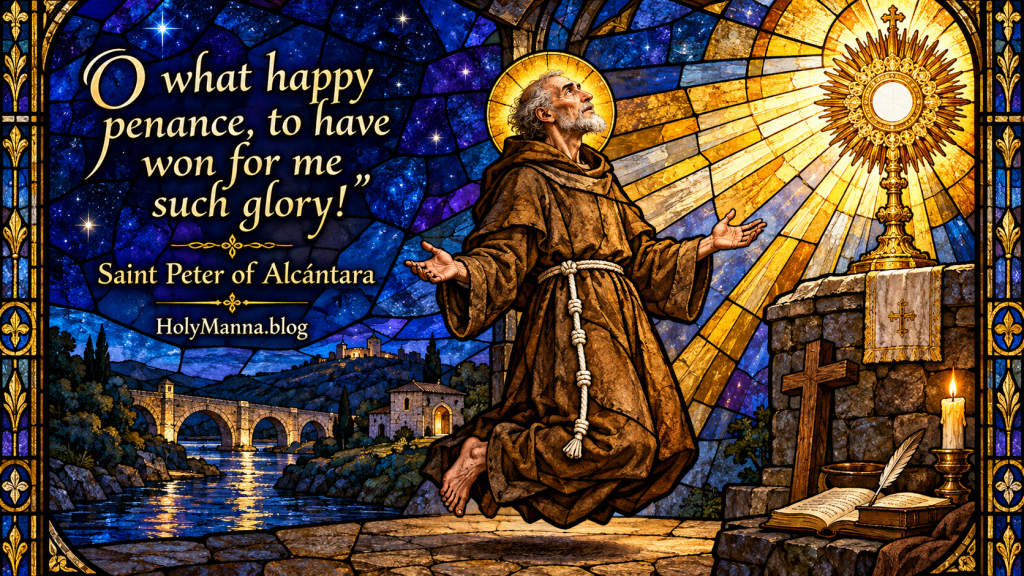
The Barefoot Mystic Who Taught Spain to Pray
Picture a man so consumed with love for God that sleep itself felt like time stolen from prayer. For roughly 40 years, Saint Peter of Alcántara slept about 90 minutes a night, sitting upright in a cell too small to lie down in, so that he could spend the dark hours keeping watch before the Lord. That single detail, recorded by no less a witness than Saint Teresa of Ávila, tells you almost everything about this remarkable Franciscan priest, mystic, reformer, and spiritual director who lived from 1499 to 1562, in the very century when the Catholic Church was fighting for her life and her renewal.
Peter of Alcántara belongs to that astonishing generation of Spanish saints that included Saint Ignatius of Loyola, Saint Teresa of Ávila, Saint John of the Cross, Saint Francis Borgia, and Saint John of Ávila. While the Protestant revolt tore at the Church from without, these men and women understood that true reform begins within, in the human heart surrendered completely to Jesus Christ. Peter became the living proof of that principle. He reformed the Franciscan Order by first reforming himself, he wrote a small book on prayer that shaped Catholic spirituality for centuries, and he gave Saint Teresa the encouragement she needed to launch the Carmelite reform when nearly everyone else called her deluded or worse.
The Church honors him as a canonized saint, and the Church teaches that “by canonizing some of the faithful, i.e., by solemnly proclaiming that they practiced heroic virtue and lived in fidelity to God’s grace, the Church recognizes the power of the Spirit of holiness within her and sustains the hope of believers by proposing the saints to them as models and intercessors” (CCC 828). Saint Peter of Alcántara holds several patronages. He is the patron of Brazil, declared so in the 19th century, and of his native Spanish region of Extremadura, declared in 1962 on the 400th anniversary of his death. Because he kept vigil through the night while his brothers slept, he is also the patron of nocturnal adoration of the Blessed Sacrament and of night watchmen. His commemoration falls on October 18th, the day of his death, in the Roman Martyrology, while the traditional calendar and Franciscan usage honor him on October 19th.
A Governor’s Son Chooses the Narrow Road
Peter Garavito was born in 1499 in Alcántara, a town in Extremadura in western Spain, close to the Portuguese border. The town takes its name from the Arabic word for “the bridge,” after the magnificent Roman bridge that still spans the Tagus River there. It is a fitting birthplace for a man whose whole life became a bridge between heaven and earth for countless souls. His father served as governor of Alcántara and worked as a lawyer, and his mother came from the noble family of Sanabria. Some older sources give the father’s name as Peter and others as Alphonso; the sources agree on his office, though not on his name. Peter’s father died while he was still young, and his mother later remarried.
A tradition handed down in Franciscan accounts says that even as a child, Peter would become so absorbed in prayer that the household servants could not rouse him or get any response from him. This charming story comes from devotional biographies and cannot be verified. What is documented is that after studying grammar and philosophy in his hometown, Peter was sent at about 14 years of age to the University of Salamanca, the most prestigious university in Spain, to study law. A brilliant career in administration or the courts lay open before him, the kind of comfortable, respectable path his family would have expected.
He walked away from all of it. At 16 years old, around the year 1515, Peter gave away his inheritance to the poor and entered the Franciscans of the stricter Observance at the remote friary of Los Majarretes. His decision echoes the words of the Lord in The Gospel of Matthew: “If you wish to be perfect, go, sell what you possess and give to the poor, and you will have treasure in heaven; and come, follow me” (Mt 19:21). The Catechism teaches that “Jesus enjoins his disciples to prefer him to everything and everyone, and bids them ‘renounce all that [they have]’ for his sake and that of the Gospel” and that “the precept of detachment from riches is obligatory for entrance into the Kingdom of heaven” (CCC 2544). Peter took that teaching with total seriousness, and he never looked back.
A story from his journey to the friary is told in Franciscan tradition. On the road to Los Majarretes, the young Peter came to a stream swollen far beyond its banks by heavy rains, with no way across. The tradition holds that he was miraculously transported to the other side. This story cannot be verified.
From the beginning, his religious life was marked by a discipline of the senses that stunned his brothers. Accounts preserved through Saint Teresa relate that he kept his eyes cast down so habitually that after years in a friary he did not know his fellow friars by sight, and knew his way around the house by following the other brothers. His gifts could not stay hidden. He was appointed superior of a new foundation even before his priestly ordination, which took place in 1524, and soon afterward he began preaching with extraordinary success. He preferred to preach to the poor, and his sermons drew heavily from the Prophets and the Wisdom books of the Old Testament.
A Friendship That Changed the Church
In 1538, at 39 years of age, Peter was elected minister provincial of the Franciscan Province of Saint Gabriel. At the chapter of Plasencia in 1540 he drew up constitutions calling the friars back to the strictest observance of the Rule of Saint Francis. The opposition was fierce. Rather than fight for power, Peter renounced his office and withdrew to the mountains of Arrábida in Portugal, where he joined a hermit priest, Father Martin of Saint Mary, in a life of solitude and prayer. Other friars soon gathered around him, small communities formed, and Peter served as guardian and master of novices at the friary of Palhais. He returned to Spain in 1553, spent 2 more years in solitude, and then journeyed barefoot to Rome to secure permission for his reform. The friary he founded at Pedroso, known as El Palancar, is so small that it is often called the smallest friary in the world, with cells more like graves than rooms, about 7 feet long. His movement, known as the Alcantarine reform or the Discalced Friars of the Strictest Observance, became a commissariat in 1556 and a full religious province under the title of Saint Joseph in 1561. The reform spread through Spain and Portugal, and in later generations Alcantarine friars carried the Gospel to the Philippines, Japan, and the Americas. In 1897 Pope Leo XIII united the reform branches into the one Order of Friars Minor.
What set Peter apart was never organizational skill. It was holiness, and holiness of a kind that reads today like something out of another world. Saint Teresa of Ávila, who knew him personally in his final years, left an eyewitness description in her autobiography, The Life of Teresa of Jesus, that remains the primary source for his life. She wrote of her first impression of him: “When I came to know him he was very old, and his body so shriveled and weak that it seemed to be composed, as it were, of the roots and dried bark of a tree rather than flesh” (The Life of Teresa of Jesus, chapter 27). She records that he commonly ate only once every 3 days, and sometimes went a week without food. His cell measured about 4.5 feet in length, so that he could never lie down; he slept sitting, his head resting against a piece of wood fixed to the wall. He went barefoot and bareheaded in sun, rain, and snow, wore only a habit of sackcloth and a cloak, and in chapter 30 of her Life Teresa adds this detail: “I have been assured that for twenty years he continuously wore a shirt made of iron” (The Life of Teresa of Jesus, chapter 30).
It would be easy to misread all this as a hatred of the body or a grim contempt for life. The witnesses say the opposite. The Catholic Encyclopedia notes that the poverty Peter practiced and enforced was as cheerful as it was real. His austerity flowed from love, from the desire to be conformed to the crucified Christ and to keep his heart utterly free for God. The Church teaches exactly this about the role of asceticism in the Christian life: “The way of perfection passes by way of the Cross. There is no holiness without renunciation and spiritual battle. Spiritual progress entails the ascesis and mortification that gradually lead to living in the peace and joy of the Beatitudes” (CCC 2015). Peter’s penances were extreme because his love was extreme, and God confirmed that love with extraordinary graces.
Witnesses reported that he was frequently rapt in ecstasy during prayer and at Mass, and testimonies gathered for his canonization process describe him raised bodily from the ground in prayer, among the levitations reported of several mystics of his era. Saint Teresa testifies that he possessed the gift of prophecy and the discernment of spirits, and she called him a saint while he was still alive. Emperor Charles V, the most powerful monarch in Europe, asked Peter to become his confessor; Peter begged the emperor not to press the request, preferring his poor friars to the imperial court. Franciscan tradition also credits him with beginning the custom of erecting a cross at the close of a parish mission, a practice that spread through the Catholic world; this origin story rests on tradition rather than documentation.
Around 1556 Peter wrote the Treatise on Prayer and Meditation, a short, practical guide to mental prayer composed in plain Spanish for ordinary people. Teresa herself gave the book and its author this endorsement: “He is the author of some little books on prayer, written in Spanish, which are being used a great deal nowadays; as he was a man with great experience of prayer, his writings are very profitable for those who practise it” (The Life of Teresa of Jesus, chapter 30). Tradition adds that Saint Francis de Sales and Venerable Louis of Granada held the little book in the highest esteem. It has been translated across the languages of Europe and is still in print today.
Then came the friendship that changed the history of the Church. Around 1560, Peter met Teresa of Ávila, a Carmelite nun in her mid 40s who was receiving visions and mystical favors that learned men around her insisted came from the devil. She was frightened, isolated, and close to despair. Peter listened to her, examined her soul, and declared plainly that her experiences came from God. He comforted her, defended her publicly before her critics, and became her spiritual director and advocate. When Teresa conceived the plan of founding a reformed Carmelite monastery of strict poverty, Peter encouraged her without hesitation; he knew from his own life exactly what such a reform would cost and exactly what it was worth. In a letter dated April 14th, 1562, just months before his death, he urged her forward, and on August 24th of that year Teresa founded the monastery of Saint Joseph in Ávila, the first house of the Discalced Carmelite reform that would eventually give the Church 2 Doctors, Teresa herself and Saint John of the Cross. Humanly speaking, the Carmelite reform owes its launch in great measure to the counsel and courage of Peter of Alcántara.
Death on His Knees
Peter of Alcántara was not a martyr, but his life was a long and costly battle. The sharpest opposition he faced came not from enemies of the Church but from within his own religious family. His constitutions of 1540 were resisted so strongly that he surrendered the office of provincial rather than divide his brothers. For years his reform existed in a precarious canonical position, caught between the jurisdiction of the Conventual and Observant branches of the Franciscans, and he had to walk barefoot across Spain and all the way to Rome to keep it alive. He bore accusations of excess and fanaticism with a patience that became proverbial in Spain; it was said that to bear a great insult, one needed the patience of Peter of Alcántara.
He also bore the daily martyrdom of his own penance. The Catechism explains the heart of what he was doing: “Jesus’ call to conversion and penance, like that of the prophets before him, does not aim first at outward works, ‘sackcloth and ashes,’ fasting and mortification, but at the conversion of the heart, interior conversion”, while adding that interior conversion “urges expression in visible signs, gestures and works of penance” (CCC 1430). Peter’s iron shirt and his sleepless nights were visible signs of an interior fire. Teresa, who feared her own weakness, marveled that he spoke of his austerities as if they were nothing, and witnesses record that God sustained his strength in ways that natural explanation struggles to cover; a man eating once every 3 days does not normally preach missions across a country for decades.
In October of 1562, worn out at 63 years of age, Peter fell gravely ill at the friary of Arenas, today called Arenas de San Pedro in his honor. Even dying, he refused every softness. The account handed down in the lives of the saint relates that when he was offered a glass of water in his final agony, he refused it with the words, “Even my Lord Jesus Christ thirsted on the Cross.” Then, gathering his last strength, he rose to his knees. He died kneeling in prayer on October 18th, 1562, repeating the words of the Psalmist: “I rejoiced when it was said unto me: let us go unto the house of the Lord” (Psalm 122:1). He did not merely accept death; he welcomed it as a homecoming. The Church teaches that “the Christian who unites his own death to that of Jesus views it as a step towards him and an entrance into everlasting life” (CCC 1020), and Peter lived that teaching down to his final breath.
O Happy Penance
What happened next comes to us on the testimony of a Doctor of the Church. Saint Teresa of Ávila, who was far away from Arenas at the moment of Peter’s death, declared that she saw his soul carried into heaven. Afterward he appeared to her, radiant, and spoke the words that have echoed through Catholic spirituality ever since. The old Roman Breviary lesson for his feast records the apparition this way: he appeared to her and said, “O what happy penance, to have won for me such glory!” All those sleepless nights, all those hungry days, all that iron against his skin, and from the other side of death Peter called it happy. Teresa continued to experience his presence and help, writing that the Lord allowed her to enjoy more of him after his death than she had during his life. The Roman Breviary adds an astonishing detail from her testimony: she “was taught of God that no one should ask anything in the name of Peter without being heard.” This is the communion of saints in action, exactly as the Church teaches it: “Being more closely united to Christ, those who dwell in heaven fix the whole Church more firmly in holiness. They do not cease to intercede with the Father for us. Their fraternal concern is the greatest help to our weakness” (CCC 956).
Devotion to Peter spread rapidly after his death, and miracles were reported at his intercession. Older compilations drawn from Butler’s Lives of the Saints record many healings and divine interventions attributed to him, including the raising of 6 dead persons to life through prayers addressed to him. These accounts come from devotional collections, and the details cannot be independently verified. What the Church did verify, through her own rigorous processes, was sufficient to raise him to the altars. Pope Gregory XV beatified him on April 18th, 1622, in the same era that saw the canonization of his friend Teresa, and Pope Clement IX canonized him on April 28th, 1669. Some online sources misprint the canonization year as 1699 or 1690; the documented date is 1669. In 1670 his feast was assigned to October 19th, since October 18th already belonged to the Feast of Saint Luke the Evangelist, and to this day the Roman Martyrology commemorates him on October 18th, his birthday into heaven.
His body rests at the Royal Sanctuary of Saint Peter of Alcántara in Arenas de San Pedro, Spain, which remains a pilgrimage site, and his statue stands among the founders of religious orders in Saint Peter’s Basilica in Rome. His name traveled far beyond Spain. The emperors of Brazil, Pedro I and Pedro II, each bore the baptismal name Pedro de Alcântara in his honor, and the cathedral of Petrópolis in Brazil is dedicated to him, a fitting monument in the nation that claims him as patron. The town of San Pedro Alcántara on the southern coast of Spain carries his name, as do parishes across the Philippines, including the historic church of Pakil in Laguna, and in the United States. For a man who wanted nothing but a cell too small to lie down in, his footprint on the Catholic world is enormous. And his patronage of nocturnal Eucharistic adoration keeps his deepest secret alive, for the Church teaches that “the Catholic Church has always offered and still offers to the sacrament of the Eucharist the cult of adoration, not only during Mass, but also outside of it, reserving the consecrated hosts with the utmost care, exposing them to the solemn veneration of the faithful, and carrying them in procession” (CCC 1378). The hours Peter stole from sleep, he gave to that adoration.
What a Sleepless Friar Teaches a Distracted Generation
It would be a mistake, and frankly a dangerous one, for anyone to imitate Peter of Alcántara’s penances literally. Teresa herself understood that his path was a unique grace, not a universal program. But the logic underneath his life applies to every single baptized person, and it may apply with special force to a generation drowning in comfort, screens, and noise.
Start with his custody of the eyes. Peter guarded his gaze so carefully that he did not know his own brothers by sight. Modern eyes are trained to do the opposite, to scroll, to consume, to look at everything and rest on nothing. What would change in your interior life if you treated your attention as something sacred, something to be guarded and given deliberately to God and to the people in front of you? The Catechism teaches that contemplative prayer is precisely a redirected gaze: “Contemplation is a gaze of faith, fixed on Jesus” (CCC 2715). Nobody needs an iron shirt to begin that. A phone left in another room during 15 minutes of silent prayer is a genuinely Alcantarine act in the 21st century.
Consider next his vigil. Peter kept watch at night because the Lord once asked a question in Gethsemane that still stings: “So, could you not watch with me one hour?” (The Gospel of Matthew 26:40). A young adult does not need to sleep 90 minutes a night to answer that question. A single holy hour each week before the Blessed Sacrament, perhaps at a late hour when the chapel is empty and the world is quiet, places a person directly in the spiritual lineage of this saint. The Church commends exactly these concrete practices of conversion, teaching that interior penance “can be expressed in many and various ways” and naming above all “fasting, prayer, and almsgiving” (CCC 1434). Skipping a meal and giving its cost to the poor, fasting from streaming for an evening, waking 20 minutes earlier to pray before the day begins; these are small things, but Peter’s whole spirituality insists that small renunciations, done for love, open enormous channels of grace.
Then there is his friendship with Teresa, which may be his most relatable lesson of all. Peter believed in a struggling soul when the credentialed experts dismissed her. He listened before he judged, he discerned instead of assuming, and he spent his dwindling strength defending someone else’s calling. Who in your life is carrying a God given dream that everyone else mocks, and what would it cost you to be their Peter of Alcántara? Encouragement is a form of almsgiving that costs no money and changes history. The entire Discalced Carmelite family, with its 2 Doctors of the Church, stands as evidence of what one well placed word of encouragement can do.
Finally, there is the saying handed down in Catholic collections of his words, given as his answer to a friar complaining about the wickedness of the world: “The remedy is simple. You and I must first be what we ought to be; then we shall have cured what concerns ourselves. Let each one do the same, and all will be well.” In an age addicted to commentary, outrage, and the reforming of everyone else, Peter’s program remains the only one that has ever worked. Reform begins at home, in one heart, on one’s knees. Where is the one place in your own life, honestly named, where reform needs to begin today?
Engage With Us!
The story of Saint Peter of Alcántara is almost too intense to be believable, and yet it is anchored in the sworn testimony of a Doctor of the Church who knew him face to face. Share your thoughts and reflections in the comments below; this community grows when readers bring their honest questions and experiences into the conversation. Here are some questions to pray with this week:
- Saint Peter gave away his inheritance at 16 years old to follow Christ. What is one comfort, habit, or possession you sense God inviting you to release, and what has held you back so far?
- Peter guarded his eyes so strictly that he knew his brothers by their voices rather than their faces. What would a realistic custody of the eyes look like in your relationship with your phone and your screens?
- He is the patron of nocturnal adoration because he traded sleep for time before the Lord. Could you commit to one holy hour of Eucharistic adoration this month, and what would you bring to Jesus in that silence?
- Peter defended Saint Teresa when the experts around her called her deceived. Who needs your encouragement and defense right now, and how will you give it this week?
- From heaven he called his penance happy. Looking at your own sacrifices, which ones do you believe you will call happy from the other side of eternity?
Saint Peter of Alcántara shows that no act of love for God is ever wasted, that the smallest cell can hold the largest heart, and that a soul who gives everything to Jesus receives back joy beyond all measure. Take one step this week, however small, toward prayer, toward penance, toward encouraging a struggling soul. Live your faith boldly, keep watch with the Lord even one hour, and do everything with the love and mercy that Jesus taught us.
Saint Peter of Alcántara, pray for us!
Follow us on YouTube, TikTok, Instagram and Facebook for more insights and reflections on living a faith-filled life.


Leave a Reply