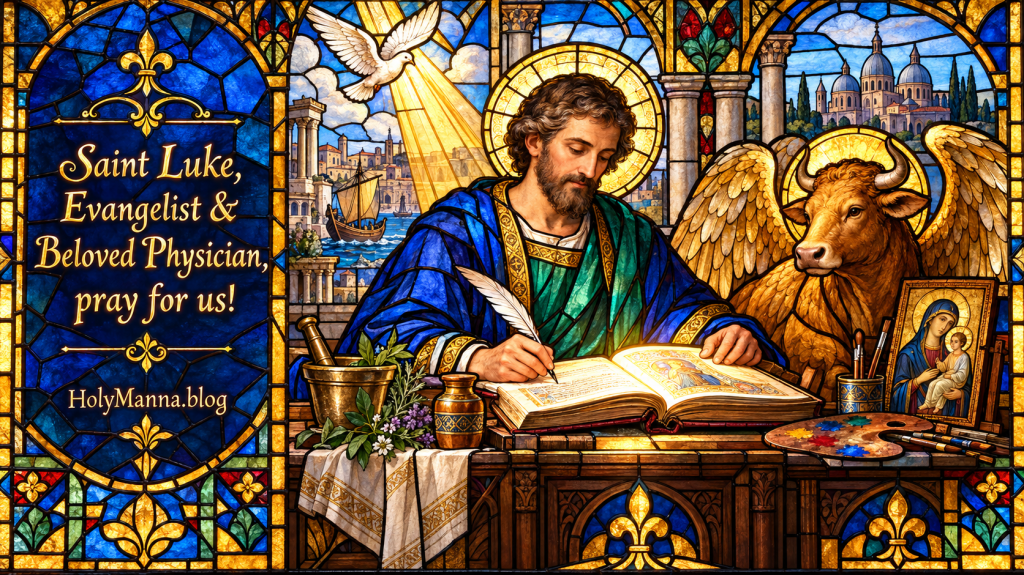
The Beloved Physician
Every October 18th, the Church celebrates the Feast of Saint Luke the Evangelist, and it is worth pausing on just how unlikely his story is. A Greek doctor from Syria, a man who by his own admission never walked the dusty roads of Galilee with Jesus, ended up writing more of the New Testament by volume than any other single human author. The Gospel of Luke and The Acts of the Apostles together make up over a quarter of the entire New Testament, and without them the Church would not have the Annunciation, the Magnificat, the Good Samaritan, the prodigal son, or the road to Emmaus. Saint Paul gave him the title that has followed him for 2,000 years when he wrote to the Colossians, “Luke the beloved physician and Demas greet you” (Col 4:14). The Church treasures his work because, as The Catechism teaches, “The Gospels are the heart of all the Scriptures because they are our principal source for the life and teaching of the Incarnate Word, our Savior” (CCC 125).
Saint Luke holds a remarkably wide set of patronages. He is the patron of physicians and surgeons because of his profession, and the patron of artists and painters because of the ancient tradition that he painted the first image of the Blessed Virgin Mary. He is also invoked as a patron of students, notaries, butchers, brewers, glassworkers, and unmarried men. His symbol in sacred art is the winged ox, one of the four living creatures of Ezekiel 1 and Revelation 4, assigned to him because his Gospel opens in the Temple with the priest Zechariah offering sacrifice, and the ox is the animal of sacrifice. For anyone who has ever felt like a latecomer to the faith, or wondered whether an ordinary career could serve God, Saint Luke is the saint to get to know.
The Making of an Evangelist
The oldest witnesses of the Church agree on where Saint Luke came from. Saint Jerome, writing in the fourth century in De Viris Illustribus, describes him plainly: “Luke, a physician of Antioch, as his writings indicate, was not unskilled in the Greek language. An adherent of the apostle Paul, and companion of all his journeying, he wrote a Gospel.” Antioch in Syria was one of the great cities of the Roman world, a crossroads of Greek learning and commerce, and according to the Church’s constant tradition Luke was born there to a pagan Greek family sometime in the early first century. His exact birth year is not recorded. Some scholars have wondered whether he was a Hellenized Jew rather than a Gentile, and others have even speculated that he may have been a slave educated in medicine, since wealthy Roman families sometimes trained household slaves as physicians. Neither of those theories can be confirmed, and the traditional view, reflected in the Fathers and in the way Saint Paul lists his companions, is that Luke was a Gentile. If so, he holds the astonishing distinction of being the only Gentile author of any book of Sacred Scripture.
His medicine is better attested than almost anything else about him. Saint Paul’s own words name his profession, and the vocabulary of his Gospel confirms it, because Luke repeatedly uses precise Greek medical terms when describing the illnesses Jesus healed. One scholarly conjecture, noted in the Catholic Encyclopedia, is that he may have studied at the famous medical school of Tarsus, the rival of Alexandria and Athens, and possibly first met Saul of Tarsus there. That is an educated guess, not a documented fact, but it is a charming one.
How did he come to Christ? Luke tells on himself in the very first sentences of his Gospel. He writes that he is handing on what was delivered “just as those who from the beginning were eyewitnesses and ministers of the word have delivered them to us” (Lk 1:2). In other words, by his own testimony he was not an eyewitness of the earthly life of Jesus. The Vatican’s account of his life says that he embraced the faith after hearing Saint Paul preach about Jesus, and that once he found the Apostle he never left him. Antioch itself was the city where, as Luke himself records, “in Antioch the disciples were for the first time called Christians” (Acts 11:26), so it is entirely fitting that one of its sons became an evangelist. It should be noted honestly that the Christian East tells the story differently. Eastern tradition counts Luke among the 70 disciples whom Jesus sent out two by two (Lk 10:1), and even identifies him as the unnamed companion of Cleopas on the road to Emmaus. That tradition is ancient and beloved, but it sits in tension with Luke’s own prologue, and it cannot be verified.
What can be verified, from Scripture itself, is the moment Luke steps into the story. Partway through The Acts of the Apostles, the narration quietly shifts from “they” to “we” at the city of Troas, around the year 51: “And when he had seen the vision, immediately we sought to go on into Macedonia, concluding that God had called us to preach the gospel to them” (Acts 16:10). From that sentence onward, Luke is no longer only the historian of the early Church; he is a participant in it. He crossed into Europe with Paul on the second missionary journey, remained behind at Philippi for several years to strengthen the young church there, rejoined Paul on the third journey, went up with him to Jerusalem, stayed near him through 2 years of imprisonment at Caesarea, survived shipwreck with him on the voyage to Rome, and remained with him in the capital of the empire to the end.
The Careful Historian of the Mercy of Christ
Here is where honesty about the sources matters. Scripture and the earliest records attribute no personal miracles to Saint Luke during his lifetime. There are no accounts of him raising the dead or multiplying bread. His miracle, if it can be called that, was of another kind entirely. God chose this careful, educated, compassionate doctor to preserve the miracles of Jesus Christ for every generation that would come after, and Luke took that commission with a physician’s seriousness. He opens his Gospel like a man signing his name to a clinical report: “it seemed good to me also, having followed all things closely for some time past, to write an orderly account for you, most excellent Theophilus, that you may know the truth concerning the things of which you have been informed” (Lk 1:3 to 4). He investigated. He interviewed eyewitnesses. He organized. The Catholic Encyclopedia speaks of his extreme accuracy as a historian, and modern study of Acts has repeatedly confirmed his precision with titles, offices, and geography across the Roman world. The Church teaches that this human diligence was taken up by God Himself, for “the Church holds firmly that the four Gospels, whose historicity she unhesitatingly affirms, faithfully hand on what Jesus, the Son of God, while he lived among men, really did and taught for their eternal salvation” (CCC 126).
Think about what the Church would be missing without him. Only Luke records the Annunciation of the angel Gabriel to Mary, the Visitation to Elizabeth, the Nativity with the shepherds and the manger, the Presentation in the Temple, and the finding of the boy Jesus among the teachers. Only Luke preserves the 3 great canticles that the Church has prayed every single day for centuries in the Liturgy of the Hours: the Benedictus of Zechariah, the Nunc Dimittis of Simeon, and above all the Magnificat of Our Lady, “My soul magnifies the Lord, and my spirit rejoices in God my Savior” (Lk 1:46 to 47). The Catechism teaches that “The Canticle of Mary, the Magnificat (Latin) or Megalynei (Byzantine) is the song both of the Mother of God and of the Church” (CCC 2619). Every evening prayer of the Church, in every monastery and rectory and living room on earth, passes through the pen of Saint Luke.
Only Luke gives the world the parable of the Good Samaritan. Only Luke gives the prodigal son and the father who runs to meet him. Only Luke tells of Zacchaeus in the sycamore tree, of the sinful woman washing the feet of Jesus with her tears, of the Lord praying for His own executioners, and of the thief on the cross who heard, “Truly, I say to you, today you will be with me in Paradise” (Lk 23:43). This is why Dante famously called Luke the scribe of the gentleness of Christ, and why his Gospel has been called the Gospel of mercy. The Church’s own definition of the Gospel reads like a summary of Luke’s 15th chapter: “The Gospel is the revelation in Jesus Christ of God’s mercy to sinners” (CCC 1846). Luke is also, in a special way, the evangelist of prayer and of the Holy Spirit. He alone shows Jesus praying at His baptism, before choosing the Twelve, and at the Transfiguration, and The Catechism notes that it is Saint Luke who hands on to the Church the 3 principal parables on prayer, the importunate friend, the persistent widow, and the Pharisee and the tax collector (CCC 2613).
His second volume, The Acts of the Apostles, is the only inspired history of the Church’s first 30 years. Pentecost, the preaching of Peter, the martyrdom of Stephen, the conversion of Paul, the Council of Jerusalem, the Gospel’s march from Jerusalem to Rome; the Church knows all of it because Luke wrote it down. And his medical heart never stopped showing. Luke describes diseases with a doctor’s eye, and he lingers over every healing, because he had discovered the Physician greater than himself. “Those who are well have no need of a physician, but those who are sick; I have not come to call the righteous, but sinners to repentance” (Lk 5:31 to 32). The Church sees in that line the whole logic of Christ’s ministry, teaching that “Christ’s compassion toward the sick and his many healings of every kind of infirmity are a resplendent sign that ‘God has visited his people’” (CCC 1503). There is even a detail suggesting Luke kept practicing medicine on mission. After Paul healed the father of Publius on Malta, Luke records that the rest of the sick on the island came and were cured (Acts 28:9), and ancient and modern readers alike have reasonably concluded that the beloved physician was treating bodies while the Apostle preached to souls.
One more treasure deserves its own word. Luke’s infancy chapters contain things only one person on earth could have known, and Luke seems to admit his source twice, writing that “Mary kept all these things, pondering them in her heart” (Lk 2:19). The ancient and cherished belief of the Church is that Luke received these memories from the Blessed Virgin herself, which would make his Gospel, in part, the testimony of Our Lady. That personal interview cannot be proven from the documents, but the internal evidence of the Gospel makes it a tradition the Church has never been embarrassed to repeat.
Shipwrecks, Prisons, and the Friend Who Stayed
Saint Luke was not martyred for the faith according to the oldest account of his death, but no one should imagine his life was comfortable. He voluntarily tied his life to Saint Paul, which meant tying his life to riots, beatings, arrests, and the open sea. He was there for the imprisonment at Philippi’s aftermath, there through the 2 years of Paul’s confinement at Caesarea, and there for the voyage to Rome that he narrates in Acts 27 with such vivid seamanship that it remains one of antiquity’s most detailed accounts of a storm and shipwreck. Fourteen days of hurricane winds, cargo thrown overboard, soldiers plotting to kill the prisoners, and finally 276 souls dragging themselves ashore on Malta; Luke lived every hour of it.
The deepest hardship, though, was fidelity itself. When Paul sat in his final Roman imprisonment, awaiting the executioner under Nero, his companions fell away one by one. Paul’s last letter records the loneliness without self-pity: “Demas, in love with this present world, has deserted me” (2 Tim 4:10). And then comes the sentence that is Saint Luke’s truest biography, 5 words that the Church has never forgotten: “Luke alone is with me” (2 Tim 4:11). When it was dangerous to be associated with Paul, when there was nothing left to gain and everything to lose, the doctor stayed. He stayed through Paul’s martyrdom around the year 67, and then, an old man with no earthly family, he kept preaching.
Here the sources must be handled honestly. The oldest surviving account of Luke’s death, an ancient prologue to his Gospel dating from the early centuries, says that he served the Lord without distraction, having neither wife nor children, and that he died at the age of 84 in Boeotia, in central Greece, full of the Holy Spirit. That peaceful death, after a long life poured out in preaching, is the earliest tradition, and the Church’s Roman Martyrology honors him without asserting martyrdom. Yet other ancient voices, including witnesses in the Christian East, count Luke among the martyrs and hold that he was put to death at Thebes, and a later story adds the detail that he was hanged from an olive tree. Those accounts of martyrdom, including the olive tree, cannot be verified. What is certain is that whether his blood was shed or not, Luke’s whole life was a martyrdom in the original sense of the word, a witness, spent to the last breath on the Gospel.
A Body in Padua, a Skull in Prague, and a Tomb in Thebes
The story of Saint Luke’s relics is one of the most remarkable in the entire history of the Church, because in modern times science was invited to examine it. Luke was buried at Thebes in Greece, and in the year 357 the Emperor Constantius II had his relics solemnly translated to Constantinople, to the Church of the Holy Apostles, alongside the relics of Saint Andrew and Saint Timothy. Tradition holds that centuries later, in the era of the iconoclast persecutions, the body was carried west to Padua in Italy to keep it safe; that journey itself cannot be documented, and it is told as tradition. What is documented is that in 1177 the bishop of Padua announced the rediscovery of Saint Luke’s tomb at the Basilica of Santa Giustina, where the body has rested in a lead coffin within a marble sarcophagus ever since. In 1354 the Emperor Charles IV, a great collector of relics, removed the skull from the body in Padua and enshrined it in Saint Vitus Cathedral in Prague, where it remains today.
Then came one of the most fascinating episodes of modern devotion. In 1992 the Orthodox Metropolitan Hieronymos of Thebes wrote to Bishop Antonio Mattiazzo of Padua, asking that a portion of the relics be returned to the saint’s original, empty tomb in Greece. Rather than simply refuse or comply, the bishop did something very Lucan; he investigated. In 1998 the centuries-old seals on the lead coffin were broken and a scientific commission led by Professor Vito Terribile Wiel Marin of the University of Padua examined the remains, with the Prague skull loaned back for the study. The findings were quietly stunning. The coffin held the skeleton of a man about 5 feet 4 inches tall who died between roughly 70 and 84 years of age. The skeleton had no skull, and the skull from Prague fit its uppermost neck vertebra precisely, while a loose tooth found in the coffin fit the skull’s jaw. Radiocarbon analysis placed the man’s death between the 1st and early 5th centuries, consistent with the traditional date of around 84 AD. The coffin’s dimensions exactly matched the ancient tomb still venerated at Thebes. And mitochondrial DNA drawn from the tooth showed ancestry closer to Syrian populations than to Greek ones, exactly what one would expect of a man born at Antioch in Syria. None of this constitutes mathematical proof of identity, and the Church does not claim it does, but it is a rare and beautiful case where every scientific result lined up with 19 centuries of tradition instead of against it. In the Jubilee year 2000, Bishop Mattiazzo sent the rib closest to the saint’s heart back to Thebes, where it now rests in Luke’s original tomb, a quiet act of healing between East and West worthy of the physician himself.
Alongside the relics stands the famous tradition of Luke the painter. From at least the 8th century, the Church has told the story that Saint Luke, who painted the Mother of God so vividly in words, also painted her image on wood, making him the first iconographer. Several of the most beloved Marian images on earth are attributed to him by tradition: the Hodegetria of Constantinople, Our Lady of Vladimir in Russia, Our Lady of Częstochowa in Poland, which tradition says was painted on a tabletop built by Jesus in the workshop of Saint Joseph, and the Salus Populi Romani enshrined at the Basilica of Saint Mary Major in Rome, which tradition says Pope Saint Gregory the Great carried in procession in 590 as he begged God to end a plague. Art historians date the surviving images to later centuries, and the story that Luke painted any physical icon cannot be verified. Yet the tradition carries a truth deeper than pigment; the Church has always sensed that no one gave humanity a truer portrait of Mary than Luke did, and painters embraced him as their own. The great artists’ confraternities of Europe, the Guilds of Saint Luke, took his name from Florence to Antwerp, and to this day medical schools, hospitals, and Catholic physicians’ societies across the world bear the name of the beloved physician. Pilgrims still venerate him at Santa Giustina in Padua, at Saint Vitus in Prague, and at his tomb in Thebes, and in England the stretch of warm, golden days that often arrives in mid-October is still called Saint Luke’s Little Summer.
Writing Your Own Chapter of the Acts of the Apostles
Saint Luke never saw the face of Jesus during His earthly ministry. He arrived, humanly speaking, too late. And yet the Church that Christ founded holds his words in her hands every single day, at every Mass where his Gospel is proclaimed and every evening when the Magnificat rises from the Liturgy of the Hours. That should land on every believer who has ever felt born 20 centuries too late to really know Jesus. Luke proves that closeness to Christ is not a matter of chronology; it is a matter of seeking Him through the witnesses He left, which is exactly what the Church still offers in Scripture and Tradition, for “the Church, in her doctrine, life and worship, perpetuates and transmits to every generation all that she herself is, all that she believes” (CCC 78). Do you ever tell yourself that you would believe more easily if you had lived in biblical times, and could it be that, like Luke, you have been given everything you need to know Christ right now?
Luke also sanctified his profession instead of abandoning it. He did not stop being a physician when he became a Christian; his training became his offering, shaping the most compassionate and carefully researched Gospel of the four. The same invitation stands for an accountant, a nurse, an engineer, a teacher, or a salesperson today. What would it look like to place your professional skills, your training, and your working hours deliberately at the service of the Kingdom of God this week? And Luke teaches the quiet heroism of staying. “Luke alone is with me” is a sentence every friendship and every marriage should aspire to deserve. Fidelity when others walk away, presence at hospital bedsides and in seasons of failure, loyalty that costs something; this is Lucan holiness, and it is available to everyone. Who in your life is in a season of suffering or abandonment right now, and what would it cost you to be the one who stays?
Practically, there is no better way to honor Saint Luke than to read him. His Gospel has 24 chapters; one chapter a day finishes it before the month ends. Praying the Magnificat each evening joins a person to the Church’s oldest daily habit. Imitating his devotion to Our Lady, pondering the events of Christ’s life in the heart as she did, is the whole genius of the Rosary. And visiting or calling someone who is sick continues his double vocation of healing. Through it all, the beloved physician is not a figure locked in the past, for the Church teaches that “being more closely united to Christ, those who dwell in heaven fix the whole Church more firmly in holiness. They do not cease to intercede with the Father for us” (CCC 956). Saint Luke is praying, right now, for everyone who picks up his book.
Engage With Us!
HolyManna invites you to share your thoughts and reflections on Saint Luke in the comments below. His story belongs to doctors and artists, to converts and lifelong Catholics, to anyone who has ever stayed faithful when it was hard, and your perspective will encourage other readers walking the same road. Consider these questions as you reflect:
- Saint Luke never met Jesus in the flesh, yet became one of His greatest witnesses. What helps you encounter Christ personally through Scripture and the sacraments today?
- Luke placed his medical training entirely at the service of the Gospel. What talent or professional skill could you consecrate to God in a concrete way this month?
- “Luke alone is with me.” When have you experienced someone staying by your side in a dark season, and to whom could you offer that same faithful presence now?
- Luke’s Gospel overflows with mercy toward sinners, the poor, and the forgotten. Which person in your daily life most needs you to see them the way Christ saw Zacchaeus?
- Tradition honors Luke for giving the world a portrait of Mary in both words and images. How could pondering the mysteries of Christ’s life in your heart, as Our Lady did, change the way you pray this week?
Saint Luke spent his whole life telling the story of the mercy of God, and then he became part of it. The same pen that recorded the prodigal son and the good thief now rests, but the story is not finished, because every baptized Christian is living in the next chapter of The Acts of the Apostles. So read his Gospel, stay faithful to the people God has given you, and let your work, whatever it is, become an instrument of healing. Go out this week and do everything with the love and mercy that Jesus taught us.
Saint Luke, the beloved physician, pray for us!
Follow us on YouTube, TikTok, Instagram and Facebook for more insights and reflections on living a faith-filled life.


Leave a Reply