Twenty-ninth Sunday in Ordinary Time – Lectionary: 145
The God Who Holds Every King’s Hand
There is a coin so ordinary that nobody in first-century Jerusalem thought twice about it, and yet it carried the deepest question a human being can ever ask: Whose image do you bear, and to whom must it be returned?
On this Twenty-ninth Sunday in Ordinary Time, October 18th, the Church places that question at the very center of the liturgy. The readings stretch across nearly six centuries, from a Persian battlefield to a Greek port city to the Temple courts of Jerusalem, and together they proclaim one staggering truth: God is the Lord of all nations, all rulers, and all of history, and everything must be rendered according to the image it bears.
In the First Reading, the prophet Isaiah announces that God has taken the pagan emperor Cyrus by the hand, calling him “his anointed” even though Cyrus does not know Him. In Psalm 96, every family of nations is summoned to give the Lord the glory due His name, because the gods of the nations are nothing at all. In the Second Reading, Saint Paul opens the earliest written document of the New Testament by reminding a small church in a bustling Roman port that God Himself chose them. And in the Gospel, Jesus takes a Roman coin stamped with Caesar’s face and turns a political trap into a revelation: the coin bears Caesar’s image, so it goes back to Caesar, but the human person bears God’s image, and that person belongs entirely to God.
Empires rise and fall, elections come and go, markets surge and crash, yet the Lord remains king. These readings invite every believer to stop asking who holds power this week and to start asking the older, deeper question: has the image of God within been rendered to its rightful owner?
First Reading — Isaiah 45:1, 4-6
When God Took a Pagan Emperor by the Hand
To feel the shock of this reading, picture the lowest moment in Israel’s story. In 587 BC the Babylonians burned Jerusalem, demolished the Temple, and marched the survivors into exile. For decades the people of God sat by the rivers of Babylon wondering if the covenant had died with the city. Into that darkness speaks the section of The Book of Isaiah that scholars call the Book of Consolation, chapters 40 through 55, addressed to the exiles with a promise of homecoming. The instrument of that homecoming is the last person anyone expected: Cyrus the Great, the pagan king of Persia. History confirms what the prophet announced. Cyrus entered Babylon in 539 BC almost without a fight, and in 538 BC he issued the decree allowing the exiles of Judah to return and rebuild the Temple, a decree recorded in Ezra 1:1-4. The famous Cyrus Cylinder, a clay document now kept in the British Museum, independently attests his policy of sending displaced peoples home and restoring their sanctuaries. The reading fits the day’s central theme perfectly: the Lord of all history can steer even a ruler who has never spoken His name.
Isaiah 45:1, 4-6
Thus says the LORD to his anointed, Cyrus,
whose right hand I grasp,
subduing nations before him,
and making kings run in his service,
opening doors before him
and leaving the gates unbarred:
For the sake of Jacob, my servant,
of Israel, my chosen one,
I have called you by your name,
giving you a title, though you knew me not.
I am the LORD and there is no other,
there is no God besides me.
It is I who arm you, though you know me not,
so that toward the rising and the setting of the sun
people may know that there is none besides me.
I am the LORD, there is no other.
Detailed Exegesis
Verse 1: “Thus says the LORD to his anointed, Cyrus, whose right hand I grasp, subduing nations before him, and making kings run in his service, opening doors before him and leaving the gates unbarred:”
The word translated “anointed” is the Hebrew mashiach, the very root of the word Messiah, a title reserved for Israel’s consecrated kings and priests. Cyrus is the only Gentile in the entire Old Testament to receive it, and the original hearers would have gasped. Grasping the king’s right hand was the language Babylon used for its god Marduk installing a monarch, so Isaiah is making a bold counterclaim: it is the LORD, not any idol, who raises up emperors. The opened doors and unbarred gates describe the historical fall of Babylon, which surrendered with astonishing ease.
Verse 4: “For the sake of Jacob, my servant, of Israel, my chosen one, I have called you by your name, giving you a title, though you knew me not.”
Here is the why behind world events. Cyrus conquers not for Persia’s glory but for the sake of a small, defeated, exiled people whom God refuses to abandon. The phrase “called you by your name” is tender election language, and the refrain “though you knew me not” reveals something beautiful about grace: God was working through Cyrus long before Cyrus had any idea who was working through him.
Verse 5: “I am the LORD and there is no other, there is no God besides me. It is I who arm you, though you know me not,”
This is among the most absolute declarations of monotheism in all of Scripture, spoken in the shadow of Babylon’s crowded pantheon. Even the weapons in the conqueror’s hands are a gift from the God he does not recognize. Nothing in history, not even military power, stands outside the Lord’s sovereignty.
Verse 6: “so that toward the rising and the setting of the sun people may know that there is none besides me. I am the LORD, there is no other.”
From east to west, the whole earth is meant to learn who God is. The purpose of history itself is the universal knowledge of the one Lord. Catholics hear an echo of this horizon at every Mass that uses Eucharistic Prayer III, which prays that a perfect offering may be made to God’s name from the rising of the sun to its setting. What Isaiah glimpsed, the Church now lives.
Teachings
The Catechism teaches that God’s governance of history is not a vague idea but a concrete reality. CCC 303 declares, “The witness of Scripture is unanimous that the solicitude of divine providence is concrete and immediate; God cares for all, from the least things to the great events of the world and its history.” The Cyrus oracle is the Old Testament’s most dramatic proof of that teaching, and the wisdom tradition says the same thing in a single image: “The king’s heart is a stream of water in the hand of the LORD; he turns it wherever he will” (Proverbs 21:1). Church history keeps repeating the pattern. In AD 313 the emperor Constantine, still an unbaptized Roman ruler, issued the Edict of Milan that ended the persecution of Christians, and the Church has long seen in such moments the same providential hand that once grasped Cyrus. God does not need perfect instruments; He needs only His own unbreakable purpose.
Reflection
This reading is an invitation to read your own headlines differently. The news cycle wants you anxious, convinced that everything depends on the next election, the next market swing, the next decision made by powerful people. Isaiah calmly disagrees. If God could grasp the hand of a Persian emperor to bring His children home, He can work through your difficult boss, your indifferent coworkers, and leaders you did not vote for. Try three concrete practices this week. First, pray by name for the civil leaders you find hardest to respect, as Saint Paul urged in 1 Timothy 2:1-2, where he asks that prayers be offered for kings and all in authority. Second, when a frustrating event dominates your week, ask God in prayer what He might be accomplishing through it rather than demanding to know why He allowed it. Third, remember a season of your own life when God was clearly working before you knew Him, because every believer has a little Cyrus inside, someone God called by name before they ever knew His. Where in your life right now might God be opening doors through people who do not know Him? Can you trust that the Lord of history is also the Lord of your unfinished story?
Responsorial Psalm — Psalm 96:1, 3-5, 7-10
A New Song for Every Nation
If the First Reading announces that God rules the nations, the psalm hands the nations their sheet music. Psalm 96 belongs to a family of songs scholars call enthronement psalms, hymns that celebrate the LORD as reigning king over all the earth. Ancient Israel sang it in the Temple, and 1 Chronicles 16 places its words on the lips of the people on the day King David brought the Ark of the Covenant into Jerusalem amid shouts, trumpets, and dancing. What makes this psalm remarkable is its reach. It is not content with Israel’s praise; it summons every land, every people, and every family of nations into the courts of the one true God, and it dares to say out loud that the gods of the nations are nothing at all. The Church loves this psalm so much that she sings it at the Mass during the Night on Christmas, when the King it announces finally arrives in Bethlehem. The refrain chosen for this Sunday, “Give the Lord glory and honor,” is the whole liturgy in six words, and it answers Isaiah’s vision directly: if there is no God besides the LORD, then worship is not one option among many, it is the truth sung aloud.
Psalm 96:1, 3-5, 7-10
R. (7b) Give the Lord glory and honor.
Sing to the LORD a new song;
sing to the LORD, all you lands.
Tell his glory among the nations;
among all peoples, his wondrous deeds.
R. Give the Lord glory and honor.
For great is the LORD and highly to be praised;
awesome is he, beyond all gods.
For all the gods of the nations are things of nought,
but the LORD made the heavens.
R. Give the Lord glory and honor.
Give to the LORD, you families of nations,
give to the LORD glory and praise;
give to the LORD the glory due his name!
Bring gifts, and enter his courts.
R. Give the Lord glory and honor.
Worship the LORD, in holy attire;
tremble before him, all the earth;
say among the nations: The LORD is king,
he governs the peoples with equity.
R. Give the Lord glory and honor.
Detailed Exegesis
Verse 1: “Sing to the LORD a new song; sing to the LORD, all you lands.”
A new song in Scripture marks a new saving act of God. Fresh mercy demands fresh music, and the invitation goes immediately beyond Israel’s borders to all the lands of the earth. Worship, from its very first note, is missionary.
Verse 3: “Tell his glory among the nations; among all peoples, his wondrous deeds.”
Praise naturally overflows into proclamation. The psalmist commands the worshiper to become a storyteller, carrying the account of God’s wondrous deeds to people who have never heard it. Evangelization is not a modern Church program; it is baked into Israel’s oldest hymnal.
Verse 4: “For great is the LORD and highly to be praised; awesome is he, beyond all gods.”
The psalm gives the reason for the song. God’s greatness is not a private opinion but a cosmic fact, and the proper human response to a fact that large is awe.
Verse 5: “For all the gods of the nations are things of nought, but the LORD made the heavens.”
The Hebrew here contains a sharp play on words: the gods, the elohim, are really elilim, worthless nothings. The argument is creation itself. Idols are manufactured by human hands, but the LORD manufactured the heavens, so the two cannot even be compared.
Verse 7: “Give to the LORD, you families of nations, give to the LORD glory and praise;”
The summons grows personal and universal at once. Not empires or armies but families of nations are invited, as if the whole human race were a household gathering for prayer.
Verse 8: “give to the LORD the glory due his name! Bring gifts, and enter his courts.”
Glory is described as something due, a debt of justice rather than a favor. The language of gifts and courts is Temple language, and it foreshadows the day when all peoples would stream into God’s house.
Verse 9: “Worship the LORD, in holy attire; tremble before him, all the earth;”
Worship engages the whole person, even the body and its vesture, and trembling is not terror but the reverent awe of a creature standing before the Creator.
Verse 10: “say among the nations: The LORD is king, he governs the peoples with equity.”
Here is the headline the nations most need to hear. The LORD reigns, and unlike Caesar or Cyrus, He governs with perfect equity. Announcing God’s kingship among the nations is the psalm’s final command and the Church’s standing mission.
Teachings
The Catechism places adoration at the very foundation of the spiritual life. CCC 2628 teaches, “Adoration is the first attitude of man acknowledging that he is a creature before his Creator. It exalts the greatness of the Lord who made us and the almighty power of the Savior who sets us free from evil.” In the same spirit, CCC 2097 explains, “To adore God is to acknowledge, in respect and absolute submission, the ‘nothingness of the creature’ who would not exist but for God.” The psalm’s insistence on singing finds a champion in Saint Augustine, who preached in Sermon 336, “Cantare amantis est,” that is, singing belongs to the one who loves. For the great Doctor of the Church, the new song is not merely new music but a new life, because only a heart transformed by love can sing it honestly. The psalm’s missionary thrust also became flesh in the Church’s story, from the apostles scattering across the Roman world to the missionaries who carried the Gospel toward the rising and the setting of the sun.
Reflection
This psalm asks an uncomfortable question of every modern believer: what do you actually sing about? The playlists, the fan chants, the brand loyalties, and the political slogans of this age reveal where hearts place their glory. The psalmist invites you to redirect that energy toward the only One who deserves it. This week, try singing at Mass like you mean it, even if your voice is terrible, because worship is a debt of love and not a performance. Tell one person outside church walls about a wondrous deed God has done in your life, since verse 3 commands exactly that. Finally, take an honest inventory of the little gods competing for your trust, the ones promising security or status, and name them for what the psalm says they are. Which “things of nought” have been receiving the glory and honor that belong to the Lord alone? What new song is God’s recent mercy asking you to sing?
Second Reading — 1 Thessalonians 1:1-5b
The Oldest Words in the New Testament
Hold this reading with a little reverence, because according to the broad and long-standing consensus of scholars, these are among the very first words of the New Testament ever written. Saint Paul composed The First Letter to the Thessalonians around the year AD 50 or 51, likely from Corinth, which places it before any of the four Gospels were set down in writing. Thessalonica was no sleepy village. It was the capital of the Roman province of Macedonia, a wealthy port city on the Via Egnatia, the great highway linking Rome to the East, and a place thoroughly devoted to the imperial cult. Paul had preached there during his second missionary journey, as Acts 17 recounts, and opposition forced him out after only a short time. He left behind a brand new community of converts surrounded by paganism and pressure, and he worried about them the way a father worries about children he cannot reach. This opening greeting is his relief and gratitude poured onto the page. It belongs to this Sunday’s theme because it shows God’s sovereignty working at the most intimate scale: the same Lord who moves emperors like Cyrus also quietly chooses ordinary people in a port city and makes them His own.
1 Thessalonians 1:1-5b
Paul, Silvanus, and Timothy to the church of the Thessalonians
in God the Father and the Lord Jesus Christ:
grace to you and peace.
We give thanks to God always for all of you,
remembering you in our prayers,
unceasingly calling to mind your work of faith and labor of love
and endurance in hope of our Lord Jesus Christ,
before our God and Father,
knowing, brothers and sisters loved by God,
how you were chosen.
For our gospel did not come to you in word alone,
but also in power and in the Holy Spirit and with much conviction.
Detailed Exegesis
Verse 1: “Paul, Silvanus, and Timothy to the church of the Thessalonians in God the Father and the Lord Jesus Christ: grace to you and peace.”
Paul names his missionary companions, the Silas of Acts and young Timothy, because the Gospel is never a solo project. Calling Jesus “Lord” in a city saturated with the imperial cult was quietly revolutionary, since that title was increasingly claimed by Caesar. The greeting “grace to you and peace” fuses the Greek and Hebrew worlds into one blessing, hinting that the Church is for every nation.
Verse 2: “We give thanks to God always for all of you, remembering you in our prayers,”
Paul’s first instinct toward this struggling community is not correction but thanksgiving. He prays for them always and for all of them, excluding nobody. Gratitude, for the Apostle, is the native language of Christian memory.
Verse 3: “unceasingly calling to mind your work of faith and labor of love and endurance in hope of our Lord Jesus Christ, before our God and Father,”
Here, in the earliest Christian document, the famous triad of faith, hope, and love already stands complete, years before Paul would sing of it in 1 Corinthians 13. Notice that each virtue is active. Faith works, love labors, and hope endures. These are not warm feelings but muscles in motion.
Verse 4: “knowing, brothers and sisters loved by God, how you were chosen.”
The Thessalonians did not find God; God chose them. Election, the same mystery that touched Israel and even reached out to Cyrus, now embraces Gentile dockworkers and shopkeepers in Macedonia. Their identity rests not on their performance but on being loved first.
Verse 5: “For our gospel did not come to you in word alone, but also in power and in the Holy Spirit and with much conviction.”
Paul remembers that his preaching carried something no rhetoric could manufacture. The Holy Spirit confirmed the message with power and filled both preacher and hearers with conviction. Words alone inform; the Spirit transforms.
Teachings
The Church treasures the triad of verse 3 as the three theological virtues. CCC 1813 teaches, “The theological virtues are the foundation of Christian moral activity; they animate it and give it its special character. They inform and give life to all the moral virtues. They are infused by God into the souls of the faithful to make them capable of acting as his children and of meriting eternal life.” In other words, faith, hope, and love are not achievements to be manufactured but gifts to be received and exercised, exactly as the Thessalonians received them. Verse 5 also anticipates one of the most quoted lines of the modern magisterium. Saint Paul VI wrote in Evangelii Nuntiandi 41, “Modern man listens more willingly to witnesses than to teachers, and if he does listen to teachers, it is because they are witnesses.” That is simply Paul’s experience in Thessalonica restated for a new century. The Gospel conquered a Roman port not through clever words alone but through lives visibly charged with the Holy Spirit, and the pattern has never changed, from the martyrs of the early Church to the missionaries and saints of every age since.
Reflection
There is something deeply encouraging about watching Paul thank God for a tiny, imperfect, brand new church. If he could see grace at work in them, he could see it in your parish, your small group, and your own stumbling spiritual life. Try praying verse 3 over the people you love this week, asking God to show you their work of faith, their labor of love, and their endurance in hope, then tell one of them specifically what you see, because believers rarely hear that kind of encouragement. Examine the three virtues in your own life with honesty. Faith that never works, love that never labors, and hope that never has to endure anything have not yet grown up. Finally, consider how the Gospel reaches the people around you. Your coworkers and friends will likely never read a theology book, but they read your life every single day. Which of the three virtues, faith, hope, or love, most needs exercise in your life right now? If the Gospel came to others through your witness and not your words alone, what would they conclude about Jesus?
Holy Gospel — Matthew 22:15-21
The Trap That Became a Revelation
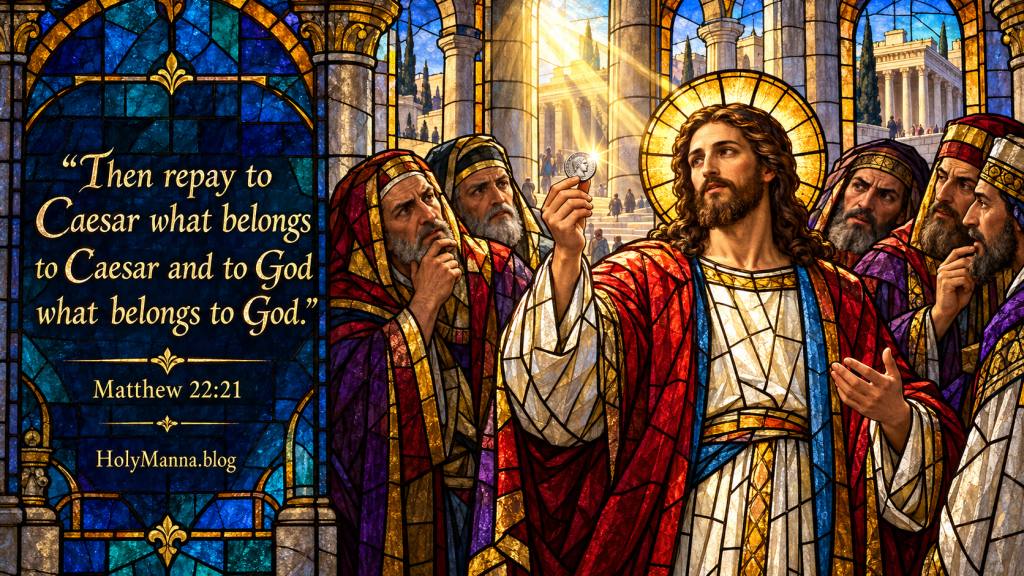
The scene unfolds in the Temple courts during the final week of Jesus’s earthly life, just days before the crucifixion. His enemies have stopped debating and started scheming. The question they choose is brilliant because it is a perfect trap. The census tax was a head tax imposed on Judea when it became a Roman province in AD 6, and it was so hated that it had sparked the bloody revolt of Judas the Galilean, remembered in Acts 5:37. To make the snare inescapable, the Pharisees, who resented Roman rule, partnered with the Herodians, who profited from it, two factions that agreed on almost nothing except that Jesus had to go. If Jesus says the tax is unlawful, the Herodians report Him to Rome for sedition. If He says it is lawful, the Pharisees brand Him a collaborator before the crowds who hailed Him on Palm Sunday. The coin itself raises the stakes. The denarius of Tiberius carried the emperor’s portrait and an inscription proclaiming him Tiberius Caesar, son of the divine Augustus, a claim of divinity that made the coin offensive in Jewish eyes. The reading crowns the day’s theme, because Jesus answers the political question of the ages by pointing past Caesar’s silver to the image of God stamped on every human soul.
Matthew 22:15-21
The Pharisees went off
and plotted how they might entrap Jesus in speech.
They sent their disciples to him, with the Herodians, saying,
“Teacher, we know that you are a truthful man
and that you teach the way of God in accordance with the truth.
And you are not concerned with anyone’s opinion,
for you do not regard a person’s status.
Tell us, then, what is your opinion:
Is it lawful to pay the census tax to Caesar or not?”
Knowing their malice, Jesus said,
“Why are you testing me, you hypocrites?
Show me the coin that pays the census tax.”
Then they handed him the Roman coin.
He said to them, “Whose image is this and whose inscription?”
They replied, “Caesar’s.”
At that he said to them,
“Then repay to Caesar what belongs to Caesar
and to God what belongs to God.”
Detailed Exegesis
Verse 15: “The Pharisees went off and plotted how they might entrap Jesus in speech.”
Matthew lets the reader see behind the curtain. This is not an honest inquiry but a premeditated verbal ambush, the first of four hostile challenges Jesus will face in the Temple that week. The irony is thick: they plot to trap Truth Himself in words.
Verse 16: “They sent their disciples to him, with the Herodians, saying, ‘Teacher, we know that you are a truthful man and that you teach the way of God in accordance with the truth. And you are not concerned with anyone’s opinion, for you do not regard a person’s status.’”
The flattery is the bait, and every word of it is accidentally true. Jesus really is truthful, really does teach God’s way, and really is immune to human respect, which is precisely why the trap will fail. The senders stay home and dispatch their students alongside the Herodians, hoping the odd alliance will disguise the ambush.
Verse 17: “Tell us, then, what is your opinion: Is it lawful to pay the census tax to Caesar or not?”
The question demands a yes or a no, and either answer destroys Him. They are not asking about tax policy; they are asking Him to choose between the gallows of Rome and the contempt of the crowd.
Verse 18: “Knowing their malice, Jesus said, ‘Why are you testing me, you hypocrites?’”
Nothing hidden stays hidden before the Lord. He reads their hearts, names their malice aloud, and calls them hypocrites, a word drawn from the Greek theater meaning actors wearing masks. The examiners discover they are the ones being examined.
Verse 19: “‘Show me the coin that pays the census tax.’ Then they handed him the Roman coin.”
Here is a detail easy to miss and impossible to forget. Jesus does not carry the coin; they do, and they produce it inside the Temple precincts. The men posing as defenders of Israel’s purity are already carrying Caesar’s image in their pockets. The trap begins collapsing the moment the silver flashes in the sunlight.
Verse 20: “He said to them, ‘Whose image is this and whose inscription?’”
Jesus answers their question with a question, as the rabbis loved to do, and shifts the entire debate onto the ground of image. The Greek word here is eikon, the same word the ancient Greek translation of Genesis 1:26-27 uses when God creates man in His own image.
Verse 21: “They replied, ‘Caesar’s.’ At that he said to them, ‘Then repay to Caesar what belongs to Caesar and to God what belongs to God.’”
With one sentence Jesus escapes the trap, acknowledges legitimate civil authority, and relativizes it forever. The coin bears Caesar’s image, so let Caesar have his silver back. But the unspoken question hangs in the Temple air: if the coin belongs to the one whose image it bears, then what belongs to God? The answer is the human person, stamped with the divine image, which means everything, beginning with the questioners themselves.
Teachings
The Church Fathers heard the word “image” and never recovered. Tertullian, writing around the year 200 in On Idolatry 15, explained that the Lord commands rendering “the image of Caesar, which is on the coin, to Caesar, and the image of God, which is on man, to God; so as to render to Caesar indeed money, to God yourself.” Saint Augustine made the same point in Expositions on the Psalms, teaching on Psalm 4 that “in like manner as Caesar exacts from you the impression of his image, so also does God: that as the tribute money is rendered to him, so should the soul to God, illumined and stamped with the light of His countenance.” Saint John Chrysostom, the golden-tongued Doctor, noticed in his Homily 70 on Matthew that Jesus says repay rather than give, observing, “For this is not to give but to render, and this He shows both by the image, and by the superscription.” Then Chrysostom drew the critical boundary line: “But you, when you hear, ‘Render unto Caesar the things which are Caesar’s,’ know that He is speaking only of those things, which are no detriment to godliness; since if it be any such thing as this, such a thing is no longer Caesar’s tribute, but the devil’s.” The Catechism carries that teaching forward. CCC 450 declares, “From the beginning of Christian history, the assertion of Christ’s lordship over the world and over history has implicitly recognized that man should not submit his personal freedom in an absolute manner to any earthly power, but only to God the Father and the Lord Jesus Christ: Caesar is not ‘the Lord.’” And CCC 2242 teaches, “The citizen is obliged in conscience not to follow the directives of civil authorities when they are contrary to the demands of the moral order, to the fundamental rights of persons or the teachings of the Gospel.” The martyrs lived this verse. They paid their taxes, obeyed just laws, and then went to their deaths rather than burn a pinch of incense to Caesar, because the coin was his but their souls were not.
Reflection
This Gospel refuses to let faith become a private hobby or politics become a religion. Jesus affirms real duties to the earthly city, so pay your taxes honestly, vote thoughtfully, serve your community, and pray for your leaders, even the ones you cannot stand. But He draws an unbreakable line. No party, no flag, no employer, and no algorithm may claim what belongs to God alone, and what belongs to God is you. Try a simple examination this week. Look at where your time, money, outrage, and loyalty actually flow, because those are the tax payments of the heart, and ask whether Caesar has been collecting what God is owed. When a cultural or workplace pressure asks you to compromise the moral law, remember Chrysostom’s warning that such a demand is no longer Caesar’s tribute at all. And when you feel worthless, remember what the coin teaches: an image stamped by the king gives the metal its value, and you bear the image of the King of kings. What in your life have you been rendering to Caesar that actually belongs to God? Does the image of God in you remain bright and legible, or does it need to be restored through confession and prayer?
The Image That Outlasts Every Empire
Tiberius Caesar is dust. His empire fell, his coins sit behind museum glass, and his claim to be the son of a god draws polite smiles from tourists. Yet the carpenter he never heard of, questioned in a provincial temple by men holding one of those coins, is worshiped this very Sunday on every continent, toward the rising and the setting of the sun, exactly as Isaiah foresaw.
That is the quiet comedy running beneath these readings. God grasped the hand of Cyrus, a king who did not know Him, and used him to bring the exiles home. The psalmist summoned the families of nations into courts that Rome’s gods could never fill, because those gods were things of nought. Paul watched the Holy Spirit plant an unshakable church in a port city devoted to the emperor. And Jesus, handed the most intimidating object of His age, looked at Caesar’s portrait and calmly reminded the world that silver belongs to kings but souls belong to God.
Every generation meets its own Caesars, the powers that demand total allegiance, whether they arrive as governments, ideologies, careers, or glowing screens. The readings of this Twenty-ninth Sunday in Ordinary Time do not call Christians to flee the world or to worship it, but to live in it as people who know exactly whose image they bear. The believer pays the tax, loves the neighbor, serves the city, and then kneels before the only King who governs the peoples with equity.
So let the next coin that passes through a hand become a little catechism. Caesar’s face fades from metal, but the image of God, restored in Baptism and brightened by grace, is destined for eternal glory. The invitation of this Sunday is simple and total: render it, all of it, to the One who made it.
Engage With Us!
These readings have a way of following a person out of church and into Monday morning, and that is exactly where the conversation should continue. Share your reflections in the comments below, because someone scrolling past tonight may need precisely the insight God has given you. To get the discussion started, consider these questions:
- In Isaiah 45:1, 4-6, God calls the pagan king Cyrus “his anointed” and works through him without his knowledge. Where have you seen God work through an unlikely or unaware instrument in your own life?
- Psalm 96:1, 3-5, 7-10 commands a new song and declares the gods of the nations to be things of nought. What “new song” is God’s recent mercy inviting you to sing, and what modern idol do you most need to retire?
- In 1 Thessalonians 1:1-5b, Paul praises a work of faith, a labor of love, and an endurance in hope. Which of these three virtues is strongest in your life today, and which one needs the most training?
- In Matthew 22:15-21, Jesus says to repay to Caesar what belongs to Caesar and to God what belongs to God. What have you been handing over to the Caesars of this age, such as work, politics, or screens, that actually belongs to God?
- Taken together, these readings proclaim that God is Lord of all nations and that every person bears His image. How would this week look different if you lived each day as someone stamped with the image of the King?
Faith was never meant to be a spectator sport. Go into this week paying every debt of love, singing the Lord’s praises without embarrassment, and treating every person as a bearer of God’s own image, doing everything with the love and mercy Jesus taught us. The coin belongs to Caesar. You belong to God, and that changes everything.
Sacred Heart of Jesus, we trust in You!
Immaculate Heart of Mary, pray for us!
Saint Michael the Archangel, defend us in battle!
Follow us on YouTube, TikTok, Instagram and Facebook for more insights and reflections on living a faith-filled life.


Leave a Reply