The Bishop Who Named the Catholic Church
Every so often the Church hands down a voice so close to the Apostles that reading him feels like pressing an ear to the wall of the Upper Room. Saint Ignatius of Antioch, Bishop and Martyr, celebrated on October 17th, is one of those voices. He belongs to the small circle known as the Apostolic Fathers, the first generation of Christian teachers formed directly by the Apostles themselves, and tradition remembers him, together with his friend Saint Polycarp, as a disciple of Saint John the Apostle. Around the year 107, while the ink of the New Testament was barely dry, this old bishop was condemned to the wild beasts and marched in chains from Syria to Rome. Along that brutal road he wrote 7 letters that still shape how Catholics speak, believe, and worship.
It was Ignatius who gave history its first recorded use of the phrase “Catholic Church.” It was Ignatius who called the Eucharist the medicine of immortality. It was Ignatius who described the bishop, the priests, and the deacons in terms so clear that the structure of the Church today is recognizable in his pages. The Catechism quotes him again and again, on death, on the Eucharist, on the bishop, on martyrdom, and on the primacy of Rome. Pope Benedict XVI, in a General Audience on March 14th, 2007, honored him with a striking summary, saying that “Ignatius may be called the ‘doctor of unity.’” The Church has loved him so long that his name is spoken at the altar itself; he is listed among the martyrs in the Roman Canon, Eucharistic Prayer I, at every Mass where that ancient prayer is used.
He signed his letters with a name he chose for himself, Theophorus, which means the God-bearer. That one word is the key to his whole story. Ignatius carried God within him, through chains, through insults, through the jaws of lions, and he wants every Christian to carry God the same way.
From Syria’s Streets to the Chair of Antioch
Ignatius was born in Syria, most likely between the years 35 and 50, within living memory of the Crucifixion and Resurrection. Nothing certain survives about his family, his upbringing, or the moment of his conversion. The honest truth is that his own letters, written at the very end of his life, are the earliest firsthand evidence about him, and he spends almost no words on himself except to call himself a sinner and the least of the faithful of Antioch.
What the early Church does record is his place in the apostolic line. The historian Eusebius, in his Church History, names Ignatius the third Bishop of Antioch, following Saint Peter himself and then Evodius, and a tradition preserved by Theodoret holds that Peter personally directed that Ignatius be appointed to that see. Origen, writing earlier, calls him the second bishop of Antioch, counting only Evodius before him. The two accounts do not actually conflict; they simply differ on whether Peter is counted in the succession. Either way, the picture is the same. Ignatius sat in a chair warmed by the Prince of the Apostles, in the very city where, as The Acts of the Apostles records, “it was in Antioch that the disciples were first called Christians” (Acts 11:26).
A beloved tradition adds something tender to this austere record. It is said that Ignatius was one of the little children whom Jesus took into His arms and blessed, as recounted in The Gospel of Mark, when the Lord taught that “whoever receives one child such as this in my name, receives me” (Mk 9:37). It is a beautiful story, and the Eastern churches have cherished it for centuries, but it appears only in later tradition and most likely grew out of reading his title Theophorus in a passive sense, as “the one borne by God.” This story cannot be verified.
What can be verified is the kind of man Antioch received as its shepherd. Antioch was the third city of the Roman Empire, wealthy, crowded, and pagan to its bones, and its Christian community lived under the constant shadow of imperial suspicion. For decades Ignatius governed that flock, taught it, and held it together through the persecutions of the late first century. The Catechism teaches that the Church “is apostolic because she is founded on the apostles” and that she continues to be taught and sanctified through their successors, the bishops (CCC 857). Ignatius is one of the earliest living proofs of that teaching, a man who received the faith from the Apostles and handed it on intact.
Shepherd of a Church Under Fire
It is worth saying plainly that the historical record attributes no spectacular miracles to Ignatius during his lifetime. No source describes him raising the dead or multiplying bread. His miracle, if it may be called that, is of another kind, and in some ways a more imitable one. God’s intervention through Ignatius came in the form of a courage and a clarity that no human power could explain, poured out at the exact moment the infant Church needed it most.
Consider what his 7 letters accomplished. Writing as a condemned prisoner, with a military escort hurrying him toward death, Ignatius produced the earliest surviving map of Catholic life outside the New Testament. To the Smyrnaeans he wrote the sentence that gave the Church her name: “Wherever the bishop appears, there let the people be; as wherever Jesus Christ is, there is the Catholic Church” (Letter to the Smyrnaeans 8). The Catechism points back to this very passage when it teaches what the word Catholic means, that the Church is catholic because Christ is present in her (CCC 830).
Consider his witness to the Eucharist. Against early heretics called Docetists, who claimed that Christ only seemed to have a body and therefore only seemed to suffer, Ignatius insisted on the full reality of the Incarnation, that Jesus was truly born, truly ate and drank, truly suffered under Pontius Pilate, and truly rose. And because Christ’s Body is real, the Eucharist is real. He urged the Ephesians to gather for the breaking of the “one bread, which is the medicine of immortality, the antidote against death, enabling us to live forever in Jesus Christ” (Letter to the Ephesians 20). The Catechism quotes that exact phrase when it teaches that Holy Communion preserves, increases, and renews the life of grace in the communicant (CCC 1405). He also tied the Eucharist to the bishop with a rule the Church still follows: “Let only that Eucharist be regarded as legitimate, which is celebrated under the bishop or him to whom he has entrusted it” (Letter to the Smyrnaeans 8, quoted in CCC 1369).
Consider his witness to holy order. For Ignatius, the bishop is not an administrator but a living icon. The Catechism teaches, citing him directly, that the bishop is “typos tou Patros: he is like the living image of God the Father” (CCC 1549, citing the Letter to the Trallians 3 and the Letter to the Magnesians 6). Again and again he begged the churches to do nothing apart from the bishop, the presbyters, and the deacons, because unity around the bishop is unity around Christ. Nearly 2,000 years later, every Catholic parish gathered with its priest, in communion with the local bishop, at Sunday Mass is living inside the pattern Ignatius described.
Consider, finally, his witness to Rome. When he wrote to the Christians of the capital, he addressed their church with unique reverence as the church “which presides in charity” (Letter to the Romans, greeting). The Catechism quotes that phrase in its teaching on the particular Churches and their communion with the Church of Rome (CCC 834). From the edge of the apostolic age, Ignatius already saw Rome standing at the center.
Why should a reader remember and emulate this man? Because Ignatius shows that heroic faith is not reserved for wonder-workers. He changed the world with a pen, a chain, and an undivided heart. Anyone who has ever felt too ordinary to matter in God’s plan should sit with that fact for a long while.
Ten Leopards and the Road to Rome
The persecution that ended Ignatius’ life came under the Emperor Trajan. The later account of his trial, a document called the Martyrium Ignatii, presents itself as the testimony of eyewitnesses and describes Ignatius being brought before Trajan himself at Antioch, answering the emperor with fearless eloquence and even a spirit of exultation before being sentenced to the beasts at Rome. That trial scene comes from a later source and cannot be fully verified in its details, and it is honest to say so. What is certain, from Ignatius’ own hand, is that he was condemned, bound, and sent to Rome to die. Eusebius places his martyrdom around the year 107, in the reign of Trajan, and that remains the traditional Catholic dating, though some modern scholars argue for a date closer to 110 or even later. The sources differ on the year; none differ on the death.
The journey itself was a slow martyrdom. Ignatius traveled under guard by sea and land across Asia Minor, and he described his escort with grim humor in his own words: “From Syria even to Rome I fight with wild beasts, by land and sea, by night and by day, being bound amidst ten leopards, even a company of soldiers, who only grow worse when they are kindly treated” (Letter to the Romans 5). Yet the road became something no one expected, almost a triumphal procession. At Smyrna he was received by his old friend Polycarp, and delegations from the churches of Ephesus, Magnesia, and Tralles came out to meet him, bringing their bishops and their love. From Smyrna he wrote 4 letters, and from Troas 3 more, before his guards’ hurried departure forced him to leave further letters to Polycarp to write on his behalf.
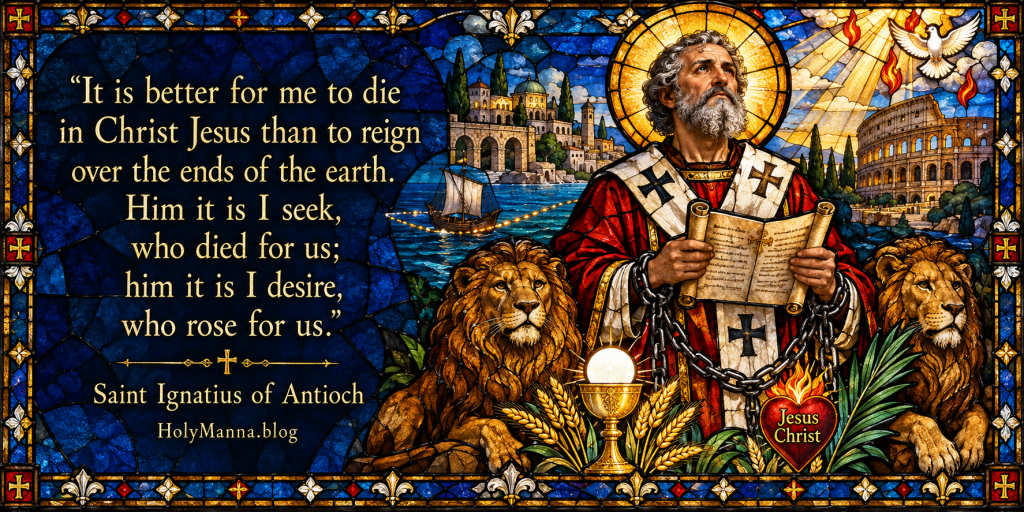
The letter to Rome is the one the Church has never been able to forget. Ignatius had heard that influential Christians in the capital might intervene to save him, and he begged them not to. His words are quoted by the Catechism in its teaching on death and on martyrdom, and they deserve to be read whole: “I am God’s wheat and shall be ground by the teeth of wild beasts, so that I may become the pure bread of Christ” and “it is better for me to die in Christ Jesus than to reign over the ends of the earth. Him it is I seek, who died for us; him it is I desire, who rose for us” (Letter to the Romans 4 and 6, quoted in CCC 1010). In the same letter he wrote one of the most piercing lines in Christian literature: “My Love has been crucified, and there is no fire in me that loves anything; but there is living water in me, speaking and saying within me, Come to the Father” (Letter to the Romans 7).
The Catechism teaches that martyrdom “is the supreme witness given to the truth of the faith: it means bearing witness even unto death” (CCC 2473), and it preserves the memory of the martyrs’ words precisely because, as it says, those archives are testimony “written in letters of blood” (CCC 2474). Ignatius is one of the first names in that archive. Not long after he reached Rome, he received the death he had begged for, torn apart by wild beasts in the Flavian amphitheater, the Colosseum, before a roaring crowd. The ancient accounts add a detail both terrible and fitting, that very little of his body remained, as if his prayer to become ground wheat had been answered literally. He had asked the Romans to allow exactly this, writing, “Entreat Christ for me, that by these instruments I may be found a sacrifice to God” (Letter to the Romans 4).
An Eastern tradition tells a further story. It is said that on the way to his execution Ignatius repeated the name of Jesus Christ without ceasing, and that when his executioners asked why, he answered that the name was written on his heart; after his death, the story goes, his heart was cut open and the pagans found the name “Jesus Christ” inscribed inside it in letters of gold. It is a moving image of the Theophorus, the God-bearer, but it comes from later tradition. This story cannot be verified.
A Name That Never Died
The veneration of Ignatius began the moment he died. According to the Martyrium Ignatii, his companions gathered what remained of his body and carried the relics back to Antioch, where they were buried outside the city gates and honored by the faithful. The same tradition reports that after his death Ignatius appeared to many of the faithful in their sleep to comfort them, and that some saw him in vision praying for the city of Rome. These apparitions are reported by the ancient account of his martyrdom, but they cannot be verified.
The journey of his relics mirrors the journey of his life. The sixth-century church historian Evagrius Scholasticus records that the Emperor Theodosius II had the relics solemnly transferred to the Tychaeum, a former pagan temple of fortune in Antioch, which was converted into a church dedicated to Ignatius; the city that had watched him led away in chains now gathered to celebrate him with a yearly festival. Then, in 637, when Antioch fell to invasion, the relics were carried to Rome and placed in the Basilica of San Clemente, where they rest to this day near the memory of Pope Saint Clement I, another Apostolic Father. Pilgrims who visit San Clemente, one of Rome’s most extraordinary churches, built in layers above a fourth-century basilica and a first-century Roman street, can pray at the resting place of the man who first wrote the words “Catholic Church.” His martyrdom site, the Colosseum, remains one of the great pilgrimage destinations of Christendom, and it is where the Pope traditionally leads the Stations of the Cross each Good Friday, in memory of Ignatius and all the martyrs who died on that sand.
No specific miraculous healings through his relics are documented in the authoritative sources, and honesty requires saying so rather than inventing them. His great posthumous miracle is of a different order; it is the survival and influence of his 7 letters. Quoted by Saint Polycarp within months of his death, preserved by Eusebius, mined by the Fathers, and cited at least 7 times in the Catechism of the Catholic Church, those letters have formed the Church’s understanding of the Eucharist, the episcopacy, and martyrdom for nearly 2 millennia. His feast has an unusual history of its own; the church of Antioch kept it on October 17th from ancient times, the General Roman Calendar observed it on February 1st from the 12th century onward, and in 1969 the Church restored the original October 17th date, now an obligatory Memorial, while the Eastern churches honor him on December 20th. His cultural reach stretches from the Roman Canon of the Mass to the countless parishes, schools, and men who bear his name, including a young Basque soldier centuries later who took the name Ignatius for himself and founded the Jesuits.
Becoming God-Bearers Today
What does a second-century martyr have to say to a reader scrolling through this post between meetings, errands, and notifications? More than almost anyone.
Start with his chosen name. Ignatius called himself Theophorus, the God-bearer, not because of visions or ecstasies but because of Baptism and the Eucharist. The Catechism teaches that through the sacraments the faithful truly become “partakers of the divine nature” (CCC 1129, citing 2 Pet 1:4). That means the Christian in a cubicle, a classroom, or a carpool line is carrying God into that place. Ignatius simply took that truth seriously enough to die for it. If a stranger watched your ordinary Tuesday, would anything suggest that you carry God within you?
Next, his love for the Eucharist. Ignatius faced lions with joy because he had already learned to recognize Christ’s Body in the breaking of the bread; the pure bread of Christ was his food long before he asked to become it. The Catechism calls the Eucharist “the source and summit of the Christian life” (CCC 1324). A practical application is within reach of anyone: arrive at Sunday Mass 10 minutes early and spend them in silence before the tabernacle, or add 1 daily Mass or holy hour to the week. When you receive Holy Communion, do you receive it as the medicine of immortality, or as a routine?
Then, his stubborn commitment to unity. Ignatius begged the churches to stay close to their bishop and to one another, because a divided Church contradicts the Christ who prayed that all may be one. The Catechism teaches that the Church is one because of her source, the unity of the Father, Son, and Holy Spirit (CCC 813). In practice, that means refusing to treat the parish as a consumer product, praying for the Pope and the local bishop by name, and declining to feed the outrage machine that sets Catholic against Catholic online. Do your words about the Church build her unity or chip away at it?
Finally, his freedom in the face of suffering. Ignatius did not seek pain for its own sake; he sought Christ, and he refused to let fear negotiate the terms of his discipleship. Most readers will never face a lion, but everyone faces the slow martyrdom of daily fidelity, the mocked conviction, the unpopular moral stand, the quiet perseverance in prayer when God seems silent. Resilience, for the Christian, is not gritted teeth; it is a grain of wheat consenting to be ground into something that feeds others. Compassion flows from the same source, for the one who knows himself loved unto death becomes safe for others to lean on. What is the one fear that most often keeps you from living your faith out loud, and what would it look like to hand it to Christ this week?
Engage With Us!
Saint Ignatius of Antioch wrote his letters so that real communities of real people could talk honestly about following Jesus, and this little corner of the internet tries to do the same. Share your thoughts and reflections in the comments below; someone else almost certainly needs to read what God has been teaching you. To go deeper, consider these questions:
- Ignatius called himself “God-bearer.” Where in your daily life, at work, at home, or online, is God asking you to carry Him more visibly?
- He called the Eucharist “the medicine of immortality.” What is one concrete change you could make this month to receive Holy Communion with greater reverence and preparation?
- Ignatius pleaded for unity around the bishop and among believers. Is there a relationship, in your parish or your family, where God is calling you to be a peacemaker?
- He wrote, “It is better for me to die in Christ Jesus than to reign over the ends of the earth.” What “kingdom” of comfort, status, or control is hardest for you to surrender to Christ?
- If you knew your remaining time was short, as Ignatius did on the road to Rome, what would you write to the people you love about Jesus?
May the witness of Saint Ignatius stir up a holy boldness in every reader. The same Christ who sustained an old bishop in chains sustains you in whatever arena this week holds. Stay close to the Eucharist, stay close to the Church, and go out and do everything, the great things and the small, with the love and the mercy that Jesus taught us.
Saint Ignatius of Antioch, pray for us!
Follow us on YouTube, TikTok, Instagram and Facebook for more insights and reflections on living a faith-filled life.


Leave a Reply