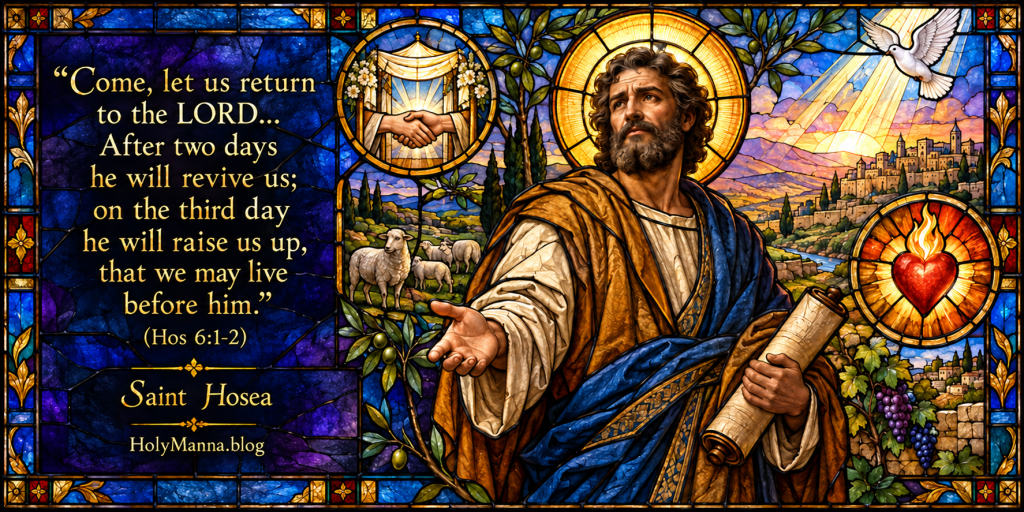
The Prophet Who Married His Message
Every year on October 17th, The Roman Martyrology commemorates a man whose entire marriage became a homily. The entry reads: “The commemoration of Saint Hosea the prophet, who, using not only words but also the events of his own life, pointed out to the unfaithful people of Israel the Lord, a spouse always faithful and moved by infinite mercy.” One liturgical note is worth flagging up front. October 17th on the General Roman Calendar is the Memorial of Saint Ignatius of Antioch, so Hosea’s celebration belongs to the Martyrology rather than to the universal calendar itself; the Byzantine churches honor the holy prophet on the very same date.
Saint Hosea stands first among the Twelve Minor Prophets, and “minor” describes only the length of his book, never its weight. He preached in the northern Kingdom of Israel during the 8th century BC, in the final, feverish decades before that kingdom was swallowed by Assyria. He is most known for one audacious act of obedience: at God’s command he married an unfaithful woman, loved her, lost her, and bought her back, so that his own wounded heart could become a living picture of God’s covenant love for an idolatrous people. He was the first prophet to describe the relationship between God and Israel as a marriage, an image that runs straight through the prophets, into the Gospels, and onto the last pages of The Book of Revelation, where the Church appears as the Bride of the Lamb.
The Catechism of the Catholic Church teaches that Israel came to discover one single motive behind God’s choice of her, “his sheer gratuitous love” (CCC 218). Nobody in the Old Testament makes that discovery more personal, more painful, or more beautiful than Hosea. He is simply what his book shows him to be: the prophet of God’s faithful, wounded, and finally victorious love.
A Son of the Northern Kingdom
Scripture introduces the prophet in a single verse: “The word of the LORD that came to Hosea the son of Beeri, in the days of Uzziah, Jotham, Ahaz, and Hezekiah, kings of Judah, and in the days of Jeroboam the son of Joash, king of Israel” (Hos 1:1). His name, Hoshea in Hebrew, means “salvation,” and it springs from the same Hebrew root that gives rise to the names Joshua and Jesus. In the older Douay tradition he appears as Osee. Beyond his father’s name, Scripture says nothing directly about his family, his trade, or his hometown, and honest devotion respects that silence rather than filling it with invention.
What the text does reveal, indirectly and unmistakably, is where he belonged. The Catholic Encyclopedia observes that Hosea was a subject of the northern Ephraimite kingdom, which he calls “the land” and whose ruler he calls “our king”; he mentions Judah only rarely and never names Jerusalem at all. Among all the writing prophets, he is the only native northerner sent to preach to the north. He knew its shrines, its politics, and its sins from the inside, and that is exactly why his grief sounds so personal. He was not a visiting critic; he was a son watching his own house burn.
His ministry is usually dated from about 750 BC to roughly 725 BC, overlapping the final years of the prophet Amos and the early years of the prophet Isaiah, and ending shortly before Samaria fell to Assyria in 722 or 721 BC. Here the sources deserve an honest flag. Several Eastern synaxaria place the prophet in the 9th century BC and speak of a ministry lasting some sixty years that ended in deep old age; Catholic scholarship, following the internal evidence of the book itself, holds firmly to the 8th century. Later Christian traditions also supply details that Scripture never gives. Saint Ephrem the Syrian and other ancient lists name a birthplace called Belemoth, Saint Jerome points instead to Beth-shemesh, and some ancient writers assign the prophet to the tribe of Issachar. These are venerable traditions, but they cannot be verified.
Hosea needed no conversion from paganism, for he was already a man of the covenant, formed in the faith of Israel. His deepening came instead through a command that must have stopped his breath: “Go, take to yourself a wife of harlotry and have children of harlotry, for the land commits great harlotry by forsaking the LORD” (Hos 1:2). Most prophets were asked to carry a message. Hosea was asked to become one. From that moment forward, his biography and his book are the same thing, and that is precisely what he is most known for: he is the prophet whose own marriage unveiled the marriage between God and his people.
A Marriage That Preached Louder Than Any Sermon
So he obeyed. “So he went and took Gomer the daughter of Diblaim” (Hos 1:3). Three children followed, and God named every one of them as a walking prophecy. The first son was called Jezreel, a name that recalled a valley soaked in royal bloodshed and announced judgment on the ruling dynasty. The daughter was called Lo-ruhamah, which means “Not pitied.” The second son was called Lo-ammi, which means “Not my people,” and with his name came the most chilling sentence in the book: “for you are not my people and I am not your God” (Hos 1:9). Imagine the prophet calling those names across a crowded market. Every time his family stepped outside, Israel heard its own sentence read aloud.
Then something astonishing happens. In Hosea 2 the courtroom turns into a courtship. The betrayed Husband, speaking through the betrayed husband, refuses to let the story end in divorce: “Therefore, behold, I will allure her, and bring her into the wilderness, and speak tenderly to her” (Hos 2:14). The wilderness, the place of Israel’s first honeymoon with God after the Exodus, becomes the place of a second one, and the Lord pronounces vows that the Church has treasured ever since: “And I will betroth you to me for ever; I will betroth you to me in righteousness and in justice, in steadfast love, and in mercy. I will betroth you to me in faithfulness; and you shall know the LORD” (Hos 2:19 to 20).
In Hosea 3 the parable becomes flesh again. “Go again, love a woman who is beloved of a paramour and is an adulteress; even as the LORD loves the people of Israel, though they turn to other gods” (Hos 3:1). Hosea does not merely forgive from a distance; he pays. “So I bought her for fifteen shekels of silver and a homer and a lethech of barley” (Hos 3:2). He purchased back his own wife at roughly the price of a slave, a down payment on Calvary, where the Bridegroom would one day buy back his Bride with something far costlier than silver.
Honesty requires a plain statement here. Scripture records no wonder-working miracles performed by Hosea during his lifetime, and the Church’s tradition attributes none to him. He called down no fire like Elijah and raised no dead like Elisha. The Roman Martyrology itself points instead to “the events of his own life” as his great sign, and in truth the marvel set before Israel through him was mercy itself, a love so humanly inexplicable that it could only have come from God. The Catholic Encyclopedia notes that readers ancient and modern have debated whether the marriage was a lived historical reality or a prophetic allegory, and faithful Catholics have stood on both sides of that question; either way, the inspired meaning is identical, because the point was never Gomer. The point was God.
This is why Hosea matters and why he deserves to be remembered and imitated. He gave Israel, and gives the Church, the vocabulary of covenant love, the Hebrew word hesed, that steadfast, stubborn, promise-keeping mercy at the center of his most famous verse: “For I desire steadfast love and not sacrifice, the knowledge of God, rather than burnt offerings” (Hos 6:6). Jesus himself quoted that verse twice, in Mt 9:13 and Mt 12:7, and The Catechism explains why: “The prophets of the Old Covenant often denounced sacrifices that were not from the heart or not coupled with love of neighbor. Jesus recalls the words of the prophet Hosea: ‘I desire mercy, and not sacrifice’” (CCC 2100). His nuptial vision also shaped the Church’s understanding of marriage itself: “Seeing God’s covenant with Israel in the image of exclusive and faithful married love, the prophets prepared the Chosen People’s conscience for a deepened understanding of the unity and indissolubility of marriage” (CCC 1611). Saint Jerome even gave posterity a one-line portrait of the prophet’s urgent, broken style: “Osee commaticus est, et quasi per sententias loquens,” which is to say, Hosea is abrupt, speaking as it were in short, detached sentences, like a man whose heart keeps interrupting his grammar.
Mocked as a Fool, Faithful to the End
Saint Hosea was not martyred, and nothing in Scripture or reliable tradition suggests a violent death. His sufferings came slower, and in some ways deeper, than a single hour of execution; they arrived on three fronts at once, and he endured all of them without a recorded miracle, a rescue, or a visible victory.
The first front was his own home. If his marriage was lived history, as most Catholic commentators hold, then Hosea carried the daily humiliation of a betrayed husband in a small, gossiping society, and then the further humiliation of walking into public and paying money to recover his own wife. Everything that makes modern hearts wince at infidelity, the shame, the whispers, the sleepless grief, he absorbed on purpose, because God asked him to turn his wound into a window.
The second front was his pulpit. Israel did not thank him for the message. The prophet preserved the insults himself: “The prophet is a fool, the man of the spirit is mad” (Hos 9:7). He was laughed at in the very sanctuaries where he preached, treated as a madman by a nation that preferred comfortable idols at Bethel to the uncomfortable Lord of the covenant.
The third front was his nation’s collapse, and it is documented history. After Jeroboam II died around 747 BC, the northern kingdom spiraled into chaos; The Second Book of Kings, chapter 15, records that in roughly twenty five years Israel ran through six kings, four of whom, Zechariah, Shallum, Pekahiah, and Pekah, were assassinated by their successors. The nation lurched between frantic alliances with Assyria and Egypt while Baal worship and the golden calf shrines corrupted its heart. Hosea preached through all of it, likely for decades, with almost nothing to show for his labor, and his voice falls silent only a few years before Samaria was destroyed by Assyria in 722 or 721 BC and its people were dragged into exile, exactly as he had warned.
What Scripture preserves of his endurance is not an escape but an interior cost, because his broken heart had become a window into the heart of God. Through him the Lord cried out over the nation that was destroying itself: “How can I give you up, O Ephraim! How can I hand you over, O Israel!” (Hos 11:8). The Church reads those words and recognizes the love The Catechism describes, a love that “will be victorious over even the worst infidelities” (CCC 219). Hosea’s heroism was the hidden kind: he kept loving a wife who left, kept preaching to a people who laughed, and kept hoping for a nation that died in front of him.
Of his death, Scripture says nothing at all. Eastern tradition holds that his ministry stretched beyond sixty years and that he died peacefully in deep old age, having spent his whole life fulfilling the will of God; it is a fitting picture, but it is a tradition, and it cannot be verified. What can be said with certainty is this: he died as he had lived, the faithful husband of a broken covenant, still holding out the promise of a Bridegroom who would not quit.
A Voice That Outlived an Empire
Honesty comes first here as well. The Catholic record attributes no healings or posthumous miracles to Saint Hosea’s intercession, and no cult of his relics ever developed in the Church. One burial tradition does exist, and it deserves to be told as the story it is. A Jewish tradition recorded in the medieval chronicle Shalshelet ha-Kabbalah relates that Hosea died far from home in Babylon, and that his body was placed on a camel that walked, unguided, all the way back to the Holy Land, finally halting in Safed in Upper Galilee, where the prophet was buried on the spot. To this day a stone structure in the old Jewish cemetery of Safed is venerated as the Tomb of Hosea, and it remains a stop for pilgrims who climb through that ancient hillside burial ground. This story cannot be verified.
His true afterlife, though, is not a tomb; it is the Word of God, where Hosea’s voice keeps speaking at the most important moments of salvation history. When the Holy Family fled to Egypt and returned, The Gospel of Matthew announced the fulfillment of Hosea’s tenderest line: “Out of Egypt have I called my son” (Mt 2:15, citing Hos 11:1; see CCC 530). When the Pharisees sneered at Jesus for eating with sinners, the Lord sent them back to this prophet for homework: “Go and learn what this means, ‘I desire mercy, and not sacrifice’” (Mt 9:13, citing Hos 6:6; see CCC 589). The Church has also always heard the Resurrection ringing inside Hosea’s call to repentance: “Come, let us return to the LORD… After two days he will revive us; on the third day he will raise us up, that we may live before him” (Hos 6:1 to 2), a passage The Catechism lists among the Scriptures behind the confession that Christ rose on the third day (CCC 627, note). Saint Paul took up Hosea’s taunt against the grave, “O Death, where are your plagues? O Sheol, where is your destruction?” (Hos 13:14), and transfigured it into the Easter cry of 1 Corinthians 15:55. Saint Paul and Saint Peter both applied Hosea’s great reversal, the renaming of “Not my people” as “You are my people” (Hos 2:23), to the calling of the Gentiles into the Church (Rom 9:25 to 26; 1 Pet 2:10), and The Catechism points to Hosea when it teaches that the gathering of the Church was prepared in God’s covenant with Israel (CCC 762) and when it unpacks the words “Our Father” (CCC 2787, note).
The liturgy keeps him close as well. The Church proclaims Hosea 6 during Lent, where his plea to return to the Lord prepares hearts for Easter, and she proclaims the aching tenderness of Hosea 11 on the Solemnity of the Most Sacred Heart of Jesus in Year B, because no Old Testament text sounds more like the Sacred Heart than his. Pope Benedict XVI reached for Hosea when he wrote his first encyclical on divine love, teaching that in the prophets, Hosea above all, God’s covenant passion for his people comes into view: “God loves, and his love may certainly be called eros, yet it is also totally agape” (Deus Caritas Est 9). Centuries earlier, Saint Augustine devoted a chapter of The City of God, Book 18, to Hosea, marveling that the prophet speaks so profoundly that his meaning is won only with real labor, and drawing from him prophecies of the calling of the nations and of the Resurrection.
His cultural footprint endures too. Artists have long placed him among the great prophets of sacred art, including a celebrated early panel of the prophet by Duccio associated with the cathedral of Siena, and the Jewish Talmud preserves the tradition that he was the greatest prophet of his generation, an esteem from outside the Church that echoes her own. Between the Roman Martyrology in the West and the synaxaria of the East, both lungs of Christendom breathe his name together every October 17th, which is a quiet miracle of unity all by itself for a man whose nation vanished 27 centuries ago.
Loving Like the God of Hosea
Here is the uncomfortable truth that makes this book so powerful: Hosea’s story was never only about Gomer. Every believer plays her part sometimes. Everyone has chased lovers who could not love back, whether they were called success, comfort, approval, or a screen that glows at two in the morning. The scandal of Hosea is not that Israel wandered; it is that God kept coming after her. He still does. His promise stands open to you today: “I will heal their faithlessness; I will love them freely, for my anger has turned from them” (Hos 14:4). For a Catholic, the road back that Hosea kept preaching has a name and a confessional door, because The Catechism describes interior repentance as “a radical reorientation of our whole life, a return, a conversion to God with all our heart, an end of sin, a turning away from evil” (CCC 1431). When was the last time you let God buy you back, instead of hiding from him in your shame?
Hosea also hands you a measuring stick for your spiritual life: “For I desire steadfast love and not sacrifice” (Hos 6:6). Devotions, fasts, and faithful Mass attendance matter enormously, but God is not collecting receipts; he wants a knowledge of himself that overflows into mercy toward actual people. The surest sign that prayer is working is not a feeling during the Rosary but patience in traffic, gentleness with a difficult coworker, and generosity toward the person who can never repay it. Does your practice of the faith make you more merciful to the people who are hardest to love, or just busier?
Finally, Hosea teaches fidelity, the virtue this generation quietly craves and rarely sees. The Catechism puts it simply: “Fidelity expresses constancy in keeping one’s given word. God is faithful” (CCC 2365). Living like the God of Hosea means keeping promises when they stop being convenient: staying kind in a marriage going through a cold season, showing up for a friend whose crisis has outlasted everyone’s patience, and speaking tenderly, as the Lord did in Hos 2:14, to the very people who have wronged you. In practice, that can look like a nightly examen that ends in gratitude rather than self-loathing, a quick return to Confession after a fall instead of weeks of hiding, one deliberate act of hesed each day, and a slow, prayerful reading of Hosea 11 whenever God starts to feel like a distant rule-keeper instead of a Father who taught you to walk. Where in your life is God alluring you into the wilderness right now, not to punish you, but to speak tenderly and begin again?
Engage With Us!
Saint Hosea spent his whole life asking Israel hard, loving questions, and he is still asking them today. Share your thoughts and reflections in the comments below; someone else in this community may need to read exactly what God has been teaching you. To help the conversation begin, here are a few questions to pray with this week.
- Hosea obeyed a command that cost him his comfort and his reputation. What is one act of obedience God may be asking of you that you have been postponing?
- God renamed “Not pitied” and “Not my people” as “You are my people.” Where do you need to let God rename a chapter of your own story?
- Jesus told the Pharisees to go and learn what Hosea meant by mercy over sacrifice. What would change in your week if you took that homework seriously?
- Hosea bought back the one who betrayed him. Who in your life is waiting for you to love them freely rather than fairly?
- The Church hears the Resurrection inside Hosea’s promise that the Lord will raise us up on the third day. How does that hope change the way you carry your current struggles?
Take heart from this quiet prophet of the 8th century BC, whose broken marriage revealed an unbreakable love. The same God who would not give up on Israel will not give up on you, and the same mercy that bought back Gomer has already been paid out for you on the Cross. So return quickly when you fall, keep your word when it costs you, and go learn what this means: mercy, not sacrifice. Live your faith boldly this week, and do everything with the love and mercy that Jesus taught us.
Saint Hosea, holy prophet of God’s faithful love, pray for us!
Follow us on YouTube, TikTok, Instagram and Facebook for more insights and reflections on living a faith-filled life.


Leave a Reply