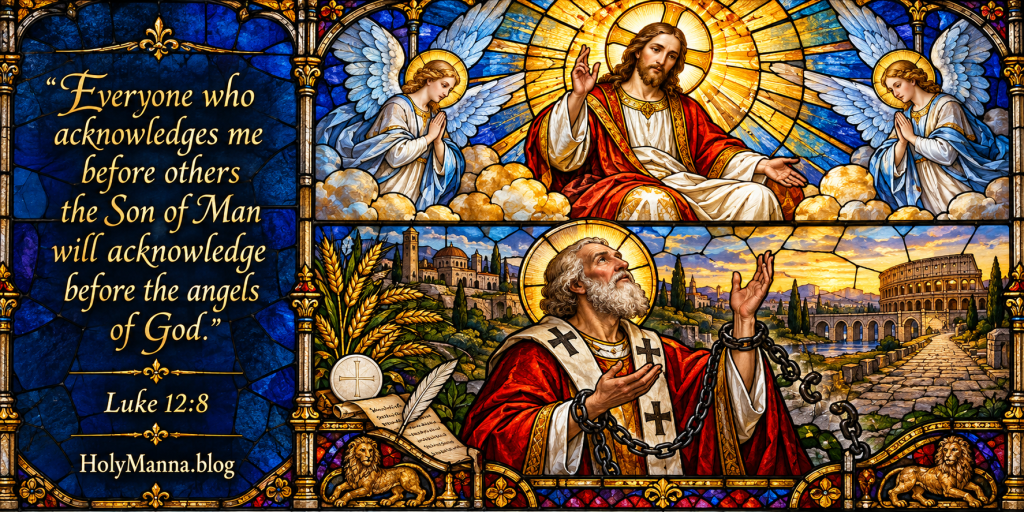
Memorial of Saint Ignatius of Antioch, Bishop and Martyr – Lectionary: 472
A Bishop in Chains and a King on His Throne
Somewhere on a Roman road around the year 107, an elderly bishop walked in chains toward the city where wild beasts were waiting for him. His name was Ignatius, successor of Saint Peter in the See of Antioch, and tradition holds that he learned the faith at the feet of the Apostle John. Ten soldiers guarded him, and he wryly compared them to a pack of leopards. Along the way, he wrote seven letters that the Church still treasures, including one addressed to the Christians of Ephesus, the very community that first received the letter proclaimed at Mass on October 17th. That is no small providence.
The central theme uniting these readings is the enthronement of Jesus Christ over every power in heaven and on earth, and the fearless confession that flows from belonging to His Body. In Ephesians 1:15-23, Saint Paul prays that believers would see what God has already accomplished: Christ raised from the dead, seated far above every principality and authority, and given as Head to the Church. Psalm 8 sings the same mystery in the night sky, a son of man crowned with glory and honor, with all things placed under his feet. Then, in Luke 12:8-12, Jesus draws the practical conclusion. If the Son of Man truly reigns, His followers can acknowledge Him before synagogues, rulers, and authorities without rehearsing a single word, because the Holy Spirit Himself will do the teaching.
Saint Ignatius of Antioch, bishop and martyr, is the living commentary on all three readings. He confessed Christ before an emperor, trusted the Spirit in the arena, and became what he received at the altar. His story frames everything that follows.
First Reading — Ephesians 1:15-23
A Prayer for Eyes That Really See
Saint Paul wrote to the Church at Ephesus, traditionally during his Roman imprisonment in the early 60s. Ephesus was a wealthy port city of Roman Asia, home to the temple of Artemis, one of the wonders of the ancient world, and to a booming trade in magic, amulets, and occult arts. Acts 19 records that new converts there publicly burned their magic scrolls. In a city where people paid dearly to appease unseen powers, Paul’s prayer lands like a thunderclap: every power there is has already been placed beneath the feet of Jesus Christ. The passage flows as one long, breathless sentence of praise in the original Greek, and it sets the throne room scene for the entire day. Roughly 45 years later, Saint Ignatius of Antioch would write his own letter to this same church while being marched to his death.
Ephesians 1:15-23
Brothers and sisters:
Hearing of your faith in the Lord Jesus
and of your love for all the holy ones,
I do not cease giving thanks for you,
remembering you in my prayers,
that the God of our Lord Jesus Christ, the Father of glory,
may give you a spirit of wisdom and revelation
resulting in knowledge of him.
May the eyes of your hearts be enlightened,
that you may know what is the hope that belongs to his call,
what are the riches of glory
in his inheritance among the holy ones,
and what is the surpassing greatness of his power
for us who believe,
in accord with the exercise of his great might,
which he worked in Christ,
raising him from the dead
and seating him at his right hand in the heavens,
far above every principality, authority, power, and dominion,
and every name that is named
not only in this age but also in the one to come.
And he put all things beneath his feet
and gave him as head over all things to the Church,
which is his Body,
the fullness of the one who fills all things in every way.
Detailed Exegesis
Verse 15: “Hearing of your faith in the Lord Jesus and of your love for all the holy ones,”
Paul opens with the two marks he listens for in any Christian community: faith directed upward to the Lord Jesus and love directed outward to “the holy ones,” the baptized members of the Church. Faith and love are inseparable in the apostolic mind. One without the other is a body missing a lung.
Verse 16: “I do not cease giving thanks for you, remembering you in my prayers,”
Before Paul asks God for anything, he gives thanks. Intercession built on gratitude is the apostolic pattern, and it quietly teaches readers how to pray for the people in their own lives, starting with thanksgiving rather than a list of complaints.
Verse 17: “that the God of our Lord Jesus Christ, the Father of glory, may give you a spirit of wisdom and revelation resulting in knowledge of him.”
Wisdom and revelation are gifts of the Holy Spirit, echoing the messianic endowment of Isaiah 11:2. The goal is not information about God but knowledge of Him, the kind of knowing that exists between persons who love each other. Doctrine matters precisely because it leads to this encounter.
Verse 18: “May the eyes of your hearts be enlightened, that you may know what is the hope that belongs to his call, what are the riches of glory in his inheritance among the holy ones,”
In Scripture, the heart is the center of the whole person, where thinking, loving, and choosing meet. The early Church loved to call Baptism an enlightenment, and Paul prays that this baptismal light would keep growing. He names the first two of three things he wants believers to see: the hope of their calling and the staggering inheritance God counts among His treasures, His holy ones.
Verse 19: “and what is the surpassing greatness of his power for us who believe, in accord with the exercise of his great might,”
Here is the third thing to see. Paul stacks up multiple Greek words for power in a single breath, as if no one term could hold it. The point is personal: this surpassing power is “for us who believe,” not locked away in heaven but actively at work in ordinary Christian lives.
Verse 20: “which he worked in Christ, raising him from the dead and seating him at his right hand in the heavens,”
The measure of God’s power is the Resurrection and the enthronement of Christ, fulfilling Psalm 110:1, the Old Testament verse most quoted in the New Testament. The Creed confesses this every Sunday: He is seated at the right hand of the Father, the position of royal authority and unending intercession.
Verse 21: “far above every principality, authority, power, and dominion, and every name that is named not only in this age but also in the one to come.”
Paul lists the ranks of spiritual powers that his Ephesian readers once feared and tried to manipulate through magic. Christ is not slightly above them. He is far above every one of them, and above every name in this age and the next. For anyone enslaved by superstition, anxiety, or the occult, this verse is a declaration of emancipation.
Verse 22: “And he put all things beneath his feet and gave him as head over all things to the Church,”
Paul quotes Psalm 8:7, the very psalm the Church sings between the readings on this memorial. The crowned son of man with all things under his feet finds his full identity in the risen Christ. Notice the gift language: the Father gave this cosmic Head “to the Church.” The Lord of the universe belongs, astonishingly, to His people.
Verse 23: “which is his Body, the fullness of the one who fills all things in every way.”
The Church is not an organization that admires Christ from a distance. She is His Body, so united to Him that Paul dares to call her His fullness. The One who fills the cosmos chooses to be completed, in the order of grace, by ordinary baptized people gathered around His altar.
Teachings
The Catechism gathers this mystery into a single luminous phrase. CCC 795 teaches, “Christ and his Church thus together make up the ‘whole Christ’ (Christus totus). The Church is one with Christ.” In the same paragraph, the Church hands on the famous words of Saint Augustine, Doctor of the Church: “Marvel and rejoice: we have become Christ. For if he is the head, we are the members; he and we together are the whole man… The fullness of Christ then is the head and the members. But what does ‘head and members’ mean? Christ and the Church.”
Saint John Chrysostom, Doctor of the Church, preached directly on this verse in his Homily 3 on Ephesians: “The fullness of the head is the body and that of the body is the head… Through all members, therefore, his body is made full. Then the head is fulfilled, then the body becomes perfect, when we are all combined and gathered into one.” Every member matters, because a body missing even one part is not yet full.
CCC 795 also preserves the answer Saint Joan of Arc gave her judges: “About Jesus Christ and the Church, I simply know they’re just one thing, and we shouldn’t complicate the matter.” A teenage girl on trial for her life summarized the entire doctrine in one sentence.
Reflection
Paul prayed this prayer for people he knew mostly by reputation, simply because he had heard of their faith. That is a habit worth stealing. This week, take Ephesians 1:17-19 and pray it word for word over someone by name, a spouse, a coworker, a friend drifting from the faith. Before receiving Communion, ask the Father for enlightened eyes to see the hope, the riches, and the power already given to you in Baptism. And when anxiety whispers that unseen forces run your life, answer it with verse 21.
Whose faith have you heard about recently, and have you thanked God for it by name? Which of the three things Paul wants you to see, the hope, the riches, or the power, feels most distant right now, and what would it take to ask God for it daily?
Responsorial Psalm — Psalm 8:2-7
When the Night Sky Asks a Question
Psalm 8 is attributed to David, and it reads like the prayer of a shepherd who spent long nights under the vast Near Eastern sky. The surrounding nations worshiped the moon and stars as deities. Israel sang something revolutionary: those glittering lights are merely the work of God’s fingers, set in place by the one LORD. Yet the psalm’s real shock is not the size of the heavens but the dignity of man beneath them. The Lectionary’s refrain, “You have given your Son rule over the works of your hands,” reads the psalm exactly as the apostles did, as a prophecy of Christ, the true Son of Man crowned with glory. On the memorial of a martyr thrown to wild beasts, this psalm quietly insists that no human life, however trampled, loses its crown.
Psalm 8:2-7
R. (7) You have given your Son rule over the works of your hands.
O LORD, our LORD,
how glorious is your name over all the earth!
You have exalted your majesty above the heavens.
Out of the mouths of babes and sucklings
you have fashioned praise because of your foes.
R. You have given your Son rule over the works of your hands.
When I behold your heavens, the work of your fingers,
the moon and the stars which you set in place—
What is man that you should be mindful of him,
or the son of man that you should care for him?
R. You have given your Son rule over the works of your hands.
You have made him little less than the angels,
and crowned him with glory and honor.
You have given him rule over the works of your hands,
putting all things under his feet.
R. You have given your Son rule over the works of your hands.
Detailed Exegesis
Verse 2: “O LORD, our LORD, how glorious is your name over all the earth! You have exalted your majesty above the heavens.”
The psalm opens with a double invocation, first the sacred divine name revealed to Moses, then the title of sovereign Lord. God’s glory saturates the earth and still overflows beyond the heavens. Praise is the only fitting first word, and the psalm will return to this same line at its close, wrapping everything in worship.
Verse 3: “Out of the mouths of babes and sucklings you have fashioned praise because of your foes.”
God silences His enemies not with armies but with the voices of infants. Strength made perfect in weakness runs through all of Scripture, and Jesus Himself quotes this very verse in Matthew 21:16 when children shout Hosanna in the temple while the authorities seethe. The smallest worshipers carry the heaviest artillery.
Verse 4: “When I behold your heavens, the work of your fingers, the moon and the stars which you set in place—”
The psalmist actually looks up. Contemplating creation is a doorway into prayer, and the image of God’s “fingers” suggests effortless artistry, the way a craftsman does fine detail work. What modern telescopes reveal in staggering scale, David already felt in his bones: the universe is enormous, and it is personal.
Verse 5: “What is man that you should be mindful of him, or the son of man that you should care for him?”
Here is the question at the heart of the psalm, and honestly, at the heart of every human life. Measured against galaxies, man seems negligible. Yet the verbs are tender: God is mindful, God cares. The question is not answered with a theory but with a relationship.
Verse 6: “You have made him little less than the angels, and crowned him with glory and honor.”
The answer to human smallness is royal dignity. Every human person bears the image of God, ranked just below the angels and crowned like a king. This is the biblical foundation for the Church’s entire teaching on human dignity, from the unborn child to the prisoner in chains.
Verse 7: “You have given him rule over the works of your hands, putting all things under his feet.”
Dominion is given, not seized, and it is stewardship rather than exploitation. This is also the precise verse Saint Paul quotes in Ephesians 1:22 about the risen Christ, which is why the Church pairs these readings. What Adam was given and squandered, Jesus, the true Son of Man, receives and fulfills forever.
Teachings
The New Testament treats this psalm as a portrait of Jesus. The Letter to the Hebrews quotes it at length and then concludes in Hebrews 2:9, “but we do see Jesus ‘crowned with glory and honor’ because he suffered death, he who ‘for a little while’ was made ‘lower than the angels,’ that by the grace of God he might taste death for everyone.” The crown of Psalm 8 turns out to be won through a cross, a truth Saint Ignatius understood when he walked willingly toward the arena.
On the dignity of man that so amazes the psalmist, CCC 356 teaches, “Of all visible creatures only man is ‘able to know and love his creator.’ He is ‘the only creature on earth that God has willed for its own sake,’ and he alone is called to share, by knowledge and love, in God’s own life.” The stars are bigger, but only man is loved for his own sake and invited into God’s own life. That is why the martyrs could lose everything visible and still count themselves rich.
Reflection
Step outside tonight and actually look up. Let the feeling of smallness come, and then hand it to God, because in His economy smallness becomes wonder rather than despair. Praise Him with the simplicity of the children in the temple, out loud if you dare. Then examine how you exercise the dominion entrusted to you, over your work, your home, your influence, and ask whether it looks like stewardship or like grasping.
When was the last time the night sky made you pray instead of scroll? Where in your life is God inviting you to trade the fear of being insignificant for the dignity of being crowned?
Holy Gospel — Luke 12:8-12
Standing Up for Jesus When It Costs Something
By Luke 12, the crowds following Jesus have grown so large that people are trampling one another. Jesus has set His face toward Jerusalem, and He uses the moment to prepare His disciples for what discipleship will actually cost. He has just warned them about the leaven of the Pharisees and told them not to fear those who can kill the body. Now He gets specific: there will be synagogues, rulers, and authorities, and His friends will stand before them on trial. Within a single generation, the Acts of the Apostles records exactly these scenes. And on October 17th, the Church proclaims these words over the memorial of a man who lived them to the letter. Saint Ignatius of Antioch was condemned during the reign of the Emperor Trajan, around the year 107, and transported under guard to Rome to be killed by wild beasts in the public games. He acknowledged Christ before the empire, and the empire gave him its answer.
Luke 12:8-12
Jesus said to his disciples:
“I tell you,
everyone who acknowledges me before others
the Son of Man will acknowledge before the angels of God.
But whoever denies me before others
will be denied before the angels of God.“Everyone who speaks a word against the Son of Man will be forgiven,
but the one who blasphemes against the Holy Spirit
will not be forgiven.
When they take you before synagogues and before rulers and authorities,
do not worry about how or what your defense will be
or about what you are to say.
For the Holy Spirit will teach you at that moment what you should say.”
Detailed Exegesis
Verse 8: “I tell you, everyone who acknowledges me before others the Son of Man will acknowledge before the angels of God.”
Jesus takes the title Son of Man from Daniel 7, where a human figure receives everlasting dominion before the throne of God. The scene is a heavenly courtroom. Whoever confesses Jesus in the ordinary courtrooms of life, the office, the classroom, the family dinner table, will hear his own name spoken by Jesus before the angels. Earthly confession has eternal echoes.
Verse 9: “But whoever denies me before others will be denied before the angels of God.”
The warning is sobering, and it should be. Yet Scripture also shows that denial need not be the last word. Peter denied the Lord three times and was restored three times beside a charcoal fire. The verse condemns a settled, persistent denial, not a moment of weakness brought to repentance. Silence, though, can become its own quiet form of denial when love demands a word.
Verse 10: “Everyone who speaks a word against the Son of Man will be forgiven, but the one who blasphemes against the Holy Spirit will not be forgiven.”
This verse has frightened sincere believers for centuries, and the Church reads it with precision. The unforgivable sin is not a particular word that slips out, and anyone anxious about having committed it almost certainly has not, because that very anxiety shows a heart still open to grace. Blasphemy against the Holy Spirit is the deliberate, final refusal of the mercy that the Spirit offers, a door God will not batter down because He respects human freedom. CCC 1864 unpacks this fully below.
Verse 11: “When they take you before synagogues and before rulers and authorities, do not worry about how or what your defense will be or about what you are to say.”
Jesus names three escalating venues: the local synagogue, the regional rulers, the imperial authorities. He does not promise His followers will avoid these rooms. He promises they can walk into them without rehearsing. The command not to worry is not a suggestion to be unprepared in life generally, but a liberation from the paralyzing fear of saying the wrong thing when faith is on trial.
Verse 12: “For the Holy Spirit will teach you at that moment what you should say.”
Here is the engine of Christian courage. The Holy Spirit is a real teacher who shows up in real time. Acts 4 shows the fulfillment, when Peter, an uneducated fisherman filled with the Holy Spirit, leaves the Sanhedrin speechless. The same promise covers the unglamorous moments too, the hard conversation with a skeptical friend, the question a child asks at bedtime, the comment thread where faith gets mocked.
Teachings
On the sin against the Holy Spirit, CCC 1864 teaches, “There are no limits to the mercy of God, but anyone who deliberately refuses to accept his mercy by repenting, rejects the forgiveness of his sins and the salvation offered by the Holy Spirit. Such hardness of heart can lead to final impenitence and eternal loss.” The sin is unforgivable only because the sinner refuses the forgiveness, the way a locked door keeps out the light.
On acknowledging Christ at full cost, CCC 2473 teaches, “Martyrdom is the supreme witness given to the truth of the faith: it means bearing witness even unto death. The martyr bears witness to Christ who died and rose, to whom he is united by charity. He bears witness to the truth of the faith and of Christian doctrine.” Remarkably, the very next paragraph of the Catechism, CCC 2474, chooses Saint Ignatius of Antioch himself as its example, quoting his Letter to the Romans: “It is better for me to die in order to unite myself to Christ Jesus than to reign over the ends of the earth.”
In that same letter, written while traveling to his execution, Ignatius begged the Roman Christians not to interfere with his sentence: “I am the wheat of God, and let me be ground by the teeth of the wild beasts, that I may be found the pure bread of Christ.” A bishop who had celebrated the Eucharist for decades saw his own death in Eucharistic terms, becoming what he had received. Pope Benedict XVI, reflecting on these letters in a 2007 General Audience, described Ignatius as a true Doctor of Unity, a man whose longing for Christ held the Church together even from inside a prison escort.
Reflection
Most readers will never face an arena, but everyone faces the small tribunals of daily life. Say grace before meals in public without lowering your head in embarrassment. Answer honestly when faith comes up at work instead of changing the subject. Keep Christ visible in your life online rather than quietly editing Him out. Before any conversation you are dreading, pray three words, Come, Holy Spirit, and mean them. And if there is a denial in your past that still stings, remember Peter, and bring it to Confession, where the Son of Man restores His own.
Where do you quietly edit Jesus out of your conversations, and what are you afraid would happen if you stopped? What would change in your week if you genuinely trusted the Holy Spirit to supply the words at the moment you need them?
The King, the Crown, and the Courage to Speak
Picture the whole day as one unbroken scene. Saint Paul, a prisoner, prays that believers would see Christ seated far above every power, with the Church as His very Body. David, a shepherd under the stars, sings of a son of man crowned with glory and honor, all things under his feet. Jesus, walking toward His own trial, promises that anyone who acknowledges Him before others will be acknowledged before the angels of God, with the Holy Spirit supplying the words. Then an old bishop from Antioch steps into the frame and proves that none of it is poetry.
Ignatius stood before the might of Rome and did not flinch, because he had already seen what Paul prayed the Ephesians would see. He knew who was actually on the throne. The man who first gave the Church the words “wherever Jesus Christ is, there is the Catholic Church” in his Letter to the Smyrnaeans understood that a Christian never stands trial alone. The whole Body stands with him, and the Head has already won.
The invitation of October 17th is simple and searching. Go to Mass and receive the pure Bread that Ignatius longed to become. Pray by name for Christians facing persecution right now across the world, for the arena never fully closed. Then speak one honest, unashamed word about Jesus this week, to one person, in one moment the Holy Spirit arranges. The God who set the stars in place is mindful of you, has crowned you, and is waiting to acknowledge your name before His angels. Courage is not the absence of fear. It is the presence of a King.
Engage With Us!
These readings have a way of finding the exact spot where faith gets quiet, and hearing how God is working in other lives strengthens everyone walking the same road. Share your reflections in the comments below, whether it is a moment the Holy Spirit gave you words, a time the night sky stopped you cold, or a prayer request for courage you need this week. Someone reading needs to hear your story.
- In Ephesians 1:15-23, Saint Paul prays that the eyes of your heart may be enlightened. What is one area of your life where you need to see with the eyes of faith rather than the eyes of fear?
- Psalm 8:2-7 asks what man is that God should be mindful of him. When you feel small or overlooked, what helps you remember the glory and honor with which God has crowned you?
- In Luke 12:8-12, Jesus promises that the Holy Spirit will teach you what to say at the moment you need it. When has the Spirit given you words or courage you did not know you had?
- Taking all of the readings together with the witness of Saint Ignatius of Antioch, what is one concrete way you can acknowledge Christ before others this week, trusting that He will acknowledge you before the angels of God?
Living a life of faith is not about having a perfect answer ready. It is about belonging to the Body of a King who has already won, and letting His Spirit speak through an ordinary, willing heart. Go into this week unafraid, and do everything with the love and mercy Jesus taught us, the same love that carried a bishop in chains all the way home.
Sacred Heart of Jesus, we trust in You!
Immaculate Heart of Mary, pray for us!
Saint Michael the Archangel, defend us in battle!
Follow us on YouTube, TikTok, Instagram and Facebook for more insights and reflections on living a faith-filled life.


Leave a Reply