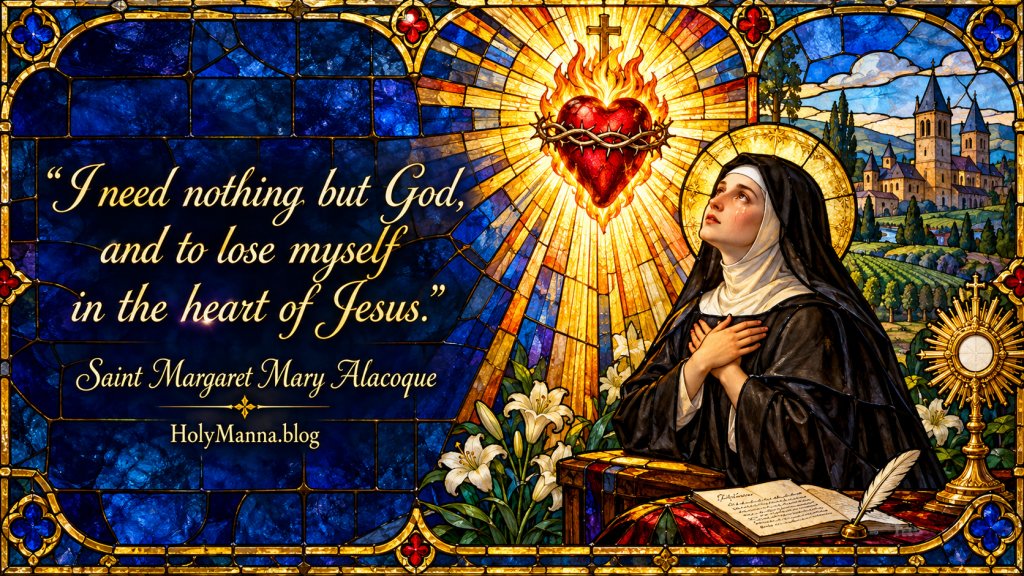
The Heart That Would Not Stay Hidden
On October 16th, the Church remembers Saint Margaret Mary Alacoque, a French Visitation nun who spent nearly her entire religious life inside the walls of a single monastery in Burgundy, and who somehow became one of the most influential saints of the last four centuries. She never founded an order, never wrote a theological treatise, and never traveled beyond her corner of France. Yet through her, the devotion to the Sacred Heart of Jesus took the form the Church knows today: the First Friday Communions, the Holy Hour, the image of the Heart of Christ crowned with thorns and aflame with love, and the Feast of the Sacred Heart now celebrated on the universal calendar. Pope Benedict XV canonized her on May 13th, 1920, and popes from Pius XI to Francis have returned to her witness again and again, most recently in the 2024 encyclical Dilexit Nos, which draws deeply on her writings.
The devotion she carried is not a private enthusiasm; it is rooted in the very mystery of the Incarnation. The Catechism teaches that Jesus “has loved us all with a human heart,” and that for this reason the Sacred Heart, pierced by human sins and for human salvation, “is quite rightly considered the chief sign and symbol of that… love with which the divine Redeemer continually loves the eternal Father and all human beings” (CCC 478). Margaret Mary did not invent that truth. She was chosen to remind a cold and forgetful age of it, and the reminder cost her almost everything.
She is honored as the patroness of devotees of the Sacred Heart, of those suffering from polio, and of those grieving the loss of their parents, patronages that grow straight out of her own story of childhood paralysis and early bereavement.
A Vow to the Blessed Virgin
Margaret Alacoque was born on July 22nd, 1647, in the hamlet of L’Hautecour, near the village of Verosvres in Burgundy, France. She was the fifth of seven children and the only daughter of Claude Alacoque, a royal notary, and Philiberte Lamyn. The Catholic Encyclopedia notes that her parents were distinguished less for wealth than for virtue, and that from early childhood Margaret showed an intense love for the Blessed Sacrament, preferring silence and prayer to childish amusements. In her autobiography, written years later under obedience to her confessor, she recalled that as a very small girl she pronounced a vow of chastity between two elevations at Mass without even understanding what the words meant. God was drawing her before she could name what was happening.
Suffering arrived early. When Margaret was about eight years old, her father died, and she was sent to school with the Poor Clare nuns at Charolles, where she made her First Communion at the age of nine. Soon afterward a severe rheumatic illness left her paralyzed and bedridden for roughly four years; some accounts extend the illness to five. Medicine could do nothing. Finally, the young girl made a vow to the Blessed Virgin Mary to consecrate herself to religious life, and the Catholic Encyclopedia records what happened next: “she was instantly restored to perfect health.” In gratitude for that favor, she added the name Mary to her baptismal name and was known ever afterward as Margaret Mary.
Healing did not mean ease. After her father’s death, relatives took control of the Alacoque household and treated Margaret Mary and her mother with real harshness; she later described those years as a kind of domestic captivity in which her only refuge was prayer before the Blessed Sacrament. When she was seventeen the family property was recovered, and her mother begged her to marry and establish herself in the world. For a time Margaret Mary wavered. She went to parties with her brothers, and for the rest of her life she mourned over two faults from that season, the wearing of some superfluous ornaments and a mask at a carnival to please her brothers. Her autobiography recounts that one night, returning from a ball, she received a vision of Christ scourged and bloody, reproaching her for forgetting Him after He had chosen her heart for Himself. That encounter settled everything. She resolved to fulfill her vow, and on May 25th, 1671, at almost twenty-four years of age, she entered the Visitation Monastery at Paray-le-Monial, the order founded by Saint Francis de Sales and Saint Jane Frances de Chantal. She was subjected to many trials to prove her vocation and pronounced her final vows in November 1672.
The Apparitions of the Sacred Heart at Paray-le-Monial
What happened next places Paray-le-Monial among the great holy sites of the world. Beginning on December 27th, 1673, the feast of Saint John the Evangelist, the apostle who rested his head on the breast of the Lord at the Last Supper as The Gospel of John describes, Sister Margaret Mary began to receive a series of apparitions of Jesus Christ that continued for about a year and a half. In the first, she experienced the Lord inviting her to take the place of the beloved disciple and rest upon His Heart. Catholic sources record His words to her: “My Sacred Heart is so intense in its love for men, and for you in particular, that not being able to contain within it the flames of its ardent charity, they must be transmitted through all means.” He told her that she, a hidden and apparently unremarkable nun, was His chosen instrument to spread devotion to His Heart.
In the apparitions that followed through 1674, she saw the Heart of Jesus on a throne of flames, more brilliant than the sun, encircled by a crown of thorns and surmounted by a cross, wounded by the ingratitude and coldness of the very souls He loved most. From these revelations came two practices that millions of Catholics still keep. The Catholic Encyclopedia summarizes them plainly: Christ inspired her to establish the Holy Hour, praying prostrate from eleven until midnight on the eve of the First Friday of each month, to share in the sorrow He endured in the Garden of Gethsemane when His apostles abandoned Him, and to receive Holy Communion on the First Friday of every month in reparation for sins against His love.
The culminating revelation, often called the great apparition, came in June 1675, during the octave of Corpus Christi, and is commonly dated June 16th. As Margaret Mary knelt before the Blessed Sacrament, the Lord showed her His Heart and spoke the words that have echoed through the Church ever since: “Behold this Heart which has so loved men that it has spared nothing, even to exhausting and consuming Itself, in order to testify Its love.” He grieved that in return He received mostly ingratitude, coldness, and contempt, even from souls consecrated to Him, and He asked that a special feast be established on the Friday after the octave of Corpus Christi to honor His Heart and make reparation. That request, carried for decades by a cloistered nun and her allies, was granted by the Church: Pope Clement XIII approved the Mass and Office of the Sacred Heart in 1765, Blessed Pius IX extended the feast to the universal Church in 1856, and today the Solemnity of the Most Sacred Heart of Jesus stands on the calendar exactly where the Lord asked for it.
From her writings also come the promises of the Sacred Heart. She recorded assurances the Lord made to those who would honor His Heart, among them, “Sinners shall find in my Heart the source and infinite ocean of mercy,” and the celebrated First Friday promise, “I promise you in the excessive mercy of my Heart that my all-powerful love will grant to all those who receive Holy Communion on the First Fridays in nine consecutive months the grace of final perseverance.” An honest note belongs here: the familiar numbered list of exactly Twelve Promises was compiled from her scattered writings and letters after her death; she never published them herself as a single enumerated list, though the content comes from her own testimony.
Margaret Mary was not a public wonder-worker, and the Church has never presented her that way. The great cure of her own life was the instantaneous healing of her paralysis after her vow to Our Lady. Her miracles were chiefly interior: an extraordinary union with Christ, a supernatural endurance under humiliation, and a gift for forming souls that showed itself when she later served as Novice Mistress, winning for the Heart of Jesus the hearts of the young women entrusted to her. The Church is careful about such graces, and The Catechism gives the frame: private revelations, even approved ones, do not belong to the deposit of faith, for “it is not their role to improve or complete Christ’s definitive Revelation, but to help live more fully by it in a certain period of history” (CCC 67). That is precisely what the Paray apparitions did. They completed nothing; they awakened everything.
Treated as a Visionary
If anyone imagines that receiving visions of Jesus makes life easier, Margaret Mary’s story is the correction. When she brought her experiences to her superior, Mother de Saumaise, she was reprimanded for presumption. The community treated her, in the pointed words of the Catholic Encyclopedia, as a visionary, and her superior commanded her to live the common life with no special practices. Margaret Mary obeyed. The strain was crushing; contemporary Catholic accounts record that she suffered a collapse so severe that her life was despaired of. The Visitation tradition recounts that Mother de Saumaise told her to ask God for a cure as a sign that her experiences were from Him, and that she recovered; because this detail rests on the community’s later telling rather than contemporary documentation, it cannot be verified.
Recovery brought a harder trial. Her superior summoned theologians to examine her, and their interrogation, by the account preserved in Catholic sources, was sheer torture to her. Learned men concluded she was deluded and prescribed more food and less prayer. She had no credentials to answer them with, only obedience and the certainty of what she had seen.
Then God sent her an ally. In February 1675, a young Jesuit named Claude de la Colombière arrived as superior of the Jesuit house at Paray and became her confessor. He listened, discerned, and judged her experiences authentic, and through his direction she found peace about being doubted. The Lord had told her that this faithful servant would help her carry the devotion to the world, and so it proved. Father de la Colombière preached the Sacred Heart, recorded her message in his spiritual journal, and defended her at the cost of his own reputation. He died in 1682, worn out at forty-one, and was himself canonized by Pope John Paul II in 1992. Two holy friends, both doubted in their lifetimes, both now saints; God loves to vindicate His servants together.
Vindication inside the monastery came slowly. In 1683 the opposition ended when Mother Melin was elected Superior and named Margaret Mary her assistant. She later became Novice Mistress, and in 1686 the community began to observe the feast of the Sacred Heart privately. In 1688 a chapel was built at Paray-le-Monial in honor of the Sacred Heart, and the devotion began to spread to other Visitation convents. In 1689 her letters record one final, startling commission: the Lord’s desire, communicated through her, that King Louis XIV consecrate France to the Sacred Heart and honor the Heart of Jesus publicly. The king never acted on the request. Many Catholic writers have observed, as a sobering reflection rather than a doctrine, that one hundred years later the French monarchy fell in the Revolution.
Margaret Mary was never martyred; her cross was the slower one of misunderstanding, interior desolation, and relentless self-denial, embraced in reparation for sin. The Catechism describes exactly this road: “The way of perfection passes by way of the Cross. There is no holiness without renunciation and spiritual battle” (CCC 2015). In October 1690, while serving a second term as assistant superior, she fell ill. She sank rapidly, received the Last Sacraments, and spoke the sentence that gathers up her whole life: “I need nothing but God, and to lose myself in the heart of Jesus.” She died at Paray-le-Monial on October 17th, 1690, at the age of forty-three.
A Devotion That Circled the World
Devotion to Margaret Mary began at once; accounts relate that mourners cut pieces of her clothing to keep as relics, and the people of Paray immediately regarded her as a saint, though the Church’s own judgment would take much longer. The discussion of her mission and virtues continued for years, carried forward especially by the Jesuits even while the devotion remained controversial in some quarters.
The formal path unfolded across two centuries. In March 1824, Pope Leo XII pronounced her Venerable. Then came the event the Catholic Encyclopedia records with striking brevity: when her tomb was canonically opened in July 1830, two instantaneous cures took place. The identities and details of those cured are not given in the standard sources, so the stories cannot be filled out further without invention, but the fact of the two cures at the opened tomb is the testimony the Church’s own encyclopedia preserves. On September 18th, 1864, Blessed Pius IX declared her Blessed, and on May 13th, 1920, Pope Benedict XV canonized her. In 1929 her feast was inscribed on the General Roman Calendar on October 17th, the day of her death, and the 1969 calendar reform moved her Optional Memorial to October 16th, where it stands today. A note of honesty is owed on one popular claim: many devotional accounts describe her body as incorrupt, but the Catholic Encyclopedia makes no such claim, and her relics are in fact enshrined within a reliquary effigy above the side altar of the Chapel of the Apparitions at the Visitation Monastery in Paray-le-Monial. The story of her incorruption, as commonly told, cannot be verified.
What can be verified, overwhelmingly, is her impact. Paray-le-Monial became one of the great pilgrimage centers of France; the famous national pilgrimages of 1873 drew enormous crowds, and in that same era the French faithful undertook the national vow that built the Basilica of Sacré-Cœur on Montmartre in Paris, consecrated in 1919, a church that owes its existence to the devotion Margaret Mary spread. Pilgrims still come to Paray from every continent to pray in the Chapel of the Apparitions, and the Catholic Encyclopedia notes that many striking favors have been obtained there, though individual favors are not detailed and so are received as the testimony of pilgrims rather than adjudicated fact.
The popes made her message their own. Leo XIII consecrated the entire human race to the Sacred Heart in 1899 with the encyclical Annum Sacrum. Pius XI, in the 1928 encyclical Miserentissimus Redemptor, upheld the credibility of her visions and made reparation to the Sacred Heart a theme for the whole Church. Pius XII devoted the 1956 encyclical Haurietis Aquas to the theological foundations of the devotion, and in 2024 Pope Francis gave the Church Dilexit Nos, an encyclical on the human and divine love of the Heart of Jesus Christ that returns repeatedly to the nun of Paray. The Church’s liturgy itself carries her fingerprints, for as The Catechism teaches, “the prayer of the Church venerates and honors the Heart of Jesus” (CCC 2669). Every First Friday Communion, every parish Holy Hour, every image of the Sacred Heart enthroned in a Catholic home is part of the harvest of her hidden, doubted, obedient life.
Learning to Return Love for Love
Margaret Mary’s life answers a question many people quietly carry: does God actually notice you? She was a sickly, fatherless girl from a small Burgundian hamlet, mistreated in her own home, doubted in her own convent, with no platform and no power. And Christ chose precisely her to tell the world about His Heart. Holiness has never required importance. It requires availability.
Her story also reframes what suffering can mean. She did not waste her humiliations; she united them to the Heart of Jesus in reparation, and God turned a cloistered nun’s hidden fidelity into a devotion that circles the globe. When you are misunderstood, passed over, or dismissed, her witness says that obedience and patience are not weakness; they are the raw material of sanctity. Where in your life right now are you being asked to stay faithful without being believed or appreciated?
The most practical inheritance she left is astonishingly doable. Receive Holy Communion on the First Friday of the month, going to Confession first if needed, and offer it in reparation for sins against the love of Christ. Spend a Holy Hour before the Blessed Sacrament, even a quiet half hour, keeping the Lord company in His agony the way His apostles failed to do. Enthrone an image of the Sacred Heart in your home as a daily declaration of who reigns there. Begin each morning with a simple offering of the day to the Heart of Jesus. None of this requires a monastery; it requires only the decision to answer love with love. Could you commit to the nine First Fridays, starting with the very next one?
Finally, let her correct the caricature of God that so many people in their twenties, thirties, and forties walked away from: a distant scorekeeper, cold and conditional. The Heart Margaret Mary saw was on fire, wounded not by lack of power but by lack of welcome. The Lord’s complaint was never that people sinned too much for Him to love them; it was that they would not come close enough to be loved. What would change in your daily life if you truly believed that the Heart of Jesus burns with love for you in particular?
Engage With Us!
HolyManna would love to hear from you, so please share your thoughts and reflections on Saint Margaret Mary Alacoque in the comments below. Her story of hiddenness, rejection, and blazing divine love has something to say to every season of life, and your experience of the Sacred Heart devotion might be exactly the encouragement another reader needs. To spark the conversation, consider these questions:
- Margaret Mary was dismissed as a visionary by her own community; when have you had to hold on to something God placed in your heart while others doubted you, and what helped you persevere?
- Christ asked for reparation, for love answering love; what is one concrete act of reparation you could offer this week for coldness toward God, your own or the world’s?
- Have you ever practiced the First Friday devotion or a monthly Holy Hour, and if not, what is honestly holding you back from starting?
- Saint Claude de la Colombière believed Margaret Mary when no one else did; who in your life needs you to be that kind of faithful, discerning friend right now?
- If you enthroned an image of the Sacred Heart in your home, what would you want that image to remind your family of every single day?
Saint Margaret Mary heard the Lord say that His Heart had spared nothing to prove His love, and she spent her whole life answering Him. The same invitation stands open today. Go to Him in the Blessed Sacrament, bring Him your wounds and your coldness, and let His Heart set yours on fire. Then live this day, and every day, with the love and mercy that Jesus taught us, trusting that the Heart which so loved the world is still waiting, still burning, and still calling you by name.
Saint Margaret Mary Alacoque, pray for us!
Follow us on YouTube, TikTok, Instagram and Facebook for more insights and reflections on living a faith-filled life.


Leave a Reply