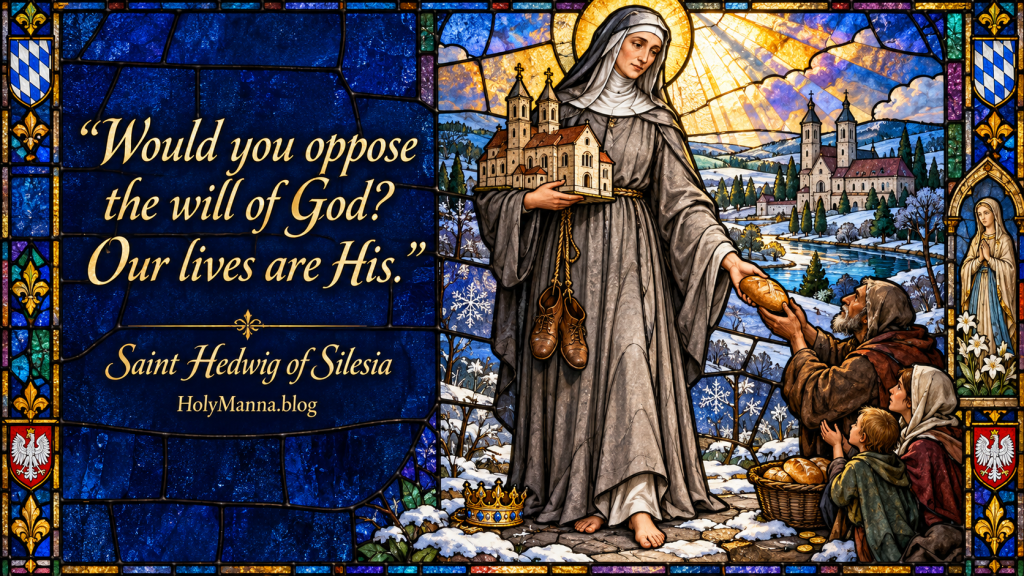
The Barefoot Duchess
Every generation produces people who have everything and still feel empty. The thirteenth century produced a woman who had everything, a castle childhood, a ducal marriage, lands, titles, and servants, and gave it all away with both hands because she had found something better. Saint Hedwig of Silesia, celebrated on October 16th, was a Bavarian noblewoman who became Duchess of Silesia, co-founded the first convent for women in her adopted land, buried her husband and nearly all of her children, and finished her life in a grey lay sister’s habit, washing the feet of the poor she had once ruled. According to Vatican News, when people questioned why a duchess dressed in used clothing and old shoes, she answered simply of the poor, “they are our masters.”
That single sentence explains her whole life. Hedwig did not practice charity as a hobby of the wealthy. She understood what The Catechism teaches, that “The works of mercy are charitable actions by which we come to the aid of our neighbor in his spiritual and bodily necessities” (CCC 2447), and she reorganized an entire court, and eventually an entire region, around that truth. The Church honors her as the patroness of Silesia and its capital Wrocław, of Poland and Kraków, of Trzebnica and Andechs, of the Dioceses of Berlin and Görlitz, and of orphans. Devotion through the centuries has also entrusted to her brides, widows, difficult marriages, and parents grieving the death of a child, because she lived through every one of those crosses herself.
One quick clarification before her story begins, because the internet muddles it constantly. Saint Hedwig of Silesia, who died in 1243, is not the same person as Saint Jadwiga, the young Queen of Poland who died in 1399 and was canonized by Saint John Paul II in 1997. Both are called Jadwiga in Polish, both are beloved, and both deserve their own telling. Today belongs to the duchess.
From a Bavarian Castle to a Silesian Court
Hedwig was born around the year 1174 at the castle of Andechs in Bavaria, into one of the most powerful noble families of the Holy Roman Empire. Her father was Count Berthold of Andechs, a prince whose titles stretched across Meran, Tirol, Carinthia, and Istria; sources disagree on his regnal number, so honesty requires leaving it open. Her mother was Agnes of Wettin. Some accounts place Hedwig’s birth as late as 1178, another small uncertainty the historical record simply carries.
Holiness ran through this family like a vein of gold, though so did heartbreak and scandal. Hedwig’s sister Gertrude married King Andrew II of Hungary and became the mother of Saint Elizabeth of Hungary, which makes Hedwig the aunt of one of the Church’s most beloved saints of charity. Gertrude herself was later assassinated in Hungary. Another sister, Agnes, entered a marriage with the King of France that scandalized Europe and was condemned by the Church. Hedwig grew up knowing that nobility guaranteed nothing, neither virtue nor safety, and that a soul must choose God deliberately.
Her parents sent her as a young girl to the Benedictine monastery of Kitzingen in Franconia for her education. There she learned Scripture, prayer, Latin, and the rhythms of monastic life, a formation that marked her forever. A charming detail survives in the Catholic record, that Hedwig held learning and holiness together rather than in competition. As reported by Catholic News Agency, she is recorded to have taught that knowledge joined to holiness of life leads to greater glory for souls in heaven. For a medieval laywoman, that conviction was remarkable, and she passed it on by making sure the women of her court and household were educated.
At about twelve years old, around 1186, Hedwig was taken from Kitzingen and married to Henry, the roughly eighteen-year-old heir of the Piast dukes of Silesia, a region that today lies in western Poland. Butler’s Lives of the Saints notes that she consented to the match out of obedience to her parents. A modern reader winces at the age, and rightly so by today’s standards, yet what Hedwig did with an arranged dynastic marriage is precisely what makes her a saint. In 1202 Henry succeeded his father as Duke of Silesia, known to history as Henry I the Bearded, and Hedwig became duchess of a land that was not her own, speaking a language she had to learn, among a people she would come to love so completely that they claimed her as their patroness forever.
Wine in the Water and Mercy in Her Hands
Hedwig and Henry built one of the most fruitful marriages in the history of Christian royalty. The Catechism teaches that “Christ dwells with them, gives them the strength to take up their crosses and so follow him, to rise again after they have fallen, to forgive one another, to bear one another’s burdens” (CCC 1642), and this couple lived that grace in public. In 1202, at Hedwig’s request, Henry established the monastery of Trzebnica near Wrocław, the first house of religious women in all of Silesia, entrusted to Cistercian nuns. It was only the beginning. Together they endowed foundations for the Cistercians, the Augustinian canons, the Franciscans, and the Dominicans, and they built hospitals for the sick and a house for lepers at a time when lepers were treated as the living dead.
What set Hedwig apart from other royal benefactors was her refusal to delegate mercy. Catholic accounts emphasize that she served the poor and the sick with her own hands, not through servants. She kept a company of the poor at her court and fed them personally. She visited prisoners, paid the debts of those who could not pay, reduced the burdens on her subjects, and defended widows and orphans who had no other advocate. One story preserved in the Catholic tradition says that when her husband’s soldiers burned a village in one of his campaigns, Hedwig tearfully pressed him to make restitution, and when he answered that rebuilding the houses and returning the livestock would be enough, she replied, “Yes, my noble lord, you can restore the lost property, but how will you repair the tears that have been shed because of you? And how will you pay for the bitter suffering you have caused?” This exchange comes from the devotional tradition surrounding her life and cannot be independently verified, yet it matches everything the documented record shows about her conscience.
The couple had children, and here the sources honestly disagree. Butler’s Lives of the Saints lists six, the sons Henry, Conrad, and Boleslas and the daughters Agnes, Sophia, and Gertrude, while other reputable accounts count seven, the last born around Christmas of 1208. What is certain is that after the birth of that final child, Hedwig proposed something radical. In 1209, after more than two decades of marriage, she and Henry pronounced a vow of continence before the Bishop of Wrocław and lived the rest of their lives in celibate devotion, she spending ever more of her time at Trzebnica. The Church has always honored such freely mutual vows as a legitimate path for spouses whom God calls to it, and the couple remained devoted partners in governance and charity.
Hedwig’s personal austerity became the stuff of Silesian memory. Butler records, on the testimony of her confessor Herbold and several of her servants, that she fasted on bread and water on Wednesdays and Fridays and that she walked to church barefoot, sometimes over ice and snow, her blistered feet leaving traces of blood on the ground, while she carried shoes under her arm to put on if she met anyone, so that no one would praise her penance. The beloved version of the story, in which her confessor ordered her to wear shoes and she cheerfully obeyed by carrying them at her belt, is a tradition that grew up around that documented habit, and it cannot be verified in that exact form. Either way, her iconography settled the matter; to this day Saint Hedwig is painted holding a church in one hand and a pair of shoes in the other. The Catechism gives the theology beneath the image, that “The way of perfection passes by way of the Cross. There is no holiness without renunciation and spiritual battle” (CCC 2015).
Wonders were attributed to Hedwig during her lifetime. Her medieval biography, the Legenda maior, gloriously illustrated in the Hedwig Codex of 1353, records her curing women and nuns of blindness, saving a choking nun, interceding to rescue a condemned man from hanging, and freeing a woman whose hands had become stuck fast to a millstone staff after she worked on a Sunday. Catholic sources also relate that Hedwig carried a small statue of Our Lady with her everywhere and blessed the sick with it, and that some of them were afterward healed. The most charming tradition of all concerns her drink. Hedwig, out of penance, drank only water, which worried her husband, so the story goes that Henry secretly tasted her cup and found that the water had become wine. That tradition cannot be verified, yet it so captured the medieval imagination that a famous class of carved glass beakers, the Hedwig glasses, still bears her name. These stories come from hagiographic tradition rather than documented history, and they are told here as the tradition tells them. What needs no miracle to prove is the record itself, a duchess whom her people trusted so deeply that her tomb became a shrine almost the moment she died.
A Mother of Sorrows at the Gates of Europe
If Hedwig’s charity made her beloved, her suffering made her a saint. She buried nearly everyone she loved, and she did it without ever accusing God.
Her adult years were scarred by the wars of fragmented Poland. Her own sons Henry and Conrad took up arms against each other, and despite their mother’s desperate efforts at reconciliation, young Henry defeated his brother, who died not long after. The grief of a mother watching her children war against one another convinced Hedwig all the more of the emptiness of worldly ambition. Then her husband was captured. During the struggle over Kraków, Duke Henry was seized by Konrad of Masovia and held prisoner at Płock, and their son raised an army to free him by force. Hedwig, who Butler says could never hear of the shedding of Christian blood without doing everything in her power to prevent it, went in person to the enemy. Butler records that the very sight of her disarmed Konrad of his rage, and she obtained her husband’s freedom and a negotiated peace. A duchess on her knees accomplished what an army was marching to attempt.
In 1238 Duke Henry the Bearded died and was buried at Trzebnica, the abbey he had founded at his wife’s request. Butler’s Lives of the Saints records that Hedwig comforted those who mourned him with the words, “Would you oppose the will of God? Our lives are His.” She then took the grey habit of a lay sister at Trzebnica and lived under the authority of her own daughter Gertrude, the abbess. She deliberately never took religious vows, for one practical and beautiful reason, so that she would remain legally free to spend her fortune on the poor.
The heaviest blow was still coming. In 1241 the Mongol invasion tore through Poland from the east, and Hedwig’s last surviving son, Duke Henry II, called the Pious, led the army of Silesia and the Polish knighthood against the invaders at Legnica. On April 9th, 1241, Henry fell on the battlefield with the flower of his knights, yet the invaders afterward withdrew and never again pressed so far toward the West. Saint John Paul II, preaching at Jasna Góra in 1979, taught that behind the heroic son “was his mother, who gave him courage and recommended to the Crucified Christ the battle of Legnica.”
The tradition preserved in her medieval Vita adds details that cannot be fully verified but have been treasured for nearly eight centuries. It relates that Hedwig knew of her son’s death three days before any messenger arrived, telling her companion Demundis, “My beloved son has fled from me, like a bird on the wing; I shall never see my son again in this life.” When the news was confirmed, the Vita records that she did not collapse in despair but raised her hands and prayed, “I thank you, O Lord, for granting me a son like this, who in life always loved and showed me great respect, and never caused me the slightest displeasure. Although I would dearly love to see him alive, I am glad that by shedding his blood he is already with you, O God, in heaven.” The foreknowledge and the exact words rest on the hagiographic tradition and cannot be verified as documented history, and they are presented here as the tradition hands them down. What is documented is her response in action. Together with her widowed daughter-in-law, Anna of Bohemia, Hedwig founded a Benedictine abbey at the battle site at Legnickie Pole, turning the field of her son’s death into a place of perpetual prayer. She comforted the widows of Legnica as one of them.
Hedwig was never martyred, yet the Church has always recognized in lives like hers a different kind of dying. She lost her homeland at twelve, her sisters to scandal and assassination, her children one by one, her husband, and finally her son on a battlefield defending Christendom, and through all of it she repeated in a hundred forms the surrender Jesus taught, “not my will, but yours, be done” (The Gospel of Luke, Lk 22:42). Having foretold her own death, according to her tradition, she died peacefully at Trzebnica on October 15th, 1243, surrounded by the nuns, with only her daughter Gertrude left alive of all her children.
The Tomb at Trzebnica
Hedwig’s tomb at Trzebnica became a place of devotion almost immediately, as her people, who had loved her in life, now sought her intercession in death. Pilgrims reported healings and favors at her grave, and the cause moved with remarkable speed for the era. Miracles examined after her death, including cures of the blind reported through her intercession, formed part of the canonization inquiry, and on March 26th, 1267, barely twenty-four years after she died, Pope Clement IV canonized her, with the cause promoted by her own grandson, Władysław, Archbishop of Salzburg. The later tradition of her cult includes stories that outrun verification, such as a seventeenth-century account that healing waters sprang up at Bad Zell in Austria where she was said to have rested on a pilgrimage to Rome; that story cannot be verified, and it is noted here only as a testament to how far her fame traveled. Her feast has had its own small pilgrimage through the calendar. She died on October 15th, Pope Innocent XI later appointed October 17th for her office, and the renewed General Roman Calendar of 1969 fixed her Optional Memorial on October 16th, the date the universal Church keeps today, while Trzebnica itself celebrates her on the 15th.
Her canonization did not end her story; it multiplied it. Trzebnica became, and remains, one of the great shrines of Central Europe, drawing pilgrims from across the world to the basilica where Hedwig and her husband rest. In the eighteenth century, Catholic Silesians who migrated to Berlin built a great church under her patronage, and since 1930 Saint Hedwig’s Cathedral has been the mother church of the Archdiocese of Berlin, meaning the patroness of Silesia now watches over the capital of Germany. After the Second World War, when millions of Germans were expelled from Silesia, they carried her devotion with them across Germany, and she became in Catholic memory a bridge between two nations that had wounded each other terribly.
That is why the twentieth century handed Saint Hedwig her most astonishing postscript. On October 16th, 1978, her feast day, the cardinals in Rome elected Karol Wojtyła of Kraków as Pope John Paul II, the first Polish pope in history. He never treated the date as coincidence. Preaching at Jasna Góra in June of 1979, he declared, “In its inscrutable designs Divine Providence chose 16 October 1978 as a turning point in my life,” and he sent a votive offering to her shrine at Trzebnica, honoring her as the patroness of reconciliation between neighboring nations. A Bavarian girl who became the mother of Silesia, claimed by Germans and Poles alike, stood in his eyes as living proof that grace heals what history breaks. The Church’s confidence in asking her prayers rests on what The Catechism teaches, that the saints “do not cease to intercede with the Father for us… So by their fraternal concern is our weakness greatly helped” (CCC 956), and that by canonizing saints the Church “recognizes the power of the Spirit of holiness within her and sustains the hope of believers by proposing the saints to them as models and intercessors” (CCC 828). One lighter note for younger readers, Hedwig’s name even found its way into modern storytelling as the name of Harry Potter’s owl, which means millions of people have spoken a saint’s name without knowing whose it was. Now the reader knows.
What a Barefoot Duchess Teaches a Comfortable Age
Saint Hedwig is a saint for people with responsibilities. She was not a hermit or a cloistered mystic; she was a wife, a mother of a large family, an administrator, a diplomat, and a public figure, and she became a saint in and through all of it, not despite it. The Catechism insists that “All Christians in any state or walk of life are called to the fullness of Christian life and to the perfection of charity” (CCC 2013). Hedwig proves that a marriage arranged at twelve, a career she did not choose, and a calendar full of duties were raw material enough for sanctity. What circumstances in your own life feel like obstacles to holiness, and what would change if they were actually the path?
Her relationship with wealth is a direct challenge to the modern reader. Hedwig did not merely donate; she descended. She wore the clothes of the poor, fed them with her own hands, and called them her masters, taking literally the Lord’s words, “whatever you did for one of these least brothers of mine, you did for me” (The Gospel of Matthew, Mt 25:40). A practical way to imitate her this week is to close the distance, not just the wallet, by serving somewhere in person, learning the name of someone who asks for help, or performing one work of mercy with the reader’s own hands rather than through an app. When was the last time charity cost you presence and not only money?
Her penance speaks to an age obsessed with comfort. Nobody is asked to walk barefoot through a Houston parking lot in August, let alone Silesian snow, but everyone is invited to the hidden, cheerful self-denial she modeled, the fast kept quietly, the comfort skipped without announcement, the shoes carried under the arm so no one notices. Hedwig would recognize instantly the wisdom of CCC 1434, that the Christian life finds expression “in many and various ways” of penance, above all “fasting, prayer, and almsgiving.” What one small, secret mortification could you carry this week for love of Jesus?
Finally, Hedwig teaches grief without bitterness. She buried almost everyone she loved and answered every loss with the same surrender, asking mourners whether they would oppose the will of God. That is not stoicism; it is trust, hard won through decades of prayer before the Blessed Sacrament she loved so much. For anyone carrying the death of a child, a difficult marriage, or a family fractured by conflict, she is a powerful intercessor, because heaven gave her every one of those crosses first. What loss are you still holding against God, and could you hand it to Him through Hedwig’s prayers today?
Engage With Us!
Saint Hedwig’s story stretches from a Bavarian castle to a Silesian battlefield to the conclave that gave the world John Paul II, and there is far more to discuss than one post can hold. Share your thoughts and reflections in the comments below; this community grows stronger every time someone speaks honestly about the faith. Here are a few questions to get the conversation started.
- Saint Hedwig called the poor her masters and served them with her own hands. What is one concrete way you can serve someone in person this week?
- Hedwig became a saint inside an arranged marriage and a life full of duties she did not choose. Where is God asking you to find holiness inside circumstances you would not have chosen?
- She responded to the death of her son with a prayer of thanksgiving for his life. How do you pray when you are grieving, and what would it take to trust God with your deepest losses?
- Her hidden penances, like carrying her shoes so no one saw her bare feet, were kept secret on purpose. Why do you think Jesus tells us in The Gospel of Matthew to pray, fast, and give in secret?
- John Paul II saw the hand of Providence in being elected on her feast day. Where have you seen God’s providence working through dates, timing, or coincidences in your own life?
Saint Hedwig of Silesia gave away a fortune, buried her dearest loves, and walked barefoot through the snow, all because she believed Jesus meant what He said about the poor, the meek, and those who mourn. Let her example stir something this week. Live your faith boldly, serve somebody with your own two hands, and do everything with the love and mercy that Jesus taught us.
Saint Hedwig of Silesia, pray for us!
Follow us on YouTube, TikTok, Instagram and Facebook for more insights and reflections on living a faith-filled life.


Leave a Reply