Friday of the Twenty-eighth Week in Ordinary Time – Lectionary: 471
The God Who Already Knows Every Name
Some truths change everything once they finally sink in, and today the Church hands her children one of the biggest: before anyone ever chose God, God chose them. On this Friday of the Twenty-eighth Week in Ordinary Time, October 16th, the readings of Lectionary 471 form a single, stunning meditation on belonging. In the Letter to the Ephesians, Saint Paul announces that believers have been chosen, destined, and sealed with the Holy Spirit as God’s own possession. Psalm 33 turns that doctrine into music, singing, “Blessed the people the Lord has chosen to be his own.” Then, in The Gospel of Luke, Jesus draws the practical conclusion: a people counted down to the hairs of their heads has no reason to wear masks and no reason to live in dread. Belonging to God casts out both hypocrisy and fear.
The date itself carries quiet poetry. October 16th is the optional memorial of Saint Hedwig and of Saint Margaret Mary Alacoque, the Visitation nun through whom devotion to the Sacred Heart spread across the world. It is also the tenth anniversary of a canonization that fits today’s first reading perfectly: on October 16, 2016, Pope Francis canonized Saint Elizabeth of the Trinity, the young French Carmelite who took her very identity from Ephesians 1 and signed her letters Laudem Gloriae, the Praise of Glory. Heaven, it seems, has a sense of timing. Today’s liturgy invites every reader to stand where she stood, inside a love that planned, claimed, and counted each soul long before the world began paying attention.
First Reading — Ephesians 1:11-14
Sealed, Signed, and Delivered: An Inheritance Already Begun
Saint Paul wrote the Letter to the Ephesians around AD 60 to 62, most likely from Roman custody, as a circular letter for the churches of Asia Minor. Ephesus was a wealthy port dominated by the Temple of Artemis, one of the seven wonders of the ancient world, and saturated with magic; The Acts of the Apostles records converts there burning their occult scrolls (Acts 19:19). Into that anxious spiritual marketplace, Paul opens not with argument but with worship. Ephesians 1:3-14 is one unbroken sentence in the original Greek, a berakah, a Jewish blessing prayer poured out at full speed because the goodness of God outruns grammar. Today’s verses are its crescendo, built like a Creed in miniature: the Father chooses and destines, the Son redeems, and the Holy Spirit seals. Paul unites the Jewish believers who “first hoped in Christ” with the Gentile newcomers addressed as “you also,” one family and one inheritance, answering the question every heart eventually asks in the dark: does anyone actually claim me?
Ephesians 1:11-14
Brothers and sisters:
In Christ we were also chosen,
destined in accord with the purpose of the One
who accomplishes all things according to the intention of his will,
so that we might exist for the praise of his glory,
we who first hoped in Christ.
In him you also, who have heard the word of truth,
the Gospel of your salvation, and have believed in him,
were sealed with the promised Holy Spirit,
which is the first installment of our inheritance
toward redemption as God’s possession, to the praise of his glory.
Detailed Exegesis
Verse 11: “In Christ we were also chosen, destined in accord with the purpose of the One who accomplishes all things according to the intention of his will.”
The Greek verb behind “chosen” carries the sense of being allotted, claimed as a portion of an inheritance. The astonishing reversal is that God, who owns everything, treats His people as the treasure He claims for Himself. This is election, and the Church reads it without flinching: the Catechism teaches, “When therefore he establishes his eternal plan of ‘predestination,’ he includes in it each person’s free response to his grace” (CCC 600). God’s plan does not bulldoze human freedom; it embraces it. Nothing about a believer’s life in Christ is an accident or an afterthought.
Verse 12: “so that we might exist for the praise of his glory, we who first hoped in Christ.”
Here Paul states the purpose of human existence in nine words: to exist for the praise of His glory. Life is not ultimately about productivity, reputation, or even religious performance. It is doxology. The phrase “we who first hoped” refers to Israel, the people who waited through centuries of promise, and it quietly honors the fact that salvation history has a plot. The Gentiles were not grafted into a vague spirituality but into a long, faithful story.
Verse 13: “In him you also, who have heard the word of truth, the Gospel of your salvation, and have believed in him, were sealed with the promised Holy Spirit.”
Notice the sequence: hearing, believing, sealing. Faith comes through hearing, and hearing leads to the sacramental life. The word for seal, sphragis, was pressed into wax on legal documents, branded on livestock, and marked on soldiers; it declared ownership, authenticity, and protection all at once. The Church has always heard Baptism and Confirmation in this verse. What a signet ring did for a king’s letter, the Holy Spirit does for a soul: He makes it unmistakably God’s.
Verse 14: “which is the first installment of our inheritance toward redemption as God’s possession, to the praise of his glory.”
The term translated “first installment” is arrabōn, a commercial word for a down payment that legally guaranteed full delivery. In modern Greek, a related word still refers to an engagement pledge, which is exactly the right instinct. The indwelling Spirit is God’s engagement gift to the soul, the first taste of a wedding feast already contracted. Heaven is not a long shot for the baptized; it is a purchase God has every intention of completing. The sentence then lands where it began, “to the praise of his glory,” because grace always circles back into worship.
Teachings
Saint John Chrysostom, the golden-mouthed Doctor of the Church, preached directly on these verses in his Homily 2 on Ephesians. He marveled at the upgrade hidden in Paul’s language: “The Israelites also were sealed, but that was by circumcision… We too are sealed, but it is as sons, with the Spirit.” He explained the down payment image with lawyerly precision, noting that “an earnest is a part of the whole.” The Catechism gathers this ancient teaching into its theology of Confirmation: “This seal of the Holy Spirit marks our total belonging to Christ, our enrollment in his service for ever, as well as the promise of divine protection in the great eschatological trial” (CCC 1296). It likewise teaches that the Spirit “gives us the ‘pledge’ or ‘first fruits’ of our inheritance: the very life of the Holy Trinity” (CCC 735). Then there is the saint whose canonization anniversary falls on this very day. Saint Elizabeth of the Trinity, a Carmelite of Dijon who died at 26 in 1906, read this passage and discovered her name, signing herself Laudem Gloriae, the Praise of Glory. She wrote, “I have found my heaven on earth, because Heaven is God, and God is in my soul,” and in her retreat Heaven in Faith she urged, “In the heaven of our soul let us be praises of glory of the Holy Trinity.” Pope Francis canonized her on October 16, 2016. A dying young woman took four verses of Scripture seriously enough to let them rename her.
Reflection
Most people spend enormous energy auditioning for belonging, at work, online, even in parish life. This reading announces that the audition ended at the baptismal font. You were chosen, sealed, and claimed before you accomplished anything. Try living one day from that settled identity. Begin tomorrow morning with a slow Sign of the Cross, remembering that it traces a seal you did not earn and cannot lose by having a bad week. Thank God out loud for one concrete sign of your inheritance already paid, perhaps the Eucharist, a forgiven sin, or a person who loves you. Then consider imitating Saint Elizabeth in miniature by letting Ephesians 1 shape how you describe yourself. When you think about who you are, does “God’s possession” make the list, or do job titles and follower counts crowd it out? Where in your life are you still auditioning for a love that has already been promised to you?
Responsorial Psalm — Psalm 33:1-2, 4-5, 12-13
The Soundtrack of a Chosen People
If the first reading is the legal document of belonging, Psalm 33 is the party that breaks out when the document is read aloud. This psalm is a hymn of pure praise, 22 verses long, matching the number of letters in the Hebrew alphabet, as if to say that praising God takes everything language has from A to Z. Its theology is built on the power of God’s word: the same word that spoke creation into being also speaks covenant promises, and both can be trusted completely. The verses chosen for today’s liturgy move in three steps. First comes the summons to praise with voice and strings. Then comes the reason: the LORD’s word is upright and His works are trustworthy. Finally comes the beatitude that the Church sings as today’s refrain, “Blessed the people the Lord has chosen to be his own,” which answers Ephesians 1 almost word for word. Paul says believers are claimed as God’s possession; the psalmist says the chosen people are God’s own inheritance. Scripture is having a conversation with itself across a thousand years, and the liturgy sets believers down right in the middle of it.
Psalm 33:1-2, 4-5, 12-13
R. (12) Blessed the people the Lord has chosen to be his own.
Exult, you just, in the LORD;
praise from the upright is fitting.
Give thanks to the LORD on the harp;
with the ten-stringed lyre chant his praises.
R. Blessed the people the Lord has chosen to be his own.
For upright is the word of the LORD,
and all his works are trustworthy.
He loves justice and right;
of the kindness of the LORD the earth is full.
R. Blessed the people the Lord has chosen to be his own.
Blessed the nation whose God is the LORD,
the people he has chosen for his own inheritance.
From heaven the LORD looks down;
he sees all mankind.
R. Blessed the people the Lord has chosen to be his own.
Detailed Exegesis
Verse 1: “Exult, you just, in the LORD; praise from the upright is fitting.”
The psalmist calls praise “fitting,” and that single word carries a whole spirituality. Praise is not an emotional extra for religious personalities; it is the proper posture of a creature before its Creator, the way gratitude fits a gift. Notice also who is summoned: the just and the upright. A life of integrity and a life of praise belong together, a pairing today’s Gospel will press hard.
Verse 2: “Give thanks to the LORD on the harp; with the ten-stringed lyre chant his praises.”
Israel praised God with instruments, craftsmanship, and skill. Worship engages the whole person, body and art included, which is why the Church has always treasured sacred music rather than treating it as decoration. The ten-stringed lyre was the full orchestra of its day; the psalmist wants nothing held back.
Verse 4: “For upright is the word of the LORD, and all his works are trustworthy.”
Here is the reason beneath the music. God’s word and God’s works match. He does not say one thing and do another, which makes Him unlike every politician, advertiser, and, if honesty prevails, every human being who has ever made a promise. Divine reliability is the bedrock of the spiritual life.
Verse 5: “He loves justice and right; of the kindness of the LORD the earth is full.”
The word translated “kindness” is the great Hebrew term hesed, the loyal, covenant-keeping love that refuses to quit. The psalmist claims the earth is full of it, a line worth remembering on days when headlines suggest otherwise. Grace saturates creation for those with eyes trained to see it.
Verse 12: “Blessed the nation whose God is the LORD, the people he has chosen for his own inheritance.”
This is the refrain verse and the hinge of the whole liturgy. Of all the treasures God might claim as His inheritance, He chooses people. Israel first received this dignity, and through Christ it opens to the nations, fulfilled in the Church.
Verse 13: “From heaven the LORD looks down; he sees all mankind.”
God’s gaze here is not surveillance but attention, the look of a Father watching His children. The verse hands the baton directly to today’s Gospel, where Jesus reveals just how fine-grained that attention is: it reaches sparrows and counts hairs.
Teachings
Saint Augustine, Doctor of the Church, preached on this psalm in his Expositions on the Psalms, where it appears as Psalm 32 under the older numbering. Meditating on its command to sing, he taught, “Sing to him in jubilation. For this is what it means to sing well to God: to sing in jubilation.” For Augustine, jubilation is the wordless overflow of a heart that loves more than it can articulate, like harvesters who drop their work songs and simply shout for joy. The Catechism explains why the psalm’s beatitude belongs to the Church without erasing Israel: “It is the People of God: God is not the property of any one people. But he acquired a people for himself from those who previously were not a people” (CCC 782). And on the Lord who looks down from heaven and sees all mankind, the Catechism teaches, “The witness of Scripture is unanimous that the solicitude of divine providence is concrete and immediate; God cares for all, from the least things to the great events of the world and its history” (CCC 303). Chosenness, in other words, is not a privilege to hoard but a relationship to sing about, and the singing itself is part of the inheritance.
Reflection
There is a reason the Church puts a psalm in the middle of every Mass: doctrine is meant to become song. Try praying today’s refrain slowly, five times, replacing abstraction with your own name in your heart: blessed are the people, blessed am I, whom the Lord has chosen. Build a small habit of sung praise this week, perhaps a hymn during the commute, a worship playlist while cooking, or actually singing at Sunday Mass instead of mouthing along. Augustine would say the skill matters less than the jubilation. When was the last time you praised God for who He is rather than asked Him for something? Does your week contain any music that points your heart upward, or has praise been crowded out by podcasts and noise?
Holy Gospel — Luke 12:1-7
Thousands Press In, and Jesus Whispers to His Friends
Saint Luke sets this scene inside the long journey to Jerusalem, where Jesus walks steadily toward the Cross while teaching everyone in earshot. The pressure has just spiked. In Luke 11, Jesus pronounced devastating woes at a Pharisee’s dinner table, and the chapter ends with scribes and Pharisees lying in wait to catch Him in His words. Now the crowd swells to something dangerous; Luke’s Greek speaks of myriads, tens of thousands, trampling one another. In the middle of the spectacle, Jesus turns first to His disciples and names the two diseases that kill discipleship from the inside: hypocrisy and fear. Both grow from the same root, the suspicion that God is not really watching, or not really good. Jesus answers both with the tenderest arithmetic in the Gospels: five sparrows, two coins, and every hair on every head, counted.
Luke 12:1-7
At that time:
So many people were crowding together
that they were trampling one another underfoot.
Jesus began to speak, first to his disciples,
“Beware of the leaven–that is, the hypocrisy–of the Pharisees.“There is nothing concealed that will not be revealed,
nor secret that will not be known.
Therefore whatever you have said in the darkness
will be heard in the light,
and what you have whispered behind closed doors
will be proclaimed on the housetops.
I tell you, my friends,
do not be afraid of those who kill the body
but after that can do no more.
I shall show you whom to fear.
Be afraid of the one who after killing
has the power to cast into Gehenna;
yes, I tell you, be afraid of that one.
Are not five sparrows sold for two small coins?
Yet not one of them has escaped the notice of God.
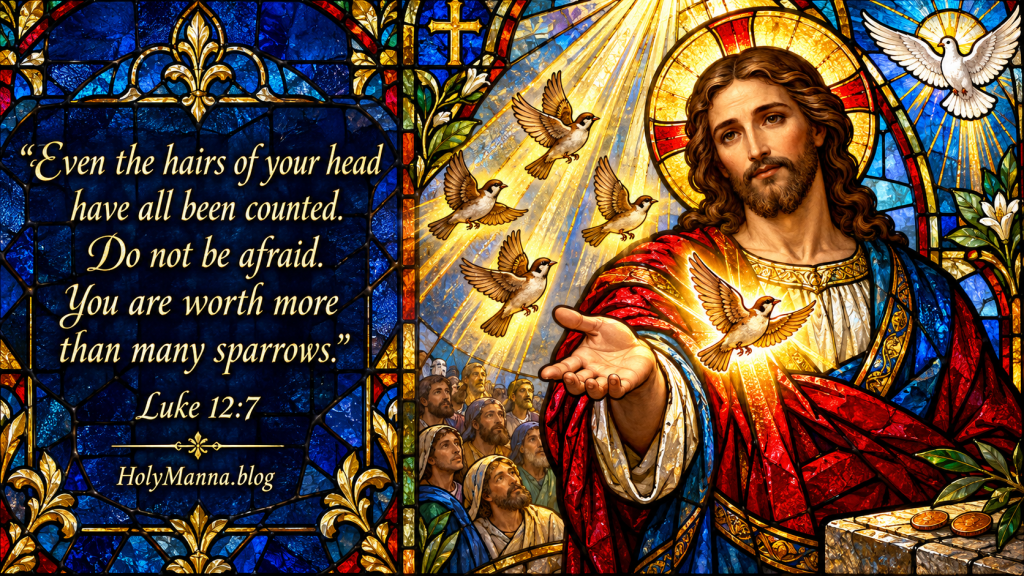
Even the hairs of your head have all been counted.
Do not be afraid.
You are worth more than many sparrows.”
Detailed Exegesis
Verse 1: “At that time: So many people were crowding together that they were trampling one another underfoot. Jesus began to speak, first to his disciples, ‘Beware of the leaven, that is, the hypocrisy, of the Pharisees.’”
Leaven was a loaded image for any Jewish listener. Before Passover, every trace of it had to be hunted out of the house, because a pinch of fermented dough quietly transforms an entire batch. The Greek word hypokrisis described a stage actor performing behind a mask, which is exactly the danger: religion can become theater, and Jesus warns His own circle first, because disciples are not immune.
Verse 2: “There is nothing concealed that will not be revealed, nor secret that will not be known.”
Hypocrisy is not only wicked; it is futile. Every mask has an expiration date. Jesus points toward the final judgment, when all things stand in full light, and the only people with nothing to dread from total disclosure are those already living transparently before God.
Verse 3: “Therefore whatever you have said in the darkness will be heard in the light, and what you have whispered behind closed doors will be proclaimed on the housetops.”
Flat Mediterranean rooftops were the loudspeakers of the ancient world, the place where news was shouted to the neighborhood. Jesus flips the image both ways: secret sins will be published, and the Gospel whispered to a frightened handful will one day be proclaimed openly. Integrity means living now as if everything were already in the light, because eventually it will be.
Verse 4: “I tell you, my friends, do not be afraid of those who kill the body but after that can do no more.”
The address stops the heart a little. Here, uniquely among the Synoptic Gospels, Jesus calls His disciples “my friends,” anticipating the Last Supper. The warning is sober, since persecution is real and bodies can be killed, but the power of persecutors has a hard ceiling. They can take a life; they cannot touch a soul.
Verse 5: “I shall show you whom to fear. Be afraid of the one who after killing has the power to cast into Gehenna; yes, I tell you, be afraid of that one.”
Gehenna was a real address, the Valley of Hinnom south of Jerusalem, where apostate kings once burned their own children in sacrifice before King Josiah defiled the site forever (2 Kings 23:10; Jeremiah 7:31-32). By Jesus’ day its name had become shorthand for final ruin. The verse redirects fear rather than multiplying it: God alone holds eternity, so reverence belongs to Him alone, and every lesser intimidation loses its grip.
Verse 6: “Are not five sparrows sold for two small coins? Yet not one of them has escaped the notice of God.”
Sparrows were the cheapest protein in the market, two for a single copper coin in Matthew’s parallel, and here five for two coins, meaning the fifth bird was tossed in free. Jesus builds His argument on the throwaway sparrow, the one so worthless it had no price. Even that one is known, remembered, and never out of God’s sight.
Verse 7: “Even the hairs of your head have all been counted. Do not be afraid. You are worth more than many sparrows.”
No one counts hairs, not even the vainest influencer. God does. The image is deliberately absurd so the point becomes unforgettable: divine attention reaches detail no human love can match. Then comes the command heaven repeats whenever it draws near: “Do not be afraid.” Fear of God, rightly ordered, does not shrink the soul; it frees it from every other fear.
Teachings
Saint Cyril of Alexandria, Doctor of the Church, preached through this passage in his Commentary on Luke. His verdict on the Pharisees’ leaven is blunt: “Hypocrisy is hateful to God and humanity. It does not bring a reward, and it is utterly useless for the salvation of the soul.” Saint Bede, preserved on this very text in the Catena Aurea of Saint Thomas Aquinas, explains the image: “as a little leaven leavens a whole lump of meal, so hypocrisy will rob the mind of all the purity and integrity of its virtues.” On fear, Aquinas distinguishes in the Summa Theologiae (II-II, q. 19) between servile fear, which dreads punishment, and filial fear, which dreads offending the Father it loves; grace matures the first into the second. The Church does not soften verse 5: “Jesus often speaks of ‘Gehenna,’ of ‘the unquenchable fire’ reserved for those who to the end of their lives refuse to believe and be converted, where both soul and body can be lost” (CCC 1034). Yet she pairs that sobriety with the sparrows: “Jesus asks for childlike abandonment to the providence of our heavenly Father who takes care of his children’s smallest needs” (CCC 305). History supplies the witnesses. Saint Thomas More went to the block rather than betray his conscience before King Henry VIII, reportedly saying, “I die the King’s good servant, but God’s first.” And fittingly for this date, Saint Margaret Mary Alacoque, whose optional memorial falls on October 16th, reported that Jesus revealed His Heart at Paray-le-Monial with the words, “Behold this Heart which has so loved men.” The Heart that counts hairs is the same Heart that burns with love.
Reflection
Everyone curates an image, and the gap between the profile and the person is where leaven grows. Pick one small act of de-masking this week: admit a mistake without spin, let a coworker or friend see the real reason behind a decision, or bring to Confession the sin that has stayed carefully off the record. Then take on fear directly. Name the one fear that most often drives your choices, whether rejection, failure, or financial ruin, and hold it next to verse 7. Memorize the sentence “Do not be afraid. You are worth more than many sparrows” and pray it whenever anxiety spikes. Which room of your life would feel threatened if everything whispered there were proclaimed from the housetops? Do you fear God with the loving reverence of a son or daughter, or do lesser fears still sit on the throne?
Held, Known, and Finally Free
Step back and watch the three readings lock together like movements of a single symphony. Saint Paul opens with the decree: believers have been chosen, destined, and sealed with the Holy Spirit as the first installment of an inheritance God fully intends to deliver. The psalmist turns the decree into a song, because a people who discover they are God’s own inheritance cannot stay quiet about it. Then Jesus walks the doctrine out into a crushing, hostile crowd and shows what it looks like under pressure: no masks, because everything hidden will come to light anyway, and no terror, because the God who holds eternity also counts hairs and keeps track of bargain sparrows. Belonging is the thread running through it all. The sealed soul, the chosen nation, and the counted hair tell one story about a God who claims His people completely and attends to them minutely.
That story asks for a response. Saint Elizabeth of the Trinity, canonized ten years ago this very day, heard these verses and let them rename her entire life as a praise of glory. Saint Thomas More heard them and kept his integrity at the cost of his head. Saint Margaret Mary heard the Heart behind them and spent her life telling the world about its love. The same invitation now rests on every reader of this page: lay down one mask, hand over one fear, and let praise rise in their place. The seal is already pressed into the soul. The down payment has already cleared. The only thing left is to live like someone who belongs to God, because, gloriously and unchangeably, every baptized soul does.
Engage With Us!
Today’s readings are rich soil, and reflection grows best in community, so share your thoughts in the comments below. Here are a few questions to get the conversation started:
- In Ephesians 1:11-14, Saint Paul says believers were sealed with the promised Holy Spirit as the first installment of their inheritance. How does remembering your Baptism and Confirmation as a seal of belonging change the way you face an ordinary Tuesday?
- In Psalm 33:1-2, 4-5, 12-13, the psalmist insists that praise is fitting and that the earth is full of the kindness of the LORD. Where have you spotted God’s hesed, His loyal kindness, in your life this week, and have you thanked Him for it out loud?
- In Luke 12:1-7, Jesus warns against the leaven of hypocrisy and commands His friends not to be afraid. Which is harder for you to surrender, the mask you wear for others or the fear you carry inside, and what one step could you take toward honesty this week?
- Taken together, the readings proclaim that belonging to God casts out both fear and hypocrisy. If you fully believed that God has chosen you, sealed you, and counted every hair on your head, what would you stop hiding, and what would you finally dare to do?
Drop an answer to any of these below, even a short one, because your reflection might be exactly what another reader needs today. Then go live it. Walk into the weekend unmasked and unafraid, praising the God who claimed you first, and doing everything, large and small, with the love and mercy Jesus taught us. You are worth more than many sparrows, and heaven has the receipts.
Sacred Heart of Jesus, we trust in You!
Immaculate Heart of Mary, pray for us!
Saint Michael the Archangel, defend us in battle!
Follow us on YouTube, TikTok, Instagram and Facebook for more insights and reflections on living a faith-filled life.


Leave a Reply