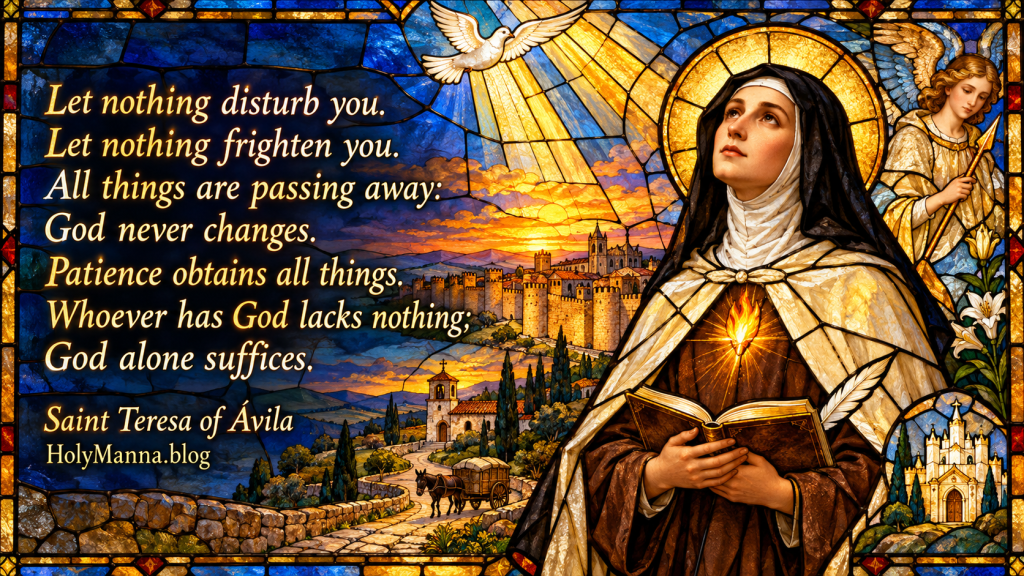
The Restless Mystic
Every so often God raises up a soul so alive, so stubborn, and so in love with Him that the Church is never quite the same afterward. Saint Teresa of Jesus, known to the world as Teresa of Ávila, is one of those souls. Born in 16th century Spain, she was a Carmelite nun who reformed her entire religious order, founded 17 new convents while crisscrossing Castile in a mule cart, experienced some of the most extraordinary mystical graces ever recorded, and wrote books on prayer so profound that the Church declared her the first woman Doctor of the Church in 1970. Her masterpiece, The Interior Castle, remains one of the greatest maps of the spiritual life ever drawn, and the Catechism of the Catholic Church quotes her by name when it defines contemplative prayer itself (CCC 2709). The Church celebrates her memorial on October 15th.
She is the patroness of Spain, of headache and migraine sufferers, of the sick, of people in religious orders, of people ridiculed for their piety, and of lacemakers. That list alone tells a story. Teresa knew chronic illness, knew mockery, knew the hidden life of the cloister, and knew what it meant to keep working with her hands while her heart burned for God. Few saints feel more startlingly modern, and few have more to say to a generation drowning in anxiety and distraction.
A Runaway Child with Heaven on Her Mind
Teresa Sánchez de Cepeda y Ahumada was born on March 28th, 1515, in the province of Ávila in Castile, Spain. Her father, Don Alonso Sánchez de Cepeda, was a serious and devout man who loved good books; her mother, Doña Beatriz de Ahumada, was pious and gentle, and died when Teresa was only about 13 or 14 years old. The household was large, with roughly a dozen children between two marriages. One detail of her origins is often overlooked and is worth remembering. Her paternal grandfather, Juan Sánchez de Toledo, was a Jewish convert to Christianity who had been publicly penanced by the Inquisition in Toledo in 1485. The woman who would become the glory of Spanish Catholicism came from a family that Spanish society had once humiliated. God writes straight with crooked lines, and He delights in choosing what the world overlooks.
Teresa’s fire showed early. In her autobiography, The Life of Teresa of Jesus, she recounts that at about 7 years old she convinced her brother Rodrigo to run away with her to the land of the Moors, hoping to be beheaded for Christ and go straight to heaven. As they walked they kept repeating that the reward of the blessed lasts “for ever, for ever, for ever.” An uncle spotted the two little pilgrims outside the city walls and marched them home. The martyrdom plan failed; the longing behind it never left her.
After her mother’s death, Teresa drifted. By her own honest account she became vain, obsessed with romances and appearances, and spiritually lukewarm. Her worried father placed her with the Augustinian nuns of Our Lady of Grace around 1531. During a later illness and convalescence, reading the Letters of Saint Jerome tipped the scales, and she resolved to enter religious life, admitting that at first she chose it less from burning love than from a clear-eyed desire to take the safest road to salvation. In 1535 she entered the Carmelite Monastery of the Incarnation in Ávila, against her father’s initial wishes, and made her profession about two years later. Some sources give 1536 for her entry; the traditional date is November of 1535.
Then her body broke. Shortly after profession she fell gravely ill, possibly with malaria, and in 1539 she sank into a coma so deep that for 4 days she was taken for dead and a grave was dug for her. She survived, but paralysis crippled her for roughly 3 years. She always attributed her recovery to the intercession of Saint Joseph, and her lifelong devotion to him is one reason so many Carmels around the world bear his name. The Church teaches that the saints in heaven truly intercede for the faithful on earth and that their prayer is their highest service to God’s plan (CCC 2683; CCC 956), and Teresa lived that truth from both sides, first as a sick young nun begging Saint Joseph’s help, and later as a heavenly intercessor herself.
Her definitive conversion came slowly. For nearly two decades she lived a divided life, drawn to prayer yet attached to the parlor conversations and social comforts of a large, relaxed convent. In 1554, before a statue of the gravely wounded Christ, an Ecce Homo, she was pierced with sorrow at how little she had returned to the One who had suffered so much for her. Around the same time, Saint Augustine’s Confessions struck her like a mirror. From that moment, she later wrote, she belonged to God without reserve. Her story is proof that conversion is not always a lightning bolt; sometimes it is a long siege that grace finally wins.
The Reform That Began with Thirteen Nuns
What is Teresa most known for? Two things that are really one thing: prayer, and the reform that flowed from it. As her prayer deepened, God flooded her with mystical graces: raptures, interior words, visions of Christ, and a vision of hell so terrifying that she said it left her with unshakable gratitude and a burning urgency for souls. In The Life, chapter 29, she describes the most famous of these graces, the transverberation, in which an angel appeared beside her holding a fiery golden dart: “I saw in his hand a long spear of gold, and at the iron’s point there seemed to be a little fire. He appeared to me to be thrusting it at times into my heart. The pain was so great, that it made me moan; and yet so surpassing was the sweetness of this excessive pain, that I could not wish to be rid of it.” Centuries later, Bernini would freeze that moment in marble in Rome. Witnesses in her canonization process, including Sister Anne of the Incarnation, testified under oath that they saw Teresa raised off the ground during prayer, favors Teresa herself found mortifying and begged God to hide.
For all the ecstasies, Teresa remained ruthlessly practical. Her most quoted definition of prayer, enshrined in the Catechism at CCC 2709, is disarmingly simple: “Contemplative prayer in my opinion is nothing else than a close sharing between friends; it means taking time frequently to be alone with him who we know loves us.” No technique, no performance; friendship with God. And she insisted holiness lives in ordinary work, telling her busy sisters in The Book of the Foundations, chapter 5, that “the Lord walks among the pots and pans.”
That friendship with God demanded action. Grieved by the laxity of her large convent, where enclosure was loose and visitors constant, Teresa resolved to found a small community living the primitive Carmelite Rule in poverty, silence, and strict enclosure. On August 24th, 1562, with 13 nuns, she opened the Convent of Saint Joseph in Ávila, the first house of the Discalced, or barefoot, Carmelites. The town erupted in opposition; lawsuits and public outrage followed, since a convent without endowment seemed a burden on the city. Teresa held firm, trusting Providence. From 1567, with the blessing of the Carmelite Prior General, she took the reform on the road, founding 17 reformed convents across Spain in 20 years, negotiating with bishops, landlords, and skeptical townspeople, often arriving at midnight in a creaking cart with a few nuns and almost no money. Some historians count 16 foundations rather than 17, depending on how the houses are tallied, but the standard Discalced count is 17. Along the way she met a short, brilliant young friar, John of Saint Matthias, and recruited him to carry the reform to the men. The world knows him now as Saint John of the Cross, Doctor of the Church, and the friendship between these two mystics is one of the great collaborations in Christian history.
One miracle tradition from her lifetime is especially tender. During construction at Saint Joseph’s, a wall collapsed onto her small nephew, Gonzalo de Ovalle, and the child was pulled out lifeless. The story, recounted by her early biographers and in canonization testimony, holds that Teresa took the boy into her arms, prayed in silence, and after some minutes handed him back to his mother alive and unharmed. This account cannot be independently verified and is presented here as the tradition handed down in her cause. What is beyond dispute is why the reader should remember and imitate Teresa: she shows that the deepest contemplation and the hardest work are not rivals but partners, and that one determined soul, wholly surrendered to God, can renew the Church from the inside.
Persecuted by Her Own Household
Teresa was never martyred, but the hardships of her life were relentless, and many of the sharpest wounds came from inside the Church she loved. Her health never fully recovered from her youth; she battled chronic illness, fevers, and ferocious headaches for the rest of her life, which is why headache sufferers claim her patronage today. She traveled thousands of miles over freezing mountain passes and flooded rivers, in heat and snow, well into her sixties.
The spiritual suspicion cut deeper. In an era when the Inquisition was hunting false mystics, a nun reporting visions was automatically suspect. Several early confessors told Teresa her experiences came from the devil and ordered her to resist them. Her autobiography was denounced to the Spanish Inquisition and held for years under examination, partly through the spite of the Princess of Éboli, a powerful noblewoman who had clashed with Teresa. Teresa herself was never condemned, and her writings were ultimately vindicated, but she lived for years under a cloud that would have crushed a weaker soul. She met it with obedience, transparency, and that wry Castilian steadiness that made her beloved even by her examiners.
Then came the war within Carmel. From 1575 to 1580, the friars of the older observance, alarmed at the growth of the reform, moved to crush it. Teresa was ordered to cease founding and confine herself to a convent, effectively a house arrest. Worse, in December of 1577, Saint John of the Cross was seized, carried off to Toledo, and imprisoned for 9 months in a tiny cell, beaten regularly, until his daring escape. Teresa wrote letters to King Philip II pleading for justice and feared for the reform’s survival. Through it all she kept repeating the trust she had written in a poem found in her own breviary, words the Catechism itself commends to anyone learning to trust God (CCC 227): “Let nothing disturb you. Let nothing frighten you. All things are passing away: God never changes. Patience obtains all things. Whoever has God lacks nothing; God alone suffices.” In 1580, Pope Gregory XIII erected the Discalced Carmelites as a separate province, and the reform was saved.
Her last journey was her hardest. In 1582, elderly and gravely ill, she was dragged along muddy roads to attend a noblewoman’s childbed, arriving at her convent in Alba de Tormes exhausted and dying. On the night of October 4th, 1582, at the age of 67, she received the Lord in Viaticum with radiant joy. Witnesses at her bedside recorded her repeating the verse of Psalm 51, “a heart contrite and humbled, O God, you will not spurn,” and saying words to the effect of “At last, I die a daughter of the Church.” Those present reported a sweet fragrance filling the room, the odor of sanctity. By a stroke of Providence almost too perfect to invent, Spain adopted the Gregorian calendar reform that very night, so the day after October 4th was October 15th, which is why her feast is kept on the 15th. The Church teaches that for the Christian, death is the end of the earthly pilgrimage and the doorway to seeing God, and the Catechism places Teresa’s own dying desire on its pages: “I want to see God, and in order to see him, I must die” (CCC 1011).
The Body That Would Not Return to Dust
What happened after Teresa’s death reads like a continuation of her story rather than an epilogue. When her body was exhumed in 1583, and again in November of 1585, it was found incorrupt, flexible, and fragrant. In the fervor of the age her relics were, frankly, treated roughly: a hand was removed and sent to Ávila, an arm was left with the grieving nuns of Alba de Tormes, and pieces were dispersed across Europe as treasured relics. After a tug of war between Ávila and Alba de Tormes, Rome ruled that her body remain at Alba de Tormes, where it rests today in a silver tomb donated by King Ferdinand VI, locked behind 10 keys held by the Carmelites of Alba, the Duke of Alba, the Father General of the Discalced Carmelites in Rome, and the King of Spain.
The story reached a stunning modern chapter within the last two years. On August 28th, 2024, the tomb was opened for the first time since 1914 so that Vatican-approved medical experts could study her relics. The postulator general of the Discalced Carmelites, Father Marco Chiesa, announced that the body was found in the same incorrupt condition as in 1914, more than 440 years after her death. Then, from May 11th to 25th, 2025, her body was exposed for public veneration in the Basilica of the Annunciation in Alba de Tormes, only the third public exposition since her death, after brief openings in 1760 and 1914, and more than 90,000 pilgrims came to pray before her. Her incorrupt heart, preserved separately at Alba de Tormes, is traditionally venerated as bearing the wound of the transverberation; the wound tradition is a matter of devotion rather than formal Church definition, and it is presented here as such. Devotional tradition also tells of a holy fragrance and even oil exuding from her relics over the centuries, and of healings granted at her tomb; these stories rest on pious testimony and cannot be independently verified. One strange historical footnote is fully documented: her severed hand relic was kept for decades by General Francisco Franco, who had it with him until his death in 1975, after which it was returned to the Carmelite nuns of Ronda.
The Church’s formal judgment on Teresa came quickly and kept growing. She was beatified by Pope Paul V on April 24th, 1614, and canonized by Pope Gregory XV on March 12th, 1622, in a single legendary ceremony alongside Saint Ignatius of Loyola, Saint Francis Xavier, Saint Philip Neri, and Saint Isidore the Farmer. In 1617 the Spanish Cortes proclaimed her patroness of Spain. On September 27th, 1970, Saint Paul VI declared her the first woman Doctor of the Church, with Saint Catherine of Siena honored days later. When the Church canonizes a saint, she solemnly proclaims that this person practiced heroic virtue and lived in fidelity to God’s grace, holding them up as a model and intercessor for the faithful (CCC 828). Teresa is that in abundance. Pilgrims today walk the walls of Ávila, pray in the Convent of Saint Joseph she founded, and kneel at Alba de Tormes; Bernini’s Ecstasy of Saint Teresa draws crowds in Rome; and her spiritual daughters and sons, the Discalced Carmelites, span the globe, a family that later gave the Church Saint Thérèse of Lisieux, Saint Teresa Benedicta of the Cross, and Saint Elizabeth of the Trinity. One honest caution for the digital age: the beloved poem that begins with the line that Christ has no body now on earth but ours, so often shared online under her name, appears nowhere in Teresa’s writings and should not be attributed to her. Her real words need no borrowing.
Letting Nothing Disturb You in an Age of Anxiety
Teresa of Ávila feels like she was canonized for this exact cultural moment. She lived with chronic illness, institutional suspicion, public ridicule, crushed plans, and decades of spiritual dryness, and she came through it all not bitter but luminous, because she anchored everything in friendship with God. Her definition of prayer at CCC 2709 is the antidote to a generation that treats prayer like a productivity hack or an aesthetic. Prayer is simply time alone, taken frequently, with the One who loves you. Not performance; presence. When was the last time you gave God 15 unhurried minutes, not to ask for anything, but simply to be with Him as a friend?
Her life also demolishes the false choice between contemplation and action. The woman who reached the seventh mansion of The Interior Castle also haggled over property deeds, nursed sick nuns, answered mountains of letters, and reminded her sisters that the Lord walks among the pots and pans. Holiness for Teresa was never an escape from ordinary life; it was ordinary life set on fire. The dishes, the commute, the spreadsheet, the crying toddler at 3 in the morning: all of it can become prayer when it is done with love and offered to God. What is the most repetitive, unglamorous task in your week, and what would change if you did it tomorrow as an act of love for Jesus?
Finally, Teresa teaches resilience rooted in eternity. Her breviary prayer, quoted at CCC 227, is worth memorizing and praying in every season of panic: let nothing disturb you, let nothing frighten you, all things are passing, God never changes. Anxiety shouts that everything is urgent and everything is fragile. Teresa answers that only one thing is necessary, and that whoever has God lacks nothing. Practically, that can look like beginning each morning with her prayer before touching a phone, keeping a set daily appointment for silent mental prayer, going to Confession after seasons of lukewarmness instead of waiting to feel worthy, and asking Saint Joseph’s intercession in impossible situations, exactly as she did. What fear would lose its grip on you this week if you truly believed that God alone suffices?
Engage With Us!
Saint Teresa of Jesus spent her whole life convincing ordinary, busy, distracted people that deep friendship with God was possible for them, and she would say the same to every reader today. Share your thoughts and reflections in the comments below; your story might be exactly what another reader needs to begin praying again. Here are some questions to pray with this week:
- Teresa described prayer as taking time frequently to be alone with the One who loves us. What concretely keeps you from that time, and what is one change you can make this week to protect it?
- Teresa endured years of dryness and suspicion before her breakthrough in 1554. Have you been treating a season of spiritual dryness as a reason to quit, rather than as an invitation to persevere?
- Teresa said the Lord walks among the pots and pans. Which ordinary duty in your life is God asking you to transform into an offering of love?
- Teresa died saying she was a daughter of the Church, even after the Church’s own members had caused her deep suffering. How is God calling you to love the Church faithfully, wounds and all?
- If you prayed “God alone suffices” over the biggest anxiety in your life right now, what would you have to release into His hands?
Saint Teresa ran toward martyrdom at 7 years old and spent the next 60 years learning that the slower martyrdom of daily faithfulness is just as glorious. Take her hand this week. Pray a little every day, work with love, trust God in the storm, and let nothing disturb you. Live your faith boldly, and do everything with the love and mercy that Jesus taught us.
Saint Teresa of Ávila, pray for us!
Follow us on YouTube, TikTok, Instagram and Facebook for more insights and reflections on living a faith-filled life.


Leave a Reply