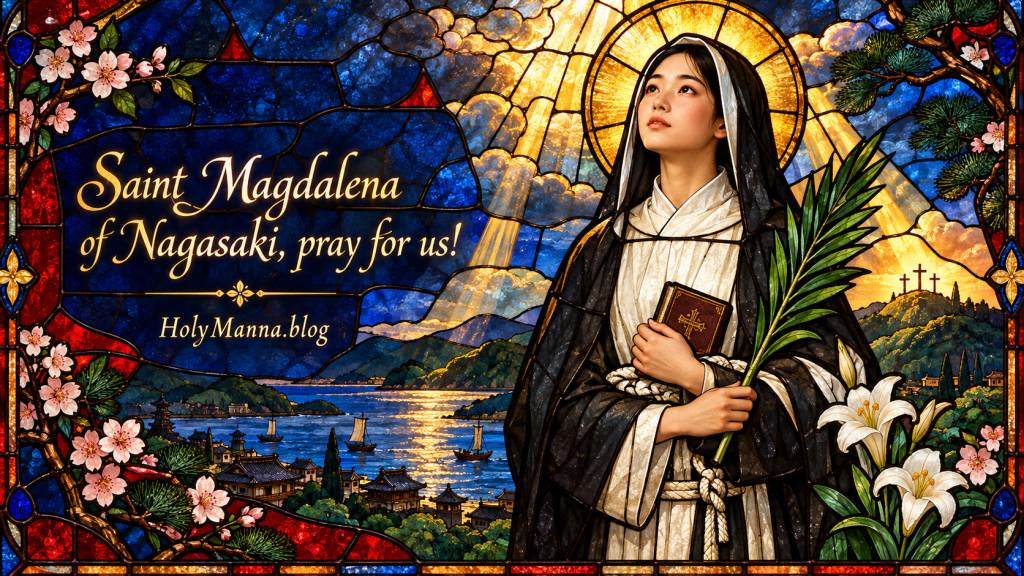
A Light the Shogun Could Not Extinguish
There are saints whose stories unfold in cathedrals and royal courts, and there are saints whose stories unfold in hiding places, on muddy hillsides, and at the bottom of a pit. Saint Magdalena of Nagasaki belongs to the second kind, and that is exactly why her witness still burns so brightly nearly 4 centuries after her death. She was a Japanese laywoman in her early twenties, an interpreter and catechist, a consecrated virgin, and a tertiary of two great religious families, the Augustinian Recollects and the Dominicans. When the machinery of the Tokugawa shogunate was crushing the faith of her people and even seasoned missionaries were breaking under torture, this young woman walked down from the hills where she had been hiding, presented herself to the persecutors in her religious habit, and declared herself a Christian. She died on October 15th, 1634, after 13 days of one of the cruelest tortures ever devised, at 23 years old.
Jesus told his disciples in The Gospel of John, “No one has greater love than this, to lay down one’s life for one’s friends” (Jn 15:13). Magdalena took those words literally, not as poetry but as a plan. The Catechism teaches that “Martyrdom is the supreme witness given to the truth of the faith: it means bearing witness even unto death” (CCC 2473), and her entire short life was an education in that witness. Pope Saint John Paul II beatified her in Manila on February 18th, 1981, in the first beatification ceremony ever celebrated outside Rome, and canonized her at Saint Peter’s on October 18th, 1987, among the 16 Martyrs of Japan led by Saint Lorenzo Ruiz. Today she is honored as the patroness of the Secular Augustinian Recollects, the lay fraternity of the Order of Augustinian Recollects, which looks to her as the model of what a layperson wholly given to Christ can become. Her commemoration in the Roman Martyrology falls on October 15th, the day she entered eternal life, while the universal calendar remembers her with Saint Lorenzo Ruiz and companions on September 28th and the Augustinian family keeps her memory in late October.
A Daughter of Martyrs in a Land on Fire
To understand Magdalena, the reader has to understand the Japan she was born into. Saint Francis Xavier had brought the Gospel to Japan in 1549, and within two generations the Church there numbered in the hundreds of thousands, one of the great missionary flowerings in history. Nagasaki itself became so thoroughly Catholic that it was called the Rome of Japan. Then the tide turned. In 1597, 26 Christians, including the Jesuit Saint Paul Miki, were marched through the winter cold and crucified on Nishizaka Hill overlooking Nagasaki. In 1614 the Tokugawa shogunate issued a sweeping edict expelling missionaries and outlawing the faith, accusing Christians of spreading a wicked law and plotting against the authority of the country. What followed was one of the most systematic and inventive persecutions the Church has ever endured, a persecution designed not merely to kill Christians but to make them deny Christ publicly.
Magdalena was born into the middle of this storm, around the year 1611, in a small community near Nagasaki. Most sources give 1611 as her birth year, while some Augustinian Recollect accounts say around 1610; the difference is small and the sources are honest about the uncertainty. What is certain is that her parents were devout Japanese Catholics, and that they paid the full price for it. Around 1620, when Magdalena was roughly 9 years old, her mother and father were martyred for the faith, and Augustinian accounts record that siblings died with them. Imagine that for a moment. Before she was 10, this little girl had learned that in her country, loving Jesus Christ could cost a family everything, and she had watched her own family pay it.
Many children would have grown bitter, or fearful, or quietly compliant. Magdalena grew bold. In 1623 the first Augustinian Recollect missionaries reached Japan, and the following year Magdalena came to know two of them, Father Francis of Jesus and Father Vincent of Saint Anthony. She was drawn to their deep interior spirituality, that distinctly Augustinian restlessness for God, and she made herself indispensable to them, serving as their interpreter and catechist in a land where a foreign priest could not survive without trusted Japanese collaborators. Around 1625 Father Francis received her into the Third Order of Saint Augustine. She consecrated her virginity to God, put on the habit and cincture of a tertiary, and became known among the Japanese Christians as a woman of the cincture, a visible sign of total belonging to Christ in a country where visibility could be a death sentence. Jesus had promised in The Gospel of Matthew, “Everyone who acknowledges me before others I will acknowledge before my heavenly Father” (Mt 10:32), and Magdalena chose acknowledgment over concealment at the very moment when concealment was the only safe option.
The Apostle of the Hills
What did holiness look like for a young laywoman in persecuted Japan? It looked like work. Magdalena taught catechism to children, begged alms for the poor, encouraged families under pressure, and strengthened the faith of Christians who were being hunted. When the persecution intensified around 1629 and public Christian life became impossible, she withdrew into the hills surrounding Nagasaki and carried on a hidden apostolate among the refugees there, baptizing infants, visiting the sick, instructing believers, and preparing souls for the very real possibility of martyrdom. She was, in the most literal sense, a lay missionary to her own people.
This is worth pausing on, because the Church teaches that this kind of apostolate is not a substitute ministry for places without priests but a true vocation flowing from Baptism itself. The Catechism says that lay people have the right and duty “to work so that the divine message of salvation may be known and accepted by all men throughout the earth” (CCC 900), and that “The disciple of Christ must not only keep the faith and live on it, but also profess it, confidently bear witness to it, and spread it” (CCC 1816). Magdalena had no pulpit, no parish, no platform. She had a cincture, a catechism, and a pair of sandals, and with those she helped hold together a Church that the most powerful government in Asia was trying to erase.
Honesty requires saying plainly that the sources record no wonder-working miracles performed by Magdalena during her lifetime. No multiplication of rice, no healings at her hands, no visions are documented. Her miracle was of another kind, the kind The Catechism calls the supreme witness, a perseverance that human strength alone cannot explain. And she needed it, because her life became a relentless procession of loss. Fathers Francis and Vincent, her first spiritual fathers, were arrested and then burned alive on Nagasaki’s Hill of the Martyrs on September 3rd, 1632. Orphaned a second time, Magdalena placed herself under the guidance of two more Augustinian Recollects, Father Melchior of Saint Augustine and Father Martin of Saint Nicholas, and within months, in December of 1632, they too were martyred. She then turned to a Dominican missionary, Father Giordano Ansalone, known in religion as Jordan of Saint Stephen, and under his direction she affiliated herself with the Dominican Third Order as well. This is why the Vatican’s official canonization biography describes her simply as “Japanese, Augustinian and Dominican tertiary.” Four spiritual directors, four martyrs. The ancient observation preserved in The Catechism, quoting Tertullian, that “the blood of martyrs is the seed of Christians” (CCC 852), was not a slogan to Magdalena. It was her address book.
The Surrender That Shook Nagasaki
By the early 1630s the persecutors had refined their methods. Killing Christians quickly, they had learned, only produced heroes, so they designed tortures meant to produce apostates instead. The most feared was the ana-tsurushi, the torture of the pit. The victim was tightly bound, often with one hand left free to signal recantation, and hung upside down from a gibbet into a deep pit filled with filth, with the body lowered to the waist or shoulders. The pressure, the stench, the darkness, and the slow agony broke most victims within hours. In October 1633 it broke Father Cristóvão Ferreira, the Jesuit provincial of Japan, whose apostasy after roughly 6 hours in the pit sent a shockwave of despair through the hidden Christian community. If the shepherds were falling, what hope did the sheep have?
Magdalena watched Christians she had catechized renounce the faith under torment, and she reached a decision that still staggers the imagination. She concluded that the best service she could render her wavering brothers and sisters was to show them, in her own body, that the grace of Christ is stronger than the pit. The Vatican’s canonization biography records that when her Dominican director was arrested, she presented herself to the guards and declared that she was a Christian. Augustinian sources date her voluntary surrender to September 1634 and add two details preserved by witnesses: she came dressed in the habit and cincture of an Augustinian Recollect tertiary, and she carried devotional books with her for meditation in prison. She did not stumble into martyrdom. She walked into it dressed for the occasion, with her spiritual reading packed.
The judges tried everything short of immediate execution. They flattered her youth, they threatened, they ridiculed, they promised. She refused to apostatize. The documented tortures that followed included the dreaded water torture, in which the victim was forced to swallow enormous quantities of water and then struck violently so that the water, mixed with blood, was expelled from the body. Through it all she remained firm. Finally she was condemned to the pit. Witness accounts preserved by the religious orders describe her being paraded on horseback through the streets of Nagasaki with a placard hanging from her neck announcing her crime, which was refusing to abandon the Christian faith. The Augustinian Recollects tell the story that even from the horse she did not stop proclaiming Christ to the crowds along the way; this detail comes from devotional retellings of the early testimony and cannot be verified.
On the execution ground she was hung upside down into the pit. Most victims lasted hours. Magdalena lasted 13 days. The Augustinian Recollects also tell the story that during those days her voice could be heard from the pit, praying and encouraging the Christians who dared to come near; this too belongs to the devotional tradition and cannot be verified. What the official record states is stark enough. The Vatican biography says that she was tortured cruelly, remained firm in her faith, and died on the gibbet after 13 days. Augustinian and Augustinian Recollect accounts, drawn from testimony gathered within a few years of her death, add that at the end heavy rains filled the pit with water and she drowned, still bound, still faithful. She died on October 15th, 1634, at 23 years old. The authorities, who understood very well how Catholics treasure the relics of martyrs, burned her body and scattered the ashes over Nagasaki Bay so that nothing of her could be kept. They thought they were erasing her. In reality they were fulfilling Scripture, for the Lord says in The Book of Revelation, “Remain faithful until death, and I will give you the crown of life” (Rev 2:10). The Catechism teaches that “Fortitude is the moral virtue that ensures firmness in difficulties and constancy in the pursuit of the good” and that it “enables one to conquer fear, even fear of death” (CCC 1808). For 13 days, suspended between heaven and the mud, Magdalena of Nagasaki showed the world what that virtue looks like when God himself sustains it.
Glory After the Ashes
The persecutors scattered her ashes, but they could not scatter her memory. Missionaries and Japanese Christians who had known Magdalena gave detailed testimony about her life and martyrdom in the 1630s, and those records were carefully preserved by the Dominicans and Augustinians. The Catechism observes that “The Church has painstakingly collected the records of those who persevered to the end in witnessing to their faith” (CCC 2474), and Magdalena’s story is a textbook case, because without those early testimonies her cause could never have advanced after Japan sealed itself off from the world. For more than 2 centuries the Japanese Church survived underground, as the hidden Christians secretly passed on Baptism and prayers from parents to children without a single priest. When Japan finally reopened and Father Bernard Petitjean encountered descendants of those hidden Christians at the Oura church in Nagasaki in 1865, the world discovered that the faith Magdalena died to strengthen had never actually died. The seed sown in the pit had kept growing in the dark.
Her path to the altars came in the 20th century, and it came with firsts. On February 18th, 1981, during his apostolic journey to the Philippines, Pope Saint John Paul II beatified Magdalena in Manila together with Lorenzo Ruiz and companions, the first beatification ceremony in the history of the Church celebrated outside Rome. On October 18th, 1987, in Saint Peter’s Square, he canonized the same group, the 16 Martyrs of Japan, which includes Dominican priests from Spain, Italy, France, and Japan, Japanese catechists and tertiaries, the Filipino layman and family father Saint Lorenzo Ruiz, and 2 women, Magdalena of Nagasaki and Marina of Omura. The Catechism explains that by canonizing some of the faithful “the Church recognizes the power of the Spirit of holiness within her” (CCC 828), and in this canonization she recognized that power at work in a young laywoman whose only earthly monument was a bay full of ashes.
The miracle approved for the canonization is itself a beautiful story of the communion of saints. In Manila in 1983, a 2-year-old girl named Cecilia Alegria Policarpio, suffering from brain paralysis that no therapy had been able to treat effectively, was completely cured through the intercession of this group of martyrs. Pope John Paul II formally recognized the miracle on June 1st, 1987. It should be said honestly that the Church attributes this healing to the intercession of the whole company of martyrs rather than to Magdalena individually, and that no separate miracles are formally documented under her name alone; she stands within that company, and The Catechism teaches of the saints in glory that “they do not cease to intercede with the Father for us” (CCC 956).
Because her relics were destroyed, devotion to Magdalena gathers around places and communities rather than a tomb. The Minor Basilica and National Shrine of Saint Lorenzo Ruiz and Companions in Binondo, Manila, honors the whole group of martyrs and draws pilgrims from across Asia. In Nagasaki, pilgrims climb Nishizaka Hill, the Hill of the Martyrs where her spiritual fathers died and where the 26 Martyrs are memorialized, and the Augustinian Recollects describe a stone statue of Magdalena in her tertiary habit standing in the city as a tribute to the thousands of Japanese laypeople who chose the pit over apostasy. Her feast is kept with particular love by the worldwide Augustinian Recollect family, and above all by the Secular Augustinian Recollects, who venerate her as their patroness, the proof that their lay vocation can be lived all the way to heroic sanctity. The Christian sites of the Nagasaki region, witnesses to the era of persecution she died in, are now recognized around the world, and when Pope Francis stood at Nishizaka in 2019 to honor the martyrs of Japan, Magdalena was part of the great cloud of witnesses he was honoring.
Courage for the Quietly Faithful
It would be easy to file Magdalena’s story under extreme circumstances and move on, since most readers will never face a magistrate demanding apostasy. But look closer, because almost everything she did is repeatable. She was a young layperson. She had no ordination, no degree, no institutional power. She learned her faith well enough to teach it to children. She served the poor. She stayed close to holy spiritual guides, and when she lost them, she found new ones instead of drifting. She made her belonging to Christ visible, wearing her cincture when hiding it would have been safer. And when the people around her were quietly giving up, she did not lecture them; she strengthened them by the way she herself stood firm. The Catechism teaches that the duty of Christians impels them “to act as witnesses of the Gospel” (CCC 2472), and witness was Magdalena’s entire method.
Modern life offers its own gentler versions of the magistrate’s tribunal. The office conversation where mentioning Mass feels risky. The group chat where defending Church teaching costs social capital. The dating culture that treats consecrated chastity as absurd. The slow pull to let the faith become private, invisible, and finally optional. Magdalena’s answer to every one of those pressures was the same: visible, cheerful, costly fidelity, sustained not by willpower but by grace, for as the Lord told Saint Paul, “My grace is sufficient for you, for power is made perfect in weakness” (2 Cor 12:9). Practical imitation might look like this: learn the faith seriously enough to hand it on, because Magdalena was a catechist before she was a martyr; find a good confessor or spiritual director and actually listen; take on one hidden work of mercy for the poor or the sick each week; and when a fellow Catholic is wavering, be the one who encourages rather than the one who shrugs. Where in daily life does the temptation to hide the faith show up most? Who in the reader’s circle is quietly wavering right now, and what would it cost to walk toward them instead of away? Jesus promised, “Blessed are they who are persecuted for the sake of righteousness, for theirs is the kingdom of heaven” (Mt 5:10), and Magdalena of Nagasaki is living proof that the promise holds.
Engage With Us!
Saint Magdalena’s story deserves more than a quick read; it deserves a conversation. Share your thoughts and reflections in the comments below, because someone scrolling past might need exactly the insight God has placed on your heart. To get the discussion started, consider these questions:
- Magdalena made her faith visible by wearing her tertiary habit when hiding it would have been safer. What is one concrete way you can make your faith more visible this week?
- She surrendered herself to strengthen Christians who were wavering. Who in your life needs encouragement in the faith right now, and how will you offer it?
- Four of her spiritual directors were martyred, yet she kept seeking guidance. Do you have a confessor, director, or holy friend who challenges you toward sanctity, and if not, what is stopping you?
- Magdalena was a catechist before she was a martyr. How well could you explain the faith to a curious friend, and what is one topic you could study this month?
- Her ashes were scattered so nothing of her would remain, yet her witness endures. What do you want your own legacy of faith to be?
Saint Magdalena of Nagasaki walked down from the hills so that others would not fall, and she trusted that the God who held her over the pit would hold her forever. Let her courage stir something in you today. Go to Mass this week like it matters, speak of Christ without apology, strengthen the person beside you who is struggling, and do everything, the brave things and the hidden things alike, with the love and mercy that Jesus taught us.
Saint Magdalena of Nagasaki, virgin and martyr, pray for us!
Follow us on YouTube, TikTok, Instagram and Facebook for more insights and reflections on living a faith-filled life.


Leave a Reply