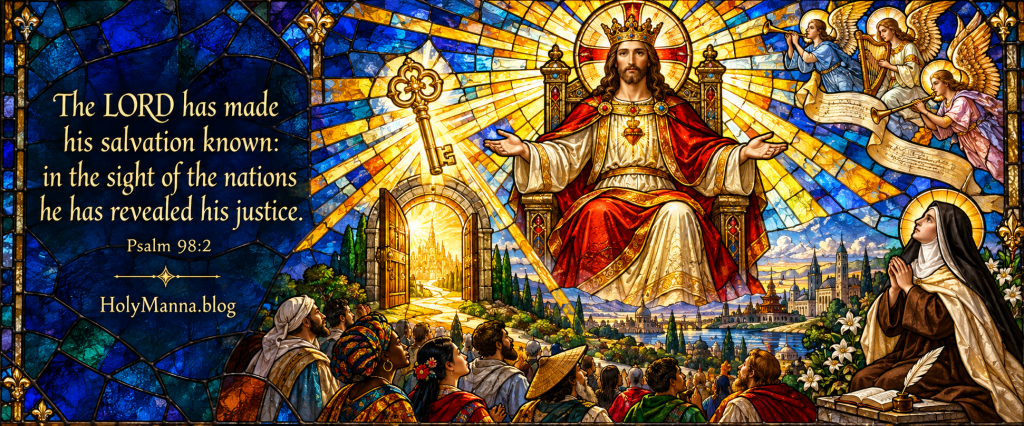
Memorial of Saint Teresa of Jesus, Virgin and Doctor of the Church – Lectionary: 470
The Night the Calendar Skipped Ten Days
There is a strange historical detail hiding inside this Memorial. St. Teresa of Jesus died at Alba de Tormes during the night of October 4th, 1582, the very night Spain adopted the Gregorian calendar. Ten days vanished from the civil record, and the next morning dawned as October 15th. The great mystic of Avila slipped out of time itself on a night that, in a sense, never existed, and the Church now celebrates her on the day the world woke up to a new reckoning. It is a fitting image for a woman who spent her life insisting that God is not far away, not hidden behind locked doors, but waiting in the innermost room of the soul.
The readings for her Memorial, Lectionary 470, carry one central theme: God has made himself known, and he wants to be known. In Ephesians 1:1-10, St. Paul erupts into a single breathless sentence of praise because God “has made known to us the mystery of his will.” In Psalm 98, the whole earth is summoned to sing because “the LORD has made his salvation known.” Then Luke 11:47-54 delivers the sobering counterpoint: Jesus pronounces woe upon religious experts who “have taken away the key of knowledge,” men who refused to enter and blocked the door for everyone else. Revelation offered, revelation celebrated, revelation obstructed. St. Teresa stands at the center of it all as living proof of what happens when a soul takes the key, turns the lock, and walks into friendship with God. That journey begins here, with the Apostle Paul writing from a Roman prison.
First Reading — Ephesians 1:1-10
One Sentence That Contains the Whole Plan of God
St. Paul wrote to the Ephesians around the year 62, most likely from house arrest in Rome, and many scholars believe the letter circulated among several churches in Asia Minor with Ephesus at the center. Ephesus was no quiet backwater. It was a wealthy port city built around the Temple of Artemis, one of the wonders of the ancient world, with a booming trade in magic scrolls and amulets, as Acts 19 vividly records. Into that marketplace of anxious superstition, Paul sends a thunderclap of confidence. In the original Greek, verses 3 through 10 form one single, unbroken sentence, a Jewish blessing prayer, a berakah, poured out over Christ. The Apostle cannot stop to breathe because the content is too good: before anything existed, God had a plan, and the plan was always Christ, and the plan always included the baptized. On the Memorial of St. Teresa, who called God her friend, this reading reveals why such friendship is even possible. God chose it first.
Ephesians 1:1-10
Paul, an Apostle of Christ Jesus by the will of God,
to the holy ones who are in Ephesus
and faithful in Christ Jesus:
grace to you and peace from God our Father and the Lord Jesus Christ.Blessed be the God and Father of our Lord Jesus Christ,
who has blessed us in Christ
with every spiritual blessing in the heavens,
as he chose us in him, before the foundation of the world,
to be holy and without blemish before him.
In love he destined us for adoption to himself through Jesus Christ,
in accord with the favor of his will,
for the praise of the glory of his grace
that he granted us in the beloved.In Christ we have redemption by his Blood,
the forgiveness of transgressions,
in accord with the riches of his grace that he lavished upon us.
In all wisdom and insight, he has made known to us
the mystery of his will in accord with his favor
that he set forth in him as a plan for the fullness of times,
to sum up all things in Christ, in heaven and on earth.
Detailed Exegesis
Verses 1 and 2: “Paul, an Apostle of Christ Jesus by the will of God, to the holy ones who are in Ephesus and faithful in Christ Jesus: grace to you and peace from God our Father and the Lord Jesus Christ.”
Paul opens with his credentials, not as a boast but as a claim of origin. His apostleship exists “by the will of God,” the same divine will that drives this entire passage. He addresses ordinary believers as “holy ones,” saints, because holiness in the New Testament begins as a gift received in Baptism before it becomes a task. Grace and peace are not pleasantries here; they are the two great effects of the Gospel.
Verse 3: “Blessed be the God and Father of our Lord Jesus Christ, who has blessed us in Christ with every spiritual blessing in the heavens.”
The blessing moves in both directions. God blesses humanity with gifts, and humanity blesses God with praise. St. John Chrysostom lingered over the word “every” in his Homily 1 on Ephesians, asking with delight, “And what lackest thou yet?” and observing that “there is nothing carnal here.” The old covenant promised land, harvests, and victories. The new covenant opens heaven itself. The Church places this verse at the very heart of her understanding of liturgy, as CCC 1077 shows by quoting this hymn to explain why worship is, first of all, blessing.
Verse 4: “as he chose us in him, before the foundation of the world, to be holy and without blemish before him.”
This is one of the most staggering claims in Scripture. Before galaxies, before Eden, before time, God already chose his people in Christ. Election here is not a cold decree but an invitation to holiness. The phrase “without blemish” is sacrificial language, the standard for a lamb offered to God, pointing every believer toward a life offered whole.
Verse 5: “In love he destined us for adoption to himself through Jesus Christ, in accord with the favor of his will.”
Adoption is the legal act by which a Roman father made an outsider a true heir, with full rights, forever. Paul says God did exactly that, and did it “in love.” The motive behind predestination is not arbitrary power but paternal affection.
Verse 6: “for the praise of the glory of his grace that he granted us in the beloved.”
Everything terminates in praise. Grace is given so that glory may be sung. The title “the beloved” belongs to Christ, echoing the Father’s voice at the Jordan, and the baptized are loved precisely inside that belovedness.
Verses 7 and 8: “In Christ we have redemption by his Blood, the forgiveness of transgressions, in accord with the riches of his grace that he lavished upon us.”
Redemption meant the ransom price paid to free a slave. The price here is the Blood of Christ, and Paul reaches for the extravagant verb “lavished.” God does not forgive grudgingly or by the teaspoon. Mercy arrives like a flood.
Verses 9 and 10: “In all wisdom and insight, he has made known to us the mystery of his will in accord with his favor that he set forth in him as a plan for the fullness of times, to sum up all things in Christ, in heaven and on earth.”
Here is the summit. The “mystery” is not a puzzle to be solved but a secret now unveiled: God intends to gather the entire fractured universe back together under one Head. The Greek verb behind “to sum up” is anakephalaiōsasthai, to recapitulate, and from this single word St. Irenaeus of Lyons built one of the earliest and most beautiful theologies of salvation.
Teachings
The Catechism of the Catholic Church opens its very first paragraph with this passage’s logic. CCC 1 teaches, “God, infinitely perfect and blessed in himself, in a plan of sheer goodness, freely created man to make him share in his own blessed life.” Creation, election, and redemption all flow from one motive, sheer goodness. On verse 10, CCC 518 declares, “Christ’s whole life is a mystery of recapitulation. All Jesus did, said and suffered had for its aim restoring fallen man to his original vocation.” The Catechism there draws on St. Irenaeus, who wrote in Adversus Haereses that Christ “recapitulated in himself the long history of mankind” so that what was lost in Adam might be recovered in Christ Jesus. On adoption, CCC 1265 teaches that Baptism “makes the neophyte ‘a new creature,’ an adopted son of God, who has become a ‘partaker of the divine nature,’ member of Christ and coheir with him, and a temple of the Holy Spirit.” The doctrine of divine adoption was precisely what gave St. Teresa her boldness in prayer. A servant requests an audience. A daughter simply walks in.
Reflection
Modern life quietly teaches people that they are accidents, cosmic afterthoughts competing for scarce attention. Paul’s hymn says the opposite about you. Before the foundation of the world, God thought of you, chose you, and set a place for you at his table. Try this concrete practice today: read Ephesians 1:3-10 slowly, out loud, replacing “us” with your own name. Let the words become a personal letter rather than ancient theology. Then bring one area of shame to Confession soon, trusting that grace is “lavished,” not rationed. Do you actually believe that God chose you in love before you ever did anything right or wrong? What would change in your prayer this week if you approached God as an heir rather than a stranger?
Responsorial Psalm — Psalm 98:1-6
A New Song for a Salvation the Whole World Can See
Psalm 98 belongs to the family of enthronement psalms, songs that acclaim the LORD as King over all the earth. Israel likely sang it in the Temple with the full orchestra the psalm itself names, harps, trumpets, and the ram’s horn, celebrating God’s saving deeds in history. But the psalm strains beyond Israel’s borders. Its language reappears almost word for word in Isaiah 52:10, where God bares his holy arm “in the sight of all the nations.” The Church heard in these verses a prophecy of the Incarnation, which is why Psalm 98 is sung at Christmas Mass during the Day. The salvation God “has made known” is not an idea; it is a Person with a face. On this Memorial, the psalm answers Ephesians like a congregation answering a preacher. Paul proclaims the unveiled mystery, and the psalmist leads the response: sing something new, because God has done something new.
Psalm 98:1-6
R. (2a) The Lord has made known his salvation.
Sing to the LORD a new song,
for he has done wondrous deeds;
His right hand has won victory for him,
his holy arm.
R. The Lord has made known his salvation.
The LORD has made his salvation known:
in the sight of the nations he has revealed his justice.
He has remembered his kindness and his faithfulness
toward the house of Israel.
R. The Lord has made known his salvation.
All the ends of the earth have seen
the salvation by our God.
Sing joyfully to the LORD, all you lands;
break into song; sing praise.
R. The Lord has made known his salvation.
Sing praise to the LORD with the harp,
with the harp and melodious song.
With trumpets and the sound of the horn
sing joyfully before the King, the LORD.
R. The Lord has made known his salvation.
Detailed Exegesis
Verse 1: “Sing to the LORD a new song, for he has done wondrous deeds; His right hand has won victory for him, his holy arm.”
The “new song” in Scripture always follows a new act of God, the way Israel sang at the Red Sea. The “right hand” and “holy arm” are anthropomorphisms for God’s personal power. No ally, no army, no human bargain won this victory. God did it himself, which is exactly what the Incarnation means.
Verse 2: “The LORD has made his salvation known: in the sight of the nations he has revealed his justice.”
This is the refrain verse and the hinge of the whole day. Salvation is “made known,” revealed, published, displayed. God’s justice here is not courtroom severity but covenant faithfulness, his determination to set the world right. Nothing about it is secret.
Verse 3: “He has remembered his kindness and his faithfulness toward the house of Israel. All the ends of the earth have seen the salvation by our God.”
The verse holds two horizons together. God remembers his particular promises to Israel, his hesed, that untranslatable covenant love, and through Israel the blessing reaches “all the ends of the earth.” Mary’s Magnificat in Luke 1 echoes this verse directly when she sings that God has remembered his mercy.
Verse 4: “Sing joyfully to the LORD, all you lands; break into song; sing praise.”
The invitation now goes global. The Hebrew suggests an eruption, a shout breaking out of a crowd that can no longer contain itself. Praise, in the psalmist’s world, is not optional decoration on faith. It is faith’s natural sound.
Verse 5: “Sing praise to the LORD with the harp, with the harp and melodious song.”
The repetition of “the harp” is deliberate poetry, the way joy repeats itself. Instruments enter the liturgy here, because the whole of human craft and culture is meant to serve the praise of God.
Verse 6: “With trumpets and the sound of the horn sing joyfully before the King, the LORD.”
Trumpets announced a king’s arrival in the ancient world. The psalm ends by naming the LORD as King, the truth every enthronement psalm celebrates and every Mass still proclaims.
Teachings
St. Augustine preached on this summons to new music in his Sermon 34, used by the Church in the Liturgy of the Hours, and his words have never been improved upon: “A song is a thing of joy; more profoundly, it is a thing of love.” For Augustine, the new song can only be sung by the new man, the person remade by grace, and the performance is nothing less than an entire life. He concludes, “Sing with your voices, your hearts, your lips and your lives: Sing to the Lord a new song.” The Church enshrined this conviction in her teaching on sacred music; CCC 1156, quoting the Second Vatican Council, calls the musical tradition of the universal Church “a treasure of inestimable value, greater even than that of any other art.” St. Teresa of Jesus lived this psalm with disarming humanity. Her sisters recorded that she sang, composed simple verses for the convent, and famously insisted that God walks among the pots and pans. Her entire reform was, in Augustine’s sense, a new song, a renewed way of living Carmel that the whole Church still hears.
Reflection
It is easy to let worship become background noise, the same responses mumbled from muscle memory. The psalm asks for something braver. Here is a concrete step: at Mass this week, sing. Actually sing, even badly, and offer the embarrassment itself to God as part of the praise. Then find one way to sing with your life, as Augustine says, perhaps by letting a coworker or friend see your joy in the faith instead of hiding it. When was the last time your gratitude to God broke out where other people could see it? What new thing has God done in your life that deserves a new song?
Holy Gospel — Luke 11:47-54
The Men Who Locked the Door and Threw Away the Key
This scene unfolds at a dinner party gone wrong. A Pharisee invited Jesus to dine, and Jesus, refusing the ritual washings, began pronouncing a series of woes against the Pharisees and the scholars of the law, the trained experts in Moses. Today’s passage contains the final and most devastating woes. The historical backdrop is real and visible to this day: Second Temple Judea experienced a genuine building boom of monumental tombs honoring the prophets, and several still stand in the Kidron Valley outside Jerusalem. Pious men raised beautiful memorials to prophets their ancestors had murdered, while preparing to murder the Prophet standing in front of them. On the Memorial of St. Teresa, a Doctor of the Church who was herself scrutinized with suspicion by learned men in her own day, the Gospel asks a piercing question about religious knowledge. The experts held the key to the mysteries Ephesians and the psalm celebrate, and instead of opening the door, they took the key away.
Luke 11:47-54
The Lord said:
“Woe to you who build the memorials of the prophets
whom your fathers killed.
Consequently, you bear witness and give consent
to the deeds of your ancestors,
for they killed them and you do the building.
Therefore, the wisdom of God said,
‘I will send to them prophets and Apostles;
some of them they will kill and persecute’
in order that this generation might be charged
with the blood of all the prophets
shed since the foundation of the world,
from the blood of Abel to the blood of Zechariah
who died between the altar and the temple building.
Yes, I tell you, this generation will be charged with their blood!
Woe to you, scholars of the law!
You have taken away the key of knowledge.
You yourselves did not enter and you stopped those trying to enter.”
When Jesus left, the scribes and Pharisees
began to act with hostility toward him
and to interrogate him about many things,
for they were plotting to catch him at something he might say.
Detailed Exegesis
Verse 47: “Woe to you who build the memorials of the prophets whom your fathers killed.”
A “woe” in biblical speech is not a curse but a cry of grief, closer to a lament at a funeral. Jesus exposes the irony of honoring dead prophets while resisting living ones. Dead prophets are safe. They make no demands.
Verse 48: “Consequently, you bear witness and give consent to the deeds of your ancestors, for they killed them and you do the building.”
The logic stings. By building the tombs without repenting of the pattern, this generation completes the project its fathers started, finishing the burial rather than heeding the message. Honoring a prophet means obeying him, not landscaping his grave.
Verses 49 and 50: “Therefore, the wisdom of God said, ‘I will send to them prophets and Apostles; some of them they will kill and persecute’ in order that this generation might be charged with the blood of all the prophets shed since the foundation of the world.”
Jesus speaks as the Wisdom of God in person, announcing that the sending will continue. Prophets and Apostles will still come, and the pattern of rejection will reach its climax in his own generation, which will see the Messiah himself crucified and his messengers persecuted.
Verse 51: “from the blood of Abel to the blood of Zechariah who died between the altar and the temple building. Yes, I tell you, this generation will be charged with their blood!”
This phrase sweeps the entire Old Testament. Abel, murdered in Genesis 4, is the first victim in Scripture. Zechariah, the priest’s son stoned in the Temple court in 2 Chronicles 24:20-22, is the last martyr in the Hebrew ordering of the canon, where Chronicles stands as the final book. Jesus is saying, from cover to cover, the blood of the righteous cries out.
Verse 52: “Woe to you, scholars of the law! You have taken away the key of knowledge. You yourselves did not enter and you stopped those trying to enter.”
Here is the climactic charge. The scholars were ordained, so to speak, to open the Scriptures to the people, and the Scriptures pointed to Christ. By burying revelation under human traditions and refusing to believe, they locked the very door they were supposed to hold open, and they tackled anyone reaching for the handle.
Verses 53 and 54: “When Jesus left, the scribes and Pharisees began to act with hostility toward him and to interrogate him about many things, for they were plotting to catch him at something he might say.”
Luke ends the scene with tragic confirmation. Rather than repent, the experts begin building a case, proving in real time that the pattern of prophet-rejection is alive and well. The road to Calvary starts at a dinner table.
Teachings
St. Cyril of Alexandria, as preserved in the Catena Aurea compiled by St. Thomas Aquinas, identifies the stolen key with piercing clarity: “The key of knowledge is faith; for by faith we come to the knowledge of truth.” The scholars did not merely fail privately; they obstructed others, and the Church has a name for that sin. CCC 2284 teaches, “Scandal is an attitude or behavior which leads another to do evil.” CCC 2286 adds that scandal “can be provoked by laws or institutions, by fashion or opinion.” Anyone whose knowledge, position, or example turns souls away from Christ repeats the sin of verse 52. St. Teresa of Jesus is the Gospel’s luminous counterexample. In sixteenth-century Spain, a time when mysticism was viewed with suspicion and her own autobiography was examined by the Inquisition, she kept insisting that the door to God stands open to everyone. Her definition of prayer, quoted in CCC 2709, is the key of knowledge handed back to ordinary people: “Contemplative prayer in my opinion is nothing else than a close sharing between friends; it means taking time frequently to be alone with him who we know loves us.” Where the scholars of the law barred the door, this Doctor of the Church propped it open for four and a half centuries of souls.
Reflection
It is tempting to read this Gospel and feel safely superior to the Pharisees, which is precisely the Pharisee’s mistake. The harder question is whether your knowledge of the faith opens doors or closes them. Try two concrete steps this week. First, examine whether cynicism, harshness online, or a superior tone has ever made Christianity look smaller to someone watching you. Second, take St. Teresa at her word and spend fifteen unhurried minutes alone with the Lord, not performing, just sharing time with a friend. Is there someone in your life who might be trying to enter, and does your example help them or hinder them? What would it look like to hand someone the key this week, perhaps by a simple invitation to Mass?
God Alone Suffices
The readings of this Memorial trace one golden thread. Before the foundation of the world, God chose his people in love and destined them for adoption, and in the fullness of time he made known the mystery of his will, the gathering of all things in Christ. The psalmist saw it coming and demanded music, because a salvation made known in the sight of the nations deserves trumpets, harps, and the full voice of the earth. Then the Gospel issued its warning: it is possible to stand at the very door of this mystery, key in hand, and refuse to go in. Knowledge about God is not the same as knowing God. The scholars of the law had the first and blocked the second.
St. Teresa of Jesus spent her life proving that the door still opens. A Spanish nun with chronic illness, powerful critics, and no advantages beyond her stubborn friendship with Christ reformed an ancient religious order, wrote masterpieces of mystical theology, and became the first woman ever declared a Doctor of the Church, in 1970 by St. Paul VI. Her secret was never complicated. She carried in her prayer book the little verses the Church now treasures in CCC 227: “Let nothing trouble you, let nothing frighten you. Everything passes. God never changes. Patience obtains all. Whoever has God wants for nothing. God alone is enough.” That is the new song. That is the key turning in the lock. The mystery has been made known, the door stands open, and the Friend inside is waiting. Walk in today, and keep walking in, every single day, until faith gives way to sight.
Engage With Us!
The conversation does not end here, and the comments below are the place to continue it. Share which reading struck you most today, how St. Teresa has touched your spiritual life, or what the Lord seemed to whisper as you prayed with these texts. Here are some questions to pray with:
- In Ephesians 1:1-10, St. Paul says God chose you before the foundation of the world and adopted you in love. Where in your life do you still live like an orphan instead of an heir, and what would it take to surrender that area to your Father?
- In Psalm 98:1-6, all the earth is commanded to sing a new song because God has made his salvation known. What specific mercy has God shown you recently that deserves to be praised out loud rather than kept private?
- In Luke 11:47-54, Jesus grieves over experts who took away the key of knowledge and blocked the door. Has anything in your words, habits, or online presence ever made it harder for someone to approach Christ, and how can you open that door instead?
- Taking all the readings together with the witness of St. Teresa of Jesus, if God has truly made himself known and desires your friendship, what is the one thing keeping you from fifteen minutes of daily prayer, and will you give it to him today?
Live this day boldly and gently at the same time. Hold the key of faith loosely enough to hand it to others, sing even when the song feels new and awkward, and let nothing trouble you. Do everything with the love and mercy Jesus taught, and remember the words of a saint who finished the race: God alone is enough.
Sacred Heart of Jesus, we trust in You!
Immaculate Heart of Mary, pray for us!
Saint Michael the Archangel, defend us in battle!
Follow us on YouTube, TikTok, Instagram and Facebook for more insights and reflections on living a faith-filled life.


Leave a Reply