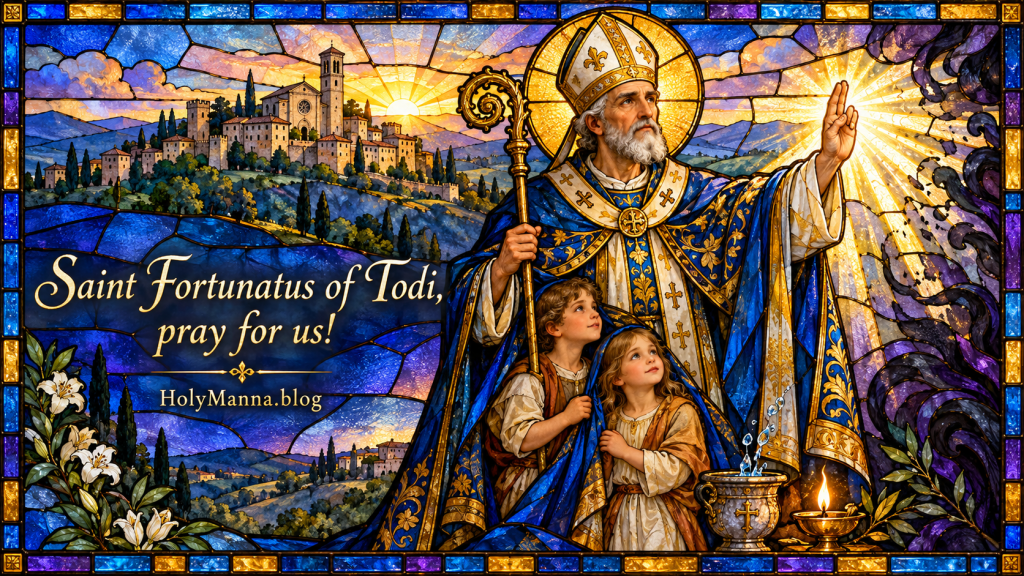
The Bishop Who Fought Hell
Some saints leave behind libraries. Some leave behind religious orders, cathedrals, or famous last words. Saint Fortunatus of Todi, who died around the year 537, left behind something rarer: the testimony of another saint. Nearly everything the Church knows about this 6th century bishop of Todi, a hilltop city in the Umbria region of central Italy, comes from the pen of Pope Saint Gregory the Great, a Doctor of the Church, who devoted a chapter of his Dialogues to him around the year 593. When the Roman Martyrology, the Church’s official catalog of saints, commemorates him on October 14th, it leans entirely on that testimony, recording that at Todi in Umbria, Saint Fortunatus the bishop was, as blessed Gregory mentions, “endowed with an extraordinary gift for casting out unclean spirits.”
That single line tells you what the Church has always remembered about him. Fortunatus was an exorcist, a man through whom God repeatedly broke the grip of the devil on suffering people, and his weapon of choice was not drama or spectacle but long, stubborn, unceasing prayer. He shepherded his people during one of the most terrifying periods in Italian history, the Gothic Wars, when armies crossed Umbria and ordinary families lost their homes, their harvests, and sometimes their children. In the middle of that chaos stood a bishop who believed that no power on earth or under it could outlast a man on his knees.
Saint Fortunatus is the patron saint of Todi, and he remains by far the most important of the city’s traditional patron saints. The magnificent church of San Fortunato, which crowns the city to this day, bears his name and guards his relics. For readers who have ever felt that evil in the world is simply too big, too organized, and too relentless to resist, Fortunatus is a friend worth meeting.
A Life Known Only by Its Fruits
Here is where honesty matters, and the Church has always prized honesty about her saints. Nothing reliable is recorded about the birthplace, family background, upbringing, or formation of Saint Fortunatus. The Dialogues of Saint Gregory, the only near contemporary source for his life, simply do not say. No trustworthy account names his parents, his hometown, or the road that led him to the episcopate. Later devotional writers sometimes filled in those blanks, but the documented record begins with Fortunatus already a bishop, already holy, and already feared by demons. Even his death date is not certain. The traditional date is around 537, and modern scholarship places his death roughly between 530 and 540, but the Dialogues themselves give no year, and at least one episode of his life has been dated by some historians to the later campaigns of the Gothic War, which would not fit a death in 537. The sources conflict, and it is better to say so plainly than to pretend otherwise.
What can be said with confidence is this. Fortunatus became bishop of Todi in the first half of the 6th century, a generation after the fall of the Western Roman Empire, when Italy was ruled by the Ostrogoths and then torn apart by the long war between the Goths and the armies of the Eastern Roman Empire. A bishop in that world was not a distant administrator. He was the father of his city, the negotiator with armies, the feeder of the poor, the last line of defense for the defenseless. Todi remembered Fortunatus precisely in that role, as the defender of the city in the age of the Gothic Wars.
There is something deeply countercultural in a saint whose early life is a blank page. The modern world insists that a person’s story is their brand, their origin, their curated identity. Fortunatus is remembered for none of that. He is remembered for what God did through him. The Catechism teaches that by canonizing some of the faithful, the Church “recognizes the power of the Spirit of holiness within her” and sustains the hope of believers by giving them models and intercessors (CCC 828). Fortunatus is exactly that kind of model: not a celebrity, but a window through which the power of the Holy Spirit became visible. If your own story were told only by its fruits, what would people learn about God from it?
The Weapon of Incessant Prayer
Saint Gregory the Great wrote his Dialogues as a series of conversations with his deacon Peter, gathering the miracle stories of the holy men of Italy so that a war weary generation would not forget that God was still at work among them. Gregory was careful about his sources. For Fortunatus, he relied on Julianus, an official of the Roman church who had recently died, and on an elderly man from Todi whom Gregory questioned personally. In the old English translation of the Dialogues, Gregory says that Fortunatus “had a most singular grace in casting out of devils.” Gregory describes a man who expelled whole legions of evil spirits, and who, when those spirits turned their violence against him personally, crushed them with the weapon of constant prayer.
Stop and sit with that image for a moment. Not a sword. Not an argument. Not a strategy. Prayer, wielded like a weapon, hour after hour, night after night. This is precisely what the Church still teaches. The Catechism states that “prayer is a vital necessity” (CCC 2744), and it presents the whole of human history as a hard battle against the powers of darkness, a battle that runs through every human heart from the beginning of the world until the last day (CCC 409). Fortunatus did not treat that battle as a metaphor. He fought it.
Gregory records a series of miracles from the bishop’s lifetime, and each one reveals something about his faith and his compassion. The first concerns a noblewoman from Tuscany whose daughter in law came with her to the dedication of a church in honor of Saint Sebastian. The night before the ceremony, the young woman had relations with her husband, and when the relics of the martyr were carried out, an evil spirit seized her. A priest tried to help her by covering her with the linen cloth from the altar, and the spirit attacked him as well. Her family, desperate, even turned to sorcerers, which only multiplied her torment. Only Fortunatus was able to free her, and he did it the only way he knew how, by giving himself to prayer for many days and nights until the spirit was driven out. The Church has never stopped exercising this ministry. The Catechism teaches that in exorcism the Church asks publicly and authoritatively, in the name of Jesus Christ, that a person “be protected against the power of the Evil One” and withdrawn from his dominion (CCC 1673). What the Church does today in her formal rite, Fortunatus did in the 6th century with tears and perseverance.
Gregory also tells of simpler mercies. Fortunatus restored sight to a blind man by tracing the sign of the cross before his eyes. He calmed a crazed horse that no one could control by making the sign of the cross over its head. These small stories matter, because they show that the same hand that confronted legions of demons was also gentle enough to heal a poor man’s eyes and a frightened animal. Jesus promised His disciples that signs would accompany those who believe, saying, “In my name they will cast out demons” (The Gospel of Mark, Mk 16:17). In Fortunatus, Todi watched that promise come true in its own streets.
The most breathtaking miracle Gregory records took place at Easter. A man named Marcellus had died, and his grieving sisters begged the bishop to come. Before dawn on Easter Sunday, the morning when the whole Church proclaims that the tomb is empty, Fortunatus went to the body with two deacons, knelt beside the dead man, and called him by name. Marcellus came back to life. It is hard to imagine a more fitting hour for such a wonder. The Lord who said “I am the resurrection and the life” (The Gospel of John, Jn 11:25) allowed His servant to echo that victory on the very feast of the Resurrection. The Catechism reminds believers that Christ’s compassion toward the sick and His many healings were a resplendent sign that God has visited His people (CCC 1503), and that the risen Lord continues this work through His saints.
Standing Between the Sword and the Innocent
Saint Fortunatus was not a martyr. He died a confessor, which means his heroism was proved not by a single moment of bloodshed but by a lifetime of endurance. And endurance was demanded of him in full, because his episcopate coincided with war.
The most famous episode of his life, the one the old man of Todi recounted to Gregory decades later, took place when Gothic soldiers passing near the city on their way toward Ravenna seized two little boys from an estate belonging to Todi and carried them off. Kidnapping children was a grimly ordinary feature of that war; armies took hostages to guarantee submission and ransom. Fortunatus went to the officer in charge and pleaded with him, again and again, to release the boys, even offering a ransom. The officer refused outright. The next day, as the Goths were leaving the city, the officer rode past the church of Saint Peter, and his horse slipped and threw him, leaving him with a shattered bone and in terrible pain. The man immediately understood his injury as a judgment for scorning the bishop’s plea, and he sent the two boys back to Fortunatus unharmed. Fortunatus, for his part, showed no triumph and no grudge. He sent holy water, and when the broken bone was bathed with it, the officer was healed.
That story deserves a second look, because it captures the whole man. Fortunatus begged for the children with the persistence of a father. When God vindicated him, he did not gloat over his enemy; he healed him. The Church teaches that the works of mercy are charitable actions by which the faithful come to the aid of their neighbor in his bodily and spiritual necessities (CCC 2447), and Fortunatus extended that mercy even to the soldier who had defied him. Scripture commands, “Pray without ceasing” (1 Thessalonians, 1 Thess 5:17), and Gregory’s entire portrait of Fortunatus is of a man who obeyed that command so literally that demons dreaded him and warlords yielded to him.
His hardships were not only military. Gregory makes clear that the demons Fortunatus expelled turned their rage on the bishop himself, and that he bore those assaults with prayer rather than fear. One story from the Dialogues shows that even his good name came under attack. After Fortunatus drove an evil spirit out of a possessed man, the expelled demon did not leave Todi quietly. According to Gregory’s account, the spirit went through the city in the guise of a stranger, loudly complaining about the bishop, and a householder, moved by what he heard, took the stranger in to his own hearth. The family that welcomed the disguised demon soon suffered terribly for it, and the city learned, at a painful price, that the bishop they had been tempted to criticize had seen the danger clearly all along. This story comes from the Dialogues of Saint Gregory and belongs to the earliest layer of the saint’s tradition, but like all the miracle accounts of that era, its details cannot be independently verified today. What it preserved for Todi was a lesson the Church still teaches: the devil is a liar and a murderer, yet his power is not infinite, for he is only a creature and cannot prevent the building up of God’s reign (CCC 395). Fortunatus lived as if he believed that with his whole heart, because he did.
When you face opposition for doing what is right, do you reach for the weapon Fortunatus reached for, or do you reach for resentment?
A Grave That Would Not Stay Quiet
Saint Gregory writes that miracles began to occur at the grave of Fortunatus soon after his death, though he does not record where that grave was. A later account of the saint’s life says he was buried within the walls of Todi at a place called Apentino, in a church dedicated to Saint Cassian; that burial tradition is ancient and cherished in Todi, but it comes from a medieval source and cannot be verified. What can be verified is remarkable enough. In 1580, during an official recognition of the saint’s relics, a lead plaque was discovered bearing the inscription, “These are the relics of St Fortunatus, Bishop and Confessor, 708.” That plaque is physical evidence that the Church of Todi was formally honoring and safeguarding his body as early as the 8th century, within living memory of the Lombard age.
The relics even survived an attempted theft. A tradition recorded by the medieval chronicler Sigebert of Gembloux holds that Bishop Theodoric of Metz carried off some of the relics around the year 970, during an era when relic stealing was, strangely enough, considered an act of devotion; yet Sigebert himself complained that he could find no trace of Fortunatus’s relics at Metz, unlike nearly all the other relics taken in that period. Todi has always taken quiet satisfaction in that detail, as a story suggesting its patron simply refused to move. The story is charming, but the fate of those particular relics cannot be verified.
The crowning chapter came at the end of the 13th century. In 1296, the people of Todi began building a vast new church in honor of their patron, the church of San Fortunato that still dominates the city’s skyline. The old church on the site was partly demolished to make way for it, and in 1297 Pope Boniface VIII consented to the translation of the relics of Saints Fortunatus, Cassian, and Callistus into the new building, granting indulgences to the faithful who attended. Today the crypt of San Fortunato houses a sepulchre containing the remains of Saints Fortunatus, Cassian, and Callistus, together with other patron saints of the city, and pilgrims who descend into that crypt find one more treasure beside them: the tomb of Fra Jacopone da Todi, the fiery Franciscan poet who lived from 1230 to 1306 and who is traditionally credited with the Stabat Mater, one of the most beloved hymns in the entire Catholic tradition. The demon fighting bishop and the weeping poet of Our Lady’s sorrows rest under the same roof, and together they have made Todi a place of pilgrimage for centuries.
Even his feast day has a story. The earliest witness to October 14th is the 9th century Martyrology of Usuard, and some scholars suspect that date arose from a mix up with Saint Fortunata, a virgin martyr of Palestine commemorated on the same day. Older lectionaries and even the city statutes of Todi in 1327 kept his feast on June 30th. Over time that date lost favor, and Todi now celebrates her patron on October 14th, the date kept by the Roman Martyrology. One further caution for devotees in the digital age: Saint Fortunatus of Todi is frequently confused online with Saint Fortunatus of Aquileia, the martyr companion of Saint Hermagoras who appears in a famous Tiepolo painting, and with Venantius Fortunatus, the hymn writing bishop of Poitiers. They are three different men. No sayings of Fortunatus of Todi himself have come down to us; the words the Church treasures about him belong to Saint Gregory and to the Roman Martyrology, and that is testimony enough.
All of this, the plaque, the pilgrims, the crypt, the centuries of celebration, flows from the Church’s confidence that the saints are not gone. The Catechism teaches that the saints in heaven “do not cease to intercede with the Father for us” (CCC 956), which is why Todi has never stopped asking Fortunatus to do in heaven what he did on earth: stand between his people and everything that threatens them.
Praying Like the Battle Is Real
So what does a 6th century exorcist bishop have to say to a reader scrolling through this post fifteen centuries later? More than you might think.
First, Fortunatus insists that the spiritual battle is real. The Church has never taught that the devil is a cartoon or a metaphor. She teaches that human history is a dramatic struggle against the powers of evil, one that engages every person (CCC 409). Most readers will never witness an exorcism, but every reader knows what it is to be dragged toward despair, addiction, rage, lust, or hopelessness, and to feel that the pull is stronger than willpower. Fortunatus’s answer was never willpower. It was prayer, sustained past the point of comfort, past the point of convenience, sometimes for days and nights on end. When Jesus taught His disciples to pray, He taught them to ask the Father to “deliver us from evil” (The Gospel of Matthew, Mt 6:13), and The Catechism explains that in this petition the Church begs deliverance from the Evil One himself, the angel who opposes God (CCC 2851). Praying that line slowly, every day, is a very Fortunatus like habit to build.
Second, Fortunatus models persistence on behalf of other people. He did not pray the two kidnapped boys free with one quick petition; he went back to the Gothic officer again and again, and he went back to God again and again. Intercession, The Catechism teaches, is a prayer of petition that leads a believer to pray as Jesus did, on behalf of others, even on behalf of those who cause harm (CCC 2635). Think of the person in your life you have quietly given up praying for, the lapsed sibling, the addicted friend, the hostile coworker. Fortunatus would not have given up. Then remember what he did when the officer who defied him lay broken on the ground: he sent healing, not scorn. Who in your life needs you to keep knocking on heaven’s door for them, and who needs your mercy after they have wronged you?
Third, Fortunatus shows that holiness does not require a famous backstory. His early life is unknown, his own words are unrecorded, and yet the Church has honored him for nearly 1,500 years because God’s power was unmistakable in him. In a culture obsessed with platforms and personal brands, that is strangely liberating. Readers can start building a Fortunatus style life this week with small, concrete steps: keep a holy water font by the door and use it with intention, since sacramentals like holy water prepare believers to receive grace and dispose them to cooperate with it (CCC 1670); fast from one comfort and offer it for someone trapped in a destructive habit; pray the Saint Michael prayer after Mass; bring persistent, named intercessions to a weekly Holy Hour; and when evil feels overwhelming, refuse the lie that it will win. What would change in your week if you treated prayer not as a last resort but as your first and sharpest weapon?
Engage With Us!
Saint Fortunatus of Todi spent his life proving that patient, relentless prayer is stronger than armies and demons alike, and his story deserves to be talked about. Share your thoughts and reflections in the comments below; your experience of prayer in hard seasons might be exactly what another reader needs to see today. Here are a few questions to get the conversation started.
- Fortunatus freed the possessed woman only after many days and nights of prayer. When have you had to persevere in prayer long past the point where you wanted to quit, and what happened?
- The bishop pleaded repeatedly for two kidnapped children who were not his own. Who are the vulnerable people God is asking you to intercede for and defend right now?
- After the Gothic officer was injured, Fortunatus responded with healing instead of vindication. Is there someone who has wronged you to whom you could show that kind of mercy this week?
- Fortunatus raised Marcellus before dawn on Easter morning. Where in your life do you need to invite the Risen Christ to bring something dead back to life?
- His early life is completely unknown, yet his holiness still shines after 1,500 years. How does that challenge the way you think about success, recognition, and legacy?
Thank you for walking through the streets of 6th century Todi today with a bishop who refused to let the darkness have the last word. Take his lesson with you into this week: pray with persistence, defend the vulnerable, show mercy to those who oppose you, and trust that no evil is stronger than the God who hears you. Live a life of faith, and do everything with the love and mercy that Jesus taught us.
Saint Fortunatus of Todi, pray for us!
Follow us on YouTube, TikTok, Instagram and Facebook for more insights and reflections on living a faith-filled life.


Leave a Reply