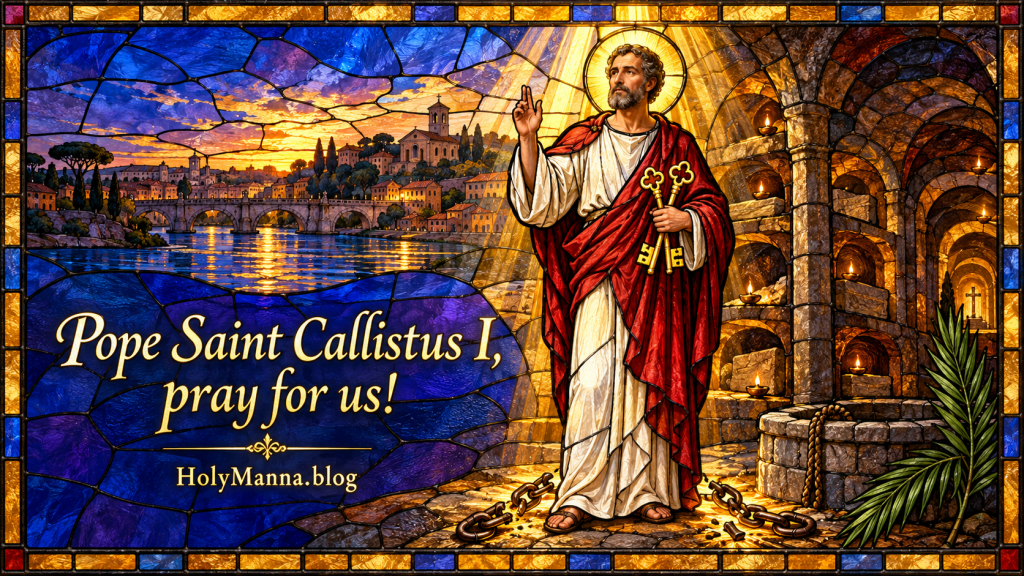
The Slave Who Held the Keys
On October 14th, the Church celebrates a pope whose résumé would get him disqualified from almost any job today. Pope Saint Callistus I was a slave. He was a failed banker who lost other people’s money. He was a fugitive who jumped off a ship to avoid arrest. He was a convict sentenced to hard labor in the mines of Sardinia. And he became the sixteenth successor of Saint Peter, the shepherd of the universal Church, and a martyr whose name is still attached to the most famous catacomb in Rome. If anyone ever doubts that God writes straight with crooked lines, Callistus is the proof in flesh and blood.
He is revered for two great gifts to the Church. First, as a deacon he was placed in charge of the first cemetery officially owned by the Church, the great burial complex on the Appian Way that has borne his name for eighteen centuries, the Catacomb of Saint Callistus. Second, as pope he defended something that modern believers take for granted but that nearly tore the third century Church apart: the truth that there is no sin so grave that God’s mercy, ministered through His Church, cannot forgive it. The Catechism states this plainly: “There is no offense, however serious, that the Church cannot forgive” (CCC 982). Callistus taught that truth when it cost him his reputation, and he sealed his witness with his blood. Because of his lifelong care for the resting places of the faithful departed, he is venerated as the patron of cemetery workers.
From the Auction Block to the Mines of Sardinia
Callistus was born in Rome around the middle of the second century, most likely in Trastevere, the crowded working-class district across the Tiber where immigrants, laborers, and the poor packed into tenements. The Liber Pontificalis calls him the son of Domitius, and the great archaeologist Giovanni Battista de Rossi found the stamp “Callistus Domitiorum” on Roman tiles from that era, which suggests his family was attached to the household of the Domitii. Whatever his parentage, one fact is certain: Callistus was a slave, the property of a Christian named Carpophorus who served in the imperial household.
Here a word of honesty is needed, because honesty is what the saints deserve. Almost everything known about Callistus’s early life comes from a single source, the Philosophumena of Hippolytus of Rome, and Hippolytus hated him. Hippolytus was a brilliant theologian who so fiercely opposed Callistus’s papacy that he had himself set up as the first antipope in history. His account is a hostile prosecutor’s brief, not a biography. The Church reads it the way a fair judge reads a hostile witness, accepting the facts while discounting the venom, and Catholic scholars from Döllinger to de Rossi have shown how unjust his interpretations were. With that lens in place, here is the story.
Carpophorus entrusted Callistus with a large sum of money, and Callistus opened a bank in the Fish Market district, where fellow Christians and widows deposited their savings. The bank failed and the deposits were lost. Hippolytus insinuates fraud; the Catholic Encyclopedia and later scholarship point instead to bad loans and debtors who would not pay. Terrified, Callistus fled to the port of Rome and boarded a ship. When he saw his master coming after him, he threw himself into the sea rather than face him. He was fished out, dragged back, and condemned to the pistrinum, the dreaded hand-mill where slaves were worked like animals. The Christians of Rome, convinced the money could still be recovered, begged for his release, and it is worth noticing that detail; the very people who had lost their savings interceded for him. Callistus then went to collect from debtors and ended up in a brawl in a synagogue on the Sabbath. He was hauled before the city prefect Fuscianus, denounced as a Christian, scourged, and sentenced to the living death of the mines of Sardinia, the island the ancients called the island of death.
God was not finished with him. Around the year 190, Marcia, the mistress of Emperor Commodus and a woman sympathetic to the faith, asked Pope Saint Victor I for a list of Christians condemned to the Sardinian mines so she could obtain their freedom. Victor gave her the list, and Callistus’s name was not on it. When the priest Hyacinthus arrived with the order of release, Callistus fell at his feet and begged, with tears, to be taken along. Hyacinthus relented. Pope Victor, rather than punishing the irregularity, sent the broken man to Antium to recover his health and gave him a monthly pension from the Church’s funds. Under Roman law his old master’s rights over him had dissolved with his sentence, so the slave came home a free man, ransomed in body as Christ had already ransomed him in soul.
The Keeper of the Dead and the Counselor of Popes
When Zephyrinus became pope in 199, he recalled Callistus to Rome, ordained him a deacon, and gave him a task that would echo through history: the administration of the cemetery on the Appian Way, the first burial ground owned corporately by the Church herself rather than by private Christian families. Callistus enlarged it, organized it, and adorned it so well that it has carried his name ever since. This was no mere groundskeeping. In caring for the bodies of the faithful, Callistus was performing a corporal work of mercy and professing the resurrection, for as The Catechism teaches, “The bodies of the dead must be treated with respect and charity, in faith and hope of the Resurrection” (CCC 2300). Every niche he carved was a quiet sermon that the body is destined for glory.
Callistus became Pope Zephyrinus’s closest adviser, effectively his archdeacon, guiding him through the theological storms of the age. When Zephyrinus died around 217, the clergy and people of Rome elected Callistus pope. Hippolytus, furious at being passed over and convinced of his own theological superiority, broke communion and gathered a rigorist faction around himself.
No miracles worked by Callistus during his lifetime are recorded in reliable sources, and HolyManna will not invent any; the hostile writers who preserved his story had no interest in recording his holiness. The later Acts of Callistus, composed some three centuries after his death, do tell of wonders, including the conversion of the senator Palmatius and his household after prodigies that followed a fire on the Capitol, and healings connected with the pope’s prayer. Those accounts are part of the later tradition of the Church. They cannot be verified.
What can be verified is a different kind of miracle, the miracle of mercy exercised with authority. Callistus decreed that Christians who had fallen into adultery and fornication could, after sincere and serious penance, be absolved and readmitted to Communion. To modern ears that sounds obvious. In the early third century it was an earthquake. A rigorist party held that the Church had no power to absolve the gravest sins after Baptism; such sinners could weep at the door until death and hope God might pardon them, but the Church would not. Tertullian, by then drifting into the Montanist heresy, exploded in his treatise De Pudicitia at news of a bishop’s edict of mercy. His own sarcastic words preserve it: “I hear that an edict has been published, and a peremptory one; the bishop of bishops, which means the Pontifex Maximus, proclaims: I remit the crimes of adultery and fornication to those who have done penance” (De Pudicitia 1). Readers should know that scholars still debate whether Tertullian aimed those exact words at Callistus or at a bishop in Africa, but there is no doubt about Callistus’s own policy, because Hippolytus attacked him directly and by name for absolving grave sinners, for readmitting repentant heretics and apostates into the Catholic Church, and for refusing to depose bishops automatically for sin.
In all of this, the Church has judged that Callistus was right and his accusers were wrong. He was exercising exactly the power Christ gave to Peter: “I will give you the keys of the kingdom of heaven, and whatever you bind on earth shall be bound in heaven, and whatever you loose on earth shall be loosed in heaven” (The Gospel of Matthew, Mt 16:19). The Risen Lord breathed on His Apostles and said, “If you forgive the sins of any, they are forgiven” (The Gospel of John, Jn 20:23). The Catechism confirms that this is not laxity but the very purpose of the sacrament: “Christ instituted the sacrament of Penance for all sinful members of his Church: above all for those who, since Baptism, have fallen into grave sin, and have thus lost their baptismal grace and wounded ecclesial communion” (CCC 1446).
Callistus matters for another reason that should make every young Catholic sit up. Roman law refused to recognize marriages between free women of high rank and slaves or freedmen. Callistus declared that in the eyes of the Church such unions were true marriages. A former slave on the Chair of Peter looked at the empire’s class system and declared it void before the altar, living out what Saint Paul had written: “There is neither Jew nor Greek, there is neither slave nor free, there is neither male nor female; for you are all one in Christ Jesus” (The Letter to the Galatians, Gal 3:28). The Catechism teaches the same principle today, that “every form of social or cultural discrimination in fundamental personal rights on the grounds of sex, race, color, social conditions, language, or religion must be curbed and eradicated as incompatible with God’s design” (CCC 1935). Callistus was guarding that design seventeen centuries before the world caught up.
He was also no pushover on doctrine, whatever his enemies claimed. Together with Zephyrinus and then on his own authority, Callistus condemned the Monarchian heretics and excommunicated Sabellius himself, who collapsed the distinction between the Father and the Son, while also rejecting the opposite error of Hippolytus, whose theology of the Word drifted toward two gods. Callistus held the narrow Catholic line between both ditches, the same line the Church would later define at Nicaea. The Liber Pontificalis also ascribes to him a decree on the Ember day fasts, though that attribution cannot be confirmed. One charming episode from his years as pope survives in the pagan Historia Augusta: when tavern keepers claimed a plot in Trastevere where the Christians had established a place of worship, Emperor Alexander Severus ruled for the Christians, judging that it was better for God to be worshipped there in any manner than for the site to become a tavern. Tradition holds that this oratory of Callistus in Trastevere stood at or near the site of what became Santa Maria in Trastevere, one of the first churches in Rome dedicated to Our Lady.
The Riot in Trastevere
Callistus governed the Church for roughly five years, and he governed under siege from his own. Hippolytus called him a heretic, mocked his past as a slave and a convict, and led a schism that would outlast Callistus’s life. Tertullian thundered against the mercy he extended. Imagine shepherding the universal Church while the most brilliant intellectuals of the age publicly shredded your character and your past sins were weaponized against you in pamphlets. Callistus answered none of it with counter-polemics that survive. He simply kept absolving sinners, kept burying the dead, and kept teaching the faith. There is a lesson in that silence.
His death came not from an emperor’s decree but from a mob. The reign of Alexander Severus was officially peaceful for Christians, yet popular hatred could still turn deadly in an instant, especially in a packed district like Trastevere. The ancient tradition, preserved in his Acts, recounts that during an anti-Christian uprising, possibly inflamed by a fire on the Capitol that pagans blamed on the Christians, Callistus was seized, and after imprisonment and scourging he was thrown from a window of his house and cast into a well with a stone, dying around October 14th in the year 222. The details of that account come from Acts written centuries later and judged spurious by Catholic scholars, so the manner of his death cannot be verified. The fact of his martyrdom, however, stands on the firmest ground available for that era: Callistus is the earliest pope listed as a martyr in the Depositio Martyrum of the year 354, the Roman Church’s own ancient calendar of her martyrs, and he was buried not in his own great cemetery on the Appian Way but hastily, across the river, in the cemetery of Calepodius on the Via Aurelia, exactly what one would expect if he died suddenly in a Trastevere riot.
There is a tender detail from those final years that reveals the man. When his priest Calepodius was martyred and his body thrown into the Tiber, Callistus searched diligently until he found it, and when he recovered it he was filled with joy and buried it with hymns of praise. The keeper of the dead gave his friend the burial he would soon need himself, and in God’s providence the two now rest together. The Catechism teaches that “Martyrdom is the supreme witness given to the truth of the faith: it means bearing witness even unto death” (CCC 2473). The pope who spent his life proclaiming that no sinner is beyond mercy bore that final witness with his own body.
The Patron of Those Who Tend the Graves
Devotion to Callistus began immediately and never stopped. The later Acts attached to his name tell of conversions and healings flowing from his ministry and his intercession, including the story of the senator Palmatius and dozens of companions who came to faith through him and followed him into martyrdom. These stories are part of the Church’s later tradition. They cannot be verified. What history does record is a quieter, longer miracle: the catacomb he once administered became the official burial place of the popes themselves. The famous Crypt of the Popes within the Catacomb of Saint Callistus received the remains of most of the third century pontiffs, along with Saint Cecilia and tens of thousands of the faithful. To this day pilgrims descend its dark stairways by the thousands every year, walking galleries that stretch for miles beneath the Appian Way, and every one of them passes under the name of the former slave who organized it all.
In the ninth century, Pope Gregory IV translated the relics of Callistus, together with those of Saint Calepodius, from the Via Aurelia to the Basilica of Santa Maria in Trastevere, where they rest beneath the high altar in the very neighborhood where he was born, built his oratory, and died. Portions of his relics were later shared with the abbey of Fulda in Germany, with Cysoing in France, and with the cathedral of Notre-Dame in Reims, and medieval Glastonbury in England claimed a portion as well, spreading his veneration across Europe. A few steps from the basilica stands the small church of San Callisto, which preserves the well into which tradition says his body was thrown; that identification rests on the unverifiable Acts, and it cannot be confirmed, yet it has drawn praying visitors for well over a thousand years. Even the Church’s modern headquarters for several Vatican offices in Trastevere, the Palazzo San Callisto, carries his name. And there is one more providence worth savoring: Hippolytus, the antipope who fought him so bitterly, was later reconciled to the Church, died a martyr alongside Pope Pontian in the mines of Sardinia in 236, the same mines where Callistus had suffered, and was canonized a saint. Catholic writers have long seen in that reconciliation the quiet intercession of the pope of mercy. When the Church canonizes her saints, The Catechism says, she “recognizes the power of the Spirit of holiness within her and sustains the hope of believers by proposing the saints to them as models and intercessors” (CCC 828). Callistus is both.
When Your Past Disqualifies You and Grace Does Not
Callistus is the saint for everyone who has ever believed their past put them beyond use. He lost people’s money. He ran. He had a record. His enemies never let him forget any of it, and God made him pope anyway. Our Lord said, “there will be more joy in heaven over one sinner who repents than over ninety-nine righteous persons who need no repentance” (The Gospel of Luke, Lk 15:7), and Callistus built his entire pontificate on that joy. He also shows that mercy is not softness. The same pope who absolved adulterers excommunicated Sabellius; he held doctrine and mercy together because they were never opposites. Is there a sin in your past that you have quietly decided is too big for Confession? Callistus, and the Church he governed, says otherwise, and The Catechism backs him without hedging in CCC 982. Go to Confession this week and test it.
His life also asks something harder. Callistus extended to others the mercy he had received, even while rigorists attacked him for it. When someone in your life fails publicly, do you respond like Hippolytus or like Callistus? It is frighteningly easy to be the rigorist in someone else’s story. Try one concrete practice this month: when you learn of someone’s fall, pray for them by name before you say a single word about them. Second, honor his patronage; visit a cemetery, pray for the dead, tend a grave that no one tends, because Callistus turned that quiet work into a school of resurrection hope. Third, imitate his silence under slander. He left no angry rebuttals, only faithful work. What would change in your week if you answered criticism with service instead of self-defense? And finally, remember his judgment on human dignity. He saw a slave and a senator’s daughter as equal before the altar. Who in your daily orbit, the coworker, the stranger, the person whose life looks nothing like yours, are you being invited to see as Callistus saw them?
Engage With Us!
HolyManna would love to hear from you. Share your thoughts and reflections on Pope Saint Callistus I in the comments below, and let this community of faith grow through your voice.
- Callistus received mercy he did not technically qualify for when he begged his way onto the release list from Sardinia. When has God’s mercy reached you in a way you did not earn or expect?
- The rigorists of the third century insisted some sins were beyond the Church’s power to forgive. Is there a sin, yours or someone else’s, that you have been treating as unforgivable, and what would it look like to bring it to Confession or to let it go?
- Callistus was defined by his enemies for his worst moments, yet God defined him by his mission. How do you let your past failures shape your sense of what God can do with you?
- As keeper of the catacombs, Callistus honored the dead as temples awaiting resurrection. When was the last time you prayed for the souls of the departed, and could you make it a weekly habit?
- Callistus defended the equal dignity of slave and free in marriage against the law of his age. Where is God asking you to defend someone’s dignity today, even at a cost to yourself?
May the witness of Pope Saint Callistus I remind you that no past is too broken for God’s purpose and no sin too heavy for His mercy. Live this day as one who has been ransomed, forgive as one who has been forgiven, and do everything with the love and mercy that Jesus taught us.
Pope Saint Callistus I, pray for us!
Follow us on YouTube, TikTok, Instagram and Facebook for more insights and reflections on living a faith-filled life.


Leave a Reply