Wednesday of the Twenty-eighth Week in Ordinary Time – Lectionary: 469
Roots Run Deeper Than Appearances
Every harvest in ancient Israel ended the same way. Farmers hauled their grain up to a breezy threshing floor, tossed it into the air with wooden forks, and let the wind do the sorting. The heavy kernels dropped straight down into the pile. The weightless husks, the chaff, simply blew away and were never seen again. The readings for October 14th, Wednesday of the Twenty-eighth Week in Ordinary Time, all turn on that single question of weight: what is truly substantial in a soul, and what merely looks substantial until the wind picks up.
In the First Reading, Saint Paul tells the Galatians that a life guided by the Holy Spirit produces real, visible fruit, while the works of the flesh produce nothing that survives. Psalm 1, the doorway to the entire Psalter, paints the same contrast in two unforgettable pictures: the just man is a tree planted beside running water, fruitful and evergreen, while the wicked are chaff driven off by the wind. Then, in The Gospel of Luke, Jesus sits at a Pharisee’s dinner table and delivers some of the most uncomfortable words in all of Scripture, warning that meticulous external religion, tithed herbs, honored seats, and flattering greetings, can conceal an interior as lifeless as an unmarked grave.
The central theme uniting these readings is that authentic holiness grows from the inside out. The Holy Spirit, like water reaching hidden roots, produces fruit that no law could manufacture and no performance can fake. Religion practiced only from the outside in eventually withers into chaff. These readings invite an honest look beneath the surface, down at the roots, which is where God has always done His best work.
First Reading — Galatians 5:18-25
Freedom That Grows Something Real
Saint Paul founded the churches of Galatia, in the highlands of central Asia Minor, during his missionary journeys around the year 49. Not long after he moved on, a group of agitators often called the Judaizers arrived behind him, insisting that Gentile converts had to be circumcised and keep the whole Mosaic law in order to be saved. Paul’s response is the most fiery letter he ever wrote. By chapter 5 he has reached his climax: the freedom Christ won is not a license to sin, and it is not a return to legal servitude either. It is life in the Holy Spirit. The region itself sharpens his words, because Galatia was home to thriving pagan cults, including the famous shrine of the mother goddess at Pessinus, so sorcery, idolatry, and ritual drunkenness were not abstractions for his readers. They were the neighborhood. Paul sets two ways of living side by side, works against fruit, and in doing so he hands the Church the key that unlocks the whole day: what the Spirit grows, the law could never force.
Galatians 5:18-25
Brothers and sisters:
If you are guided by the Spirit, you are not under the law.
Now the works of the flesh are obvious:
immorality, impurity, licentiousness, idolatry,
sorcery, hatreds, rivalry, jealousy,
outbursts of fury, acts of selfishness,
dissensions, factions, occasions of envy,
drinking bouts, orgies, and the like.
I warn you, as I warned you before,
that those who do such things will not inherit the Kingdom of God.
In contrast, the fruit of the Spirit is love, joy, peace,
patience, kindness, generosity,
faithfulness, gentleness, self-control.
Against such there is no law.
Now those who belong to Christ Jesus have crucified their flesh
with its passions and desires.
If we live in the Spirit, let us also follow the Spirit.
Detailed Exegesis
Verse 18: “If you are guided by the Spirit, you are not under the law.”
To be under the law meant living under its supervision the way a child lives under a tutor, an image Paul himself uses earlier in Galatians 3:24-25. The Spirit does not abolish what the law aimed at; He accomplishes it from within, writing on hearts what Moses wrote on stone, just as Jeremiah 31:33 promised.
Verse 19: “Now the works of the flesh are obvious: immorality, impurity, licentiousness.”
By flesh, Paul does not mean the body, which God created good. He means fallen human nature curved in on itself. The Catechism teaches that concupiscence is real in every soul, noting, “The apostle St. Paul identifies it with the rebellion of the ‘flesh’ against the ‘spirit’” (CCC 2515). The first triad names sins against purity, which advertise themselves without any help.
Verse 20: “Idolatry, sorcery, hatreds, rivalry, jealousy, outbursts of fury, acts of selfishness, dissensions, factions.”
After idolatry and sorcery, both live options in pagan Galatia, the catalog turns strikingly social. Eight of these works are relational. The flesh does not merely stain the individual; it shreds community, which is why a divided, quarreling parish or family is always a spiritual symptom before it is a personality problem.
Verse 21: “Occasions of envy, drinking bouts, orgies, and the like. I warn you, as I warned you before, that those who do such things will not inherit the Kingdom of God.”
Paul repeats a warning he gave in person, and inheritance is the operative word. Heirs are children, and the works of the flesh are the behavior of those refusing to live as children of God. The Catechism states soberly, “Mortal sin is a radical possibility of human freedom, as is love itself” (CCC 1861). Freedom is that serious.
Verse 22: “In contrast, the fruit of the Spirit is love, joy, peace, patience, kindness, generosity.”
The grammar preaches. Works are plural, manufactured, and exhausting. Fruit is singular, organic, and alive, one life expressing itself in many flavors. Love stands first because every other quality on the list is simply charity wearing different clothes for different situations.
Verse 23: “Faithfulness, gentleness, self-control. Against such there is no law.”
No legislature on earth has ever outlawed gentleness. The person transformed by the Spirit has outrun the law’s reach entirely, since statutes exist to restrain lawbreakers, not to limit saints.
Verse 24: “Now those who belong to Christ Jesus have crucified their flesh with its passions and desires.”
Paul speaks of something already accomplished. In baptism the Christian was plunged into Christ’s death, and the old self was nailed up with Him. Daily mortification, fasting, and self-denial do not repeat that crucifixion; they keep faith with it.
Verse 25: “If we live in the Spirit, let us also follow the Spirit.”
The Greek verb translated follow pictures soldiers marching in formation, keeping step. Grace received must become grace practiced, one obedient step at a time, in traffic, at work, and at the kitchen table.
Teachings
The Church reads this passage so closely that it shapes her official list of the fruits of the Holy Spirit. The Catechism teaches, “The fruits of the Spirit are perfections that the Holy Spirit forms in us as the first fruits of eternal glory. The tradition of the Church lists twelve of them: ‘charity, joy, peace, patience, kindness, goodness, generosity, gentleness, faithfulness, modesty, self-control, chastity’” (CCC 1832). The count of twelve follows the ancient Latin Vulgate text of Galatians 5:22-23, and the word perfections matters: these are not personality traits some people are born with, but the finished work of God appearing in ordinary lives.
Saint John Chrysostom, Doctor of the Church, noticed the same grammar modern readers notice. Commenting on this passage, he explains why Paul chose the word fruit, “it is because evil works originate in ourselves alone, and therefore he calls them works, but good works require not only our diligence but God’s loving kindness” (Commentary on Galatians). Saint Jerome adds with his usual sharpness, “He has spoken elegantly by allotting works to the flesh and fruits to the Spirit. Vices come to nothing and perish in themselves. Virtues multiply and abound in fruit” (Commentary on Galatians).
The Catechism also hands on the breathtaking words of Saint Basil the Great about life in the Spirit: “Through the Holy Spirit we are restored to paradise, led back to the Kingdom of heaven, and adopted as children, given confidence to call God ‘Father’ and to share in Christ’s grace, called children of light and given a share in eternal glory” (CCC 736). That is the stake in this reading, nothing less than paradise regained.
Reflection
The honest first step with this passage is to stop skimming the vice list looking for the dramatic sins and to sit instead with the quiet ones: rivalry, jealousy, selfishness, envy, and outbursts of fury. Those are the works of the flesh that show up in group chats, office politics, and family dinners. Bring the one that recurs most often to Confession, and name it out loud.
Then flip the page and choose one fruit, just one, to ask the Holy Spirit for by name every morning this week. Patience in the school pickup line and gentleness in a tense conversation are not small things; they are evidence that God is alive in a soul. Which fruit of the Spirit seems most absent from your daily life right now, and what would it look like to beg the Holy Spirit for it by name each morning? Where are you still trying to manufacture through willpower what God is waiting to grow through grace?
Responsorial Psalm — Psalm 1:1-4, 6
The Tree by the Water and the Dust on the Wind
Psalm 1 was placed at the front of the Psalter on purpose, like a porch built before a cathedral. Before Israel sings a single note of praise or lament, this wisdom psalm makes everyone entering choose between two ways, a theme reaching back to Moses setting life and death before the people in Deuteronomy 30:19 and carried forward into the earliest Christian catechesis. Its imagery comes straight from the land. In the dry hill country, a tree survives only if its roots find water, which is why farmers planted trees deliberately beside irrigation channels. Chaff, meanwhile, was the most disposable thing in daily life, husks separated from grain on the threshing floor and gone with the evening breeze. The Church deepens the psalm further by drawing today’s refrain from the lips of Jesus, who declares in John 8:12, “I am the light of the world. Whoever follows me will not walk in darkness, but will have the light of life.” The blessed man rooted by the stream and the disciple walking in the light are the same person, and both belong at the center of this day’s theme of fruitfulness.
Psalm 1:1-4, 6
R. (see Jn 8:12) Those who follow you, Lord, will have the light of life.
Blessed the man who follows not
the counsel of the wicked
Nor walks in the way of sinners,
nor sits in the company of the insolent,
But delights in the law of the LORD
and meditates on his law day and night.
R. Those who follow you, Lord, will have the light of life.
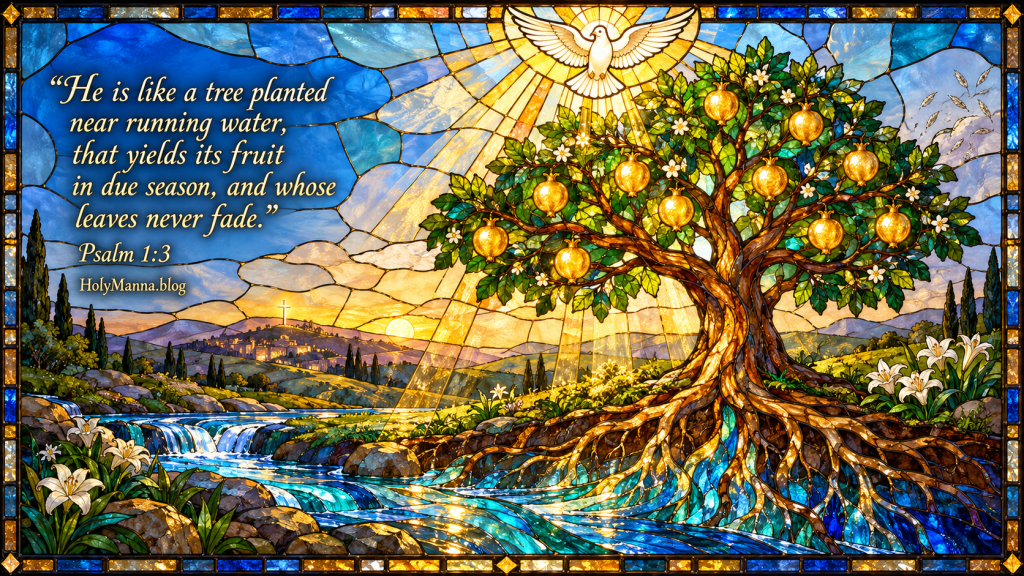
He is like a tree
planted near running water,
That yields its fruit in due season,
and whose leaves never fade.
Whatever he does, prospers.
R. Those who follow you, Lord, will have the light of life.
Not so the wicked, not so;
they are like chaff which the wind drives away.
For the LORD watches over the way of the just,
but the way of the wicked vanishes.
R. Those who follow you, Lord, will have the light of life.
Detailed Exegesis
Verse 1: “Blessed the man who follows not the counsel of the wicked, nor walks in the way of sinners, nor sits in the company of the insolent.”
The verbs trace sin’s slow gravity: first listening to bad counsel, then walking a crooked path, and finally sitting down at home among scoffers. Compromise rarely arrives all at once. It arrives by increments, one accepted voice at a time.
Verse 2: “But delights in the law of the LORD and meditates on his law day and night.”
Delight is the surprise here. God’s law is received not as a cage but as a gift. The Hebrew verb for meditates suggests murmuring the words softly aloud, chewing on them, which is the ancient root of the Church’s practice of praying slowly with Scripture.
Verse 3: “He is like a tree planted near running water, that yields its fruit in due season, and whose leaves never fade. Whatever he does, prospers.”
The tree was planted, deliberately set beside the stream by someone who intended it to live. Fruit comes in due season, which demands patience, and unfading leaves promise perseverance through drought. Prosperity here means fruitfulness in God’s sight, not a padded bank account.
Verse 4: “Not so the wicked, not so; they are like chaff which the wind drives away.”
The doubled denial, preserved from the ancient Greek and Latin versions of this psalm, lands like a hand slammed on a table. Chaff has no roots, no weight, and no future. Nobody has to punish it. The first stiff wind is sentence enough.
Verse 6: “For the LORD watches over the way of the just, but the way of the wicked vanishes.”
The Hebrew says the Lord knows the way of the just, with the intimate knowledge of covenant friendship. The wicked are not so much destroyed as dissolved, since a way leading nowhere eventually just stops being a way.
Teachings
The Fathers of the Church refused to read this psalm as a portrait of a generic good person, because no mere man has ever avoided every counsel of the wicked. Saint Augustine, Doctor of the Church, opens his commentary on the very first verse by declaring, “This is to be understood of our Lord Jesus Christ, the Lord Man” (Exposition on Psalm 1). Christ alone is the fully Blessed Man, the true tree planted by living waters, and the baptized become blessed by being grafted onto Him. Augustine then reads the tree’s yield as “fruit and leaves, that is, deeds and words” (Exposition on Psalm 1), a reminder that a Christian’s actions and speech grow from the same root and should taste like the same tree.
The psalm’s picture of meditating on God’s law day and night remains the Church’s blueprint for prayer. The Catechism teaches, “Meditation engages thought, imagination, emotion, and desire” (CCC 2708), describing exactly the whole-person pondering this verse commends. The Catechism also gathers the entire psalm’s logic of path and fruit into one luminous sentence: “The Decalogue, the Sermon on the Mount, and the apostolic catechesis describe for us the paths that lead to the Kingdom of heaven. Sustained by the grace of the Holy Spirit, we tread them, step by step, by everyday acts. By the working of the Word of Christ, we slowly bear fruit in the Church to the glory of God” (CCC 1724).
Reflection
The tree never chose where to sink its roots by accident, and neither does anyone else. Every life is planted beside some stream, and the honest question is what is actually flowing there: Scripture and the sacraments, or a scrolling feed of outrage and envy. The psalm’s opening verse is a practical examination of conscience for the digital age, since the counsel of the wicked now arrives through earbuds and algorithms. Try replacing the first ten minutes of morning phone time with ten minutes of the day’s Gospel, and keep that appointment for one full week. What stream is your life actually planted beside, and what would it take to sink your roots into the Word of God every single day? Which voices in your daily scroll quietly function as the counsel of the wicked, and which one needs to be muted this week?
Holy Gospel — Luke 11:42-46
The Dinner Party Where Jesus Flipped the Script
This scene begins a few verses earlier, when a Pharisee invites Jesus to dinner and is shocked that He does not perform the ritual handwashing first. Jesus answers the raised eyebrow with a series of woes, which in the prophetic tradition are not curses but cries of grief, the sound Isaiah made over a people headed for ruin. The Pharisees were not villains from central casting. They were a devout lay renewal movement, numbered around six thousand by the Jewish historian Josephus, who wanted ordinary Israelites to live priestly holiness in daily life. The law of Moses in Deuteronomy 14:22-23 required tithing grain, wine, and oil, but the Pharisees extended the tithe down to kitchen herbs, and later rabbinic tradition recorded in the Mishnah would even exempt rue from tithing, which makes the scrupulosity Jesus describes all the more striking. The scholars of the law, the professional interpreters who built rule upon rule, sat at the same table. Into that room full of impressive religious résumés, Jesus speaks the day’s theme out loud: external polish without judgment and the love of God is fruitless, and worse, it is contagious death dressed as devotion.
Luke 11:42-46
The Lord said:
“Woe to you Pharisees!
You pay tithes of mint and of rue and of every garden herb,
but you pay no attention to judgment and to love for God.
These you should have done, without overlooking the others.
Woe to you Pharisees!
You love the seat of honor in synagogues
and greetings in marketplaces.
Woe to you!
You are like unseen graves over which people unknowingly walk.”Then one of the scholars of the law said to him in reply,
“Teacher, by saying this you are insulting us too.”
And he said, “Woe also to you scholars of the law!
You impose on people burdens hard to carry,
but you yourselves do not lift one finger to touch them.”
Detailed Exegesis
Verse 42: “Woe to you Pharisees! You pay tithes of mint and of rue and of every garden herb, but you pay no attention to judgment and to love for God. These you should have done, without overlooking the others.”
Jesus does not mock small fidelity; He re-orders it. Tithing herbs is fine, but using it to dodge the weightier duties of justice and love inverts the whole law, the same inversion the prophet condemned in Micah 6:8. Notice that He says both belong together, the small obediences and the great ones.
Verse 43: “Woe to you Pharisees! You love the seat of honor in synagogues and greetings in marketplaces.”
The seat of honor was the bench near the Torah scrolls, facing the congregation, where everyone could watch a man be holy. Marketplace greetings came loaded with honorific titles. Religion had become social capital, a performance with an audience instead of a love with a Beloved.
Verse 44: “Woe to you! You are like unseen graves over which people unknowingly walk.”
Under Numbers 19:16, touching a grave rendered a person unclean for seven days, which is why Jewish custom marked tombs with whitewash each spring so Passover pilgrims could avoid them. The reversal is devastating. Men obsessed with avoiding defilement had become hidden sources of it, spreading spiritual death to everyone who admired and imitated them.
Verse 45: “Then one of the scholars of the law said to him in reply, ‘Teacher, by saying this you are insulting us too.’”
The lawyer is right, and that is the point. The scholars drafted the interpretations the Pharisees lived by, so the indictment of the system naturally reaches its architects. In an honor-driven culture, his complaint about insult reveals the very disease Jesus is diagnosing, a heart more wounded by embarrassment than by sin.
Verse 46: “And he said, ‘Woe also to you scholars of the law! You impose on people burdens hard to carry, but you yourselves do not lift one finger to touch them.’”
Rule had been stacked upon rule until ordinary farmers and fishermen staggered under obligations the experts never helped them carry. The contrast with Jesus could not be sharper, for He says of Himself in Matthew 11:30, “For my yoke is easy, and my burden light.” True teachers lighten the road to God; counterfeit ones pave it with gravel and then grade the limping.
Teachings
Saint Cyril of Alexandria, Doctor of the Church, preached directly on this passage and named the Pharisees’ selective fervor with surgical precision: “They omitted as of no importance those duties which they were especially bound to practice, like justice and the love of God. They carefully and scrupulously observed, or rather commanded the people subject to their authority to observe, only those commandments that were means of great revenues for themselves” (Commentary on Luke, Homily 84). On the image of the hidden graves, Cyril adds, “See here, I pray, that hypocrisy is utterly blamed. It is a hateful malady toward God and humanity” (Commentary on Luke).
Saint Ambrose of Milan, Doctor of the Church, turns the warning toward every generation of teachers: “They cheat with their show and deceive with their practice, so that when they speak fair words outwardly, they are full of foulness within” (Exposition of the Gospel of Luke). His next observation stings on purpose, that very many teachers demand from others what they themselves cannot imitate.
The Church is careful to be fair here. The Catechism acknowledges, “This principle of integral observance of the Law not only in letter but in spirit was dear to the Pharisees” (CCC 579). Their zeal itself was not the sin; detaching zeal from charity was. Jesus Himself affirms in Matthew 22:40, “The whole law and the prophets depend on these two commandments,” meaning love of God and love of neighbor, the exact two things verse 42 says the Pharisees overlooked.
Reflection
Everyone has a mint and rue, some small, controllable observance that quietly substitutes for the harder work of justice, forgiveness, and love. Never missing a devotion while nursing a grudge, or posting Scripture while underpaying an employee, is the modern version of tithing herbs over an unseen grave. The invitation is not to abandon the small fidelities but to let them flow from a converted heart, so the outside and the inside finally match. A concrete start is to pair every devotion this week with one act of justice or mercy that costs something, a debt forgiven, a wrong made right, or a burden lifted off someone else’s shoulders without being asked. Where in your life is tithing mint easier than practicing judgment and the love of God? Whose heavy burden could you help carry this week, and what is honestly stopping you?
Planted by the Water, Judged by the Fruit
Taken together, these readings tell one story with three scenes. Saint Paul names what the Holy Spirit grows in a surrendered soul: love, joy, peace, and the whole harvest no law could ever force. The psalmist shows where that growth comes from, roots sunk deep into the stream of God’s word, and what the alternative becomes, chaff on the wind. Then Jesus, at a dinner table full of religious achievement, warns what happens when the fruit is faked, when devotion becomes decoration over an unseen grave.
The good news hiding inside the hard words is that God is not asking anyone to produce fruit by sheer effort. Trees do not strain. They stay planted, they drink, and the fruit comes in due season. The sacraments are the running water, Confession clears the dead wood, the Eucharist feeds the roots, and daily Scripture keeps the soul murmuring God’s law day and night. The Holy Spirit does the growing, and He has never once failed a soul that stayed near the stream.
So this is the invitation for October 14th: stop performing and start abiding. Choose one fruit of the Spirit to beg for daily. Choose one burden to lift off someone else. Get to Confession soon, and let the Gardener work on the roots instead of polishing the leaves. A world exhausted by image management is quietly starving for people who are the same on the inside as the outside, people planted by running water, whose leaves never fade. That kind of life does not just inherit the Kingdom of God someday. It starts tasting like the Kingdom now.
Engage With Us!
Share a reflection in the comments below, because someone scrolling past today may need exactly the insight God has planted in another reader’s heart, and this community grows the same way everything in these readings grows, one honest fruit at a time.
- In Galatians 5:18-25, Saint Paul contrasts the works of the flesh with the fruit of the Spirit. Which single fruit from verse 22 or verse 23 do you most need right now, and what daily habit would give the Holy Spirit room to grow it in you?
- In Psalm 1:1-4, 6, the blessed man meditates on God’s law day and night and becomes a tree planted near running water. What would it realistically look like for you to build Scripture into your mornings and evenings this week?
- In Luke 11:42-46, Jesus warns against tithing mint and rue while neglecting judgment and the love of God. Which small, comfortable observance in your life sometimes substitutes for the harder work of justice, mercy, and love?
- Across all of these readings, God calls His people to holiness that grows from the inside out. Where is God inviting you to stop managing appearances and start sinking roots?
Keep walking this road of faith with courage, because the One who planted every believer by the running water intends a harvest. Live this day honestly, love generously, and do everything with the love and mercy Jesus taught, trusting that fruit borne in hidden faithfulness is never hidden from God.
Sacred Heart of Jesus, we trust in You!
Immaculate Heart of Mary, pray for us!
Saint Michael the Archangel, defend us in battle!
Follow us on YouTube, TikTok, Instagram and Facebook for more insights and reflections on living a faith-filled life.


Leave a Reply