The Martyrs of Córdoba
Around the year 400, a Christian poet from northern Spain named Prudentius sat down to write one of the most beautiful works of the early Church, Peristephanon, a title that means On the Crowns of the Martyrs. In it, he imagines the Last Judgment as a great procession in which every city of the Christian world steps forward to present its most precious treasure to Christ. The treasure is not gold. It is not marble or silk. It is the martyrs. And when the turn of Córdoba arrives, Prudentius writes, “Corduba will give Acisclus and Zoellus and her three crowns.”
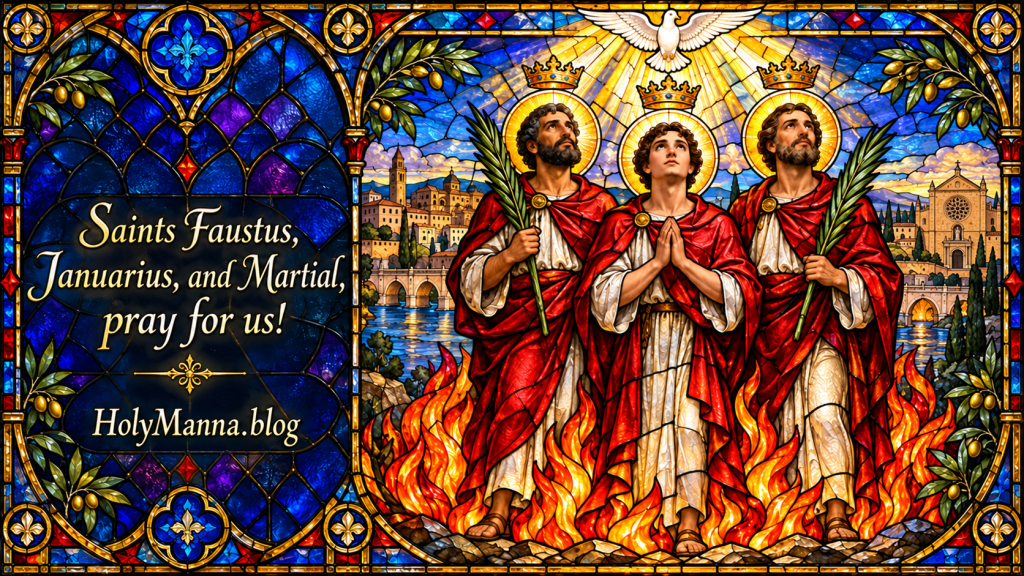
Those “three crowns” are the saints the Church remembers on October 13th: Faustus, Januarius, and Martial, three Christians of Córdoba in southern Spain who were tortured and burned alive in the year 304 during the Great Persecution of the Emperor Diocletian. From that day forward, the city has called them las Tres Coronas de Córdoba, the Three Crowns of Córdoba, and has venerated them since antiquity among its heavenly patrons.
Their story is short, brutal, and luminous. They left behind no writings, no monasteries, no missionary journeys. What they left behind was a confession of faith spoken from a torture rack, a confession so clear and so complete that the Church has treasured it for 17 centuries. The Catechism teaches, “Martyrdom is the supreme witness given to the truth of the faith: it means bearing witness even unto death. The martyr bears witness to Christ who died and rose, to whom he is united by charity” (CCC 2473). Faustus, Januarius, and Martial gave that supreme witness together, side by side, three friends refusing to let go of one God.
Sons of Córdoba, Children of the Church
Honesty comes first when telling the story of these three men: almost nothing is known about their early lives. No reliable record preserves their birthplaces, their families, their trades, or the moment they first came to believe in Jesus Christ. The persecution that killed them also had a way of erasing the ordinary paper trail of Christian lives, and the earliest surviving accounts are interested in their deaths, not their childhoods.
What can be said with confidence is where they lived and what kind of world formed them. Córdoba, known in Roman times as Corduba, was no backwater. It was the capital of the wealthy province of Baetica, a city of senators, orators, and merchants on the banks of the Guadalquivir River. Christianity had taken root there early; by 294, just a decade before the martyrdom of the three, the city’s bishop was the famous Hosius of Córdoba, who would later stand at the Council of Nicaea in defense of the divinity of Christ. Faustus, Januarius, and Martial belonged to a living, organized, praying local Church, a Church strong enough to produce heroes.
Later Spanish tradition tried to fill in the silence of history with a family tree. According to a story that appears centuries after their deaths, the three were sons of Saint Marcellus, a Roman centurion martyred at Tangier around 298, and his wife Nonia, and they belonged to a family of 12 sons who all died as martyrs across Spain. It is a moving tradition, one that imagines holiness passed from father to sons like an inheritance, but it rests on a much later account, and it cannot be verified. Another tradition holds that Faustus himself was a Roman soldier who converted to Christianity. That story likewise comes from later sources and cannot be verified.
What needs no speculation is the depth of their formation. Whoever taught these three men the faith taught them well. When the moment of testing came, they did not improvise. They knew exactly who God is, exactly what was being asked of them, and exactly what Our Lord had promised: “And do not fear those who kill the body but cannot kill the soul” (The Gospel of Matthew, Mt 10:28). The youngest of them, Martial, would die professing the Holy Trinity with the precision of a catechism and the joy of a wedding guest. That does not happen by accident. It happens when ordinary Christians take their formation seriously long before the crisis arrives.
Ordinary Men, an Extraordinary Witness
Here is something refreshing about Faustus, Januarius, and Martial: the record attributes no miracles to them during their lifetimes. No healings, no visions, no multiplied bread. As far as the surviving sources show, they were simply believers, three Christians of Córdoba going about their lives, worshiping the true God, and refusing to burn incense to false ones.
That is precisely why they matter. The sanctity of these three was not the sanctity of spectacular gifts; it was the sanctity of fidelity. The Catechism describes the virtue that carried them: “Fortitude is the moral virtue that ensures firmness in difficulties and constancy in the pursuit of the good… The virtue of fortitude enables one to conquer fear, even fear of death, and to face trials and persecutions” (CCC 1808). Fortitude is not a feeling. It is a habit, built quietly over years of small faithfulness, and then revealed suddenly in one terrible hour.
The Church has always understood that the moment of martyrdom itself is a kind of miracle, a work of grace rather than of human willpower. Three men do not calmly bless God while their bodies are being destroyed unless God Himself is sustaining them. The early Christians treated the records of such deaths as sacred treasure, and The Catechism explains why: “The Church has painstakingly collected the records of those who persevered to the end in witnessing to their faith. These are the acts of the Martyrs. They form the archives of truth written in letters of blood” (CCC 2474). The Acts of Faustus, Januarius, and Martial belong to those archives.
Their witness also bore visible fruit. The Church of Córdoba did not shrink after their deaths; it grew in fervor and in memory, building a shrine over their remains within the same century in which they died. The ancient Christian writer Tertullian had already named this mysterious law of the Kingdom when he told the persecutors of his own day, “The blood of Christians is seed” (Tertullian, Apology, chapter 50), a line the Church has long repeated in the familiar form that the blood of the martyrs is the seed of the Church. Córdoba proved him right. The city that watched three of its sons burn became, for centuries, one of the great martyr cities of the West, and every later Córdoban martyr, down to the famous martyrs under Muslim rule in the 800s, stood in the long shadow of the Three Crowns.
The Rack, the Blade, and the Flame
In 303 and 304, Diocletian unleashed the most systematic persecution the Roman Empire ever directed against the Church. Churches were demolished, Scriptures were seized and burned, clergy were imprisoned, and finally an imperial edict commanded all inhabitants of the empire to offer sacrifice to the gods under pain of death. It was under this regime that Faustus, Januarius, and Martial were arrested in Córdoba and brought before a judge named Eugenius in the year 304.
Their Acts, preserved in the great collection of the scholar Thierry Ruinart and retold by Alban Butler in The Lives of the Fathers, Martyrs, and Other Principal Saints, record the trial in vivid detail. A word of honesty is owed here: the written account of their passion, as it has come down through the centuries, was composed well after the events themselves, so the dialogue it preserves is the cherished testimony of the Church’s tradition rather than a courtroom transcript. With that said plainly, here is what that tradition has handed on.
The three were hoisted onto the rack in order of age: first Faustus, then Januarius, and last of all Martial, the youngest. Stretched beside his companions, Faustus did not cry out in despair. He rejoiced, and his recorded words have echoed through the centuries: “How happy is this union in our sufferings, which will unite us in our crowns!”
Eugenius ordered the executioners to torment the three without pause until they agreed to adore the gods. Hearing the command, Faustus answered with a creed compressed into a single breath: “There is one only God, who created us all.” For this the judge ordered a punishment calculated to humiliate as much as to hurt. The account records that Faustus’s nose, ears, eyelids, and lower lip were cut off, and the teeth of his upper jaw beaten out, and that at the cutting off of each part the martyr gave thanks to God with fresh joy in his countenance. Januarius was then subjected to the same mutilations.
All the while, young Martial lay on the rack praying earnestly for constancy. Notice that detail, because it is one of the most human in all the acts of the martyrs: he was not fearless, he was praying for the strength not to fail. When Eugenius pressed him to obey the imperial edicts, Martial gave the answer that crowns the whole account: “Jesus Christ is my comfort. Him I will always praise with the same joy with which my companions have confessed his name in their torments. There is one only God, Father, Son, and Holy Ghost, to whom our homages and praises are due.”
In that one sentence, a tortured young layman professed the central mystery of the Christian faith. Centuries later, a council held in his own Spanish homeland would give the Church the formula that The Catechism still teaches: “The Trinity is One. We do not confess three Gods, but one God in three persons” (CCC 253). Martial said the same thing from the rack, with his friends’ blood on the floor beside him.
Defeated by their constancy, Eugenius condemned all three to be burned alive, and Butler records that they cheerfully finished their martyrdom by fire at Córdoba. The traditional Roman Martyrology for October 13th summarizes their passion in a single unflinching line: “At Cordova, in Spain, the birthday of the holy martyrs Faustus, Januarius, and Martial. First tortured on the rack, then having their eyelashes shaven, their teeth plucked out, their ears and noses cut off, they finished their martyrdom by fire.” The Church calls the day of a martyr’s death his birthday, his dies natalis, because it is the day he is born into eternal life. For these three, the fire was not an ending. It was a doorway, and the promise of The Book of Revelation was waiting on the other side of it: “Be faithful unto death, and I will give you the crown of life” (Rev 2:10).
Relics Beneath the Floor
The veneration of the Three Crowns began almost immediately and has never stopped. Already in the 4th century, the same century in which they died, a church was raised in Córdoba to shelter the remains of the martyrs Faustus, Januarius, and Martial, on the very site where the Basilica of San Pedro stands today. A funerary inscription from Córdoba, dated by scholars to roughly the 5th or 6th century, invokes “the holy martyrs of Christ Jesus, Faustus, Januarius and Martialis, Zoilus and Acisclus,” showing that ordinary Christians of the city wanted to be buried under the protection of their three crowns alongside the city’s other great martyrs.
When the Muslim conquest swept over Spain in 711, the Christians of Córdoba, the Mozarabs, clung to the memory of their martyrs through centuries of pressure. A Latin hymn composed in their honor, which scholars date to roughly the 7th century, survives from the old Spanish liturgy, and the medieval liturgy for their feast did something theologically brilliant: it deliberately presented Faustus, Januarius, and Martial as a new trio of the three young Hebrew men whom King Nebuchadnezzar cast into the fiery furnace in The Book of Daniel. The parallel preaches itself. Three young men, one tyrant, one furnace, one unshakable confession: “Our God whom we serve is able to deliver us from the burning fiery furnace… But if not, be it known to you, O king, that we will not serve your gods” (Dan 3:17 to 18). The three youths of Babylon walked out of the flames; the three crowns of Córdoba walked through them into glory. Both answers belong to the same faith.
Devotion to the three spread far beyond their city. The old Catholic Encyclopedia records that the relics of Córdoba’s martyrs were eagerly sought by the other churches of Spain, and even in Gaul and elsewhere, a remarkable testimony to their fame across early medieval Europe. The Church has honored them as saints from time immemorial, in the manner The Catechism describes when it teaches that by proclaiming saints “the Church recognizes the power of the Spirit of holiness within her and sustains the hope of believers by proposing the saints to them as models and intercessors” (CCC 828).
Then came one of the great moments in the city’s religious history. In 1575, during works at the church of San Pedro, workers discovered beneath the floor the long-hidden remains of the Martyrs of Córdoba, resting where the ancient Christians had laid them. Córdoba received the discovery with jubilation as a providential restoration of its treasure. The relics were enshrined with honor, and in the 18th century the splendid Baroque Chapel of the Holy Martyrs was built around them, with a magnificent altarpiece begun in 1742 by Alonso Gómez de Sandoval and a silver reliquary urn that pilgrims still venerate today. In 2006, Pope Benedict XVI raised San Pedro to the dignity of a Minor Basilica, in large part because of the sacred bones it guards. To this day, the faithful of Córdoba honor their Santos Mártires there, and the three are also kept as local patronal feasts in the Spanish towns of El Arenal in Ávila and Fresno de Caracena in Soria.
Two small honest notes complete the picture. First, while a few early calendars record their commemoration on other autumn dates, the Roman Martyrology has long fixed their feast on October 13th, and that remains the Church’s standing date. Second, no individually documented miracle stories, such as specific healings at their tomb, have come down in verifiable form attached to these three; what has come down instead is something arguably more impressive, an unbroken chain of veneration stretching from Roman Spain, through the Visigoths and the Mozarabs, to the pilgrims of the 21st century. The saints in glory are not idle during those centuries. As The Catechism teaches of all the saints, “Being more closely united to Christ, those who dwell in heaven fix the whole Church more firmly in holiness… They do not cease to intercede with the Father for us” (CCC 956).
What the Fire Could Not Touch
So what do three burned Spaniards from the year 304 have to say to a believer scrolling through this post 17 centuries later? More than might be expected.
Start with friendship. Faustus, Januarius, and Martial did not suffer alone, and the first recorded sentence of their passion is about the joy of suffering together. Faustus called their shared torment a happy union that would unite them in their crowns. The Christian life was never designed to be lived solo. Everyone needs companions who will still be standing beside them when faithfulness becomes costly. Who are the two or three people who strengthen your faith, and when did you last thank God for them? If the honest answer is that no such people exist yet, then the first lesson of the Three Crowns is to go find them, in a parish, a small group, a Bible study, anywhere faithful friendship can take root.
Next, consider Martial’s prayer on the rack. He was the youngest, and he prayed earnestly for constancy. He did not pretend to be strong; he asked for strength, and he received it. That is the whole spiritual life in miniature. Perseverance is not self-generated; it is requested, received, and renewed daily. What is the “rack” in your life right now, the place where remaining faithful costs you something real, and have you actually asked God for the constancy to endure it?
Then there is the confession itself. Under torture, these men said shockingly simple things: that there is one God, that Jesus Christ was their comfort, and that all praise belongs to the Father, the Son, and the Holy Spirit. Nothing clever, nothing complicated, just the faith of the Church stated without apology. Most believers will never face a judge like Eugenius, but every believer faces daily moments when quietly editing the faith would be easier than stating it. The Three Crowns suggest a different path: know the faith cold, love it warmly, and say it plainly. Even the Sign of the Cross, prayed slowly and deliberately each morning, repeats Martial’s dying confession of the Trinity. When was the last time you professed your faith out loud, to another person, in your own words?
Finally, remember what the fire could not touch. Eugenius could take their eyes, their ears, their lips, their teeth, and their lives. He could not take their joy, their unity, or their God. Everything that the world can destroy, it eventually will; everything that matters most, it cannot reach. Saint Paul, awaiting his own martyrdom, wrote, “Henceforth there is laid up for me the crown of righteousness, which the Lord, the righteous judge, will award to me on that Day” (2 Timothy, 2 Tim 4:8). That crown was laid up for three men of Córdoba, and it is laid up for every soul that stays faithful to the end.
Engage With Us!
The conversation does not end with the reading. Share your thoughts and reflections on Saints Faustus, Januarius, and Martial in the comments below, and consider praying with these questions this week.
- Faustus rejoiced that suffering alongside his companions would unite them in their crowns. Who shares your journey of faith, and how can you intentionally deepen that holy friendship this month?
- Martial prayed earnestly for constancy while on the rack. In what area of your life do you most need to stop relying on willpower and start begging God for perseverance?
- Under torture, all three martyrs confessed one God in the simplest possible words. If you had one sentence to profess your faith, what would you say, and who in your life needs to hear it?
- The Christians of Córdoba venerated their martyrs through centuries of occupation and pressure. What practices help you hold on to the faith when your surroundings do not support it?
- The medieval liturgy saw the three Hebrew youths of Daniel 3 in these three martyrs. Where in Scripture do you see your own story, and how does that passage call you to greater trust?
Saints Faustus, Januarius, and Martial endured the rack, the blade, and the flame rather than deny the God who made them and the Savior who redeemed them. Few are called to that furnace, but all are called to that fidelity. Live this day, and every day, with the courage of the Three Crowns of Córdoba, doing everything, large and small, with the love and mercy that Jesus taught us, and trusting that the Lord who crowned three faithful friends in Spain has a crown of life waiting for every soul that remains faithful unto death.
Saints Faustus, Januarius, and Martial, the Three Crowns of Córdoba, pray for us!


Leave a Reply